
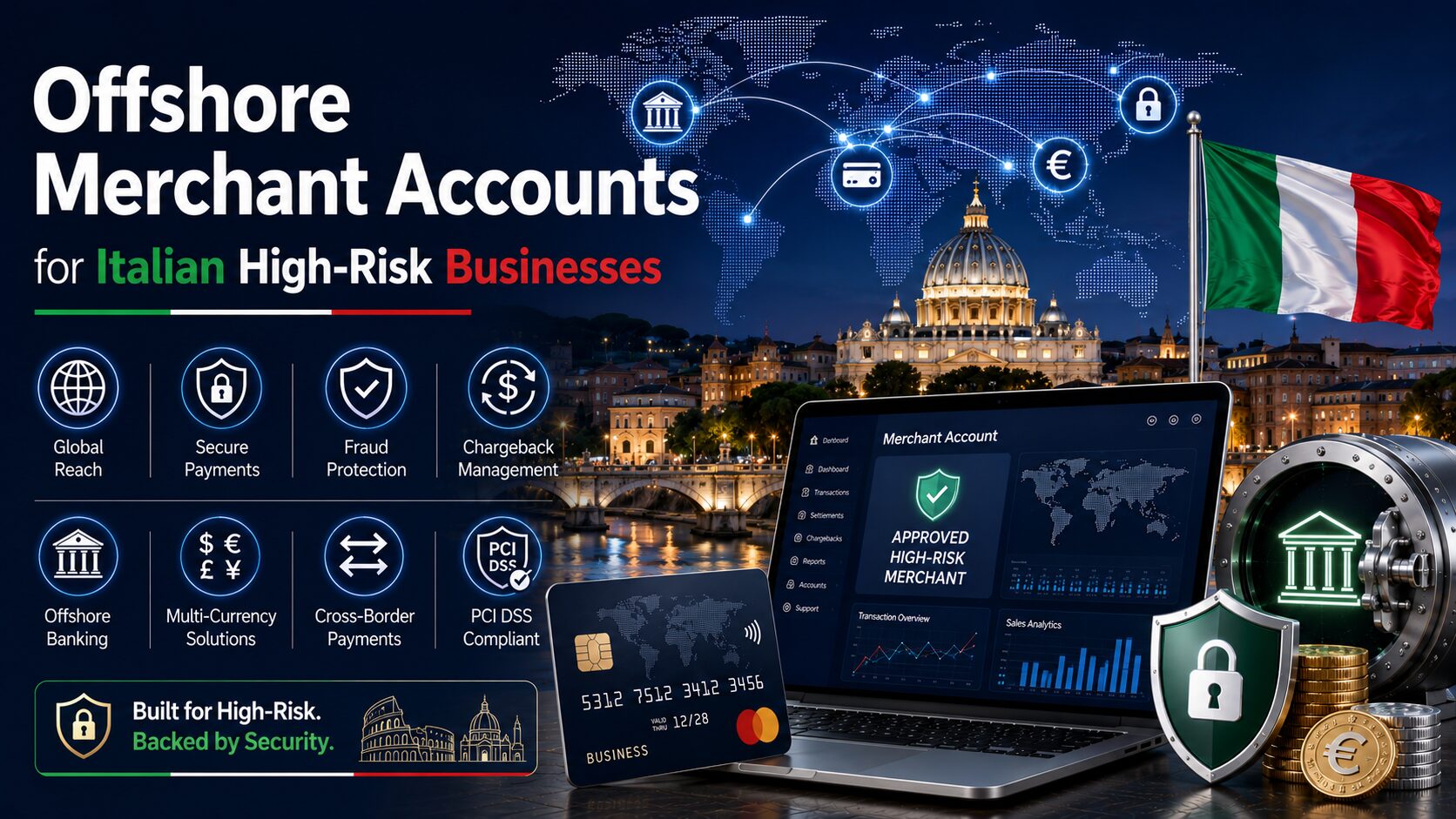
Italy just completed one of the most dramatic gambling market resets in Europe. On November 14, 2025, the country switched from a fragmented, decade-old concession system to a tightly controlled framework of just 52 licenses — down from a market that had grown sprawling and inconsistently overseen over more than ten years. For high-risk merchants and payment providers operating in or targeting Italy, this reset fundamentally changes what “gambling-adjacent processing” means in this market heading into 2026, and it’s worth understanding in detail before evaluating any offshore or domestic payment strategy.
This guide covers Italy’s new gambling licensing regime, what it means for payment processors, how Italy’s advertising restrictions affect merchant strategy, and which providers are worth evaluating for Italian high-risk categories beyond gambling specifically.
Italy’s 2025-2026 Gambling Market Reset: What Actually Changed
Italy’s Agenzia delle Dogane e dei Monopoli (ADM) — the Customs and Monopolies Agency, formerly known as AAMS — has regulated the country’s gambling sector since a comprehensive framework first took shape in 2006 and expanded in 2011. For over a decade, the system operated on rules that were increasingly viewed as outdated for a much larger, more complex digital gambling market, prompting a complete restructuring through Legislative Decree 41/2024.
The 2025 tender dramatically shrank the licensed operator pool. ADM’s tender process concluded with 52 concessions awarded to 46 operators — a sharp reduction from the 93 applications submitted, and a much smaller, more controlled network than the market had operated under previously. This wasn’t a minor licensing renewal cycle; it was a deliberate consolidation.
The cost of entry increased enormously. Each concession now carries a €7 million fee, paid in two installments — €4 million upon award and €3 million upon launch. That price point alone forced smaller operators to withdraw from the Italian market entirely or merge with larger groups able to absorb the cost. In exchange, successful operators receive a nine-year license, a meaningful stability upgrade for those able to commit to the higher entry cost.
Major international brands chose to exit rather than pay to stay. Betway, Unibet, Betaland, Betn1, and 1xBet all opted not to pursue new concessions under the stricter and costlier regime, marking a genuine reshaping of Italy’s competitive gambling landscape. ADM characterized these departures as part of a deliberate “smooth and decisive reset” rather than a market failure.
The new system went live on November 14, 2025, at 7 a.m. — with 52 newly validated licenses activated following some final technical adjustments that delayed the original midnight launch by a few hours. Total state revenue from the licensing phase reached €364 million, surpassing the Ministry of Economy and Finance’s original €350 million projection.
Licensing now requires genuine EU/EEA presence. Any company seeking a concession must be incorporated within the EU or EEA, and if headquartered outside Italy, must maintain a registered office inside the country for tax purposes. This closes off the kind of pure offshore-incorporation strategy that might work in less strictly regulated gambling markets.
Technical and compliance requirements are unusually demanding. Licensed operators must use .it domains, connect their gaming systems to ADM’s centralized monitoring infrastructure, and adhere to recognized international standards including ISO 9001 for quality management, ISO 26000 for social responsibility, and ISO 27001 for data security. This level of technical oversight is among the most advanced in Europe, and ADM can conduct on-demand security and compliance audits at its discretion.
Cash transactions face a strict weekly limit. Italian gambling regulation now limits cash use to €100 per week, reinforcing a broader push toward traceable, card-and-digital payment methods — directly relevant to how payment infrastructure needs to be structured for licensed operators.
Phase 2 reforms are coming in 2026. The government plans to introduce a new federal framework for land-based venues — arcades, bingo halls, casinos, and national betting franchises — and has signaled it will revisit the 2018 “Dignity Decree” advertising ban, with discussions involving Deputy Minister Maurizio Leo, Sports Minister Andrea Abodi, and industry stakeholders including Serie A officials who continue lobbying for a more commercially viable sponsorship landscape.
Italy’s Gambling Advertising Ban: The Dignity Decree
Separate from the licensing reset, Italy operates under one of Europe’s most sweeping gambling advertising restrictions. The 2018 “Dignity Decree” (Decreto Dignità, Law 96/2018) prohibits all direct and indirect gambling advertising across television, radio, print, online, outdoor advertising, and social media, along with sports sponsorship by gambling companies. This is significantly more restrictive than advertising rules in markets like the UK or even Spain, and it directly shapes how licensed Italian operators can acquire customers — which in turn affects payment provider conversations around expected transaction volume, customer acquisition cost assumptions, and growth projections. As noted above, 2026 discussions may revisit this ban, but as of now it remains fully in force.
What This Means for Payment Processing Strategy
For any payment provider or merchant considering the Italian gambling market, the 2025-2026 reset changes the calculation considerably compared to just a year or two earlier:
Genuine ADM licensing is now a much higher bar to clear, given the €7 million concession cost and the EU/EEA incorporation requirement. This naturally filters out smaller operators and pure offshore-only structures that might work in less demanding jurisdictions.
Payment infrastructure needs to account for the centralized ADM monitoring requirement and the strict cash-use limitation, meaning a payment provider serving licensed Italian gambling operators needs genuine familiarity with these specific technical and compliance obligations, not just generic EU iGaming experience.
The market has consolidated around fewer, larger, better-capitalized operators, which shifts the payment provider conversation toward higher-volume, longer-term relationships rather than the more fragmented multi-operator landscape that existed before the reset.
For Italy’s other high-risk categories — forex, CBD, adult content, and subscription businesses — the picture looks much more like the standard European high-risk market: domestic Italian bank caution creates an acceptance gap that specialized or offshore providers fill, without the same dramatic regulatory overhaul gambling just went through.
Domestic vs. Offshore for Italian Merchants: What Changes
| Factor | Domestic Italian Processing | Offshore Processing |
| ADM-licensed gambling operators | Aligned with ADM’s centralized monitoring and EU/EEA requirements | Should complement, not replace, ADM compliance infrastructure |
| Unlicensed gambling | Not a legal domestic option post-reset | High risk given the consolidated, well-enforced new licensing regime |
| Forex trading | Requires proper EU passporting/authorization | Similar — licensing precedes any viable merchant account |
| Adult content, CBD, subscriptions | Limited domestic acceptance, similar to broader EU | Standard offshore value proposition |
| Cash transaction handling | Strict €100/week limit for gambling specifically | Same limit applies regardless of acquirer location |
| Best fit | Well-capitalized ADM-licensed operators able to absorb €7M concession cost | Non-gambling high-risk categories, or gambling operators needing supplementary payment infrastructure alongside ADM compliance |
Providers Worth Evaluating for the Italian Market
- RoxPay
RoxPay is an Italian fintech payment gateway that’s PCI DSS Level 1 certified, ISO 27001 certified, and OAM registered (Italy’s registry for financial and payment agents), with processing capability spanning adult content, gambling, crypto, forex, and CBD merchants. Its position as a European-licensed alternative — rather than a purely offshore provider — is a genuine differentiator for Italian merchants who want the category acceptance offshore providers offer, combined with the regulatory protection, established dispute resolution mechanisms, and consumer protection frameworks that come with a European payment institution license. Settlement to any SEPA bank in 24-48 hours at competitive interchange-plus pricing makes RoxPay a strong first call for Italian merchants weighing domestic-feeling infrastructure against traditional offshore options.
- WebPays
WebPays’ broad European high-risk experience across gaming, forex, adult, and subscription categories extends usefully into Italy, particularly for merchants who need PCI DSS-compliant infrastructure. For gambling-adjacent merchants specifically, WebPays should be evaluated on its familiarity with ADM’s specific post-reset requirements — the centralized monitoring connection, .it domain requirement, and EU/EEA incorporation rule — rather than assumed based on generic EU gambling experience.
- eMerchantBroker (EMB)
EMB’s experience across CBD, forex, and adult categories is directly relevant to Italy’s persistent domestic acceptance gaps in these verticals. Its chargeback management infrastructure is useful for subscription and adult-adjacent businesses, where Italian consumers, like those elsewhere in Europe, frequently dispute unfamiliar billing descriptors.
- PayCly
PayCly’s multi-currency support and CBD/forex/adult specialization suit Italian merchants operating as part of a broader European strategy. For anything gambling-adjacent, working with PayCly makes most sense once genuine ADM licensing under the new Decree 41/2024 framework is confirmed and in place — given the scale of Italy’s 2025 reset, this isn’t a category where a payment provider’s flexibility can substitute for the underlying license.
Industry-Specific Considerations for Italian Merchants
Online gambling: ADM licensing under the new Decree 41/2024 framework is now the clear, expensive, and demanding baseline — €7 million in concession fees, EU/EEA incorporation, centralized monitoring integration, and strict cash-use limits. Given the scale of the 2025-2026 reset and the exit of major international brands unwilling to meet the new bar, unlicensed gambling processing targeting Italian customers carries substantial regulatory risk.
Forex trading: EU passporting or Italian-recognized authorization drives underwriting decisions, consistent with patterns across the broader EU market.
Adult content: Faces persistent domestic acceptance gaps typical of most European markets; specialized providers like RoxPay or offshore alternatives remain the standard path to market entry.
CBD and subscription businesses (IPTV, dating): These follow patterns similar to the rest of the EU — chargeback history and billing transparency matter more than Italy-specific licensing hurdles, since neither faces an ADM-style regulatory reset the way gambling just did.
Documentation Italian High-Risk Merchants Should Prepare
- Business registration and corporate structure documentation, including EU/EEA incorporation proof and a registered Italian office for tax purposes if headquartered abroad — a hard requirement for gambling concessions specifically
- ADM concession, where applicable, along with documentation of ISO 9001, ISO 26000, and ISO 27001 compliance for gambling operators
- 3–6 months of recent bank statements
- Processing history, including chargeback ratios, from any prior merchant accounts
- Clear terms of service, refund policy, and player-protection measures, including deposit limits, spending warnings, session duration notices, and self-exclusion tools required under Italian gambling regulation
- OAM registration confirmation from the payment provider, where relevant, as a signal of genuine Italian regulatory alignment rather than purely offshore operation
Choosing the Right Setup: A Practical Framework
Italian high-risk merchants — particularly in gambling — are best served asking a very specific question in 2026: can this business genuinely absorb the €7 million concession cost and EU/EEA incorporation requirement that Italy’s reset now demands, or does it make more sense to focus on non-gambling high-risk categories where the acceptance gap is more standard? Given how many established international brands chose to exit the Italian gambling market entirely rather than meet the new bar, this isn’t a rhetorical question — it’s a genuine strategic fork for any operator or payment provider considering this specific vertical.
For Italy’s other high-risk categories — forex, adult content, CBD, and subscription businesses — providers like RoxPay (as a European-licensed alternative worth serious consideration alongside traditional offshore options), WebPays, eMerchantBroker, and PayCly all offer relevant experience navigating conservative Italian domestic banking standards.
Conclusion
Italy’s high-risk payments landscape in 2026 is defined above all by the most significant gambling regulatory reset in the country’s recent history — a shrunk pool of 52 concessions costing €7 million each, EU/EEA incorporation requirements, and a technical compliance regime among the most demanding in Europe, all of which pushed major international brands to exit rather than requalify. For gambling-adjacent merchants, genuine ADM licensing under Decree 41/2024 is now a serious financial and operational commitment, not a simple checkbox. For Italy’s other high-risk categories — forex, adult content, CBD, and subscription businesses — providers like RoxPay, WebPays, eMerchantBroker, and PayCly offer relevant experience navigating a domestic banking environment that remains cautious about these categories much as it does across the broader EU.
Frequently Asked Questions (FAQs)
Q1: What changed in Italy’s online gambling licensing in 2025-2026?
A: ADM completed a major tender process awarding 52 concessions to 46 operators — down sharply from 93 applications — each costing €7 million, with the new system going live on November 14, 2025. Several major international brands, including Betway, Unibet, and 1xBet, chose to exit the Italian market rather than pursue the new, more expensive licenses.
Q2: What is ADM and what does it regulate?
A: The Agenzia delle Dogane e dei Monopoli (formerly AAMS) is Italy’s gambling regulator, overseeing online casino, sports betting, poker, bingo, lottery, and skill games through a concession-based licensing system.
Q3: What is the Dignity Decree and how does it affect gambling businesses in Italy?
A: The 2018 Dignity Decree (Law 96/2018) prohibits nearly all forms of gambling advertising and sports sponsorship in Italy across TV, radio, print, online, outdoor, and social media. The government has signaled it may revisit this ban as part of 2026 Phase 2 reforms.
Q4: Are there cash limits for gambling transactions in Italy?
A: Yes. Italian gambling regulation limits cash use to €100 per week, reinforcing a shift toward traceable card and digital payment methods.
Q5: Can a foreign gambling operator get an Italian ADM concession without a local presence?
A: No. Operators must be incorporated within the EU or EEA, and if headquartered outside Italy, must maintain a registered office inside the country for tax purposes.
Comments
No comments yet. Be the first to share your thoughts.
Leave a comment