
Search “IPTV payment gateway” and nearly every result reads like the same template with the logo swapped out: “IPTV is classified as high-risk due to chargebacks, subscription billing, and regulatory concerns… PCI-compliant… fraud prevention… 24/7 support… apply now.” That boilerplate isn’t wrong, exactly — it’s just describing the surface symptom (rejection) without explaining the actual mechanism, which means it can’t help you evaluate whether a given provider genuinely solves your specific version of the problem or just says the same reassuring words as everyone else.
IPTV’s payment difficulty comes from a specific, well-documented pattern that’s worth understanding on its own terms before comparing providers: card networks and acquirers flag the industry itself, independent of how any individual operator actually runs their business. That distinction — stigma versus practice — is the single most useful lens for evaluating IPTV payment providers, because it explains why some providers can offer genuine stability while others are really just processing at the edge of tolerance until the next monitoring review flags the whole category again.
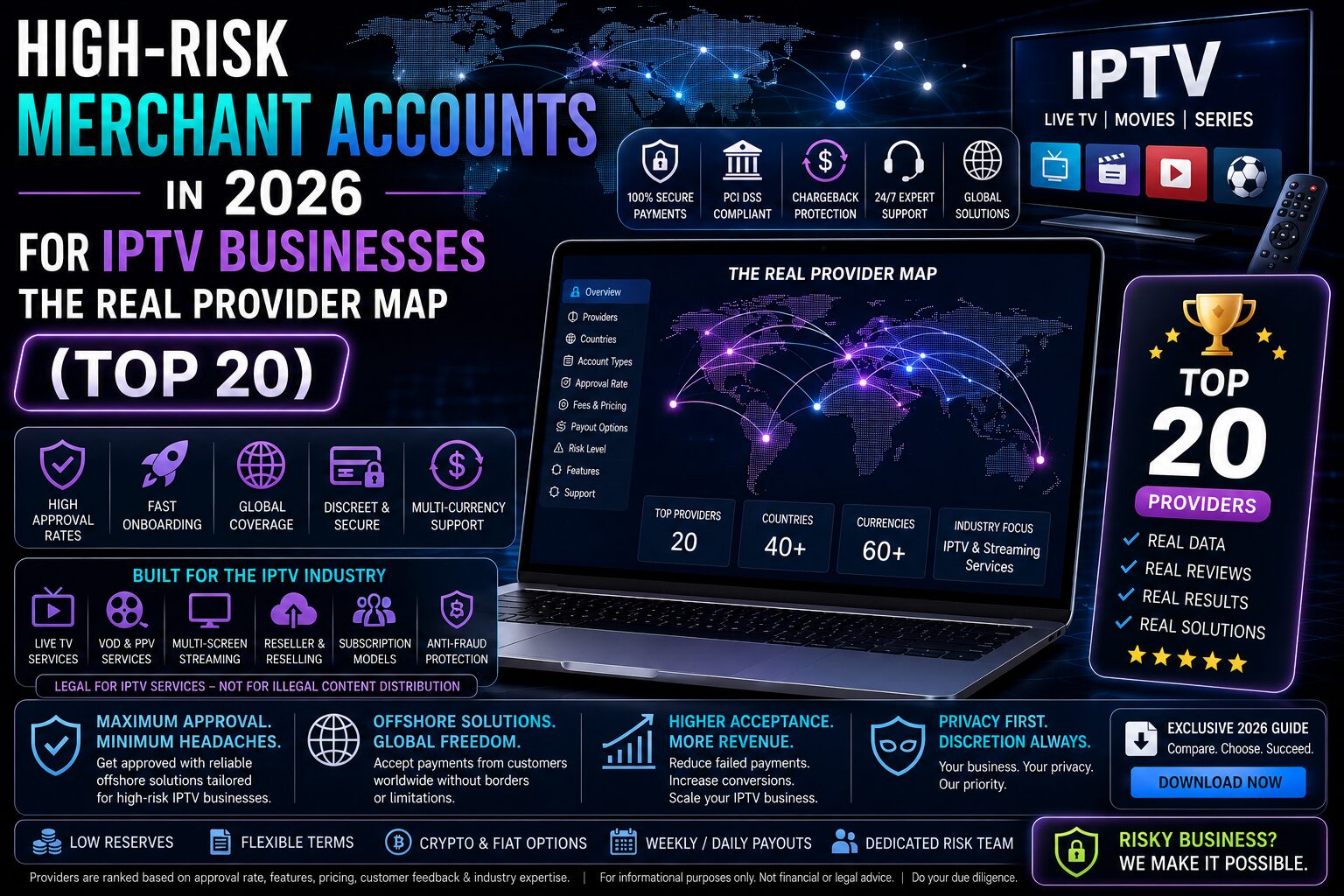
This piece maps 20 real providers serving the IPTV vertical by the specific problem each is built to solve — not by a list of interchangeable names repeating the same “high-risk, PCI-compliant, 24/7 support” language.
Why IPTV Payment Processing Is a Distinct Problem
IPTV gets rejected on category stigma, not individual risk assessment. Card networks and acquirers automatically flag IPTV as problematic and reject applications instantly, regardless of an individual operator’s specific compliance practices, content licensing arrangements, or actual chargeback history — the same classification-not-risk pattern covered in this series’ peptide guide, but driven here by a mix of content-licensing legal ambiguity and reputational caution rather than product classification codes specifically.
Continuity billing is the actual mechanic driving most of the category’s dispute volume. IPTV and streaming services overwhelmingly run on recurring, auto-renewing subscriptions — a billing structure card networks monitor closely because it generates a specific, recurring dispute pattern: customers forgetting about a recurring charge months after signing up, or disputing a charge out of dissatisfaction with content quality rather than genuine fraud. This is a meaningfully different dispute driver than one-time-purchase e-commerce fraud, and it’s precisely why chargeback ratios in this category can climb above the 1% threshold that triggers formal card brand monitoring programs even when a merchant isn’t doing anything wrong.
Free trial abuse is a specific, well-documented fraud vector unique to this billing model. Users creating multiple accounts specifically to exploit free trials — then disputing the eventual conversion charge, or simply churning through trial after trial without ever paying — represents a distinct threat pattern that generic e-commerce fraud tooling isn’t built to catch, and that IPTV-experienced providers specifically build detection around.
Content licensing and geographic viewer restrictions add a compliance layer most high-risk categories don’t have. License agreements frequently require platforms to monitor viewer locations and payment sources, creating regulatory complexity around geo-restriction enforcement that a generic payment gateway simply isn’t built to handle, and that only genuinely IPTV-experienced processors think to ask about during underwriting.
Instant-access expectations create a real operational tension with fraud prevention. Customers expect immediate content access the moment payment clears, but standard verification and fraud-review delays common to high-risk processing directly conflict with that expectation — meaning the right IPTV payment provider needs real-time processing and fast settlement without sacrificing the fraud screening this high-dispute category genuinely needs.
Mainstream processors don’t just decline IPTV — they frequently approve first and freeze later. A pattern specifically called out across multiple sources in this space: Stripe and PayPal-style mainstream processors sometimes onboard IPTV merchants without recognizing the category immediately, then freeze accounts within weeks once the vertical is identified or chargeback ratios start climbing — meaning the real risk with mainstream processors in this category isn’t rejection, it’s a false sense of stability followed by a sudden, disruptive freeze.
The Five Models in IPTV Payment Processing
- The Continuity-Billing Specialist. Built specifically around subscription, free-trial-conversion, and pay-per-view billing models, with fraud tooling purpose-built for the free-trial-abuse and forgotten-recurring-charge dispute patterns that define this category’s actual risk profile.
- The Offshore/Broker Generalist. Broader high-risk providers listing IPTV among several supported verticals, offering deeper offshore banking relationships for operators who’ve been declined by continuity-billing specialists or need genuinely international acquiring coverage.
- The IPTV-Dedicated Niche Provider. A newer, growing category of providers built exclusively or primarily around IPTV specifically — genuinely useful in some cases, but a category worth extra scrutiny given how much near-identical marketing language circulates among smaller entrants in this specific niche.
- The Dedicated-MID Structural Specialist. Solves specifically for the “another IPTV merchant’s chargeback spike froze my account too” failure mode common to pooled merchant ID structures, by guaranteeing individual, non-shared MIDs.
- The Speed-and-Instant-Approval Marketer. Leans on fast approval and instant access as the core pitch — genuinely useful for operators racing to launch, but worth the same “what’s traded for speed” scrutiny applied throughout this guide series.
Here’s how 20 real providers sort into that structure.
Model 1: Continuity-Billing Specialists
WebPays markets directly at IPTV specifically, with multi-currency support, low decline rates, and 24/7 fraud monitoring built around the subscription mechanics IPTV depends on — its own positioning explicitly names failed transactions, high chargebacks, and providers “that don’t fully support IPTV businesses” as the core problem it’s solving, a genuinely accurate framing of the category’s real difficulty.
HighRiskPay.com explicitly supports the full range of IPTV billing structures in one setup — recurring subscriptions, free-trial conversions, one-time purchases, and pay-per-view — with fraud monitoring, smart retries, transaction screening, and dispute mitigation strategies specifically designed for continuity subscription businesses, plus explicit support for global audiences and fluctuating transaction volumes, a genuinely relevant feature given how internationally distributed most IPTV customer bases are.
Sensapay names the free-trial-abuse and content-dissatisfaction dispute drivers directly as its core design consideration — a useful sign that its underwriting and fraud tooling are actually built around IPTV’s specific mechanics rather than treating the category as generic high-risk e-commerce.
GLODIPAY positions itself as purpose-built for IPTV specifically, with chargeback alert systems that flag disputes before they formally post, combined with machine learning-based fraud detection — a genuinely proactive approach to the recurring-charge dispute pattern rather than the more common reactive dispute-response model most generalist processors offer.
Model 2: Offshore/Broker Generalists
These providers list IPTV among several high-risk verticals rather than building around it exclusively, and their real value is offshore banking depth for operators who’ve already hit a wall with a continuity-billing specialist.
Instabill brings a long-established high-risk merchant account track record to IPTV specifically, with international acquiring relationships genuinely useful for IPTV operators serving a heavily international, multi-currency customer base rather than a domestically concentrated one.
eMerchantBroker (EMB) covers IPTV alongside CBD, forex, and adult, with a broad acquiring network useful for IPTV operators bundling adjacent digital content or subscription products under one brand.
Durango Merchant Services, Shark Processing, and SMB Global all extend their broader offshore high-risk banking relationships to IPTV as one of several supported categories — a reasonable fallback for operators already declined by an IPTV-dedicated specialist, particularly relevant given how frequently mainstream and even some high-risk-adjacent processors freeze IPTV accounts once the category is formally identified.
PayCly, GlobalPay, and Merchant One round out this tier, each naming IPTV or streaming media among their supported categories within a broader multi-vertical high-risk portfolio, useful for operators wanting one relationship covering IPTV alongside other digital or subscription-based product lines.
RoxPay is worth flagging here specifically as it has been throughout this guide series: a genuinely European-licensed payment institution (PCI DSS Level 1, ISO 27001, OAM-registered) rather than a purely offshore acquirer — relevant for IPTV operators wanting the regulatory standing of a licensed EU entity, given how much content-licensing and geographic compliance scrutiny this category faces compared to most other high-risk verticals.
Model 3: IPTV-Dedicated Niche Providers — Read This Section With Extra Care
This is a genuinely growing category, and it’s worth naming both its real value and its real risk honestly.
GetBlackPay and Offshore Unipay both position themselves as dedicated IPTV specialists with essentially identical marketing language to each other — “PCI-compliant,” “global acquiring,” “years of experience processing IPTV payments,” “no freezes or shutdowns” — a pattern that shows up repeatedly across smaller IPTV-focused sites in this space. That similarity isn’t necessarily disqualifying (a genuinely small, specialized niche will naturally produce providers describing themselves in similar terms because they’re solving the same real problem), but it does mean these are exactly the providers where independent verification — actual client reviews, confirmed operating history, and a real conversation about acquiring bank relationships rather than just marketing copy — matters more than with a larger, more established, independently-reviewable name.
PayFac Solutions similarly markets itself around crypto-friendly, global IPTV payment solutions with fast activation, worth the same scrutiny applied to any provider emphasizing speed and simplicity heavily in its marketing — confirm the underlying acquiring relationship and reserve structure directly rather than taking the marketing page at face value.
Easy Pay Direct brings a track record that extends beyond IPTV specifically (it’s also covered in this guide series’ peptide piece for its load-balanced, multi-account processing model) into robust security features for IPTV specifically — a somewhat more established, cross-vertical provider compared to the IPTV-only names above, which may offer a more independently verifiable track record.
Model 4: The Dedicated-MID Structural Specialist
2Accept deserves its own category here for the same reason it did in the adult and general high-risk pieces in this series: every merchant gets a dedicated Merchant ID rather than being pooled under a shared master account — directly relevant to IPTV specifically, since a pooled-MID structure means another IPTV merchant’s chargeback spike (a common occurrence given the category’s dispute patterns) can freeze your funds regardless of your own account’s clean standing. 2Accept’s own case study cites a client (“StreamWave IPTV”) specifically praising fast approval, fraud protection, multi-currency support for a global customer base, and seamless subscription platform integration — a genuinely relevant combination of features for a continuity-billing IPTV business.
Model 5: Speed-and-Instant-Approval Marketers
Several of the providers already covered above (GetBlackPay, Offshore Unipay, PayFac Solutions) lean into instant or fast approval as a core selling point, and the same guidance applies here as throughout this guide series: a genuinely fast approval can reflect efficient, IPTV-experienced underwriting — or it can reflect account terms (reserve percentage, contract lock-in) that make approval easy to grant precisely because the provider is absorbing less risk than the headline speed suggests. Ask directly about reserve structure and contract length before treating approval speed alone as the deciding factor.
The Fit Framework: Question, Not Rank
| Your IPTV business situation | Model to start with |
| Established subscription/continuity billing model, want purpose-built dispute prevention | Continuity-Billing Specialist (WebPays, HighRiskPay.com, GLODIPAY, Sensapay) |
| Already declined by a specialist, need offshore banking depth | Offshore/Broker Generalist (Durango, EMB, Instabill, Shark Processing) |
| Want EU-licensed regulatory standing given content/geo-compliance scrutiny | RoxPay |
| Considering a smaller, IPTV-only dedicated provider | IPTV-Dedicated Niche Provider — but verify independently before committing (GetBlackPay, Offshore Unipay, PayFac Solutions) |
| Worried specifically about pooled-MID freeze risk from other IPTV merchants | 2Accept’s dedicated MID model |
| Racing to launch and prioritizing fast approval | Any speed-focused provider — but confirm reserve/contract terms directly first |
| Genuinely international, multi-currency customer base | PayCly, GlobalPay, Instabill |
Red Flags Specific to IPTV Payment Processing
Near-identical marketing language across multiple “dedicated IPTV” providers is a real signal to slow down, not a reason to dismiss them outright. Several genuinely distinct IPTV-focused providers describe themselves in almost word-for-word similar terms (“PCI-compliant,” “no freezes,” “years of experience”) — this reflects a genuinely small, specialized niche as much as anything else, but it means independent verification (real client references, confirmed operating history, a direct conversation about the actual underlying acquiring bank) matters more here than with more established, independently-reviewable names elsewhere in this guide series.
Mainstream processors approving IPTV merchants initially, then freezing accounts within weeks, is a well-documented pattern specific to this category. If a mainstream or general-purpose processor approves your IPTV business without asking detailed questions about your specific billing model, content licensing, and free-trial structure, treat that ease of approval as a warning sign rather than reassurance — the freeze risk in this scenario is genuinely higher than with a provider that asked harder questions upfront.
Free-trial abuse fraud tooling is a genuine differentiator, not a checkbox feature. Ask specifically how a provider detects and prevents multiple-account free-trial exploitation — this is a distinct fraud vector from generic e-commerce fraud, and a provider that can’t describe its specific approach to it likely hasn’t built genuinely IPTV-experienced underwriting.
Pooled Merchant ID structures carry the same elevated risk in IPTV that they do in adult processing — given how consistently continuity-billing disputes drive this category’s chargeback ratios, a shared-MID setup exposes you to other merchants’ dispute spikes in a way a dedicated MID (2Accept’s specific model) avoids entirely.
“No freezes, ever” and similarly absolute claims deserve the same skepticism applied throughout this guide series. Given how documented the category-wide stigma and sudden-freeze pattern is in IPTV specifically, any provider guaranteeing permanent immunity from account review or freeze is making a claim that should prompt closer investigation into its actual acquiring bank relationships and operating history, not less.
What Actually Determines a Good Fit
Does the provider’s fraud tooling specifically address free-trial abuse and forgotten-recurring-charge disputes, or does it offer only generic e-commerce fraud scoring that misses IPTV’s actual dispute mechanics?
Is this a genuinely IPTV-experienced provider with a verifiable track record, or a newer niche entrant whose marketing language closely mirrors several competitors — and if the latter, have you independently verified client references before committing?
Does the provider offer a dedicated Merchant ID, or are you being pooled with other IPTV merchants whose own chargeback spikes could freeze your account regardless of your own standing?
Does the provider ask detailed questions about your specific billing model, content licensing, and geographic viewer restrictions during underwriting — a genuine sign of category expertise — or does it approve quickly with minimal scrutiny, a pattern that’s historically preceded sudden freezes in this specific vertical?
Conclusion
IPTV payment processing isn’t solved by finding the provider with the most reassuring boilerplate language — it’s solved by understanding that this category’s difficulty comes specifically from continuity billing’s dispute mechanics (forgotten recurring charges, content-dissatisfaction disputes, free-trial abuse) combined with a pattern of category-wide stigma that gets IPTV rejected or frozen regardless of individual operator practices. WebPays, HighRiskPay.com, GLODIPAY, and Sensapay have built genuine continuity-billing-specific tooling. Durango, EMB, Instabill, and Shark Processing offer offshore banking depth for operators already declined elsewhere. RoxPay brings genuine EU regulatory standing relevant to this category’s content-compliance scrutiny. The newer IPTV-dedicated niche providers — GetBlackPay, Offshore Unipay, PayFac Solutions — deserve real consideration but also real independent verification given how much near-identical marketing language circulates in this specific corner of the market. And 2Accept’s dedicated-MID model directly solves the pooled-account freeze risk that’s especially acute in a category this dispute-prone. The right starting point isn’t whichever provider’s landing page sounds most reassuring — it’s understanding your own billing model’s specific dispute drivers well enough to ask the right underwriting questions before you sign.
Comments
No comments yet. Be the first to share your thoughts.
Leave a comment