
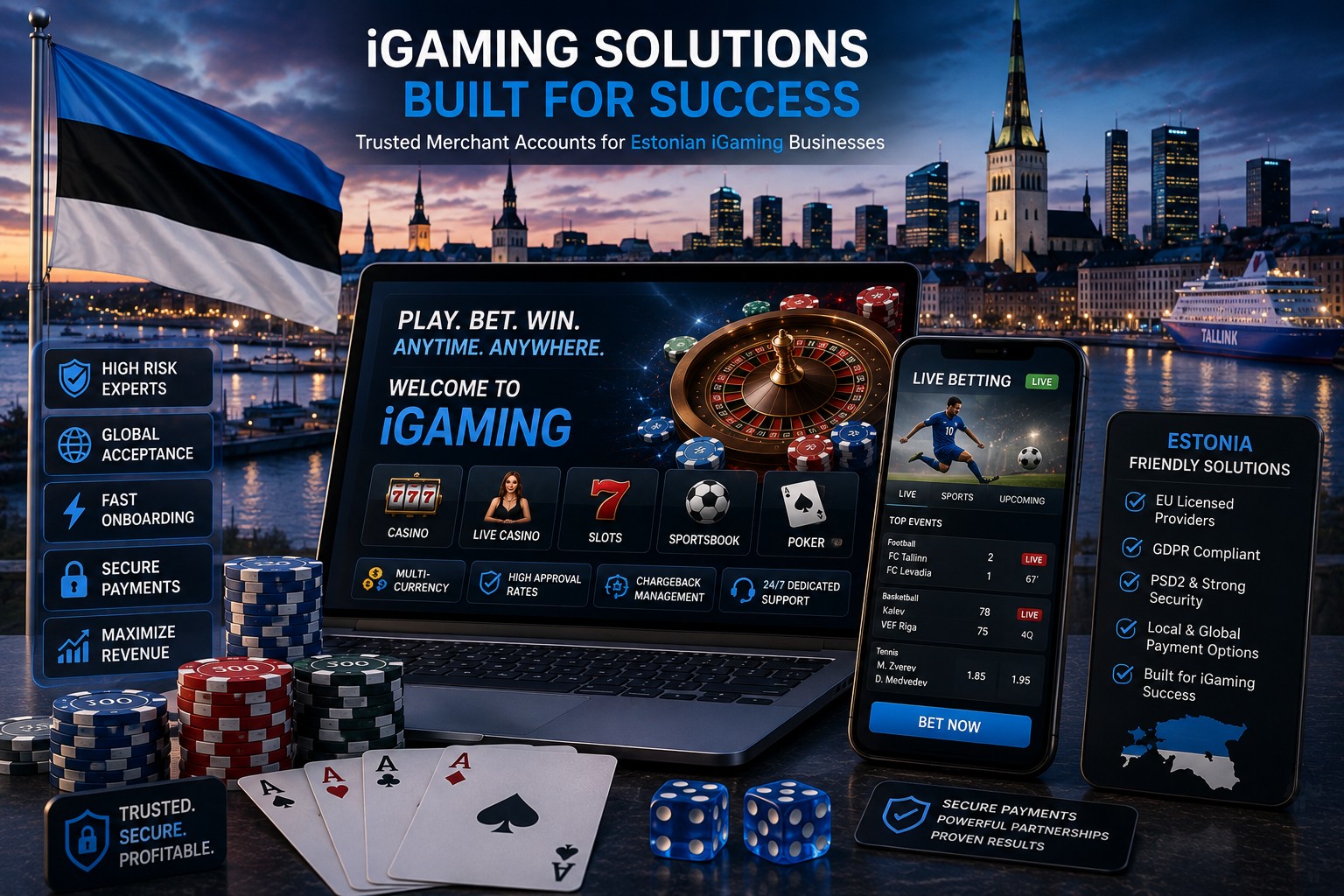
Estonia runs one of the more unusual regulatory structures in European gambling: a single agency — the Estonian Tax and Customs Board (EMTA) — handles licensing, supervision, and tax collection simultaneously, rather than splitting these functions across separate bodies the way most EU jurisdictions do. That combined authority extends directly into payment processing: EMTA maintains an official blocklist that restricts not just unlicensed gambling sites, but the payment service providers facilitating them. This guide ranks the top 10 merchant account providers for EMTA-licensed iGaming operators in 2026.
Why Estonian iGaming Payment Processing Has Its Own Technical Requirements
EMTA’s blocklist targets payment processors directly, not just operators. This is the single most important payment-specific fact about the Estonian market: the official blocklist used to restrict unlicensed sites explicitly extends to PSPs facilitating them, meaning a payment provider’s own standing with EMTA matters as much as the operator’s licensing status.
EHMA and HAMPI system integration is a mandatory technical requirement, comparable in spirit to Germany’s LUGAS. Operators must connect their electronic recordkeeping and control systems with the Estonian Gambling Supervisory System (EHMA) and its reporting interface (HAMPI) before an operating permit is even issued — this connectivity requirement directly shapes what a payment provider’s backend integration needs to support.
Estonia’s public licensing register is a genuine payment-access credential, not just a compliance formality. An operator appearing on EMTA’s public list of legal gambling operators carries real weight with payment processors, software providers, and institutional banking partners — similar in function to how an MGA license in Malta improves banking access, covered elsewhere in this guide series.
The licensing process is two-stage and genuinely lengthy, which matters for planning your payment provider relationship timeline. An Activity License takes 4-6 months, followed by a separate Operating Permit taking 2-4 months once technical systems are verified — a payment provider relationship should generally be lined up well before final licensing, not after, given how EHMA/HAMPI integration needs to be demonstrated as part of the permit process itself.
Estonia’s 0% corporate tax on retained earnings is a genuine structural advantage worth factoring into overall margin planning. Corporate income tax applies only to distributed profits, not retained earnings — combined with a 6% GGR tax on remote gambling (with a rate adjustment to 7% under discussion for 2026), this gives Estonian-licensed operators meaningfully more reinvestment flexibility than jurisdictions with standard annual corporate taxation, a relevant context when evaluating processor fee sensitivity.
Capital requirements vary significantly by game category, directly affecting which type of operator a payment provider is actually underwriting. Games of chance require €1,000,000 in capital; toto (sports betting/pool betting) requires €130,000; skill games require just €25,000 — a payment provider needs to understand which specific category your license covers, since underwriting risk and appropriate terms differ meaningfully across these tiers.
The Top 10 Merchant Account Providers for Estonian iGaming
- RoxPay
RoxPay’s genuine EU-licensed payment institution status (PCI DSS Level 1, ISO 27001 certified) is a structurally strong fit for Estonia’s technically demanding, EU-integrated compliance environment.
Strengths: Genuine EU regulatory credibility aligning naturally with EMTA’s own digitized, transparent oversight model; supports gambling, forex, and crypto processing for operators with mixed product lines across Estonia’s four gambling categories.
Weaknesses: Confirm direct EHMA/HAMPI integration capability explicitly — genuine EU licensing doesn’t automatically guarantee this specific Estonian technical requirement is built and proven.
- EMS Ltd Global
EMS specifically differentiates itself around deep regulatory understanding of gambling frameworks across the UK and Europe, directly relevant to Estonia’s EU-integrated, technically rigorous licensing framework.
Strengths: Genuine European regulatory depth; streamlined underwriting built around licensing verification and transaction behavior; documented access to gambling-friendly acquirers.
Weaknesses: Estonia-specific EHMA/HAMPI integration depth isn’t distinctly documented from its broader European coverage — confirm directly.
- Fibonatix
Fibonatix offers standard-timeline European gambling merchant processing with multi-currency support, relevant to Estonia’s requirement for genuinely EU-integrated payment infrastructure.
Strengths: Genuine European gambling-vertical positioning; multi-currency infrastructure; documented KYC/compliance guidance for gambling merchants.
Weaknesses: Not positioned as a fastest-turnaround option; confirm Estonia-specific technical integration directly.
- WebPays
WebPays offers dedicated gambling merchant account infrastructure with explicit attention to preventing payment freezes, relevant given EMTA’s active blocklist enforcement extending to PSPs directly.
Strengths: Genuine gambling-vertical specialization; transparent published terms; explicit long-term account stability focus, valuable given how directly EMTA’s enforcement can affect payment providers themselves.
Weaknesses: Estonia-specific EHMA/HAMPI compliance documentation isn’t distinctly highlighted — confirm directly.
- Inquid
Inquid’s named Casino & Betting specialization and MID cascading technology are relevant given elevated decline rates gambling merchants commonly face.
Strengths: Explicit betting-vertical specialization; MID cascading directly addresses elevated gambling-MCC decline rates; multi-currency support relevant to Estonia’s EU-wide reach.
Weaknesses: Confirm genuine Estonia-specific EHMA/HAMPI integration explicitly before assuming broad EU coverage extends to it.
- Amald
Amald’s dedicated MID structure offers real account isolation value, particularly relevant given how directly EMTA’s PSP blocklist enforcement could affect a shared-aggregator account exposed to another merchant’s compliance issue.
Strengths: Explicit dedicated MID offering; PCI-DSS compliant gateway infrastructure; broad acquiring bank network.
Weaknesses: Less Estonia-specific positioning than dedicated European gambling-jurisdiction specialists.
- Instabill
Instabill’s genuinely international acquiring relationships offer backup value for Estonian operators, useful as a redundancy layer alongside a primary EU-domestic processor.
Strengths: Long institutional track record in gambling-specific placement; multi-region acquiring depth provides genuine redundancy.
Weaknesses: Less Estonia-specific regulatory depth than EU-domestic specialists; settlement timelines generally trail local-EU alternatives.
- PayCly
PayCly’s multi-currency infrastructure across 100+ currencies suits Estonian operators building genuinely EU-wide player acquisition strategies, given EMTA licensing’s applicability across the EU single market.
Strengths: Strong multi-currency settlement capability; streamlined onboarding relative to slower competitors.
Weaknesses: Confirm genuine EHMA/HAMPI integration and Estonia-specific compliance depth rather than assuming general EU multi-currency support covers it.
- eLotPay
eLotPay’s hybrid card-and-crypto settlement model offers Estonian operators genuine payment diversification, relevant for skill-games-category operators in particular given the category’s lower capital threshold and often more international, digitally-native player base.
Strengths: Genuine dual-rail flexibility; automatic stablecoin/local-currency conversion reduces volatility exposure.
Weaknesses: Confirm which of Estonia’s four gambling categories your crypto-accepting business actually falls under, since regulatory treatment can vary; less established Estonia-specific track record than dedicated European specialists.
- BoxCharge
BoxCharge is a genuine cross-border payment orchestration platform with strong European alternative payment method coverage — included with the standard caveat that gambling isn’t among its explicitly listed industry verticals.
Strengths: Sophisticated multi-acquirer smart routing could add value at the orchestration layer for Estonian operators serving genuinely EU-wide player bases; strong SEPA and European APM infrastructure.
Weaknesses: Not a gambling-specialized provider, and no documented EHMA/HAMPI integration — confirm underwriting appetite and technical compliance capability directly.
Comparison Table
| Rank | Provider | Standout Strength | EHMA/HAMPI Integration |
| 1 | RoxPay | Genuine EU-licensed institution | Confirm directly |
| 2 | EMS Ltd Global | Deep UK/EU regulatory expertise | Confirm directly |
| 3 | Fibonatix | European gambling positioning | Confirm directly |
| 4 | WebPays | Freeze-prevention focus | Confirm directly |
| 5 | Inquid | MID cascading | Confirm directly |
| 6 | Amald | Dedicated MID | Confirm directly |
| 7 | Instabill | International backup redundancy | Best as secondary layer |
| 8 | PayCly | Multi-currency infrastructure | Confirm directly |
| 9 | eLotPay | Crypto-hybrid, skill-games fit | Confirm category applicability |
| 10 | BoxCharge | Smart routing, SEPA/APM coverage | Not gambling-specific |
What to Genuinely Look For as an Estonian iGaming Operator
Confirm which of Estonia’s four gambling categories your license actually covers, since capital requirements and payment provider underwriting appetite genuinely differ between games of chance, toto, skill games, and lottery products.
Ask directly, and get a technical answer, about EHMA/HAMPI system integration. This is the core Estonian technical compliance requirement — a provider without a demonstrated answer likely hasn’t built genuine Estonian market infrastructure.
Understand that EMTA’s blocklist can extend to payment providers themselves, making a provider’s own EMTA compliance standing a genuine underwriting and stability factor, not just your own licensing status.
Line up your payment provider relationship well before final licensing, not after, given how the two-stage licensing process (potentially 6-10 months total) requires demonstrated technical integration as part of the Operating Permit approval itself.
Factor Estonia’s 0% tax on retained earnings into your realistic margin and processing-fee-sensitivity planning, since this structural advantage genuinely differs from most other EU gambling jurisdictions covered in this guide series.
Frequently Asked Questions
Q1: What is EMTA and what role does it play in Estonian gambling regulation?
A: The Estonian Tax and Customs Board (Maksu- ja Tolliamet), the sole authority combining licensing, supervision, and tax collection for Estonian gambling — a more consolidated structure than most EU jurisdictions, which typically split these functions across separate bodies.
Q2: How long does Estonian gambling licensing take?
A: The Activity License stage takes 4-6 months, followed by a separate Operating Permit taking 2-4 months once technical systems (including EHMA/HAMPI integration) are verified — potentially 6-10 months total.
Q3: Can EMTA block payment processors, not just gambling operators?
A: Yes — Estonia’s official blocklist explicitly extends to payment service providers facilitating unlicensed operators, not just the operators themselves.
Q4: What is Estonia’s gambling tax rate?
A: 6% on gross gaming revenue from remote gambling (with a rate adjustment to 7% under discussion for 2026), while lottery is taxed separately at 22% of ticket sales.
Q5: What are the capital requirements for an Estonian gambling license?
A: They vary by category — €1,000,000 for games of chance, €130,000 for toto (sports/pool betting), and €25,000 for skill games.
Comments
No comments yet. Be the first to share your thoughts.
Leave a comment