
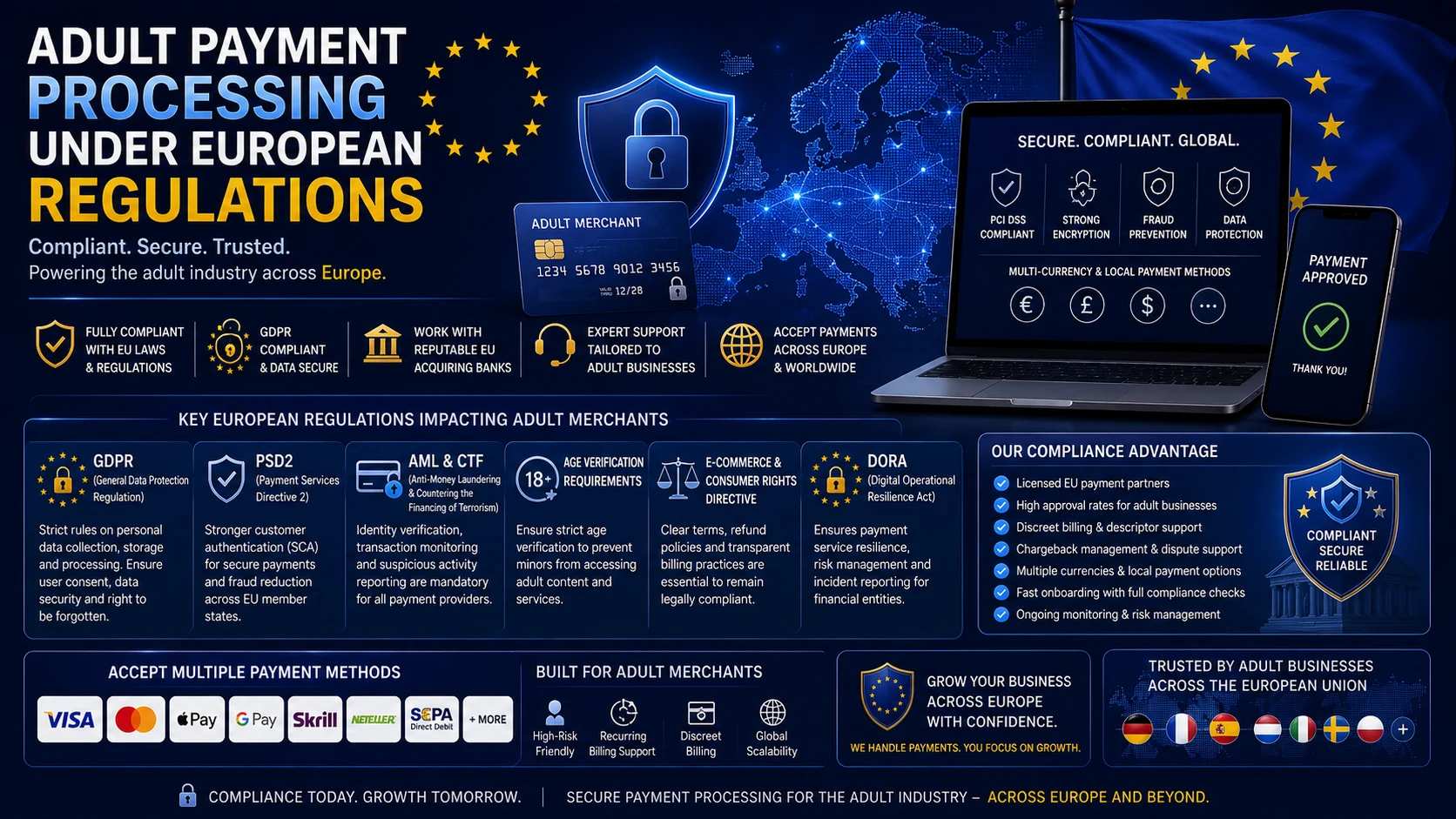
Unlike markets where high-risk payment processing is shaped mainly by commercial policy, the EU regulates it directly, PSD2, GDPR, AMLD6, and (for crypto-inclusive operators) MiCA all apply simultaneously, and a major overhaul of the payments framework itself is currently mid-transition. This guide pulls together the regulatory picture adult merchants operating in or serving the EU need to understand in 2026.
Adult payment processing in the EU currently operates under PSD2 as the baseline (mandatory Strong Customer Authentication via 3DS2), with GDPR governing all payment and age-verification data handling. PSD3 and the new Payment Services Regulation reached provisional political agreement in November 2025 and are moving toward formal adoption, expected to apply EU-wide roughly 21 months after publication, meaning PSD2 remains the operative law through the transition. AMLD6 must be transposed into national law by July 10, 2027. Crypto-inclusive operators face MiCA’s dual-licensing requirement alongside standard payment licensing. National regulators can add further requirements on top of every EU-wide baseline.
The Current Baseline: PSD2
As of 2026, PSD2 remains the cornerstone framework, it has applied since 2018 and continues to set the operative baseline until PSD3 and the PSR are formally adopted and transposed. For adult merchants specifically, the key requirement is Strong Customer Authentication (SCA): 3D Secure 2.0 implementation is mandatory for card-not-present transactions, not optional, and this directly affects checkout design and conversion for a category already managing elevated friction.
What’s Coming: PSD3 and the Payment Services Regulation
This is a genuinely significant, actively moving piece of the picture. PSD3 and the new Payment Services Regulation (PSR) together represent the most significant overhaul of European payments regulation since PSD2 itself, repealing and replacing both PSD2 and the Electronic Money Directive with a single, harmonized supervisory framework.
Current status and timeline:
- Provisional political agreement was reached between the European Parliament and Council on November 27, 2025
- COREPER endorsed the trilogue agreement on April 23, 2026, with final compromise texts published
- A European Parliament plenary vote was expected in late May 2026, with publication in the EU Official Journal anticipated for June, July, or potentially September 2026
- The PSR enters into force 20 days after publication and applies EU-wide approximately 21 months later; PSD3 requires national transposition over the same window
What changes for adult merchants once this takes effect:
- Stricter fraud liability rules, with payment service providers potentially bearing more responsibility for customer losses when fraud prevention mechanisms fail
- Enhanced fraud data-sharing frameworks between institutions, with GDPR already understood to permit fraud data processing under certain legal bases
- Tightened supervision of non-bank payment providers, relevant for adult merchants working with EMIs and specialist high-risk processors rather than traditional banks
- Mandatory customer and staff education on fraud risks for payment service providers
The practical takeaway: until formal adoption and transposition complete, PSD2 continues to govern, but adult merchants building payment infrastructure now should anticipate PSD3/PSR’s stricter fraud liability and reporting requirements rather than treating current rules as a fixed, permanent baseline.
GDPR: The Data Layer Running Through Everything
GDPR applies to every layer of adult payment processing, payment data itself, and critically, age-verification data given how central identity verification has become to compliant operation. EU-based processors simplify GDPR compliance significantly for the payment data component specifically, since merchants working with EU-headquartered providers avoid the extra step of negotiating separate data processing agreements required for non-EU processors.
For age verification specifically, covered in depth in our companion guide on how age verification impacts adult payment processing, GDPR’s data minimization principle matters directly: regulators increasingly expect only the minimum data necessary for age assurance to be collected, with no retention of personally identifiable information beyond what’s needed for the check itself.
AMLD6: The Anti-Money Laundering Layer
The Sixth Anti-Money Laundering Directive must be transposed into national law by July 10, 2027, bringing further harmonization of beneficial ownership registers and cross-border cooperation mechanisms. For adult merchants, this affects payment provider onboarding directly, expect deeper beneficial ownership disclosure requirements and more standardized AML documentation expectations as the transposition deadline approaches across member states.
MiCA: The Crypto Layer, Where Applicable
For adult businesses accepting stablecoin or crypto payments, covered in depth in our companion guide on crypto payments for adult businesses, the Markets in Crypto-Assets regulation adds a distinct compliance track. Operators processing fiat withdrawals alongside crypto need both a CASP authorization under MiCA and a Payment Institution or EMI license, with the transitional period for legacy operators ending July 1, 2026.
National-Level Variance: The Layer EU Directives Don’t Fully Standardize
EU-wide directives establish the baseline, but national regulators retain authority over specific industries, meaning requirements can genuinely differ by member state even under the same overarching EU framework. Adult merchants operating across multiple EU countries should confirm national-level industry requirements for each specific market rather than assuming uniform treatment across the bloc.
Decision Framework
If you’re building EU payment infrastructure now: Implement SCA/3DS2 as a baseline requirement today, and design your fraud prevention and reporting infrastructure with PSD3/PSR’s stricter liability rules in mind, since the transition window is measured in months, not years.
If you handle age verification data: Build data minimization into your verification flow now, GDPR expectations here are already active, not pending.
If you accept crypto payments: Confirm dual MiCA/EMI licensing before the July 2026 transitional deadline if you haven’t already.
If you operate across multiple EU member states: Confirm national-level industry requirements per country rather than assuming your compliance posture transfers uniformly across the bloc.
Conclusion
Adult payment processing under European regulation isn’t governed by a single rulebook, it’s PSD2 today, transitioning toward PSD3/PSR over the next 21+ months, layered with GDPR’s data obligations, AMLD6’s tightening AML requirements ahead of its 2027 deadline, MiCA for crypto-inclusive operators, and national-level industry rules on top of all of it. Merchants building for durability should treat the current framework as a moving target and design compliance infrastructure with the direction of travel in mind, not just today’s baseline.
Frequently Asked Questions
Q: Is PSD2 or PSD3 the operative law for adult payment processing in the EU right now?
A: PSD2, as of 2026, PSD3 and the Payment Services Regulation reached political agreement in late 2025 and are moving through formal adoption, but they won’t apply EU-wide until roughly 21 months after official publication, expected sometime in 2026.
Q: How does GDPR affect age verification specifically?
A: GDPR’s data minimization principle requires collecting only the data necessary for age assurance and avoiding retention of personally identifiable information beyond what the verification check itself requires.
Q: What’s the deadline for AMLD6 compliance?
A: EU member states must transpose AMLD6 into national law by July 10, 2027, which will bring further harmonization of beneficial ownership registers relevant to payment provider onboarding.
Comments
No comments yet. Be the first to share your thoughts.
Leave a comment