
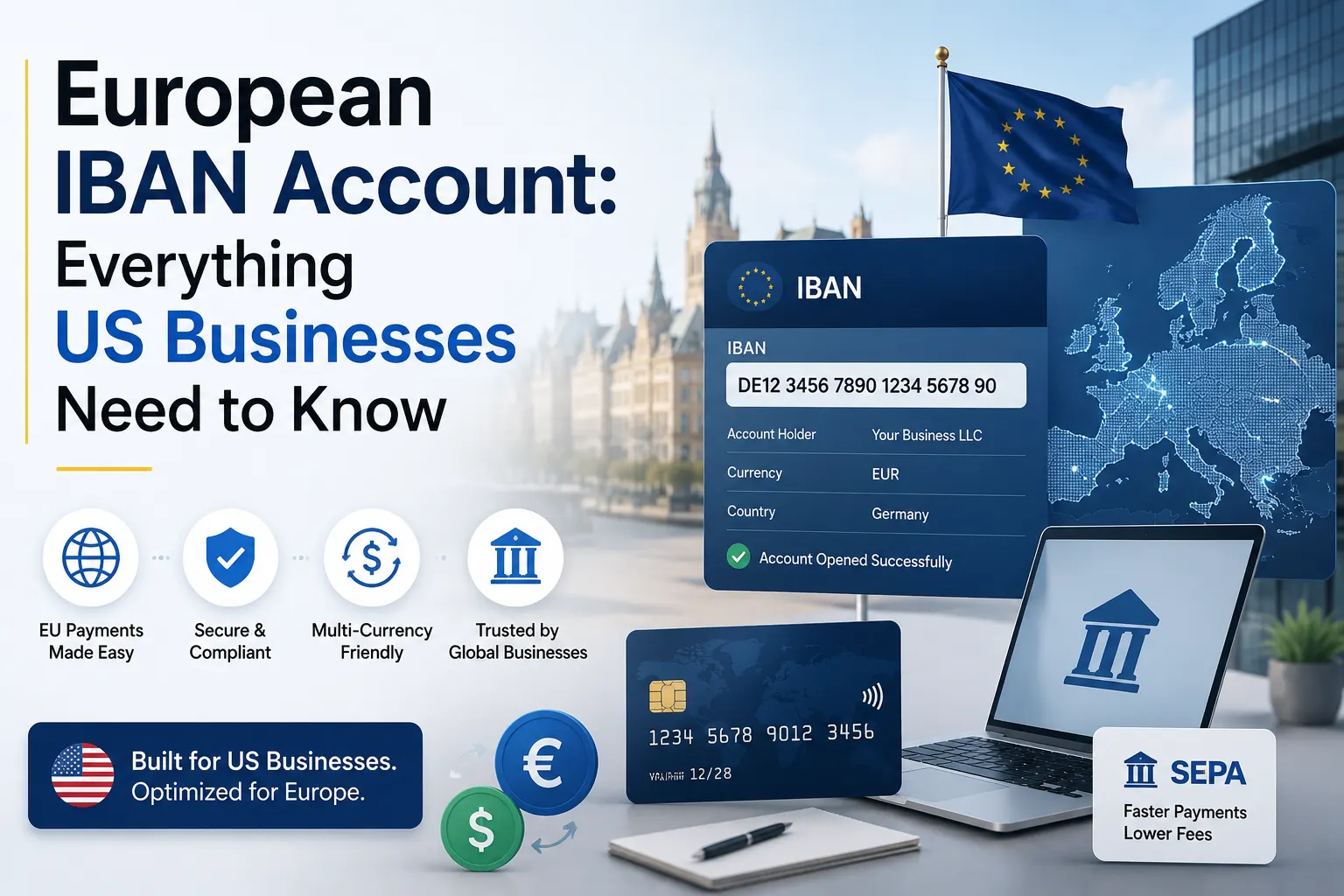
Every time a European client pays a US business into a USD-only account, a bank quietly converts that payment and keeps a markup most business owners never actually see itemized. A European IBAN account fixes that specific leak, but it also comes with US tax reporting obligations that catch a lot of American business owners off guard. Here’s what actually matters before opening one.
TL;DR:
A European IBAN account lets US businesses receive euro payments as domestic SEPA transfers instead of expensive international wires, cutting conversion costs and payment delays for anyone invoicing European clients regularly. Providers like Wise and Revolut make this accessible to US-registered businesses in 2026, but any account is a reportable foreign financial account under FBAR once aggregate foreign balances hit $10,000, and potentially under FATCA Form 8938 at higher thresholds. The euro savings are real; so is the compliance responsibility that comes with them.
Why US Businesses Actually Need a European IBAN Account
The clearest case is straightforward: a US business that regularly invoices European clients. Every euro payment landing in a USD-only account gets automatically converted by the receiving bank, which pockets a markup on top of the actual exchange rate, often invisible in the transaction but very real in the total received.
A European IBAN account solves this by giving the business a genuine local account number in the Eurozone, letting European customers, employers, or payment providers pay as if settling a domestic transaction. For businesses with recurring European revenue, suppliers, or payroll obligations, this isn’t a convenience feature, it’s a direct, recurring cost reduction on every euro transaction.
Beyond cost, there’s also a trust factor. Many European payment providers and business partners specifically require or strongly prefer paying into a local IBAN rather than routing an international wire, since domestic transfers settle faster and carry fewer failure points.
SEPA vs. SWIFT: The Difference That Actually Saves You Money
Understanding this distinction is the single most important technical detail for a US business evaluating European IBAN options.
- SEPA (Single Euro Payments Area) covers 21 Eurozone countries plus several additional participating states, enabling fast, low-cost euro transfers processed as domestic payments, often same-day or near-instant under the SEPA Instant Credit Transfer rules
- SWIFT transfers are the traditional international wire method, slower and considerably more expensive, typically involving intermediary banks that each take a cut
- Not every euro IBAN is automatically SEPA-enabled. Accounts issued outside the EU/EEA SEPA network, including some UK and Swiss accounts, still rely on SWIFT for euro transfers, which defeats much of the cost advantage a business is seeking in the first place
Before opening any account, confirming SEPA eligibility specifically, rather than assuming any account with a European-looking IBAN qualifies, is a step worth not skipping.
Types of European IBAN Accounts Available to US Businesses
Not every business IBAN account serves the same purpose, and choosing the right structure matters.
- A local Euro current account: through a traditional European bank, typically carrying monthly fees around €5-€15, supports both SEPA and SWIFT transfers and works well for businesses with an established European presence
- A multi-currency IBAN account: through a fintech like Wise or Revolut lets a US business hold, send, and convert euros alongside other currencies under one login, generally at exchange fees around 0.2%-0.5%, considerably below what a traditional bank markup would run
- A virtual IBAN account: often issued as a sub-account within a larger provider structure, suits businesses managing multiple payment streams or reconciling payments across several client relationships without needing a fully standalone banking relationship
- A corporate IBAN account for fintech companies: specifically, offered by EMIs positioned to serve fintech, marketplace, or platform business models with more specialized compliance and volume support
For most US businesses invoicing European clients directly, the multi-currency IBAN account through a digital provider tends to be the fastest and most cost-effective online IBAN account opening path, full traditional banking relationships generally aren’t necessary unless the business has a genuine European operational footprint.
FATCA and FBAR: What US Businesses Must Report
This is the part of the equation most guides gloss over, and it genuinely matters. Opening a European IBAN account creates real, ongoing US reporting obligations that don’t disappear just because the account is convenient.
- FBAR (FinCEN Form 114): is required once the aggregate maximum value of all foreign financial accounts, combined, not per account, exceeds $10,000 at any point during the year. Three accounts of $4,000 each, for example, combine to $12,000 and trigger the requirement for all three. The FBAR deadline is April 15, with an automatic extension to October 15 requiring no separate request.
- FATCA Form 8938: applies at higher thresholds, generally $50,000 for single filers living in the US, and considerably higher for those living abroad, and is filed alongside the annual tax return rather than separately with FinCEN.
- Reporting is aggregated across currencies: A multi-currency IBAN account holding several currency balances converts each to USD using the Treasury’s year-end exchange rate, with the reported figure based on the highest aggregate value reached during the year, not simply the balance on December 31.
- Providers often report independently, too: Wise, for example, has confirmed compliance with FATCA and CRS reporting obligations, meaning tax authorities may already have visibility into an account even before a business files its own FBAR.
- Penalties are real: Non-willful FBAR violations start at $10,000 per year; willful violations can reach the greater of $100,000 or 50% of the account balance.
None of this means a US business should avoid a European IBAN account, it means the compliance side needs to be built into the decision from day one, ideally with an accountant familiar with FBAR and FATCA specifically, rather than treated as an afterthought.
Which Providers Actually Accept US Businesses in 2026
Provider eligibility for US businesses varies more than most comparison articles acknowledge.
- Wise: operates as a UK-regulated EMI with a Belgian entity (Wise Europe SA) covering EU accounts, and is widely used by US businesses for its multi-currency IBAN account offering and transparent FX pricing
- Revolut Business: is available to US-registered companies, though as of 2026 it operates as a fintech platform in the US rather than a chartered bank, meaning US deposits aren’t FDIC-insured, worth weighing against its FX advantages directly
- Traditional European banks: remain considerably harder for US businesses to access directly, given FATCA compliance costs that lead many EU banks to simply avoid US-person clients rather than build out the required reporting infrastructure
- Specialized EMIs: particularly those licensed in Lithuania or similar fintech-friendly jurisdictions, often provide a more consistent onboarding experience for US businesses than either traditional banks or larger consumer-facing fintechs, whose US eligibility policies can shift with little notice
Given how frequently individual providers’ terms of service change around US-person eligibility, confirming current acceptance directly with the provider, rather than relying solely on a comparison article, is worth the extra step before committing.
How to Open a European IBAN Account as a US Business
The process is largely consistent across providers that do accept US businesses:
- Confirm the provider explicitly accepts US-registered businesses and offers SEPA-enabled IBANs, not just a European-sounding account number
- Prepare US business registration documents, EIN, beneficial ownership information, and identification for company officers
- Complete remote KYC verification, typically including proof of the US business address and the nature of the business’s European activity
- Once approved, activate the IBAN and confirm SEPA transfer capability before relying on it for client invoicing
- Set up a system, ideally with an accountant, for tracking aggregate foreign account balances against the FBAR $10,000 threshold from day one
Multi-Currency Considerations for US Businesses
Most US businesses working with European clients eventually need more than euros alone, UK clients paying in GBP, or broader international business requiring a genuine multi-currency IBAN account. Holding several currencies under one provider avoids the cost of maintaining separate relationships per currency, and internal conversion between held currencies is typically far cheaper than converting through a US bank’s international wire process.
Common Mistakes US Businesses Make
- Assuming any European IBAN is SEPA-enabled: without confirming directly, then discovering transfers are routing through slower, costlier SWIFT rails
- Treating FBAR and FATCA as optional: because the account is held with a fintech rather than a traditional bank, both obligations apply regardless of provider type
- Underestimating how quickly the $10,000 FBAR aggregate threshold is reached: when accounts are viewed individually rather than combined
- Choosing a provider without confirming current US-business eligibility: given how frequently these policies change
Frequently Asked Questions
Do US businesses need to report a European IBAN account to the IRS?
Yes. Any European IBAN account is a foreign financial account for FBAR purposes, reportable once aggregate foreign account balances exceed $10,000 at any point in the year. Higher-value accounts may also trigger FATCA Form 8938 reporting requirements.
What’s the difference between SEPA and SWIFT for a European IBAN account?
SEPA transfers move euros within participating European countries as fast, low-cost domestic-style payments. SWIFT is the traditional international wire method, slower and more expensive. Not every European IBAN is SEPA-enabled, so confirming this before opening an account matters.
Can a US-registered business actually open a European IBAN account online?
Yes, through providers like Wise and Revolut Business that explicitly accept US-registered companies, typically with a fully remote application process requiring standard business registration and identification documents.
Is it worth opening a European IBAN account for occasional European payments?
It depends on volume. Businesses invoicing European clients regularly see clear, recurring savings on conversion costs. Businesses with only occasional European transactions may find the compliance overhead outweighs the savings.
Are digital providers like Wise and Revolut as safe as traditional banks for US businesses? They’re regulated financial institutions, but protections differ, Revolut’s US operations, for instance, aren’t FDIC-insured as of 2026, unlike its now fully licensed UK banking arm. Confirming each provider’s specific protections before committing meaningful balances is worth the diligence.
Comments
No comments yet. Be the first to share your thoughts.
Leave a comment