
Introduction
Speed has become one of the most important factors in modern financial services. Businesses expect faster settlements, consumers demand immediate access to funds, and financial institutions are under increasing pressure to improve transaction efficiency. Traditional bank transfers, which often take hours or even days to settle, no longer meet the expectations of today’s digital economy.
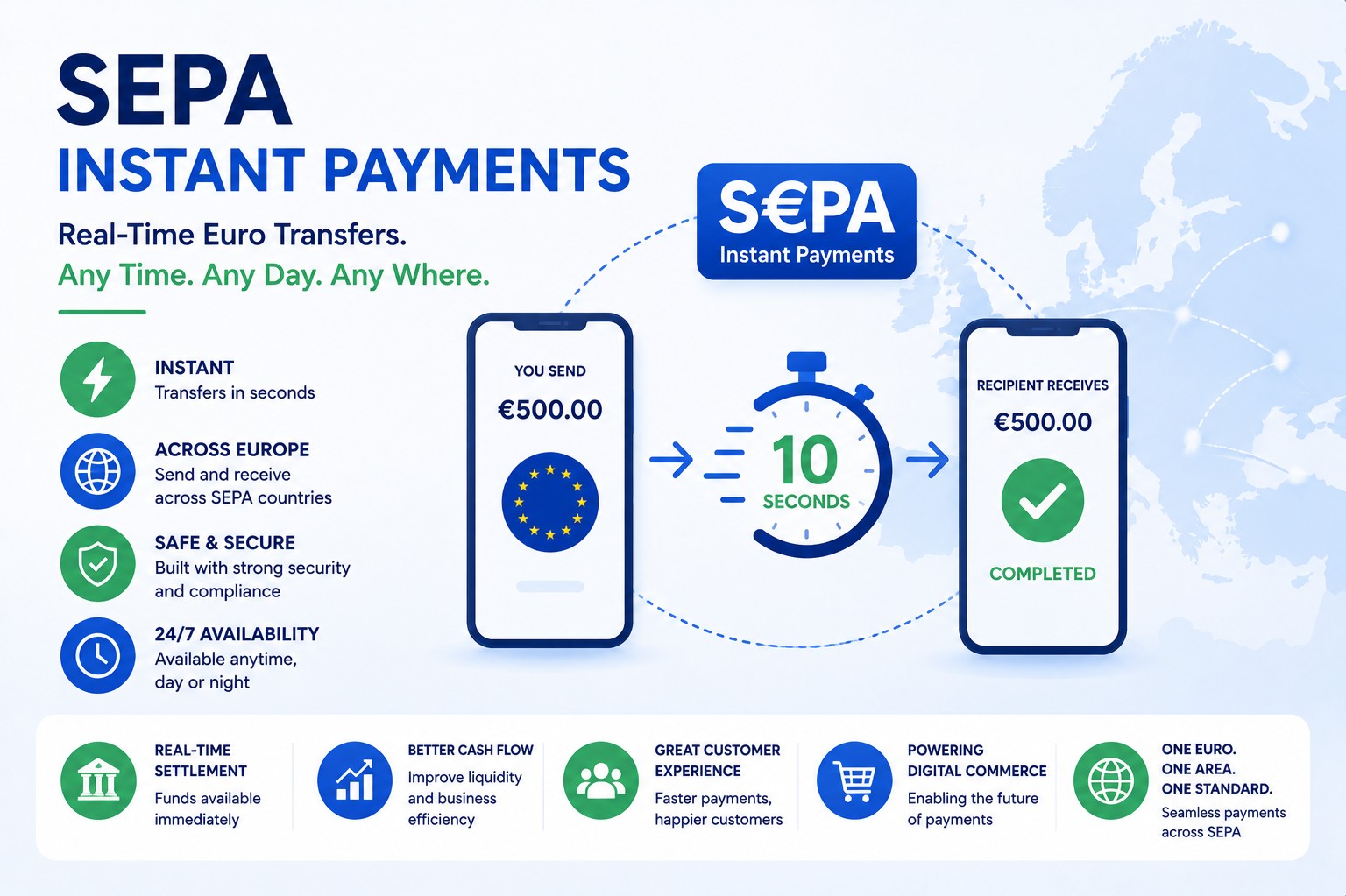
This demand for immediacy has fueled the growth of SEPA Instant Payments, a payment scheme designed to enable near-instant euro transfers across participating European financial institutions. By allowing funds to move within seconds, the system is transforming how individuals and businesses manage money.
As real-time payments become a global trend, SEPA Instant Payments are playing a crucial role in modernizing Europe’s payment infrastructure and supporting a more connected financial ecosystem.
What Are SEPA Instant Payments?
SEPA Instant Payments are real-time euro credit transfers that enable money to be sent and received within seconds, regardless of the day or time.
Unlike traditional bank transfers that may depend on banking hours or settlement windows, instant transfers operate continuously.
The system supports:
- 24/7 availability
- Near-instant fund transfers
- Cross-border euro payments
- Real-time settlement confirmation
This allows users to send and receive funds quickly and efficiently across participating countries.
Understanding the SEPA Framework
The Single Euro Payments Area (SEPA) was established to simplify euro-denominated payments across Europe.
Its objective is to create a unified payment market where transfers can be processed under common standards.
SEPA enables:
- Domestic and cross-border payments
- Standardized payment processing
- Improved interoperability
- Greater payment efficiency
SEPA Instant Payments build upon this foundation by introducing real-time transfer capabilities.
Why Instant Payments Matter
The financial world is moving toward immediacy.
Consumers increasingly expect transactions to occur as quickly as digital communications.
Businesses benefit from faster access to funds, while financial institutions gain opportunities to improve customer experiences.
Instant payment systems help:
- Improve cash flow
- Reduce settlement delays
- Increase transaction transparency
- Enhance customer satisfaction
- Support digital commerce
These benefits are driving widespread adoption across Europe.
How SEPA Instant Payments Work
The process begins when a sender initiates a transfer through a participating financial institution.
The payment request is transmitted immediately through the instant payment network.
The receiving institution verifies the transaction and credits the recipient’s account within seconds.
The process typically includes:
- Payment initiation
- Authentication
- Transaction validation
- Real-time processing
- Settlement confirmation
- Immediate fund availability
The entire process is designed to occur almost instantly.
Key Benefits for Businesses
Businesses are among the biggest beneficiaries of instant payment capabilities.
Faster Cash Flow
Immediate access to incoming funds improves liquidity management.
Improved Customer Experience
Customers appreciate quick and reliable payment services.
Enhanced Operational Efficiency
Faster settlement reduces delays in business processes.
Better Payment Visibility
Real-time confirmations improve financial transparency.
Reduced Payment Friction
Transactions can be completed without waiting for traditional settlement cycles.
These advantages help organizations operate more efficiently in competitive markets.
Benefits for Consumers
Consumers also gain significant value from instant payments.
Advantages include:
- Immediate fund transfers
- 24/7 payment availability
- Faster bill payments
- Quick peer-to-peer transactions
- Improved financial flexibility
Whether splitting expenses, sending emergency funds, or making purchases, instant transfers provide greater convenience.
Supporting Cross-Border Commerce
One of the most important strengths of SEPA Instant Payments is their ability to facilitate cross-border transactions.
Businesses operating across multiple European markets often require efficient payment solutions.
Real-time euro transfers help:
- Accelerate supplier payments
- Improve international cash flow
- Simplify cross-border operations
- Reduce payment delays
These capabilities support both regional and international commerce.
SEPA Instant Payments and Digital Commerce
E-commerce continues to grow across Europe.
Online businesses require payment systems that match the speed of digital shopping experiences.
Instant payment capabilities help merchants:
- Receive funds faster
- Improve transaction certainty
- Reduce settlement delays
- Enhance customer trust
As digital commerce evolves, real-time payment infrastructure becomes increasingly important.
Security and Risk Management
Security remains a critical component of instant payment systems.
Because transactions occur in real time, strong safeguards are necessary to prevent fraud and unauthorized activity.
Financial institutions utilize:
- Strong customer authentication
- Transaction monitoring
- Fraud detection technologies
- Encryption protocols
- Risk management systems
These measures help maintain trust while supporting rapid transaction processing.
Challenges and Considerations
While instant payments provide significant advantages, certain challenges remain.
These include:
Fraud Prevention
Faster transactions require more sophisticated fraud detection systems.
Infrastructure Modernization
Financial institutions may need technology upgrades.
Operational Readiness
Organizations must adapt processes to real-time payment environments.
Customer Awareness
Users need clear understanding of how instant transfers function.
Addressing these challenges is essential for continued growth and adoption.
The Role of Fintech Innovation
Fintech companies are helping accelerate the adoption of instant payment technologies.
Many providers offer solutions that enhance:
- Payment accessibility
- User experiences
- Transaction visibility
- Payment automation
- Financial management
Innovation is helping businesses and consumers fully leverage the benefits of real-time payments.
The Future of SEPA Instant Payments
The future of European payments is increasingly centered on real-time capabilities.
Emerging trends include:
- Greater instant payment adoption
- Expanded financial institution participation
- Open banking integration
- Automated payment workflows
- Enhanced digital commerce solutions
- Improved cross-border payment experiences
As these developments continue, instant transfers are expected to become a standard feature of everyday financial services.
Conclusion
SEPA Instant Payments are transforming the European payments landscape by enabling real-time euro transfers that operate around the clock. By delivering faster settlements, improved cash flow, enhanced customer experiences, and greater payment efficiency, they are helping modernize financial infrastructure across the region.
As businesses and consumers increasingly demand immediate transactions, instant payment systems will continue playing a central role in the future of digital finance. Organizations that embrace these capabilities will be better positioned to thrive in an increasingly connected and real-time economy.
Comments
No comments yet. Be the first to share your thoughts.
Leave a comment