
Introduction
The banking industry is undergoing one of the most significant transformations in its history. For decades, traditional banks dominated financial services, offering customers a standardized range of products including savings accounts, loans, payment services, and investment solutions. However, rapid technological innovation, changing consumer expectations, and the rise of fintech companies have created a new financial ecosystem known as alternative banking.
It has emerged as a flexible and technology-driven approach to delivering financial services. Rather than relying solely on traditional branch networks and legacy systems, it providers leverage digital platforms, automation, artificial intelligence, and innovative business models to serve both consumers and businesses.
As global demand for faster, more accessible, and customer-centric financial services continues to grow, alternative banking is becoming a major force shaping the future of finance.
What Is Alternative Banking?
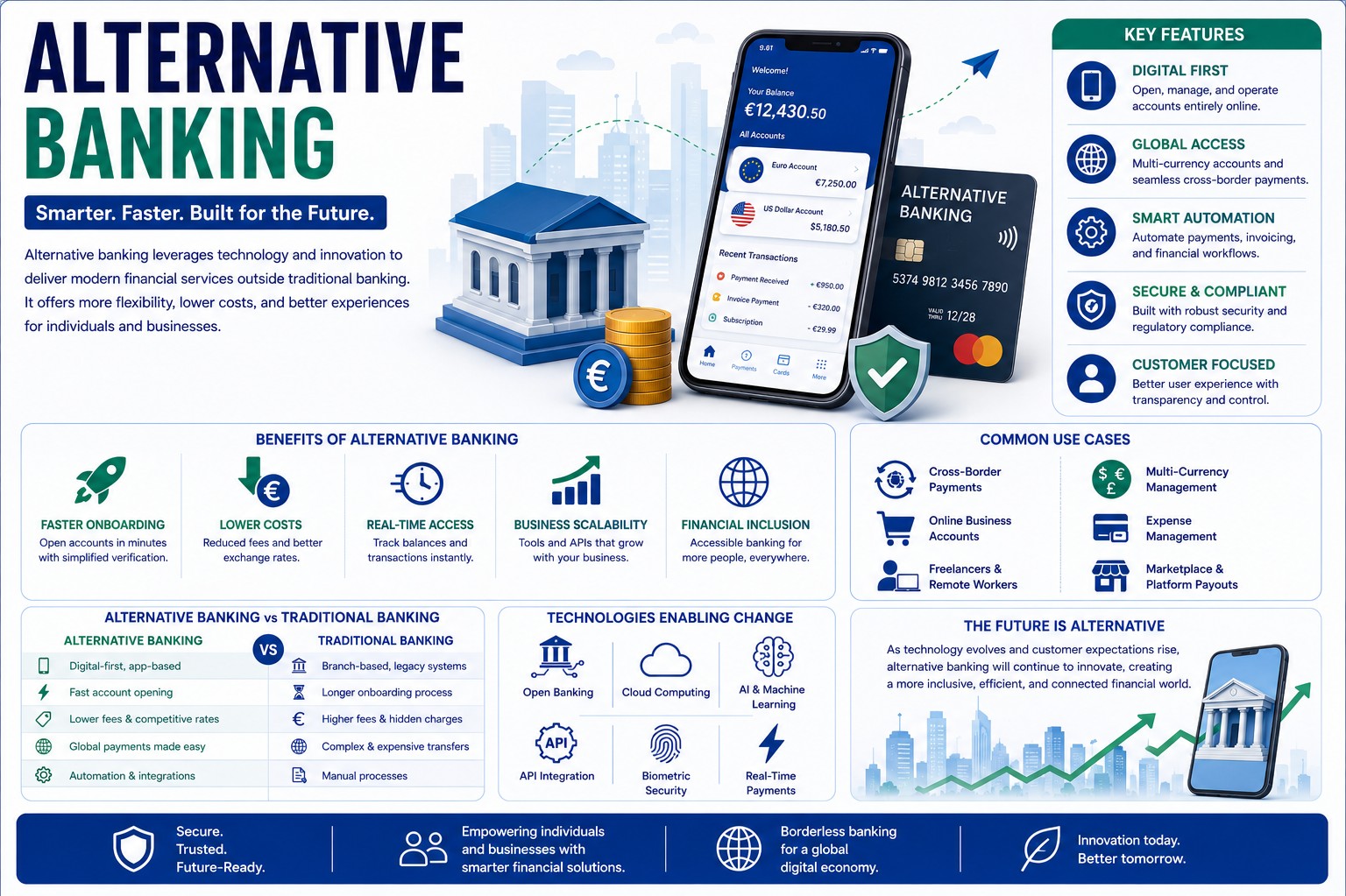
Alternative banking refers to financial services provided outside the traditional banking framework. These services may be delivered by fintech companies, neobanks, challenger banks, payment institutions, electronic money institutions, and other non-traditional financial providers.
Unlike conventional banks that often rely on physical branches and legacy infrastructure, alternative banking platforms operate primarily through digital channels.
They offer a wide range of services including:
- Digital accounts
- International payments
- Business banking solutions
- Multi-currency accounts
- Lending services
- Payment processing
- Expense management
- Financial automation
The goal is to provide faster, more efficient, and more user-friendly financial experiences.
Why Alternative Banking Is Growing
Several factors have contributed to the rapid growth of alternative banking.
Consumers increasingly expect instant access to financial services through smartphones and digital platforms. Traditional banking processes can sometimes feel slow, expensive, and difficult to navigate.
At the same time, businesses require more flexible financial tools capable of supporting international operations, digital commerce, and automated workflows.
These banking providers address these needs by offering streamlined onboarding, real-time account management, lower fees, and innovative financial products.
The rise of cloud computing, open banking, and fintech innovation has further accelerated the adoption of alternative banking solutions worldwide.
Key Features of Alternative Banking
One of the defining characteristics of alternative banking is its digital-first approach.
Customers can often open accounts, verify identities, manage transactions, and access financial services entirely online.
Many providers offer intuitive mobile applications that provide real-time insights into account activity and spending behavior.
Alternative banking platforms also emphasize automation. Tasks such as invoicing, expense tracking, payment reconciliation, and financial reporting can often be completed automatically.
These features help businesses reduce administrative burdens while improving operational efficiency.
Alternative Banking and Business Growth
Businesses have become some of the biggest adopters of alternative banking services.
Traditional banking systems may struggle to meet the needs of rapidly growing companies, particularly those operating internationally. Cross-border payments, currency conversions, and complex treasury management requirements often create operational challenges.
Alternative banking providers frequently offer solutions specifically designed for modern businesses, including:
- Multi-currency accounts
- International payment capabilities
- Virtual IBANs
- Automated payment workflows
- Corporate expense management
- API integrations
These tools help businesses scale more efficiently while improving financial visibility and control.
The Rise of Neobanks and Challenger Banks
Neobanks and challenger banks represent some of the most visible examples of alternative banking.
These institutions operate primarily through digital platforms and often focus on delivering highly personalized customer experiences.
Unlike traditional banks, many neobanks are built on modern technology stacks that enable faster innovation and greater operational flexibility.
Customers benefit from simplified account opening processes, transparent pricing structures, real-time notifications, and enhanced digital experiences.
As consumer expectations continue to evolve, neobanks are becoming increasingly competitive within the broader financial services market.
Alternative Banking and Financial Inclusion
Financial inclusion remains a significant global challenge.
Millions of individuals and small businesses still face barriers when attempting to access traditional banking services. These barriers may include geographic limitations, documentation requirements, minimum balance thresholds, or insufficient banking infrastructure.
Alternative banking providers are helping address these challenges by offering accessible digital solutions that reach underserved populations.
Mobile-first platforms, simplified onboarding processes, and innovative identity verification technologies are expanding access to financial services across emerging and developed markets alike.
This increased accessibility contributes to greater economic participation and financial empowerment.
Cross-Border Payments and Alternative Banking
International payments represent one of the strongest use cases for alternative banking.
Traditional cross-border transactions often involve multiple intermediaries, high fees, and lengthy processing times.
Alternative banking platforms frequently provide faster and more cost-effective international payment solutions. Many offer local account details in multiple countries, competitive foreign exchange rates, and transparent fee structures.
Businesses operating globally can benefit from improved cash flow management and reduced transaction costs.
As global commerce continues expanding, efficient cross-border payment capabilities have become increasingly valuable.
Technology Driving Alternative Banking
Technology is the foundation of alternative banking innovation.
Cloud-based infrastructure enables scalability and operational flexibility. Artificial intelligence improves fraud detection, customer support, and financial insights. Open banking frameworks facilitate secure data sharing and service integration.
Application programming interfaces (APIs) allow businesses to connect banking services directly with accounting platforms, enterprise software, and payment systems.
Machine learning algorithms help identify financial trends and automate decision-making processes.
These technological advancements enable alternative banking providers to deliver highly efficient and customer-focused financial services.
Challenges Facing Alternative Banking
Despite its growth, alternative banking faces several challenges.
Regulatory compliance remains a major consideration. Financial institutions must comply with anti-money laundering requirements, know-your-customer regulations, data protection standards, and consumer protection laws.
Trust can also be a challenge for newer providers competing against well-established banks with long histories and strong brand recognition.
Cybersecurity risks continue to evolve as financial services become increasingly digital.
To succeed long term, alternative banking providers must balance innovation with security, compliance, and customer trust.
Alternative Banking and the Future of Finance
The future of finance is expected to become increasingly digital, interconnected, and customer-centric.
Alternative banking providers are well positioned to drive this transformation through continued innovation and technological advancement.
Embedded finance, real-time payments, artificial intelligence, decentralized financial technologies, and open banking initiatives are expected to further expand the capabilities of alternative banking platforms.
Consumers and businesses will increasingly demand financial services that are flexible, personalized, and available on demand.
Organizations capable of meeting these expectations will shape the next generation of financial services.
Benefits of Alternative Banking
Alternative banking offers numerous advantages for both individuals and businesses.
These benefits include:
- Faster account setup and onboarding
- Lower operational and transaction costs
- Improved digital experiences
- Greater financial transparency
- Enhanced international payment capabilities
- Automated financial management
- Increased accessibility
- Real-time account monitoring
- Flexible financial products
- Better integration with business systems
These advantages continue to drive adoption across a wide range of industries and customer segments.
Conclusion
Alternative banking is redefining how financial services are delivered in the modern economy. By leveraging technology, automation, and innovative business models, alternative banking providers are creating faster, more accessible, and more efficient financial solutions for consumers and businesses alike.
From digital accounts and international payments to financial automation and embedded finance, alternative banking is addressing many of the limitations associated with traditional banking systems.
As fintech innovation accelerates and customer expectations continue to evolve, alternative banking will play an increasingly important role in shaping the future of global finance. Organizations that embrace these innovations today will be better positioned to thrive in tomorrow’s digital financial ecosystem.
Comments
No comments yet. Be the first to share your thoughts.
Leave a comment