
Introduction
The European financial landscape has undergone a remarkable transformation over the past two decades. Businesses and consumers once faced significant challenges when sending money across borders, including high fees, lengthy processing times, and complex banking procedures. The introduction of SEPA transfers has fundamentally changed this experience by creating a unified payment framework that allows euro transactions to move across participating countries as easily as domestic payments.
Today, SEPA transfers serve as one of the most important components of Europe’s financial infrastructure. They support millions of transactions daily, enabling businesses, financial institutions, and individuals to send and receive funds efficiently across multiple countries.
As international trade, digital commerce, and cross-border financial services continue to grow, understanding how SEPA transfers work has become increasingly important for organizations operating within the European market.
What Are SEPA Transfers?
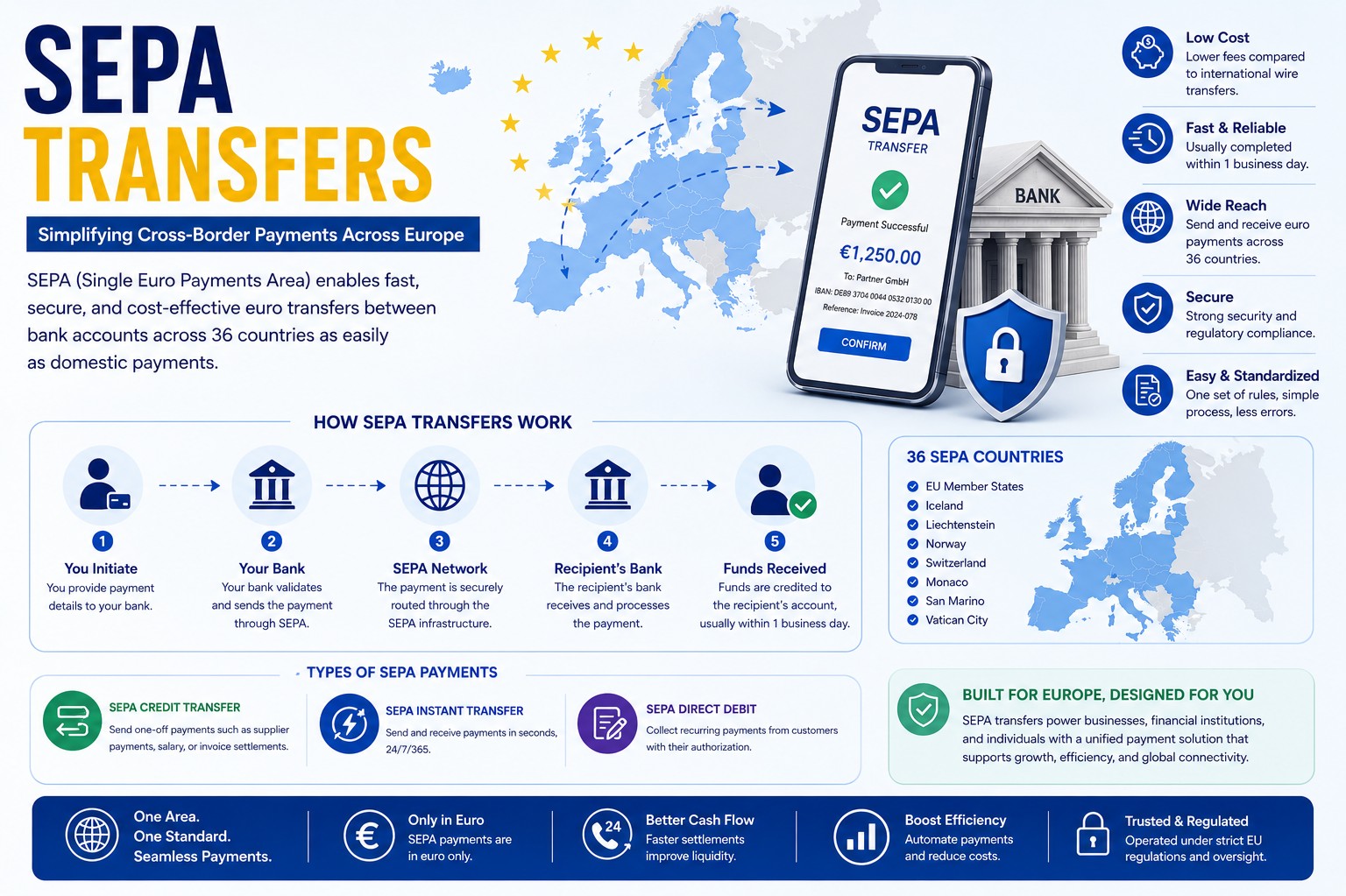
SEPA stands for the Single Euro Payments Area, a payment initiative designed to harmonize euro-denominated bank transfers across participating European countries.
A SEPA transfer allows funds to be transferred between bank accounts within the SEPA zone using standardized rules, formats, and processing procedures. The objective is to make cross-border euro payments as simple, fast, and affordable as domestic transfers.
SEPA includes all member states of the European Union as well as several additional countries and territories that participate in the framework.
Through this unified system, businesses and consumers can send euro payments across borders without dealing with the complexities traditionally associated with international banking.
Why SEPA Transfers Were Introduced
Before SEPA was established, cross-border payments within Europe often involved different banking standards, varying processing requirements, and inconsistent fee structures.
Businesses operating in multiple countries faced significant administrative burdens when managing supplier payments, payroll processing, and customer transactions. Consumers encountered delays and additional costs when transferring funds internationally.
SEPA was introduced to eliminate these inefficiencies and create a more integrated European payments market.
By standardizing payment procedures and encouraging interoperability between financial institutions, SEPA has significantly improved payment efficiency throughout the region.
How SEPA Transfers Work
The process behind SEPA transfers is designed to be straightforward and efficient.
When a sender initiates a payment, the bank collects key information such as the recipient’s name, International Bank Account Number (IBAN), payment amount, and transaction details.
The payment is then processed using standardized messaging formats that enable participating financial institutions to exchange information seamlessly.
Once approved, the funds are transferred to the recipient’s account through the SEPA infrastructure. In most cases, standard SEPA credit transfers are completed within one business day.
The simplicity and consistency of the process contribute to the widespread adoption of SEPA transfers across Europe.
Types of SEPA Transfers
The SEPA framework supports multiple payment instruments designed to address different transaction needs.
SEPA Credit Transfer
The SEPA Credit Transfer is the most commonly used payment method within the framework. It enables individuals and businesses to send euro payments from one bank account to another across participating countries.
This payment type is widely used for supplier payments, salary transfers, invoice settlements, and general business transactions.
SEPA Instant Transfer
SEPA Instant Transfer represents a significant advancement in payment speed.
Unlike traditional bank transfers that may require several hours or a full business day, SEPA Instant Transfers allow funds to be credited to the recipient’s account within seconds.
This capability supports real-time commerce, emergency payments, and enhanced customer experiences.
SEPA Direct Debit
SEPA Direct Debit enables organizations to collect recurring payments directly from customer bank accounts after obtaining authorization.
This method is commonly used for subscription services, utility payments, insurance premiums, and recurring business billing arrangements.
Benefits of SEPA Transfers for Businesses
Businesses operating within Europe benefit significantly from SEPA transfers.
One of the most important advantages is cost efficiency. Standardized payment processes often reduce transaction costs compared to traditional international wire transfers.
SEPA transfers also improve operational efficiency by simplifying payment management across multiple countries. Organizations can centralize treasury operations and manage euro payments using a single banking framework.
The ability to process payments quickly and reliably enhances supplier relationships and improves cash flow management.
For multinational businesses, SEPA transfers support seamless financial operations across European markets.
Benefits for Consumers
Consumers also enjoy substantial advantages through the SEPA framework.
Sending money to family members, paying tuition fees, purchasing goods, or managing international financial obligations becomes significantly easier when standardized payment systems are available.
SEPA transfers provide greater transparency regarding fees and processing timelines while reducing administrative complexity.
As digital banking adoption continues to increase, consumers increasingly rely on SEPA infrastructure for everyday financial transactions.
SEPA Transfers and E-Commerce
The growth of digital commerce has amplified the importance of SEPA transfers.
Online merchants serving customers across Europe require payment methods that are efficient, secure, and cost-effective. SEPA payments provide an attractive alternative to card-based transactions for many businesses and consumers.
SEPA-based payment solutions can reduce processing costs while offering direct bank-to-bank payment capabilities.
For e-commerce companies operating across multiple European markets, SEPA transfers help streamline payment collection and improve settlement efficiency.
The Role of IBAN in SEPA Transfers
The International Bank Account Number plays a central role in SEPA transactions.
IBANs provide a standardized method for identifying bank accounts across participating countries. This standardization reduces errors and improves payment accuracy.
By using IBANs, financial institutions can process transfers more efficiently while minimizing delays associated with incorrect account information.
For businesses handling large transaction volumes, accurate IBAN management contributes significantly to payment success rates.
Security and Compliance
Security remains a critical aspect of the SEPA ecosystem.
Participating financial institutions must comply with strict regulatory standards related to payment processing, anti-money laundering controls, customer authentication, and data protection.
Advanced encryption technologies, secure communication protocols, and fraud monitoring systems help safeguard transactions throughout the payment lifecycle.
These protections contribute to the trust and reliability that have made SEPA transfers a preferred payment method across Europe.
Challenges and Considerations
Despite their many benefits, SEPA transfers are not without limitations.
The framework primarily supports euro-denominated transactions, meaning businesses operating with multiple currencies may still require additional banking solutions.
Variations in banking practices, payment cut-off times, and local implementation standards can occasionally affect transaction experiences.
Organizations must also ensure compliance with evolving regulatory requirements and maintain accurate payment data to avoid processing issues.
However, these challenges are generally outweighed by the efficiency gains offered by the SEPA framework.
The Future of SEPA Transfers
The future of SEPA transfers is closely tied to broader payment innovation initiatives across Europe.
Real-time payments, open banking, API-driven financial services, and digital identity solutions are expected to further enhance payment experiences.
The continued expansion of SEPA Instant Transfers will likely accelerate the adoption of real-time payment capabilities among businesses and consumers.
Financial institutions are also investing in automation, artificial intelligence, and advanced payment technologies to improve efficiency and reduce operational costs.
As Europe’s digital economy continues to evolve, SEPA transfers will remain a cornerstone of regional payment infrastructure.
Conclusion
SEPA transfers have transformed the way money moves across Europe by creating a unified, efficient, and secure payment framework. By standardizing euro-denominated transactions, SEPA has simplified cross-border payments for businesses and consumers alike.
From supporting international trade and e-commerce growth to improving cash flow management and reducing payment costs, SEPA transfers deliver significant benefits across the financial ecosystem.
As payment technologies continue to evolve and real-time banking becomes increasingly important, SEPA will remain a vital foundation for European financial integration and digital commerce.
Comments
No comments yet. Be the first to share your thoughts.
Leave a comment