
Introduction
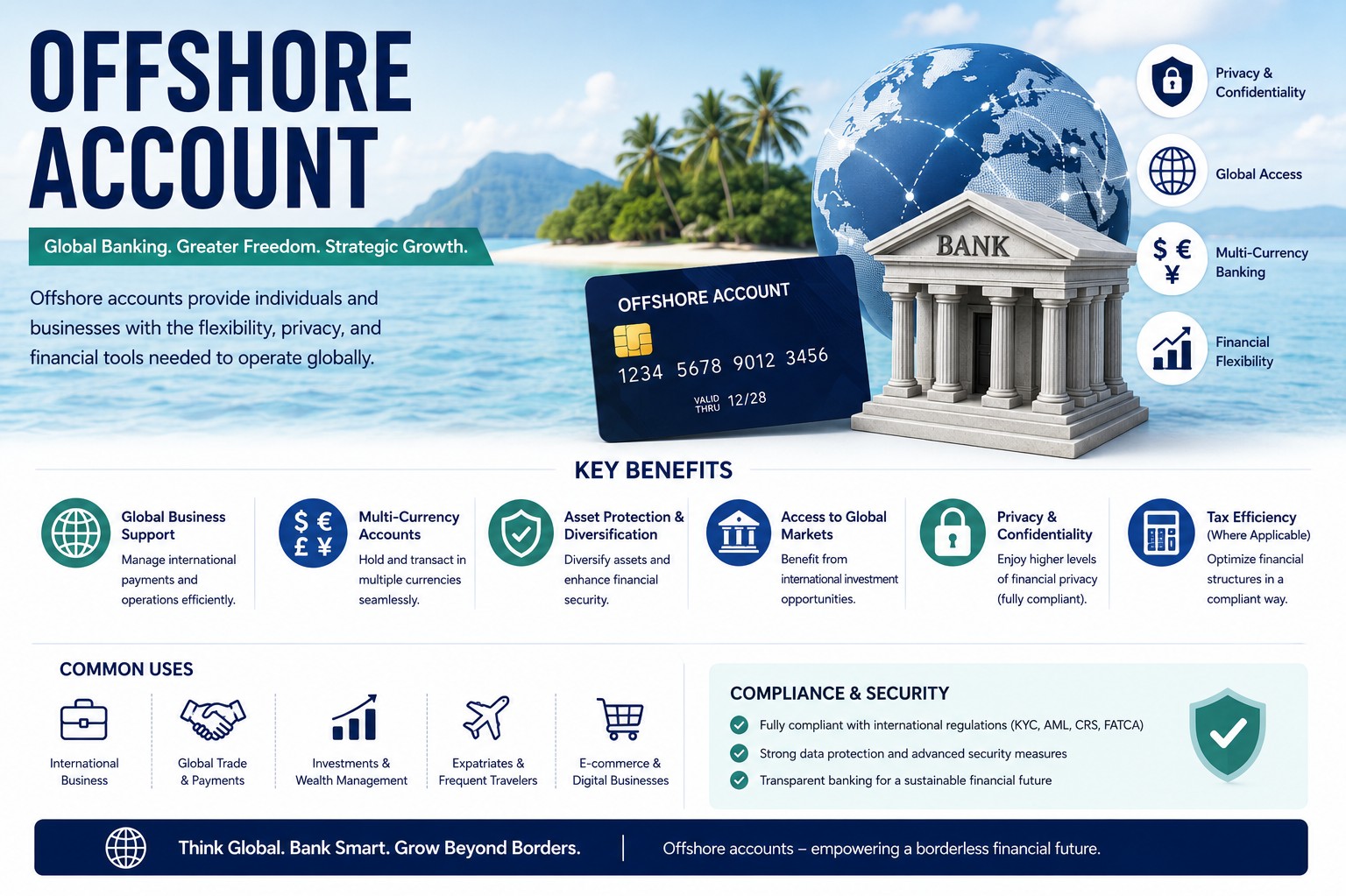
As businesses expand across borders and individuals seek greater financial flexibility, international banking solutions have become increasingly important. Among these solutions, the offshore account remains one of the most discussed and often misunderstood financial tools in the global banking industry.
For many people, offshore accounts are associated with secrecy and tax avoidance. In reality, offshore banking serves a wide range of legitimate purposes, including international business operations, multi-currency management, asset diversification, cross-border transactions, and global wealth planning.
In today’s interconnected financial environment, offshore accounts are widely used by multinational corporations, entrepreneurs, expatriates, investors, digital businesses, and internationally mobile professionals.
Understanding how offshore accounts work, their benefits, challenges, and regulatory considerations is essential for anyone operating within the global economy.
What Is an Offshore Account?
An offshore account is a bank account opened in a jurisdiction outside the account holder’s country of residence or primary business operations.
These accounts may be established by individuals, corporations, trusts, investment funds, and international organizations seeking access to foreign banking services.
Offshore accounts function similarly to domestic bank accounts. They allow customers to hold funds, make transfers, receive payments, manage investments, and conduct financial transactions.
The key distinction lies in the location of the banking institution and the international advantages that certain jurisdictions may offer.
Today, offshore accounts are commonly used as part of broader international financial strategies rather than as standalone banking solutions.
Why Offshore Accounts Are Growing in Popularity
Globalization has transformed the way people and businesses manage money.
Companies increasingly serve customers across multiple countries, maintain international supply chains, and conduct transactions in various currencies. Individuals frequently relocate for work, invest internationally, or maintain financial interests across several jurisdictions.
Traditional domestic banking structures may not always provide the flexibility required to support these activities.
An offshore account can help simplify international financial management by offering access to global banking networks, multi-currency capabilities, and cross-border payment services.
As international commerce continues to expand, demand for offshore banking solutions continues to grow.
Benefits of an Offshore Account
One of the primary advantages of an offshore account is access to international banking services.
Many offshore banks offer multi-currency accounts that allow customers to hold, receive, and transfer funds in different currencies without maintaining separate accounts in multiple countries.
This can significantly improve efficiency for businesses managing international payments and foreign exchange exposure.
Offshore accounts also support financial diversification by allowing individuals and companies to spread banking relationships across multiple jurisdictions.
For globally active organizations, this diversification can strengthen financial resilience and improve access to international markets.
Supporting International Business Operations
Businesses operating across borders often face challenges related to payment processing, currency management, supplier payments, and international settlements.
An offshore account can streamline these activities by providing access to global payment infrastructure and international banking services.
Many multinational companies use offshore banking solutions to centralize treasury operations, manage liquidity more effectively, and simplify international transactions.
Digital businesses, fintech companies, e-commerce merchants, and service providers frequently rely on offshore accounts to support global operations and serve customers in multiple regions.
As cross-border commerce becomes increasingly common, offshore banking plays an important role in supporting business growth.
Multi-Currency Banking Advantages
Currency management remains a significant challenge for internationally active businesses and investors.
Exchange rate fluctuations can affect profitability, cash flow forecasting, and financial planning.
Many offshore banks provide multi-currency account capabilities that allow account holders to maintain balances in several currencies simultaneously.
This flexibility helps reduce foreign exchange conversion costs and supports more efficient international transaction management.
For businesses receiving payments from multiple countries, multi-currency banking can significantly improve operational efficiency.
Asset Diversification and Financial Stability
Financial diversification is another common reason individuals and organizations choose offshore banking solutions.
Maintaining assets across different banking jurisdictions can help reduce concentration risk and provide access to a broader range of financial products and services.
Some account holders use offshore accounts to complement domestic banking relationships rather than replace them entirely.
Diversification strategies often focus on improving financial flexibility, enhancing international access, and supporting long-term financial planning objectives.
In an increasingly interconnected world, geographic diversification has become an important consideration for many global investors.
Offshore Accounts and Regulatory Compliance
Modern offshore banking operates within a highly regulated environment.
International transparency initiatives have significantly increased reporting requirements for financial institutions and account holders. Banks must comply with anti-money laundering regulations, know-your-customer requirements, sanctions screening obligations, and international reporting standards.
Offshore accounts are fully legal when established and maintained in compliance with applicable laws and reporting requirements.
Financial institutions conduct extensive due diligence to verify customer identities, understand sources of funds, and assess potential risks.
As regulatory expectations continue to evolve, compliance remains a central component of offshore banking operations.
Common Misconceptions About Offshore Accounts
One of the biggest misconceptions surrounding offshore accounts is that they exist solely for tax avoidance or secrecy purposes.
While historical banking practices in certain jurisdictions contributed to this perception, today’s offshore banking industry operates under significantly greater transparency and regulatory oversight.
Legitimate offshore banking serves practical financial needs such as international business management, global investments, asset diversification, and cross-border payment facilitation.
Most reputable offshore financial institutions maintain strict compliance standards and cooperate with international regulatory frameworks.
Understanding these realities is important when evaluating offshore banking solutions objectively.
Risks and Challenges
Although offshore accounts offer many advantages, they are not without challenges.
Opening an offshore account often requires extensive documentation, enhanced due diligence, and compliance reviews. Some jurisdictions may impose minimum balance requirements or account maintenance fees.
Regulatory obligations can also vary significantly depending on the account holder’s country of residence and tax status.
Businesses and individuals should seek professional legal, tax, and financial advice before establishing offshore banking structures.
Careful planning helps ensure compliance while maximizing the potential benefits of offshore banking arrangements.
Technology and the Evolution of Offshore Banking
Technology is transforming offshore banking just as it is reshaping the broader financial services industry.
Digital onboarding, online account management, artificial intelligence, advanced security systems, and real-time payment capabilities are making offshore banking more accessible and efficient.
Many international banks now offer digital platforms that enable customers to manage accounts remotely while maintaining strong compliance controls.
These innovations are improving customer experiences and expanding access to global financial services.
As fintech innovation continues to accelerate, offshore banking is expected to become increasingly integrated with digital financial ecosystems.
The Future of Offshore Accounts
The future of offshore accounts will likely be shaped by greater transparency, enhanced compliance standards, and continued technological innovation.
Global businesses will continue seeking banking solutions that support international operations, while individuals will increasingly prioritize financial flexibility and diversification.
Offshore banking providers are expected to invest further in digital capabilities, cross-border payment solutions, and integrated financial services.
As international commerce grows and financial markets become more interconnected, offshore accounts will remain valuable tools for managing global financial activities.
Organizations and individuals that understand evolving regulatory requirements will be best positioned to leverage offshore banking effectively.
Conclusion
An offshore account is a powerful financial tool that supports international banking, global business operations, multi-currency management, and financial diversification.
Far from the outdated stereotypes often associated with offshore banking, modern offshore accounts serve legitimate and strategic purposes for businesses and individuals operating in a global economy.
When used responsibly and in compliance with applicable regulations, offshore accounts can provide greater financial flexibility, improved access to international markets, and enhanced support for cross-border activities.
As globalization continues to reshape finance and commerce, offshore banking will remain an important component of modern international financial management.
Comments
No comments yet. Be the first to share your thoughts.
Leave a comment