
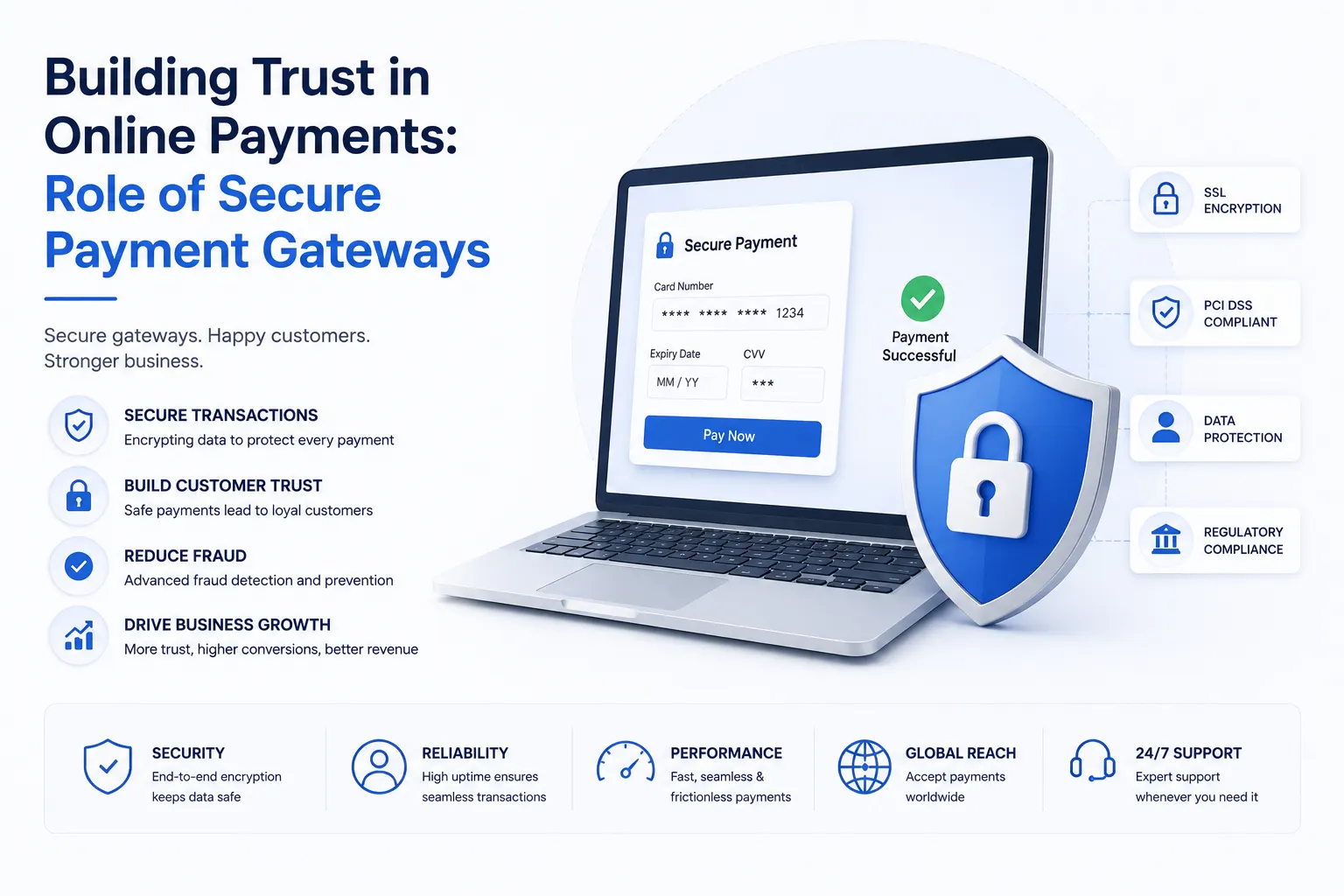
In 2026, trust is the single most valuable asset in online commerce. Secure payment gateways are no longer just transaction infrastructure, they are the primary trust mechanism between merchants and their customers. For high-risk merchants, offshore merchants, and any business processing payments online, the gateway you choose signals your credibility to every buyer.
| Metric | Insight |
|---|---|
| $48B | Global payment fraud losses projected in 2026 |
| 69% | Consumers who abandon checkout over security doubts |
| 3.2× | Higher conversion for merchants with visible security badges |
| 91% | Merchants say trust signals directly affect revenue |
Payment trust is not abstract. Every time a customer clicks “Pay Now,” they are placing confidence in an entire chain of payment processing infrastructure, from the merchant’s checkout page, through the payment gateway, to the acquiring bank. If any link in that chain is weak, the result is abandoned carts, chargebacks, disputes, and reputational damage that cascades through the merchant’s relationship with payment providers.
What Makes a Payment Gateway Genuinely Secure?
Not all payment gateways are equal. The security credentials of a payment provider directly determine how protected both merchants and consumers are during a transaction. Understanding these differences is critical before choosing a merchant account or payment processing partner, especially for businesses in high-risk verticals.
| PCI DSS Level 1 | The highest certification for card data security. Required for all major gateways processing over 6M card transactions per year. |
|---|---|
| Tokenisation | Replaces card data with a unique token. Even if intercepted, the data is useless. Standard in 2026 for all reputable payment gateways. |
| 3D Secure 2.x | Frictionless authentication that shifts fraud liability from merchant to issuer. Now mandatory in the UK and EU for e-commerce payments. |
| AI Fraud Detection | Real-time transaction scoring using ML models trained on billions of transactions. Reduces false positives while catching genuine fraud. |
| TLS 1.3 Encryption | End-to-end encryption of all transaction data in transit. Any gateway still on TLS 1.2 represents a meaningful security downgrade. |
| Chargeback Management | Proactive chargeback prevention tooling that protects merchants from disputes — particularly important for high-risk payment categories. |
The Trust Gap: Why Merchants and Consumers See It Differently
Merchants and consumers define payment trust differently, and secure payment gateways must satisfy both audiences simultaneously. This dual mandate is one of the most underappreciated challenges in payment processing design.
For consumers, trust is visible: SSL certificates, recognisable brand logos (Visa, Mastercard, PayPal), security badges, and the presence of 3DS authentication prompts. A 2025 Baymard Institute study found that 69% of consumers cite payment security concerns as a factor in cart abandonment, second only to unexpected shipping costs.
For merchants, trust is structural: reliable uptime, predictable settlement timelines, transparent fee structures, and a merchant services partner that won’t suddenly freeze funds or terminate the merchant account without warning. This second type of trust is especially acute for high-risk merchants, whose relationship with payment providers is often more fragile.
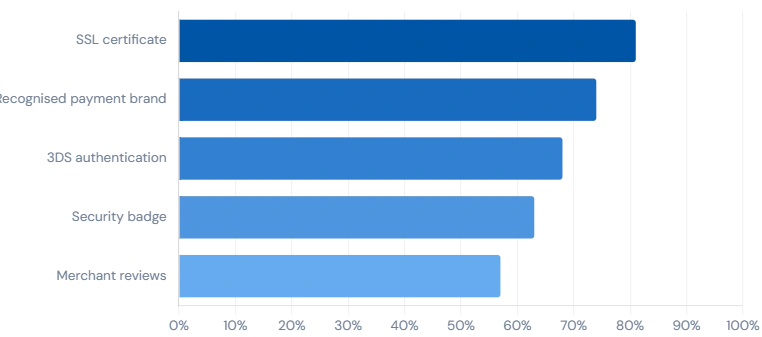 % of consumers (very important)
Payment Gateway Security: A Comparison of Key Providers (2026)
The payment gateway market in 2026 features a spectrum of providers, from global infrastructure giants to specialist high-risk payment processors serving offshore merchants and niche verticals. The security and trust credentials of each category differ substantially.
| Provider Type | PCI DSS Level | 3DS 2.x Support | Tokenisation | High-Risk Support | Offshore Merchants | Avg Fraud Rate |
|---|---|---|---|---|---|---|
| Global gateway (Stripe, Adyen) | Level 1 | Full | Network + gateway | Limited verticals | Select jurisdictions | 0.08% |
| High-risk specialist gateway | Level 1 | Full | Gateway-level | Full support | Broad coverage | 0.21% |
| Offshore merchant gateway | Level 1–2 | Partial | Gateway-level | Full support | Core offering | 0.38% |
| Aggregator (PayPal, Square) | Level 1 | Full | Network-level | Minimal/none | Very limited | 0.11% |
| Regional/bank gateway | Level 1–2 | Partial | Varies | Rarely | Domestic only | 0.14% |
Building Trust for High-Risk and Offshore Merchants
For businesses in high-risk categories, or for offshore merchants whose customer base is in the US or UK, the trust challenge is more complex than for standard e-commerce. Payment providers are inherently more cautious, chargeback exposure is elevated, and the pool of available merchant services partners is smaller.
Why trust infrastructure matters more for high-risk merchants
A high-risk merchant that loses payment processing access mid-operation faces immediate and severe consequences: inability to process revenue, potential customer data complications, and reputational exposure. The cost of being suddenly de-platformed by a payment gateway is estimated at $45,000–$250,000 in lost revenue for a typical mid-market merchant, according to merchant services industry data from 2025.
This makes the selection of a payment provider with genuine commitment to the vertical, backed by real compliance infrastructure, not just a landing page, one of the most critical business decisions a high-risk merchant makes.
- Choose payment gateways with documented experience in your specific high-risk vertical
- Ensure the gateway offers 3DS 2.x for liability shift on card-not-present transactions
- Verify PCI DSS Level 1 certification before signing a merchant account agreement
- Demand a written policy on rolling reserve release timelines, vague policies cost merchants cash flow
- Assess whether the gateway has a dedicated chargeback management team or only an automated system
- For offshore merchant accounts, confirm jurisdiction-specific compliance support
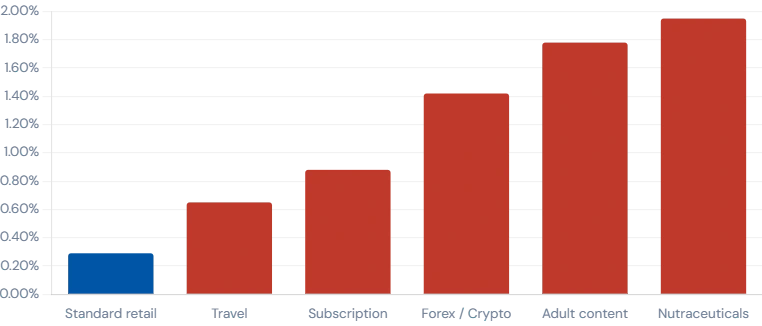 The Role of Transparency in Merchant Trust
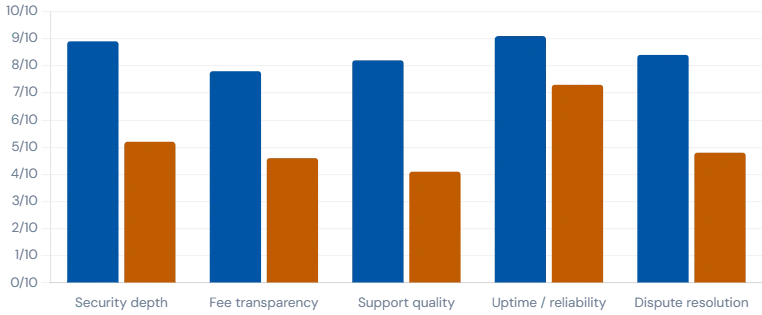
Trust is not built solely through technology. In 2026, merchants, particularly those who have been burned by opaque payment providers, are demanding a new standard of commercial transparency from their merchant services partners. This means clear fee structures, honest rolling reserve policies, and upfront communication about what triggers account reviews.
What transparent payment processing looks like in practice
The most trusted payment gateways in 2026 share a common set of operational practices: they disclose their underwriting criteria before onboarding, they publish their chargeback thresholds clearly, and they offer merchants a clear escalation path rather than an automated email when an issue arises.
- Full interchange-plus or tiered fee disclosure before contract signature
- Written rolling reserve release policy (typically 180 days, but negotiable for low-chargeback merchants)
- Named account manager for merchants processing over $50,000/month
- Published uptime SLA, reputable payment gateways target 99.95%+ availability
- Clear dispute resolution process with defined response timelines
Pros and Cons: Secure Gateways vs Lower-Cost Alternatives
Merchants, especially those starting out, often face a trade-off between the security depth of an established payment gateway and the lower fees offered by aggregators or less-regulated payment providers. The decision has long-term implications for trust, reliability, and risk.
Secure, regulated gateways
- Full PCI DSS Level 1 certification
- 3DS 2.x fraud liability protection
- Dedicated chargeback dispute management
- Transparent merchant account agreements
- Regulatory compliance across US and UK
- Higher consumer checkout trust signal
- Better long-term merchant account stability
Lower-cost / less regulated options
- Higher fraud exposure (often 3–5× more)
- No dedicated account management
- Higher risk of sudden account termination
- Limited or no high-risk merchant support
- Opaque fee schedules and hidden charges
- Minimal dispute resolution infrastructure
- Compliance gaps creating regulatory exposure
 2026 Trust Signals Merchants Should Display at Checkout
Beyond the infrastructure layer, the visible trust signals a merchant displays at checkout have a measurable impact on conversion rates. Payment gateway partners typically provide these assets, but it is the merchant’s responsibility to implement them correctly.
| Uplift | Trust Signal | Detail |
|---|---|---|
| +23% | SSL Certificate Displayed | Padlock visible in browser bar |
| +18% | Card Brand Logos Shown | Visa, MC, Amex at checkout |
| +11% | Security Badge Present | McAfee, Norton, PCI logo |
| +9% | 3DS Prompt Shown | Authentication step visible |
Comments
No comments yet. Be the first to share your thoughts.
Leave a comment