
Introduction
Banks today operate in an environment where customers expect instant transactions, 24/7 account access, personalized services, and seamless digital experiences. To meet these expectations, financial institutions rely on a critical technology infrastructure known as Core Banking.
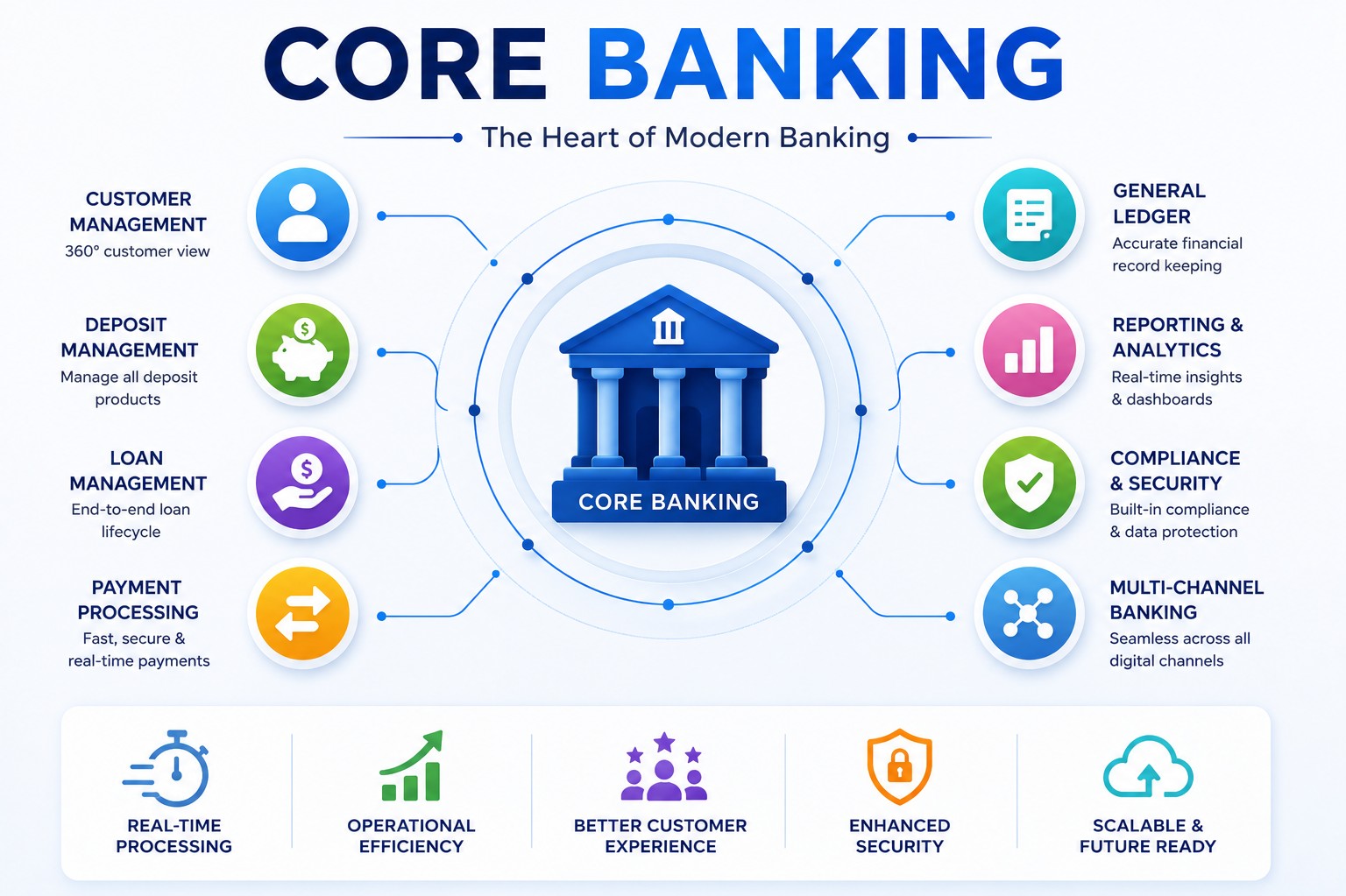
Core banking serves as the central system that manages a bank’s essential operations, including account management, deposits, loans, payments, customer information, and transaction processing. Often described as the “heart” of a banking institution, core banking enables customers to access banking services from any branch, digital platform, or channel in real time.
As digital transformation accelerates across the financial industry, core banking systems are evolving from traditional legacy platforms into modern, cloud-based, API-driven solutions that support innovation, scalability, and operational efficiency. For banks, fintech companies, and financial service providers, core banking has become the foundation of modern financial services.
What Is Core Banking?
Core Banking refers to the centralized system that processes and records the day-to-day transactions and services offered by a financial institution.
The term “CORE” is commonly associated with Centralized Online Real-time Exchange, reflecting the ability of customers to access banking services from multiple locations through a unified system.
A core banking platform manages essential functions such as:
- Customer accounts
- Deposits and withdrawals
- Loan management
- Payment processing
- Interest calculations
- Fund transfers
- Transaction records
- Customer information management
Through a centralized database, all branches and digital channels operate from the same source of information, ensuring consistency and real-time access to financial data.
Why Core Banking Is Important
Core banking is the operational backbone of a bank.
Without an efficient core banking system, financial institutions would struggle to provide modern banking services, maintain accurate records, and meet customer expectations.
Core banking enables:
- Real-time banking operations
- Multi-channel service delivery
- Centralized customer data management
- Improved operational efficiency
- Regulatory compliance
- Enhanced customer experiences
As banking becomes increasingly digital, the importance of robust core banking infrastructure continues to grow.
How Core Banking Works
A core banking system acts as the central processing engine for banking activities.
When a customer performs a transaction, such as transferring funds or making a deposit, the core banking platform:
- Receives the transaction request.
- Validates customer and account information.
- Processes the transaction.
- Updates account balances.
- Records the transaction in the central database.
- Provides confirmation in real time.
Because all branches and digital channels connect to the same system, customer information remains consistent and accessible across the organization.
Key Components of a Core Banking System
Customer Information Management
Core banking platforms maintain centralized customer records, including:
- Personal information
- Account details
- Transaction history
- Relationship management data
This enables banks to provide consistent services across all channels.
Deposit Management
The system handles savings accounts, current accounts, fixed deposits, and other deposit products.
Functions include:
- Balance updates
- Interest calculations
- Account maintenance
- Transaction tracking
Loan Management
Core banking systems support the entire lending lifecycle.
This includes:
- Loan origination
- Credit assessment
- Repayment tracking
- Interest calculations
- Delinquency management
Payment Processing
Banks process a wide variety of payments through core banking platforms.
Examples include:
- Domestic transfers
- International payments
- Real-time payments
- Standing instructions
- Bill payments
General Ledger Integration
Financial transactions are automatically recorded in the institution’s accounting systems, ensuring accurate financial reporting.
Evolution of Core Banking
Traditional Core Banking
Historically, banks relied on legacy systems hosted on-premises.
These platforms were often:
- Expensive to maintain
- Difficult to upgrade
- Limited in scalability
- Dependent on manual processes
While effective for many years, traditional systems often struggle to support modern digital banking demands.
Modern Core Banking
Today’s core banking platforms are increasingly:
- Cloud-native
- API-driven
- Modular
- Scalable
- Real-time enabled
These innovations allow financial institutions to launch products faster and adapt to changing market conditions.
Benefits of Modern Core Banking
Improved Customer Experience
Customers expect seamless access to banking services across mobile, online, and branch channels.
Modern core banking systems enable:
- Instant account updates
- Faster transactions
- Personalized services
- 24/7 accessibility
Operational Efficiency
Automation reduces manual processes and administrative workloads.
Benefits include:
- Lower operational costs
- Faster processing times
- Reduced errors
- Improved productivity
Faster Product Innovation
Modern platforms allow banks to introduce new products and services more quickly.
This supports competitiveness in a rapidly evolving financial landscape.
Scalability
Cloud-based core banking systems can easily accommodate growing transaction volumes and customer bases.
Enhanced Security
Advanced security frameworks help protect customer data and reduce fraud risks.
Core Banking and Digital Transformation
Digital transformation is one of the primary drivers behind core banking modernization.
Banks are increasingly integrating core banking systems with:
- Mobile banking applications
- Digital wallets
- Payment gateways
- Open banking platforms
- Artificial intelligence solutions
These integrations create a connected banking ecosystem that improves customer engagement and operational agility.
The Role of APIs in Core Banking
Application Programming Interfaces (APIs) have become essential in modern banking environments.
APIs allow core banking platforms to connect with:
- Fintech applications
- Payment providers
- Third-party services
- Open banking ecosystems
This connectivity enables financial institutions to offer innovative digital experiences without replacing their entire infrastructure.
Core Banking and Compliance
Financial institutions operate within highly regulated environments.
Core banking systems support compliance through:
- Transaction monitoring
- Audit trails
- Risk management tools
- Regulatory reporting
- Customer verification processes
These capabilities help banks meet evolving legal and regulatory requirements.
Challenges in Core Banking Modernization
Despite its benefits, modernizing core banking systems can be complex.
Legacy Infrastructure
Many banks continue to rely on decades-old systems that are difficult to replace.
Implementation Costs
Core banking transformation projects often require significant investment.
Data Migration
Migrating customer and transaction data must be carefully managed to avoid disruptions.
Operational Risks
Banks must ensure service continuity during modernization initiatives.
Successful transformation requires strategic planning and strong governance.
Emerging Trends in Core Banking
Cloud Banking
Cloud-based core banking solutions are becoming increasingly popular due to their flexibility and scalability.
Artificial Intelligence
AI is improving:
- Fraud detection
- Customer service
- Risk analysis
- Operational efficiency
Embedded Finance
Core banking capabilities are increasingly being integrated into non-financial platforms.
Open Banking
Open banking frameworks are driving greater connectivity and innovation across the financial ecosystem.
Real-Time Banking
Customers increasingly expect immediate access to funds and instant transaction processing.
Modern core banking systems support these real-time experiences.
The Future of Core Banking
The future of banking will be built on flexible, intelligent, and highly connected core banking platforms.
Future systems are expected to deliver:
- Greater automation
- Real-time operations
- Advanced analytics
- AI-powered decision-making
- Seamless third-party integrations
- Enhanced customer personalization
As competition intensifies and customer expectations continue to rise, financial institutions that invest in modern core banking infrastructure will be better positioned for long-term success.
Conclusion
Core banking is the foundation upon which modern financial institutions operate. It powers essential banking services, supports digital transformation, enables real-time transactions, and provides the infrastructure necessary for innovation and growth.
As technology continues to reshape the financial industry, modern core banking platforms are becoming more flexible, scalable, and customer-centric. Banks, fintech companies, and financial service providers that embrace core banking modernization will be better equipped to deliver superior customer experiences, improve operational efficiency, and thrive in the increasingly digital future of finance.
Comments
No comments yet. Be the first to share your thoughts.
Leave a comment