
Introduction
As businesses expand across multiple channels, countries, and payment methods, managing transactions has become increasingly complex. Organizations today must process card payments, bank transfers, digital wallets, real-time payments, mobile transactions, and cross-border settlements while ensuring security, compliance, and operational efficiency.Traditional payment infrastructures often rely on fragmented systems that create inefficiencies, increase costs, and limit scalability. To address these challenges, financial institutions and enterprises are adopting Payment Hubs centralized platforms designed to streamline payment processing across multiple channels and networks.
This acts as the command center for an organization’s payment operations, enabling seamless transaction management, improved visibility, and enhanced customer experiences. As digital payments continue to grow globally, Payment Hubs are becoming an essential component of modern financial infrastructure.
What Is a Payment Hub?
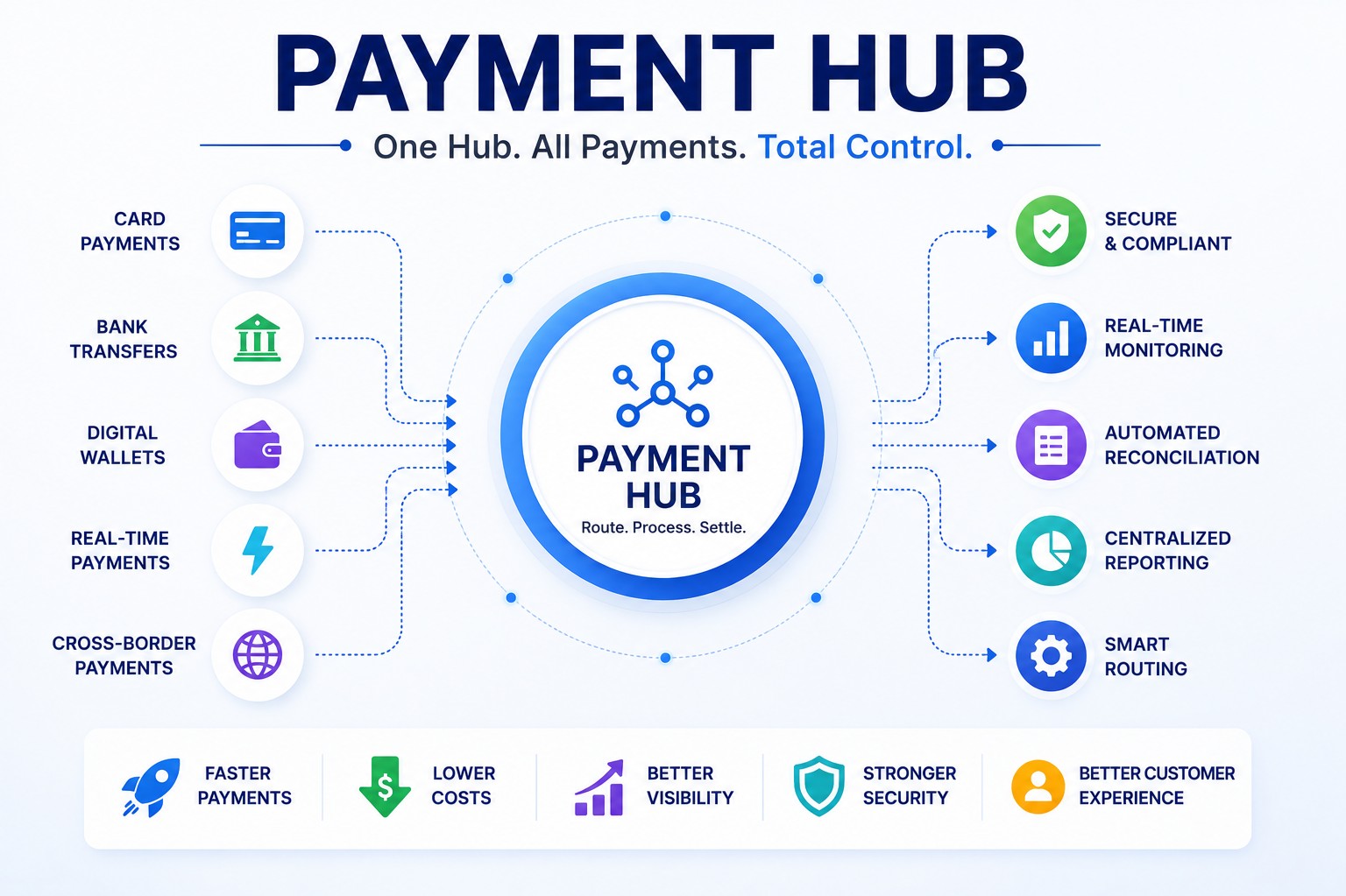
A Payment Hub is a centralized platform that manages, processes, routes, and monitors payments across various payment channels and systems.
Rather than operating separate systems for different payment types, organizations use a Payment Hub to consolidate payment activities into a single platform.
A Payment Hub typically supports:
- Credit and debit card payments
- Bank transfers
- ACH payments
- Real-time payments
- Cross-border transactions
- Digital wallets
- Mobile payments
- SEPA payments
- SWIFT transactions
This centralized approach improves efficiency while reducing operational complexity.
Why Payment Hubs Matter
Modern businesses operate in an increasingly digital environment where customers expect fast, secure, and seamless payment experiences.
Without a centralized payment infrastructure, organizations may face:
- Fragmented systems
- Higher operational costs
- Delayed settlements
- Manual reconciliation
- Limited payment visibility
- Compliance challenges
Payment Hubs solve these issues by creating a unified payment ecosystem that supports multiple transaction types from a single platform.
How a Payment Hub Works
A Payment Hub serves as an intermediary layer between payment channels, banking systems, and business applications.
The process generally follows these steps:
Payment Initiation
A customer or business initiates a payment through a supported channel.
Validation
The Payment Hub validates transaction details, customer information, and payment instructions.
Routing
The platform determines the most efficient payment route based on predefined rules and network availability.
Processing
The payment is processed through the appropriate network or financial institution.
Settlement
Funds are transferred and settled according to payment type and destination.
Reporting
Transaction information is recorded and made available through centralized dashboards and reporting tools.
This streamlined workflow improves efficiency and transparency.
Key Features of a Payment Hub
Centralized Payment Processing
Organizations can manage all payment activities through a single interface.
This eliminates the need for multiple standalone systems.
Intelligent Payment Routing
Advanced Payment Hubs automatically select the most efficient processing path.
Benefits include:
- Faster settlements
- Lower transaction costs
- Reduced payment failures
Real-Time Monitoring
Businesses gain visibility into payment status, processing times, and settlement progress.
This improves operational control and customer service.
Multi-Channel Support
Payment Hubs support various payment methods, enabling organizations to meet diverse customer preferences.
Automated Reconciliation
Automated matching of payments and invoices reduces manual work and improves accuracy.
Compliance Management
Modern Payment Hubs help organizations comply with regulatory requirements through built-in controls and monitoring capabilities.
Benefits of Implementing a Payment Hub
Operational Efficiency
Centralizing payment operations reduces system complexity and administrative workloads.
Lower Costs
Organizations can reduce infrastructure costs and improve resource utilization.
Improved Customer Experience
Faster and more reliable payment processing enhances customer satisfaction.
Greater Scalability
Payment Hubs can support growing transaction volumes without requiring major system changes.
Enhanced Security
Advanced security features help protect sensitive payment data and reduce fraud risks.
Better Visibility
Real-time reporting provides valuable insights into transaction performance and cash flow.
Payment Hubs and Cross-Border Payments
Cross-border transactions are often among the most complex payment processes.
Payment Hubs simplify international payments by:
- Connecting multiple payment networks
- Supporting multi-currency transactions
- Improving payment tracking
- Reducing processing delays
- Streamlining compliance procedures
For multinational businesses, this can significantly improve payment efficiency and transparency.
Payment Hubs and Real-Time Payments
The rise of instant payment networks is increasing demand for faster transaction processing.
Payment Hubs support real-time payment capabilities by:
- Integrating with instant payment rails
- Enabling 24/7 transaction processing
- Improving settlement speed
- Enhancing liquidity management
As real-time payments become more common, Payment Hubs play a crucial role in supporting modern payment expectations.
Industries Benefiting from Payment Hubs
Banks and Financial Institutions
Banks use Payment Hubs to modernize legacy systems and manage diverse payment channels efficiently.
Fintech Companies
Fintech firms leverage Payment Hubs to support innovative payment services and digital financial products.
E-Commerce Businesses
Online merchants benefit from streamlined payment acceptance and reconciliation.
Corporations
Large enterprises use Payment Hubs to centralize treasury and payment operations across multiple regions.
Payment Service Providers
PSPs utilize Payment Hubs to improve transaction processing and merchant services.
Challenges of Payment Hub Implementation
Despite their advantages, Payment Hub projects can present challenges.
System Integration
Connecting legacy systems and external networks may require significant planning.
Data Migration
Organizations must ensure accurate migration of historical payment data.
Regulatory Compliance
Payment Hub implementations must align with local and international regulations.
Change Management
Employees and stakeholders may require training to adapt to new payment processes.
Proper planning and implementation strategies help mitigate these challenges.
Emerging Trends in Payment Hubs
Artificial Intelligence
AI is improving payment routing, fraud detection, and transaction monitoring.
Cloud-Based Payment Hubs
Cloud technology is increasing flexibility, scalability, and cost efficiency.
Open Banking Integration
Payment Hubs are increasingly connecting with open banking ecosystems.
Embedded Finance
Payment capabilities are becoming integrated directly into business platforms and applications.
ISO 20022 Adoption
Modern Payment Hubs are being designed to support the global transition to ISO 20022 messaging standards.
The Future of Payment Hubs
As payment ecosystems become more complex, the importance of centralized payment infrastructure will continue to grow.
Future Payment Hubs are expected to deliver:
- Greater automation
- Real-time global payments
- Enhanced analytics
- AI-powered optimization
- Improved interoperability
- Stronger security frameworks
Organizations that invest in modern Payment Hub solutions will be better positioned to manage growing payment volumes and evolving customer expectations.
Conclusion
Payment Hubs have become a cornerstone of modern payment infrastructure by centralizing transaction processing, improving visibility, and supporting multiple payment channels through a single platform. As businesses and financial institutions continue their digital transformation journeys, Payment Hubs provide the scalability, efficiency, and flexibility needed to manage increasingly complex payment ecosystems.
By streamlining operations, reducing costs, enhancing compliance, and enabling faster transactions, Payment Hubs are helping shape the future of payments in an increasingly connected global economy.
Comments
No comments yet. Be the first to share your thoughts.
Leave a comment