
Introduction
The demand for speed has transformed nearly every aspect of modern life, including financial services. Consumers expect instant communication, real-time information, and immediate access to services. Naturally, these expectations have extended to payments. Waiting days for funds to clear is increasingly viewed as outdated in a world where digital transactions occur within seconds.This shift has accelerated the adoption of Faster Payment Systems across the globe. These payment infrastructures enable individuals and businesses to send and receive money almost instantly, regardless of the time or day. By reducing delays and improving accessibility, faster payments are reshaping how economies move money.
As governments, banks, fintech companies, and payment providers invest in real-time financial infrastructure, Faster Payment Systems are becoming a fundamental part of the modern financial ecosystem.
What Are Faster Payment Systems?
Faster Payment Systems are payment networks designed to process transactions in real time or near real time.
Unlike traditional payment methods that may require several hours or even multiple business days for settlement, faster payment networks facilitate immediate fund transfers between accounts.
These systems typically operate continuously, allowing payments to be processed:
- 24 hours a day
- 7 days a week
- Including weekends
- Including public holidays
The result is a more efficient and responsive financial environment for both consumers and businesses.
Why Faster Payment Systems Matter
Modern economies depend on the efficient movement of money.
Businesses need timely payments to manage cash flow, pay suppliers, and support daily operations. Consumers expect immediate access to funds and seamless digital experiences.
Traditional payment systems often involve processing delays due to banking schedules, clearing cycles, and intermediary institutions.
Faster Payment Systems address these limitations by enabling immediate transactions, reducing friction throughout the payment process.
This improvement benefits the entire financial ecosystem.
How Faster Payment Systems Work
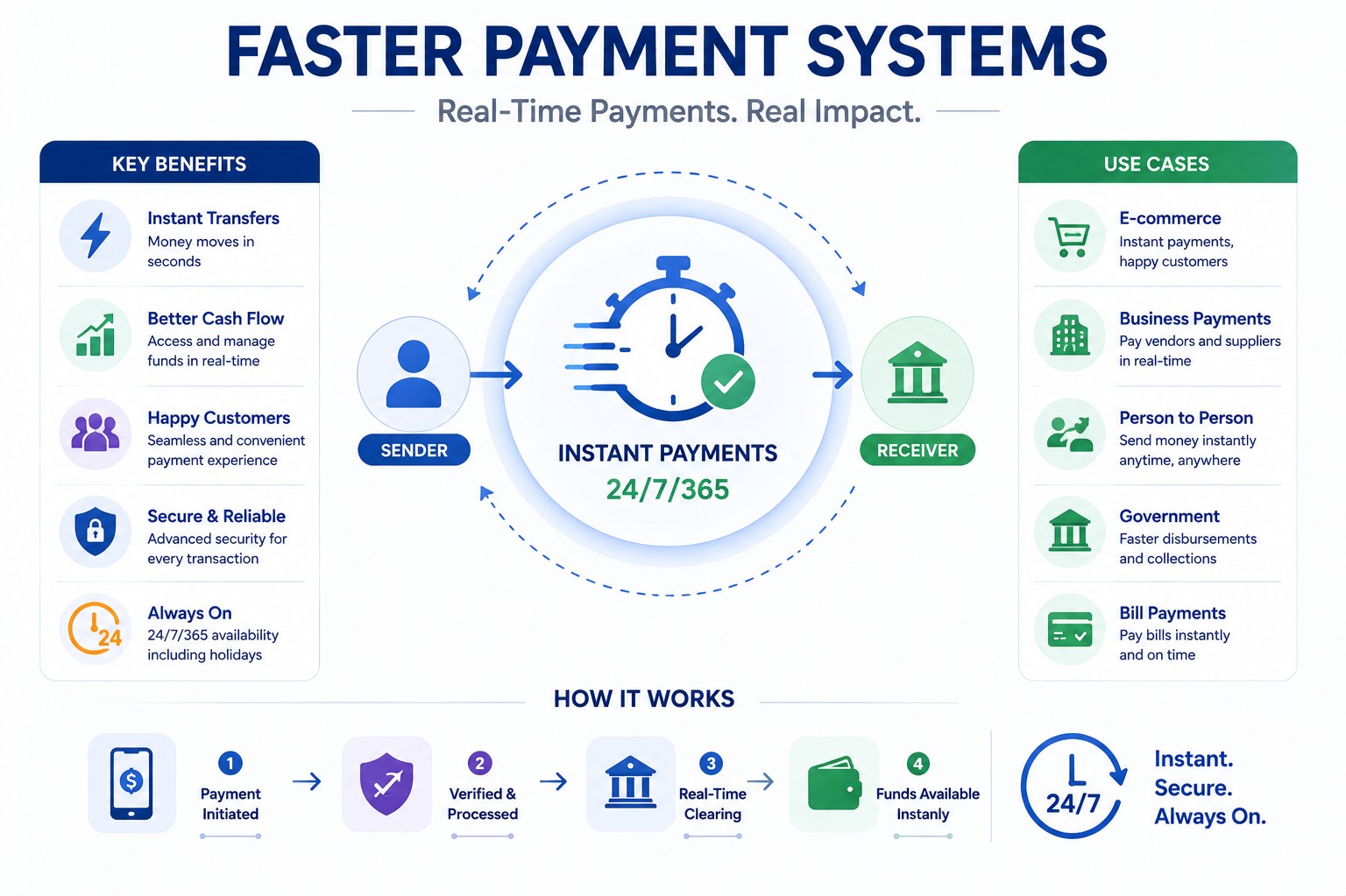
When a payment is initiated through a Faster Payment System, transaction details are transmitted electronically through a dedicated payment network.
The system verifies the payment information, confirms account availability, and processes the transfer in real time.
Funds are then made available to the recipient almost immediately.
Advanced technology, secure messaging protocols, and modern payment infrastructure enable these rapid transactions while maintaining security and reliability.
Although the process appears simple to users, sophisticated financial systems operate behind the scenes to ensure smooth execution.
Key Benefits of Faster Payment Systems
One of the primary advantages of Faster Payment Systems is speed.
However, their value extends far beyond faster transactions.
Key benefits include:
- Immediate fund availability
- Improved cash flow management
- Enhanced customer experiences
- Reduced payment delays
- Increased operational efficiency
- Greater financial transparency
- Continuous payment availability
- Stronger digital banking capabilities
These benefits support both economic growth and financial innovation.
Improving Business Cash Flow
Cash flow remains one of the most important factors influencing business success.
Delayed payments can create liquidity challenges, particularly for small and medium-sized enterprises.
Faster Payment Systems allow businesses to receive funds immediately, improving working capital management and reducing uncertainty.
Companies can pay suppliers more efficiently, manage payroll obligations more effectively, and respond more quickly to changing financial conditions.
This enhanced liquidity contributes directly to operational stability and business growth.
Enhancing Consumer Experiences
Consumers increasingly expect financial services to operate at digital speeds.
Whether splitting bills, paying rent, transferring money to family members, or making online purchases, users prefer immediate transaction completion.
Faster Payment Systems support these expectations by eliminating lengthy waiting periods.
Instant access to funds improves convenience while enhancing trust in digital financial services.
As customer expectations continue evolving, real-time payments are becoming a competitive necessity rather than a premium feature.
Supporting Digital Commerce
E-commerce and digital marketplaces rely heavily on efficient payment systems.
Payment delays can create friction for merchants, customers, and service providers.
Faster Payment Systems streamline online transactions by enabling immediate fund transfers and quicker payment confirmations.
This efficiency improves the customer experience while helping businesses process orders and manage financial operations more effectively.
As digital commerce continues expanding globally, real-time payment capabilities are becoming increasingly important.
Financial Inclusion and Accessibility
Financial inclusion remains a global priority.
Many individuals and small businesses face challenges accessing efficient financial services due to infrastructure limitations or high transaction costs.
Faster Payment Systems can help improve accessibility by providing affordable and convenient digital payment options.
Real-time transfers reduce dependency on cash while supporting broader participation in digital economies.
This capability is particularly valuable in emerging markets where digital financial services continue to expand rapidly.
Faster Payments and Fintech Innovation
Fintech companies have played a significant role in accelerating real-time payment adoption.
Digital banks, payment apps, mobile wallets, and embedded finance platforms increasingly depend on instant payment capabilities to deliver competitive customer experiences.
Faster Payment Systems enable fintech providers to offer:
- Instant transfers
- Real-time settlements
- Improved user experiences
- Innovative financial products
- Enhanced payment services
These capabilities support continued innovation throughout the financial sector.
Security Considerations
While speed is important, security remains essential.
Faster Payment Systems incorporate advanced security measures designed to protect users and financial institutions.
Common safeguards include:
- Encryption technologies
- Multi-factor authentication
- Fraud monitoring
- Transaction verification
- Real-time risk analysis
Financial institutions continuously invest in security enhancements to ensure real-time payments remain safe and reliable.
Maintaining trust is critical to widespread adoption.
Challenges Facing Faster Payment Systems
Despite their benefits, Faster Payment Systems also face challenges.
Instant transactions leave less time for manual review and fraud detection. Financial institutions must therefore implement advanced monitoring systems capable of identifying suspicious activity in real time.
Other challenges include:
- Infrastructure investment requirements
- Regulatory compliance obligations
- Cross-border interoperability issues
- Operational risk management
- Customer education
Addressing these challenges is essential for sustainable growth.
The Future of Faster Payment Systems
The future of payments is increasingly real-time.
Governments, central banks, financial institutions, and technology providers continue investing in modern payment infrastructure designed to support instant transactions.
Several trends are expected to shape future development:
- Real-time cross-border payments
- Open banking integration
- Artificial intelligence-driven payment optimization
- Digital identity solutions
- Embedded finance ecosystems
- Advanced fraud prevention technologies
These innovations will further improve speed, accessibility, and efficiency throughout global payment networks.
Conclusion
Faster Payment Systems are transforming the way money moves in the modern economy. By enabling instant transactions, improving liquidity, enhancing customer experiences, and supporting digital innovation, these systems have become a cornerstone of contemporary financial infrastructure.
As businesses and consumers increasingly demand real-time financial services, the adoption of Faster Payment Systems will continue to accelerate. Organizations that embrace modern payment technologies will be better positioned to improve operational efficiency, meet customer expectations, and compete in an increasingly digital financial landscape.
The future of payments is fast, connected, and available around the clock—and Faster Payment Systems are leading that transformation.
Comments
No comments yet. Be the first to share your thoughts.
Leave a comment