
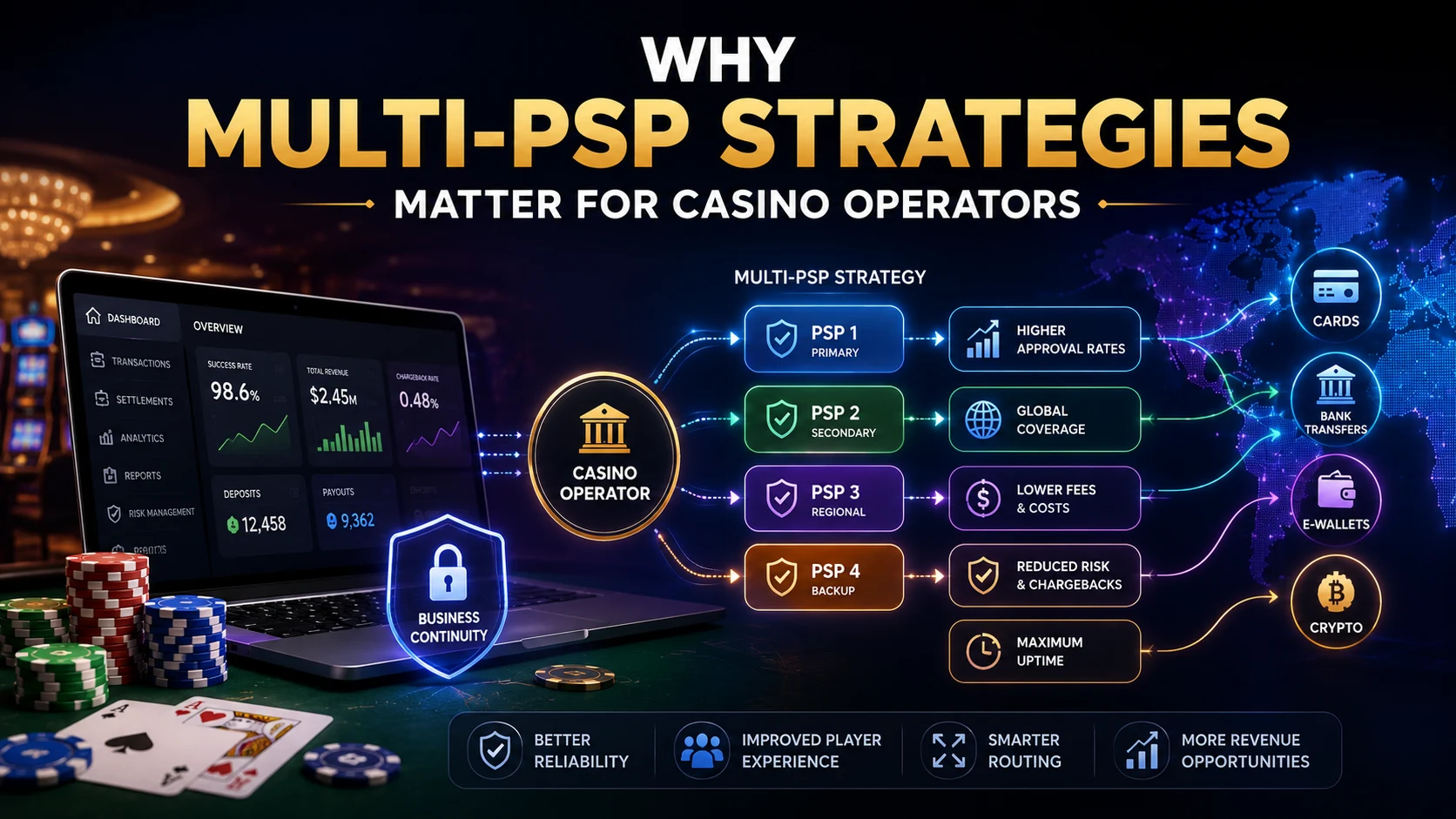
Relying on a single payment service provider (PSP) for your entire casino operation isn’t a simplicity advantage, it’s a structural risk. Bank de-risking, sudden processor terminations, and regional approval-rate gaps are documented, recurring patterns in gambling specifically, not edge cases. A multi-PSP strategy, running several payment providers in parallel with smart routing between them, is how established operators avoid a single policy change or outage taking down their entire cashier.
If you’re researching this, there’s a good chance you’ve either already experienced a processor relationship end abruptly, or you’re trying to avoid finding out the hard way what happens when it does. That’s the right instinct. In gambling specifically, a single-PSP setup isn’t a leaner version of a multi-PSP one, it’s a genuinely different risk profile, and understanding why is the first step to building infrastructure that survives real volume and real regulatory shifts.
What “Multi-PSP” Actually Means
A multi-PSP strategy means running two or more payment gateways or acquiring relationships in parallel, with transactions routed between them based on rules like cost, approval likelihood, region, or currency, rather than sending 100% of your volume through a single provider. This isn’t the same as simply having a backup account sitting unused; a real multi-PSP setup actively distributes live transaction volume and can fail over automatically if one provider degrades or goes offline.
Why This Matters More in Gambling Than Almost Any Other Vertical
Bank de-risking is a documented, recurring pattern, not a hypothetical
Financial institutions periodically decide to exit entire high-risk merchant categories, including gambling, rather than evaluate individual businesses on their own compliance record. When that happens, every merchant relying solely on that institution loses payment processing capability overnight, regardless of how well-run or compliant their operation actually is. This has happened industry-wide, repeatedly, and it’s specifically why “our processor is reliable” isn’t the same guarantee in gambling that it might be in a lower-risk vertical.
Approval rates vary meaningfully by provider and region
No single PSP performs equally well across every market and payment method. A provider with strong card-acquiring approval rates in Europe may underperform in Latin America, where local bank-transfer methods dominate player behavior. Operators running a single PSP globally are, by definition, accepting whatever approval-rate gaps that provider has in every region they haven’t optimized for, gaps that show up directly as lost deposit conversion.
Chargeback and compliance risk concentrates dangerously in a single relationship
Visa’s VAMP threshold for “excessive” chargebacks dropped from 2.2% to 1.5% as of April 2026 across the US, Canada, the EU, and Asia-Pacific. If your entire volume runs through one processor and your chargeback ratio creeps toward that threshold, you risk losing acquiring access across your entire operation at once. Spreading volume across multiple PSPs doesn’t eliminate this risk, but it does mean a spike tied to one provider’s specific fraud exposure doesn’t automatically jeopardize every transaction you process.
Regulatory and jurisdictional coverage isn’t uniform across providers
Different PSPs support different licensing jurisdictions and compliance frameworks. An operator expanding into new markets often finds their existing provider simply doesn’t support the jurisdiction they’re entering, a multi-PSP setup, built with jurisdiction coverage in mind from the start, avoids having to renegotiate infrastructure every time you enter a new regulated market.
What a Real Multi-PSP Setup Looks Like in Practice
- A primary card-acquiring relationship: for core online payments and digital payments volume, typically the highest-volume, most cost-efficient rail for your dominant markets.
- A secondary acquirer or aggregator gateway: covering markets or payment methods your primary provider handles poorly, filling in alternative payment methods coverage gaps.
- A dedicated crypto rail for crypto payments: serving underbanked regions or crypto-native player segments that a fiat-only setup can’t reach effectively.
- At least one offshore merchant account relationship: ideally structured around a directly licensed electronic money institution, providing redundancy specifically against domestic bank de-risking.
- Smart routing logic: that directs each transaction to the provider most likely to approve it, based on real-time data like currency, region, card type, and historical approval patterns, rather than routing everything through a single default path.
Pros and Cons of Multi-PSP vs. Single-Provider Setups
Multi-PSP strategy:
- Redundancy against sudden processor termination or bank de-risking
- Higher blended approval rates through smart routing to the best-performing provider per transaction
- Better regional and payment-method coverage than any single provider offers alone
- More integration and reconciliation complexity, requiring stronger internal payments operations
- Multiple relationships to manage, verify, and monitor for compliance simultaneously
Single-PSP strategy:
- Simpler operations, easier reporting, lower initial setup complexity
- Total exposure to a single point of failure, one policy change can freeze your entire cashier
- Approval-rate gaps in markets the provider doesn’t serve well go unaddressed
- Concentrated chargeback-ratio risk against Visa’s tightened VAMP threshold
Common Mistakes Operators Make Building a Multi-PSP Setup
- Treating a second provider as a dormant backup rather than an active routing option: A PSP relationship that’s never actually processing live volume isn’t tested, and you won’t know it works until you’re already in a crisis.
- Adding providers without a clear routing strategy: Multiple PSPs without smart routing logic just adds operational complexity without the approval-rate or redundancy benefits, the routing layer is what actually makes multi-PSP work.
- Skipping licensing verification on secondary providers: A backup relationship is only useful if it’s actually solid; verify licensing directly with regulators for every provider in your stack, not just your primary one.
- Ignoring reconciliation overhead: Running multiple providers means reconciling transactions across separate systems, build this into your internal operations from the start rather than discovering the reporting gap after volume scales.
Playing Strategy: How to Build This Out Without Overcomplicating It
- Start with two providers, not five: A primary acquiring relationship plus one genuinely different secondary (a different region’s strength, or a crypto rail) captures most of the redundancy and approval-rate benefit without unmanageable complexity.
- Choose your second provider based on a real gap, not just availability: If your primary provider underperforms in a specific region or payment method, that’s where your second PSP should specialize, not simply “another card processor.”
- Build routing rules before you need them: Decide in advance which provider handles which currency, region, or payment method, rather than improvising failover logic after an outage.
- Test failover deliberately: not just theoretically. Periodically route real volume through your secondary provider to confirm it actually performs as expected under live conditions.
- Expand your PSP mix as you scale into new jurisdictions or markets: rather than trying to build a fully global multi-PSP stack before you have the volume or market presence to justify it.
Practical Takeaway
A multi-PSP strategy isn’t over-engineering for casino operators, it’s the direct response to a well-documented industry pattern: high-risk merchant accounts get terminated, de-risked, or regionally underperform in ways single-provider setups simply can’t absorb. The operators building resilient casino payment infrastructure aren’t the ones with the single best PSP relationship, they’re the ones who’ve built smart routing across several, so no individual provider’s policy shift, outage, or regional weakness can take down the whole operation.
Comments
No comments yet. Be the first to share your thoughts.
Leave a comment