
Introduction
In everyday conversations, the terms payment and transaction are often used interchangeably. Whether shopping online, transferring money through a banking app, or paying business invoices, people frequently assume they mean the same thing. However, in banking and financial technology, these two terms have distinct meanings.
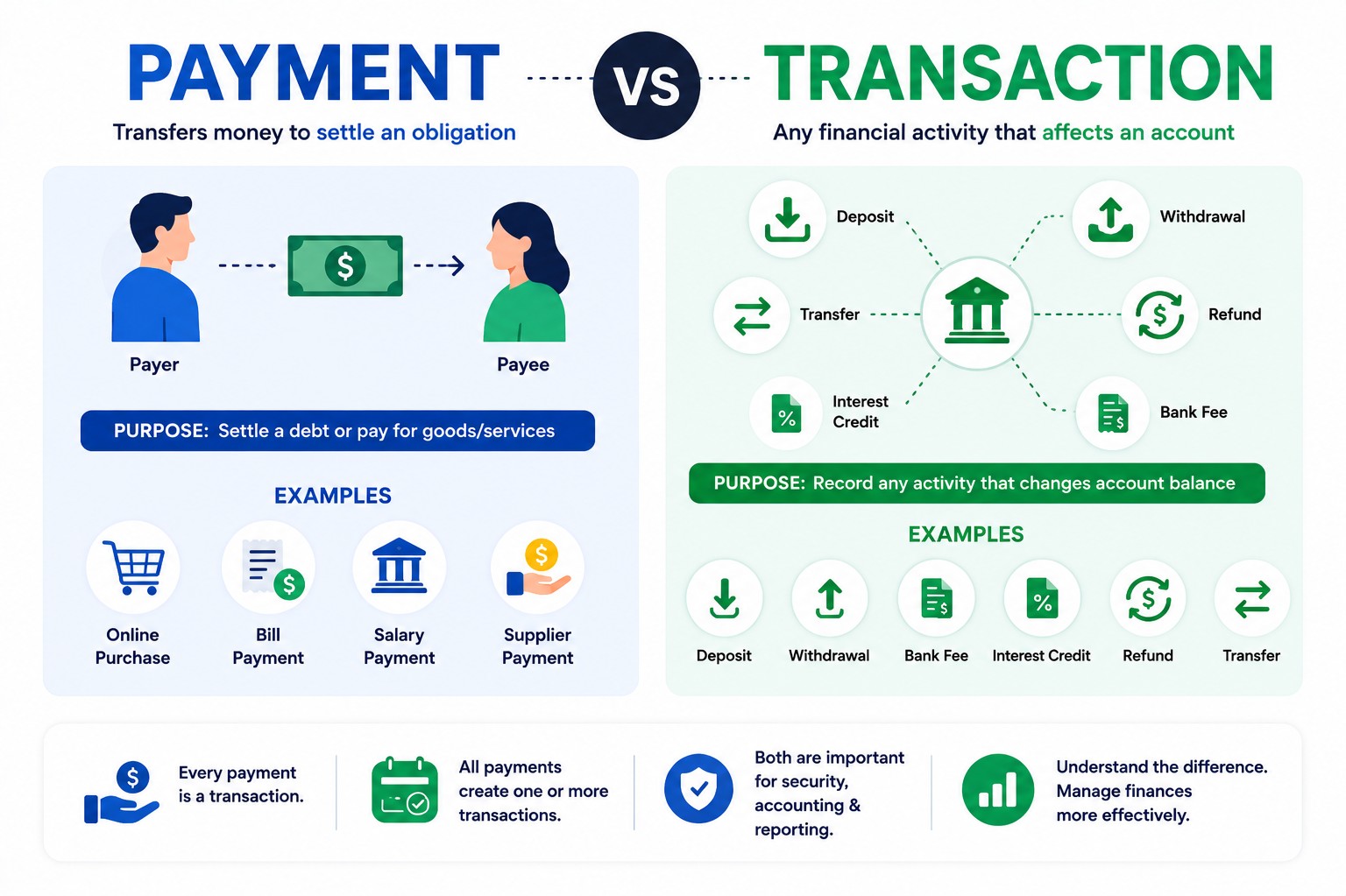
Understanding the difference between a payment and a transaction is important for businesses, financial institutions, payment providers, and consumers. While every payment is a transaction, not every transaction is a payment. A transaction represents any financial activity involving money or assets, whereas a payment specifically refers to the transfer of funds to settle an obligation.
As digital commerce continues to grow, distinguishing between payments and transactions helps businesses improve financial reporting, payment reconciliation, fraud prevention, and operational efficiency.
What Is a Payment?
A payment is the transfer of money from one party to another in exchange for goods, services, or to fulfill a financial obligation.
The primary purpose of a payment is to settle a debt or complete a purchase. Payments can be made using various methods, including cash, credit cards, debit cards, bank transfers, digital wallets, cryptocurrencies, and account-to-account (A2A) transfers.
Every payment has a payer, a payee, a payment amount, and a payment method. Once completed successfully, the financial obligation is considered fulfilled.
Examples include paying utility bills, purchasing products online, sending salary payments, or transferring money to a supplier.
What Is a Transaction?
A transaction is any financial activity that changes the balance of an account or records the movement of money or assets.
Transactions include payments, but they also cover many other financial events such as deposits, withdrawals, refunds, transfers between accounts, currency exchanges, interest credits, bank fees, investment purchases, and account adjustments.
Every payment creates a transaction, but numerous transactions occur without representing an actual payment.
Financial institutions record every transaction to maintain accurate account balances and financial histories.
Payment vs Transaction: The Core Difference
The simplest way to understand the difference is that a payment is a specific type of transaction.
A payment focuses on transferring money to satisfy an obligation, while a transaction refers to any financial event that affects an account or financial record.
For example, receiving interest from a bank is a transaction but not a payment made by the account holder. Similarly, transferring funds between two personal bank accounts is a transaction but does not necessarily represent a payment for goods or services.
Every payment appears as a transaction, but transactions include many activities beyond payments.
Key Differences Between Payment and Transaction
| Feature | Payment | Transaction |
|---|---|---|
| Purpose | Settles a financial obligation | Records any financial activity |
| Scope | Specific type of financial event | Broad financial activity |
| Involves Money Transfer | Yes | Usually, but not always for purchases |
| Includes Purchases | Yes | Yes |
| Includes Deposits | No | Yes |
| Includes Withdrawals | No | Yes |
| Includes Refunds | No (refund received is a transaction) | Yes |
| Includes Bank Fees | No | Yes |
| Used In | Commerce and bill settlement | Banking and accounting |
How Payments Work
A payment begins when the payer authorizes the transfer of funds.
The payment instruction is sent through a payment network or banking infrastructure for verification. The payment provider validates the information, checks available funds, performs security checks, and requests authorization.
Once approved, the money is transferred to the recipient, and both parties receive confirmation.
The completed payment is then recorded as a financial transaction in both accounts.
How Transactions Work
Transactions occur whenever financial activity affects an account.
Banks, payment providers, and financial institutions record transactions to maintain accurate financial records.
Examples include ATM withdrawals, salary deposits, loan repayments, foreign exchange conversions, bank charges, online purchases, and investment transactions.
Each transaction contains details such as transaction ID, date, amount, account information, and transaction status.
These records help ensure transparency and support auditing and reconciliation.
Types of Payments
Businesses and consumers use various payment methods depending on their needs.
Card payments remain one of the most common methods for online and in-store purchases. Bank transfers are widely used for business payments and payroll. Digital wallets simplify mobile and online transactions, while account-to-account payments are becoming increasingly popular through Open Banking.
Recurring payments support subscriptions and utility bills, while international payments facilitate cross-border commerce.
Each payment type ultimately creates one or more financial transactions.
Types of Transactions
Financial transactions extend well beyond payments.
Common transaction types include deposits, withdrawals, internal account transfers, refunds, chargebacks, loan disbursements, investment purchases, dividend payments, currency exchanges, service charges, and interest credits.
Businesses rely on transaction records to monitor financial performance, prepare financial statements, and comply with accounting standards.
A comprehensive transaction history provides valuable insights into cash flow and operational activity.
Why the Difference Matters for Businesses
Understanding the distinction between payments and transactions helps businesses manage financial operations more effectively.
Payment data focuses on customer purchases, supplier settlements, and revenue collection. Transaction data provides a broader picture by including banking activity, operational expenses, refunds, taxes, and account adjustments.
This distinction improves financial reporting, accounting accuracy, payment reconciliation, and cash flow analysis.
Businesses that understand both concepts can make more informed financial decisions.
Role in Payment Processing
Payment processing involves multiple transactions behind the scenes.
For example, when a customer pays with a credit card, the payment triggers several transactions, including payment authorization, fund reservation, settlement between financial institutions, merchant funding, and accounting entries.
Although customers experience a single payment, the financial system processes multiple interconnected transactions.
Modern payment infrastructure automates these complex workflows to ensure speed, accuracy, and security.
Security and Compliance
Both payments and transactions require strong security controls.
Payment providers use encryption, tokenization, fraud detection systems, and multi-factor authentication to protect payment information.
Financial institutions monitor transactions continuously to identify suspicious activity, detect money laundering, and comply with regulatory requirements.
Transaction monitoring plays a critical role in preventing financial crime while maintaining trust in payment systems.
Artificial Intelligence in Payments and Transactions
Artificial intelligence is improving both payment processing and transaction management.
AI-powered systems analyze transaction patterns, detect fraud in real time, optimize payment routing, and automate financial reconciliation.
Machine learning algorithms help reduce payment failures while improving customer experiences through intelligent risk assessment.
As digital finance evolves, AI will continue enhancing the efficiency and security of financial ecosystems.
Future Trends
The distinction between payments and transactions will become increasingly important as financial services become more automated.
Real-time payments, Open Banking, embedded finance, digital wallets, blockchain technology, and AI-driven financial systems are generating more transaction data than ever before.
Businesses will increasingly rely on advanced analytics to transform transaction records into actionable financial insights while delivering faster and more seamless payment experiences.
Understanding both concepts will remain fundamental to modern financial management.
Conclusion
Although the terms are often used interchangeably, payments and transactions represent different aspects of financial activity. A payment is the transfer of money to settle an obligation, while a transaction refers to any financial event that affects an account or records the movement of funds.
Every payment is a transaction, but transactions also include deposits, withdrawals, refunds, transfers, fees, and many other financial activities.
For businesses, understanding the difference improves accounting accuracy, payment reconciliation, fraud prevention, and financial reporting. As digital payments continue to evolve, distinguishing between payments and transactions will remain essential for building efficient and secure financial operations.
Comments
No comments yet. Be the first to share your thoughts.
Leave a comment