
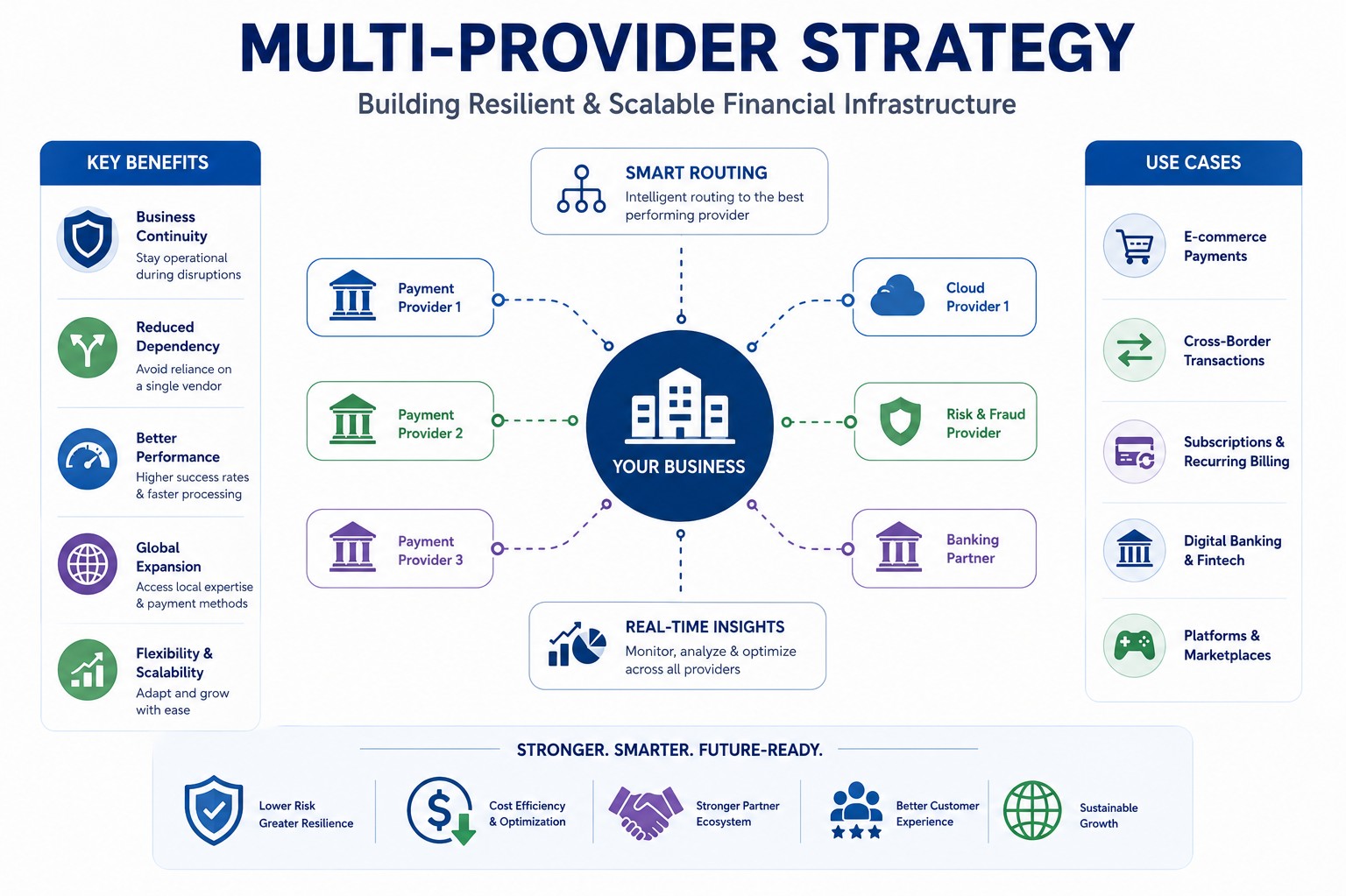
In today’s digital economy, businesses depend heavily on technology providers to support payment processing, banking operations, customer transactions, fraud prevention, and financial management. As organizations expand globally, relying on a single provider can create operational risks that may affect revenue, customer experience, and business continuity.To address these challenges, many companies are adopting a multi-provider strategy. This approach involves working with multiple service providers instead of depending entirely on one vendor for critical business functions.
Whether applied to payment processing, cloud infrastructure, banking services, or financial technology platforms, a multi-provider model helps organizations improve resilience, increase flexibility, and reduce operational risks.
As digital commerce continues to grow, multi-provider strategies are becoming a key component of modern financial infrastructure.
What Is a Multi-Provider Strategy?
A multi-provider strategy refers to the use of multiple service providers to support a specific business function or operational process.
Instead of relying on a single vendor, organizations distribute services across multiple partners to improve reliability and performance.
For example, a business may use:
- Multiple payment processors
- Several acquiring banks
- Multiple cloud service providers
- Different fraud prevention platforms
- Multiple banking partners
This diversified approach reduces dependency on a single provider and creates greater operational flexibility.
Why Businesses Are Adopting Multi-Provider Models
Digital businesses operate in increasingly complex environments where downtime, transaction failures, and service interruptions can have immediate financial consequences.
A single provider outage may disrupt payment processing, impact customer experiences, and result in lost revenue.
A multi-provider strategy helps mitigate these risks by ensuring alternative providers are available when needed.
Organizations are also seeking greater flexibility, improved performance, and access to specialized capabilities that may not be available through a single vendor relationship.
These advantages make multi-provider models increasingly attractive across industries.
Improving Business Continuity
One of the most important benefits of a multi-provider strategy is enhanced business continuity.
Unexpected service disruptions can occur due to technical failures, cyber incidents, maintenance activities, or regulatory challenges.
When businesses depend entirely on one provider, these disruptions may halt critical operations.
A multi-provider environment allows organizations to redirect workloads, transactions, or services to alternative providers when necessary.
This redundancy helps maintain operational stability and protects revenue streams during unexpected events.
Reducing Vendor Dependency
Vendor concentration risk is a growing concern for many organizations.
Dependence on a single provider can limit flexibility and increase vulnerability to pricing changes, service issues, and contractual restrictions.
A multi-provider approach reduces this dependency by creating a more balanced ecosystem of service relationships.
Organizations gain greater negotiating power and can adapt more quickly to changing business requirements.
This flexibility becomes particularly valuable as companies scale and enter new markets.
Enhancing Payment Performance
Within the payments industry, multi-provider strategies are commonly used to improve transaction success rates.
Businesses often work with multiple payment gateways, payment service providers, or acquiring banks.
Transactions can be routed dynamically based on:
- Geographic location
- Payment method
- Provider performance
- Processing costs
- Authorization rates
This intelligent routing improves payment efficiency while reducing transaction failures.
For merchants processing large transaction volumes, even small performance improvements can significantly increase revenue.
Supporting Global Expansion
International growth introduces new operational and regulatory challenges.
Different markets often require local payment methods, banking relationships, compliance capabilities, and infrastructure support.
A multi-provider model enables organizations to select specialized providers that best support specific regions and business requirements.
Rather than forcing a single provider to support every market, businesses can leverage local expertise and infrastructure where needed.
This approach often results in better customer experiences and more efficient operations.
Increasing Operational Flexibility
Business needs evolve constantly.
Technology requirements, customer preferences, regulatory obligations, and market conditions can change rapidly.
A multi-provider strategy provides greater flexibility by allowing organizations to adapt services without major operational disruptions.
Businesses can introduce new capabilities, replace underperforming providers, or test innovative solutions more easily when multiple providers are already integrated into operations.
This adaptability supports long-term growth and innovation.
Strengthening Risk Management
Risk management is another key driver behind multi-provider adoption.
Organizations face a wide range of operational risks including:
- Service outages
- Cybersecurity incidents
- Regulatory changes
- Infrastructure failures
- Vendor insolvency
- Geographic disruptions
By diversifying service providers, businesses reduce exposure to any single point of failure.
This distributed approach improves resilience and strengthens overall risk management frameworks.
Multi-Provider Strategies in Financial Services
Financial institutions increasingly rely on multi-provider ecosystems.
Banks, fintech companies, payment providers, and financial platforms often integrate multiple vendors to support:
- Payment processing
- Fraud detection
- Identity verification
- Compliance monitoring
- Cloud infrastructure
- Data analytics
This approach allows organizations to combine best-in-class solutions while maintaining operational flexibility.
As financial services become more technology-driven, multi-provider architectures are expected to become even more common.
Challenges of Multi-Provider Management
Despite its advantages, a multi-provider strategy also introduces complexity.
Organizations must manage multiple contracts, integrations, security requirements, and operational relationships.
Data consistency, reporting standards, and performance monitoring may become more challenging when services are distributed across several providers.
Effective governance, vendor management, and technology integration are essential for success.
Businesses should carefully evaluate costs and operational requirements before implementing a multi-provider model.
Technology and Automation
Modern technology platforms play an important role in supporting multi-provider environments.
Automation tools help organizations manage workflows, monitor performance, and route transactions across multiple providers efficiently.
Artificial intelligence and advanced analytics can further optimize provider selection by evaluating real-time performance metrics.
These technologies simplify operational management while maximizing the benefits of provider diversification.
As automation capabilities continue to improve, multi-provider strategies will become easier to implement and manage.
The Future of Multi-Provider Infrastructure
The future of digital business is increasingly distributed.
Organizations are moving away from single-vendor dependencies and embracing flexible ecosystems that support innovation, resilience, and scalability.
Cloud computing, embedded finance, open banking, artificial intelligence, and payment orchestration platforms are accelerating this trend.
Businesses that develop robust multi-provider strategies will be better positioned to respond to changing market conditions and customer expectations.
The ability to adapt quickly while maintaining operational stability will become a significant competitive advantage.
Conclusion
A multi-provider strategy has become an essential component of modern financial and technology infrastructure. By leveraging multiple service providers, organizations can improve resilience, reduce operational risks, enhance payment performance, and support international growth.
While managing multiple providers requires careful planning and governance, the long-term benefits often outweigh the additional complexity. As digital ecosystems continue to evolve, businesses that embrace multi-provider models will be better equipped to deliver reliable services, maintain business continuity, and drive sustainable growth in an increasingly connected world.
Comments
No comments yet. Be the first to share your thoughts.
Leave a comment