
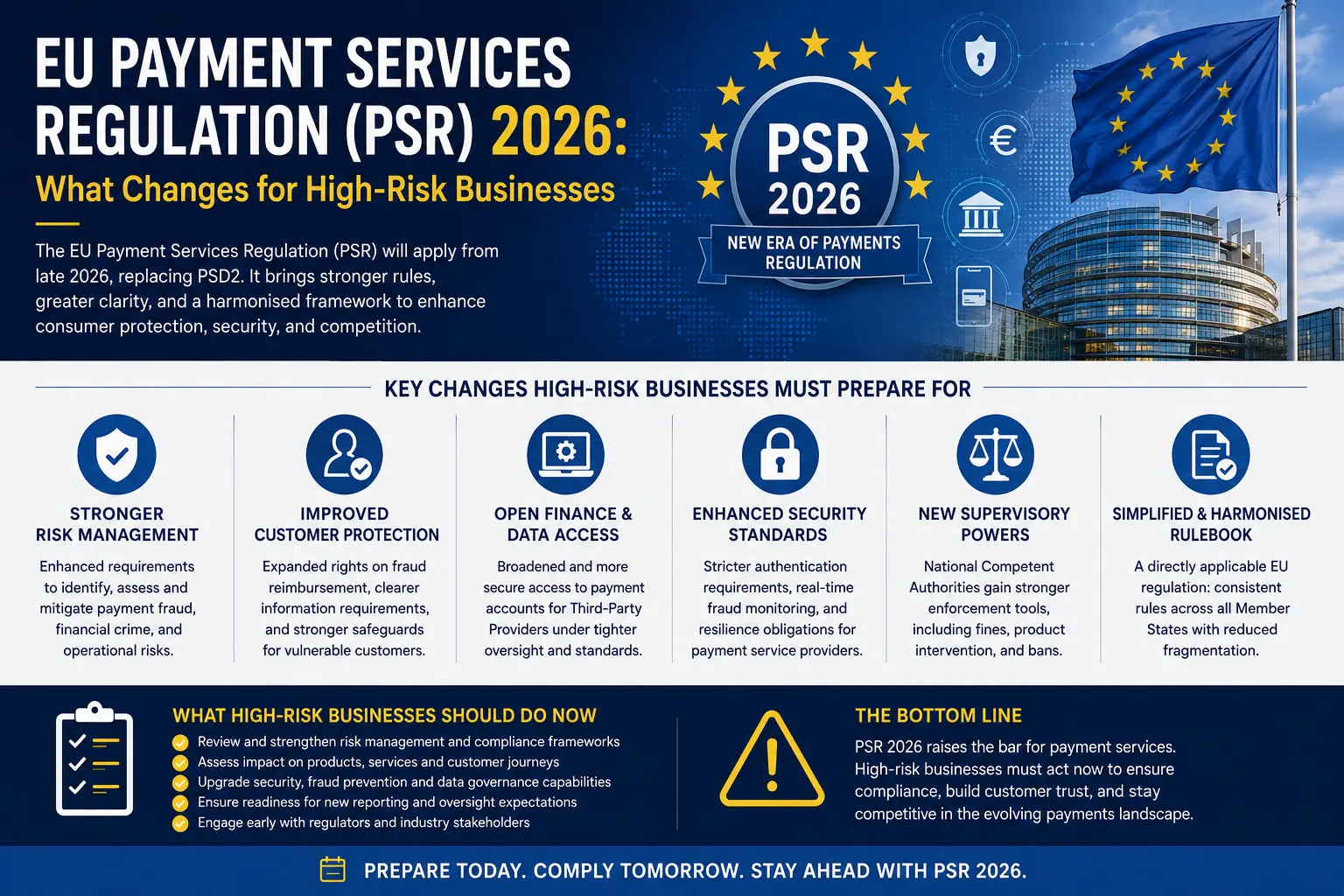
The EU’s payments framework is undergoing its most significant restructuring since the original PSD2 reshaped open banking in 2018, and high-risk merchants and payment providers operating in or serving EU markets need to understand exactly what is changing before the new rules take effect. The Third Payment Services Directive (PSD3) and the new Payment Services Regulation (PSR) reached final compromise text in April 2026, after nearly three years of negotiation, and the package fundamentally rewrites licensing, fraud liability, and authorisation rules across every category of payment institution. This guide breaks down what high-risk businesses specifically need to prepare for, on a timeline that is now substantially clearer than it was even a few months ago.
TL;DR
- PSD3 and the PSR reached final compromise text on April 23, 2026, with the Council’s COREPER endorsing the agreement and the European Parliament’s ECON Committee voting shortly after
- Official Journal publication is expected in June/July 2026, with the new rules generally applying 21 months later, placing full compliance deadlines in late 2027 to early 2028
- The PSR is a directly applicable Regulation requiring no national transposition, a structural shift from PSD2 that eliminates the fragmentation high-risk payment providers have navigated across EU member states for years
- Existing licences for non-bank payment institutions remain valid for a maximum of 30 months after the rules enter into force, after which re-authorisation is required
- The Limited Network Exemption, previously interpreted inconsistently across member states, will now have PSR-specified conditions that apply uniformly, directly affecting closed-loop and gift card style high-risk business models
- Fines for non-compliance can reach 4% of annual turnover or €20 million, modelled directly on the GDPR penalty structure
Why PSD3 and the PSR Matter More for High-Risk Businesses Than PSD2 Did
PSD2, introduced in 2018, was a Directive, meaning every EU member state had to transpose it into national law individually, producing years of divergence in how rules were actually applied from one jurisdiction to the next. High-risk payment providers operating across multiple EU markets have spent the better part of a decade managing this fragmentation, often maintaining different compliance configurations for different member states even while nominally operating under the same EU-level framework.
The most fundamental change in the new package is architectural. The PSR is a Regulation, directly applicable across all member states without national transposition, eliminating much of that historical divergence at a stroke. PSD3 remains a Directive, but its scope narrows specifically to organisational matters: authorisation, governance, capital requirements, fund safeguarding, and supervision of payment institutions. The PSR, by contrast, governs conduct-of-business rules, customer information, transaction authorisation and execution, and liability allocation, that will now apply identically whether a payment provider is licensed in Ireland, Lithuania, or Malta.
For high-risk merchants who have historically chosen their EU payment provider’s licensing jurisdiction partly based on regulatory interpretation differences, this harmonisation removes a variable that has shaped payment provider selection strategy for years.
The 2026 Timeline: Where Things Actually Stand
Understanding exactly where PSD3 and the PSR sit in the legislative process matters for compliance planning, because the timeline has moved through several stages in rapid succession during 2026.
The European Parliament and the Council reached provisional political agreement on both instruments on November 27, 2025. On April 22, 2026, COREPER, the Council’s Committee of Permanent Representatives, formally endorsed the trilogue agreement texts. The following day, April 23, 2026, the Council issued final compromise texts for both PSD3 and the PSR. On the Parliament’s side, the ECON Committee was scheduled to vote on May 5, 2026, with a full Parliament plenary vote expected to follow later in May.
Once the Parliament completes this process, the texts undergo legal-linguistic review before formal publication in the Official Journal of the European Union, currently anticipated for June or July 2026, though several legal analysts have flagged a realistic possibility of this slipping to September 2026. The new rules will generally apply 21 months after that publication date, which places practical compliance deadlines somewhere in late 2027 to early 2028, depending on the final publication timing.
Existing non-bank payment institution licences remain valid for a maximum of 30 months following the rules’ entry into force, after which institutions must have completed re-authorisation under the new framework. High-risk payment providers should treat this 30-month window as a hard planning constraint rather than a distant deadline, given how much documentation and operational change re-authorisation is expected to require.
Licensing and Capital Changes: What High-Risk Payment Providers Will Face
The PSD3/PSR package introduces materially stricter prudential and licensing requirements for payment institutions and electronic money institutions, entities that many high-risk merchants depend on directly for merchant accounts and payment processing infrastructure.
Increased initial capital requirements: are expected under revised calculation methods, meaning payment institutions may need to hold more equity than under the current PSD2 framework. For smaller, specialist high-risk payment providers, this could affect market structure over time, potentially favouring better-capitalised providers and accelerating consolidation among smaller specialist acquirers.
Mandatory wind-down plans: must now be included in licence applications, a new requirement designed to protect customer funds and payment continuity in the event of a payment institution’s failure. High-risk merchants relying on smaller, less-established payment providers should view a provider’s wind-down planning as one indicator of long-term operational stability.
Stricter safeguarding and concentration risk rules: apply to how payment institutions hold and protect customer funds, addressing a regulatory concern that institutions were taking on excessive concentration risk in how they safeguarded client money. For high-risk merchants, this should improve the practical security of funds held by their payment provider, though it may also marginally increase the operational cost that providers pass through in their fee structures.
EMD2 is repealed and electronic money institutions become a sub-category of payment institutions: under the unified framework, ending the separate licensing track that previously existed for e-money issuers. Payment providers operating under existing EMI licences will need to plan their transition to “payment institution authorised to issue e-money” status, including updated governance documentation and a formal re-authorisation application.
Fraud Liability: The Single Biggest Operational Shift
The PSR materially resets liability and redress obligations to address the dramatic rise in authorised push payment (APP) fraud and other scam typologies that have escalated under the PSD2 framework, and this is the area most likely to directly affect high-risk merchants’ day-to-day payment operations.
Extended Verification of Payee
Verification of payee, confirming that the name on a payment instruction matches the actual account holder, currently applies only to a subset of transactions under the EU’s Instant Payments Regulation. The PSR extends this verification requirement to all credit transfers, materially reducing the window for misdirected or fraudulently redirected payments, but also requiring payment providers to build and maintain the verification infrastructure across a much broader transaction set than previously required.
Mandatory Spending Controls and New Reimbursement Obligations
Payment service providers must now offer customers spending limits and blocking measures as standard features, alongside a new reimbursement requirement specifically addressing employee impersonation fraud, a fraud category of direct relevance to high-risk merchants managing significant B2B payment flows or large-scale payroll and vendor payment operations.
Liability Shifts Toward Institutions
The broader regulatory direction is to shift the burden of fraud loss away from the customer and toward financial institutions, with regulators citing forecasts of cumulative payment fraud losses reaching hundreds of billions of dollars over the coming decade as the justification for the reform. Payment institutions and high-risk merchants relying on them should expect enhanced Strong Customer Authentication (SCA) governance requirements, broadened fraud-monitoring obligations, and continued development of EBA-issued Regulatory and Implementing Technical Standards that will shape the detailed compliance requirements over the implementation period.
The Limited Network Exemption: A Direct Hit on Closed-Loop High-Risk Models
One of the more technical but consequential changes for certain high-risk business models concerns the Limited Network Exemption, the provision that allows certain closed-loop payment instruments (gift cards, loyalty programmes, single-merchant prepaid systems) to operate outside full payment institution licensing requirements.
Under PSD2, member states had latitude to interpret the conditions for this exemption differently, and some took a more restrictive approach than others. The PSR will specify uniform conditions for the exemption directly, removing this member-state interpretive variance. High-risk merchants operating prepaid, loyalty, or closed-loop payment structures, common in gaming, hospitality, and subscription verticals, should review their current exemption status against the PSR’s harmonised conditions well before the rules take effect, since a previously valid exemption claim in one member state could require restructuring under the uniform standard.
Penalties and Enforcement Posture
Non-compliance with the new framework carries materially higher financial exposure than under PSD2. Fines can reach 4% of a firm’s annual turnover or €20 million, whichever is higher, a penalty structure deliberately modelled on the GDPR approach that has proven effective at driving compliance investment across other regulated sectors. The PSR also extends direct supervision and enforcement consideration to entities meeting the threshold for designation as Very Large Online Platforms or Very Large Online Search Engines, creating potential overlap with Digital Services Act obligations for high-risk merchants operating large-scale digital platforms alongside payment functions.
Pros and Cons of PSD3/PSR for High-Risk Businesses
Pros
- Directly applicable PSR rules eliminate years of member-state interpretive divergence, simplifying multi-jurisdiction EU payment provider relationships
- Harmonised Limited Network Exemption conditions provide clearer, more predictable compliance status for closed-loop and prepaid high-risk business models
- Stricter safeguarding rules improve the practical security of merchant funds held by payment institutions
- Settlement Finality Directive amendments allowing direct payment institution participation in payment systems increase competitive options beyond traditional banks
- Extended fraud liability shifting toward institutions may reduce the dispute and chargeback burden that high-risk merchants currently absorb from certain fraud typologies
Cons
- Increased capital and governance requirements may reduce the number of smaller specialist high-risk payment providers, narrowing options for harder-to-place verticals
- The 30-month re-authorisation window for existing licences creates a hard compliance deadline that smaller providers may struggle to meet, risking service disruption for the merchants who depend on them
- Extended verification of payee and broadened SCA requirements add operational complexity and potential transaction friction during the implementation period
- Fines of up to 4% of turnover or €20 million significantly raise the stakes of non-compliance for payment providers and, by extension, the merchants relying on their continued operation
- The realistic compliance timeline (late 2027 to early 2028) requires sustained, multi-year preparation rather than a single readiness milestone
FAQ: EU Payment Services Regulation for High-Risk Businesses
When will PSD3 and the PSR actually take effect for high-risk merchants?
Formal publication in the Official Journal is expected in June or July 2026, potentially slipping to September. The new rules generally apply 21 months after publication, placing realistic compliance deadlines in late 2027 to early 2028. High-risk merchants and their payment providers should treat 2026 and 2027 as active preparation years rather than waiting for the application date to arrive.
Does the PSR apply directly to merchants, or only to payment providers and banks?
The PSR primarily regulates payment institutions, electronic money institutions, and banks, not merchants directly. However, high-risk merchants will experience the practical effects through their payment provider relationships: changed fee structures, new fraud verification steps at checkout, and potential provider consolidation as smaller specialist providers adjust to the new capital requirements.
What happens to a high-risk merchant’s payment provider if it cannot meet the new capital requirements?
Payment providers unable to meet the increased capital and governance standards within the 30-month re-authorisation window risk losing their licence to operate, which would force affected merchants to migrate to a different, compliant payment provider. High-risk merchants should monitor their current provider’s PSD3/PSR readiness as part of ongoing vendor risk management.
How does the Limited Network Exemption change affect gaming and hospitality merchants using closed-loop payment systems?
The PSR’s uniform exemption conditions may be stricter or more lenient than the specific member state interpretation a merchant has previously relied on. Merchants with closed-loop, prepaid, or loyalty-based payment structures should conduct a specific compliance review against the finalised PSR text once published, rather than assuming their current exemption status will carry over unchanged.
Will PSD3/PSR increase the cost of EU payment processing for high-risk merchants?
Some cost increase is likely, at least in the near term, as payment providers absorb higher capital, safeguarding, and fraud-monitoring compliance costs and pass a portion through in their fee structures. Over the longer term, the harmonisation benefits and reduced member-state divergence may offset some of this by simplifying multi-jurisdiction compliance overhead.
Comments
No comments yet. Be the first to share your thoughts.
Leave a comment