
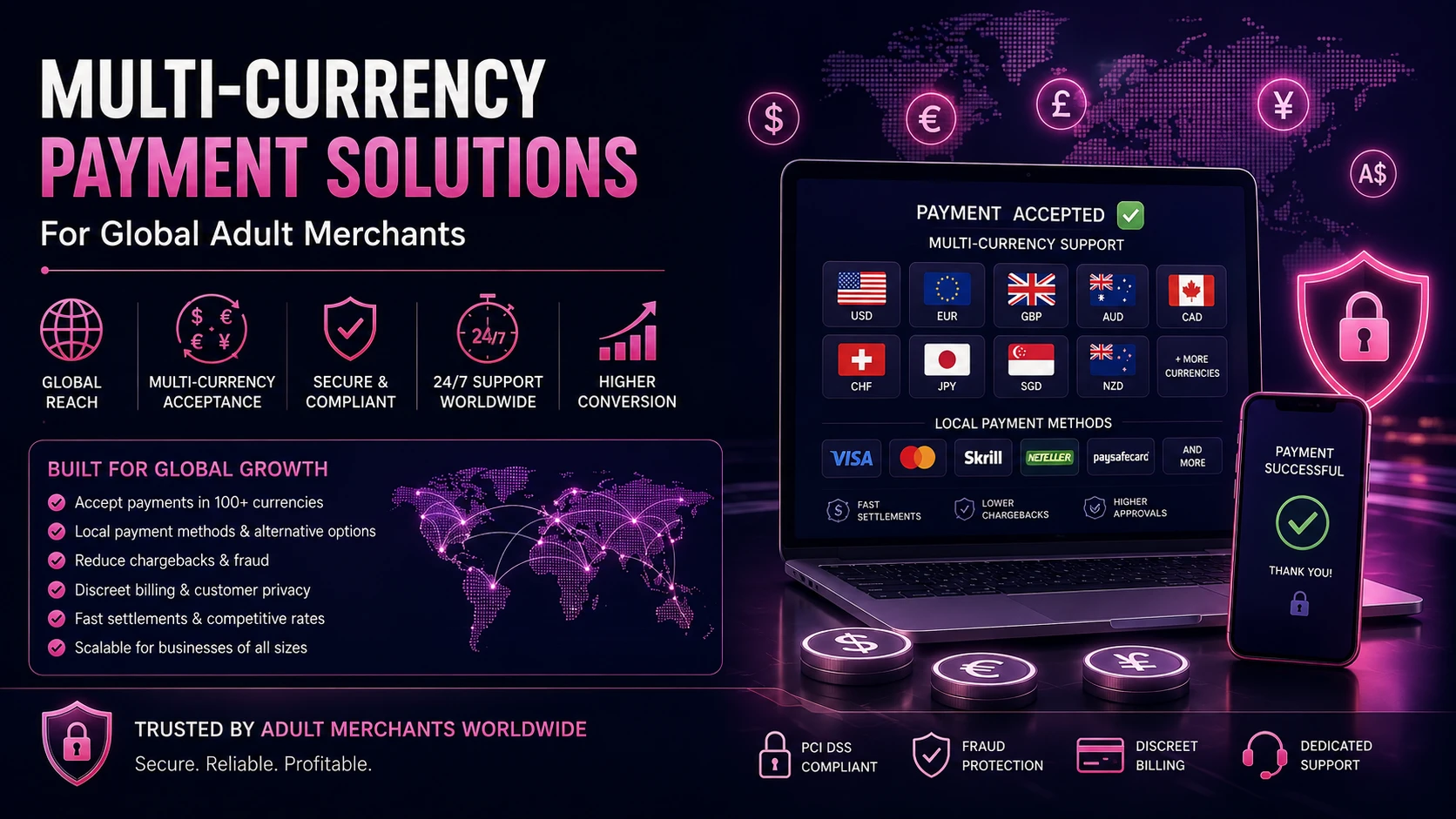
Adult platforms are inherently international, and every non-domestic subscriber checking out in an unfamiliar currency represents a real conversion risk, cart abandonment, unfavorable FX rates, and declined transactions all compound for a merchant category already fighting elevated decline rates. This guide covers how multi-currency infrastructure actually works for global adult merchants specifically.
Multi-currency payment processing lets adult merchants price, process, and settle in a customer’s local currency instead of forcing every buyer through a foreign-currency checkout, reducing cart abandonment and improving authorization rates on cross-border payments. Local pricing, local processing, and local settlement are three distinct layers, and most adult merchants don’t need all three from day one. Match the investment to your actual international volume rather than over-building infrastructure before it’s needed.
Why This Matters More for Adult Merchants
Adult businesses already face elevated decline rates from card network risk classification. Layering currency mismatch on top, a transaction where issuing currency, processing currency, and billing address all differ, makes a transaction look statistically riskier to fraud systems even when it’s entirely legitimate, compounding a problem this category can least afford to add to.
The Three Distinct Layers
Local pricing: displays prices in the customer’s currency at checkout, even if settlement still happens in a different currency behind the scenes, the fastest, lowest-complexity improvement available.
Local processing: routes transactions through regional acquiring relationships, which can meaningfully improve authorization rates compared to a single home-market acquirer handling everything.
Local settlement: means actually holding and receiving funds in the local currency, avoiding conversion costs on that currency pair entirely.
A merchant can implement any one of these independently, local pricing alone often delivers the biggest conversion improvement for the least infrastructure investment.
What Multi-Currency Infrastructure Solves
- Reduced cart abandonment: from currency sticker shock, since customers convert prices mentally (often inaccurately) when checkout only shows a foreign currency
- Fewer declines from risk-flagging mismatches: since matched currency and billing geography reduces the automated risk signals that trigger unnecessary declines
- Protection against FX volatility: eating into margin on high-volume currency pairs, when settlement is delayed and rates move against the merchant
- Simplified reconciliation: across markets, versus manually tracking conversion and settlement across disconnected regional accounts
Building the Right Setup by Stage
Early-stage, limited international volume: Enable local currency display through your existing payment gateway without overhauling settlement infrastructure yet, monitor decline rates by country to see where currency friction is actually costing you.
Growing, meaningful volume in 2-5 currencies: Evaluate providers offering genuine local settlement in your top currencies, avoiding the double-conversion cost of a single-currency setup with automatic conversion.
Established, broad international footprint: Consolidate onto unified multi-currency account infrastructure and consider an offshore merchant account as part of a diversified acquiring strategy, covered in depth in our companion guide on offshore accounts for adult merchants.
What to Watch For
- Dynamic Currency Conversion (DCC) at checkout: often gives customers a worse rate than standard conversion, generally worth avoiding as a primary strategy given how much trust already matters in this category
- Settlement timing matters: since even short delays between authorization and settlement can meaningfully change realized value during volatile FX periods
- Not every high-risk payment gateway supports genuine multi-currency settlement: some adult-focused processors are built primarily for domestic processing, meaning global merchants may need to layer a separate cross-border-focused provider alongside their primary relationship
Decision Framework
If international sales are under roughly 15–20% of revenue: Start with local currency display only and track results before investing further.
If you have sustained volume in several specific currencies: Evaluate genuine multi-currency settlement rather than accepting ongoing conversion costs on your highest-volume currency pairs.
If you’re operating at real global scale: Consolidate onto unified multi-currency infrastructure and layer in offshore acquiring for genuine geographic diversification.
Conclusion
Multi-currency infrastructure is one of the more directly controllable levers a global adult merchant has, unlike card network classification or banking reputational risk, currency and settlement strategy is something the business can optimize directly. Matching the investment to actual international volume, rather than over-building from day one, gets the real conversion and margin benefits without unnecessary operational complexity.
Frequently Asked Questions
Q: What’s the difference between local pricing and local settlement?
A: Local pricing displays prices in the customer’s currency at checkout even if settlement happens elsewhere. Local settlement means actually holding funds in that currency, avoiding conversion costs on that pair entirely, they’re separate infrastructure decisions that can be implemented independently.
Q: Does multi-currency processing actually reduce declines?
A: Indirectly, yes, transactions with mismatched issuing currency, processing currency, and billing address look statistically riskier to fraud systems even when legitimate, so local processing reduces that mismatch and the unnecessary declines it can trigger.
Q: Should adult merchants use Dynamic Currency Conversion (DCC)?
A: Generally not as a primary strategy, DCC often gives customers a worse exchange rate than standard conversion, which can hurt trust and repeat purchases in a category where customer trust is already harder to build.
Comments
No comments yet. Be the first to share your thoughts.
Leave a comment