
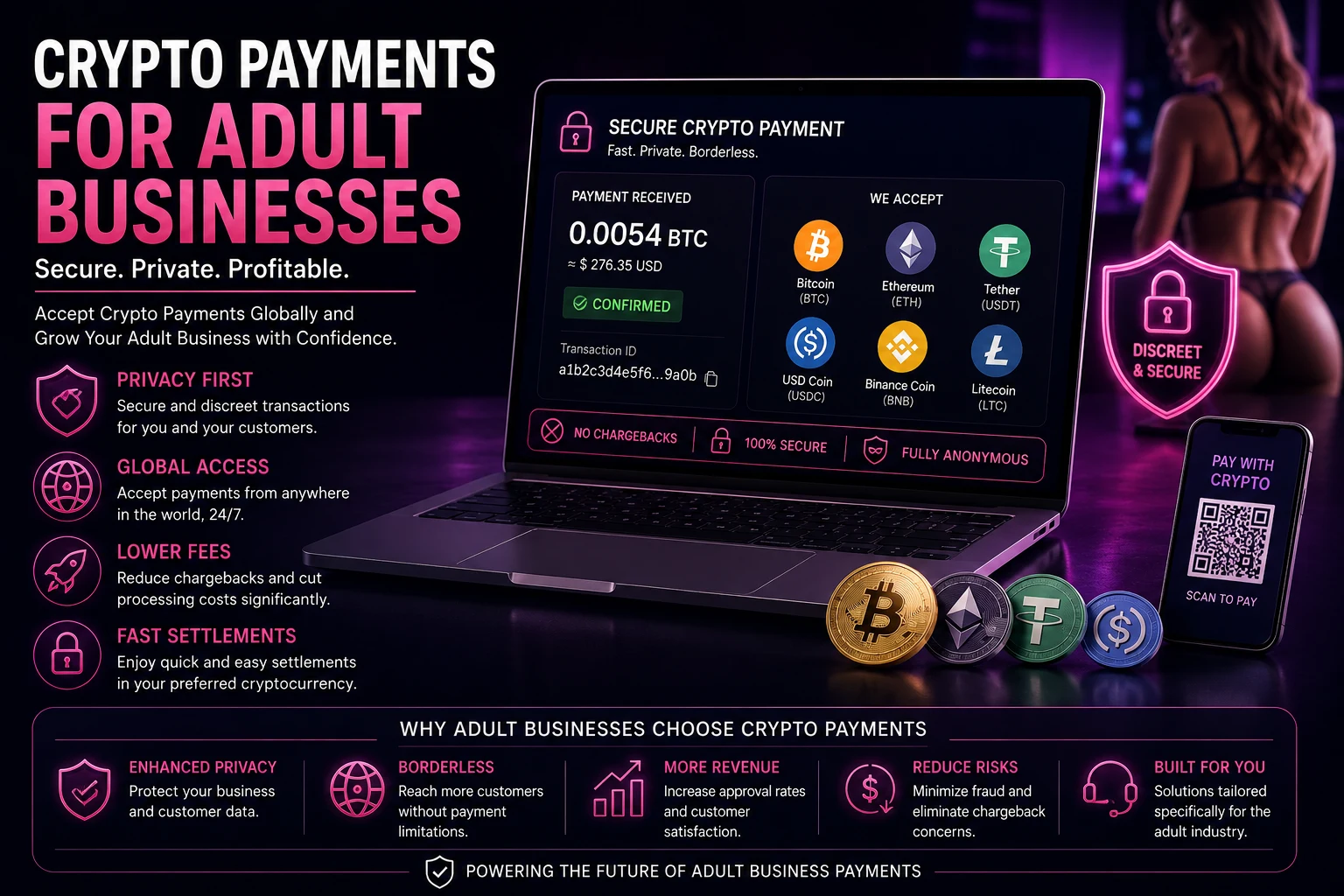
Stablecoin settlement is quietly becoming standard infrastructure for high-risk merchants who can’t rely on stable card processing, adult businesses included. This guide covers how crypto payment rails actually work for this category, what’s genuinely changed in 2026, and where the providers you already know don’t cover this ground.
Stablecoins (USDT, USDC), not volatile assets like Bitcoin, are the practical crypto option for adult businesses, offering faster settlement and reduced dependence on card network classification. MiCA in the EU now requires either a CASP authorization or an EMI license with crypto-payment permissions for compliant operation, with the transitional period for legacy operators ending July 1, 2026. None of the five general processors covered in our other adult payment guides (PayCly, WebPay, Boxcharge, Amald, Inquid) specialize in crypto settlement specifically, this is a distinct infrastructure layer requiring dedicated crypto-payment gateways or EMIs with crypto permissions.
Why Crypto Rails Matter for Adult Businesses Specifically
Card-based payment processing for adult businesses carries structurally elevated decline and dispute rates, and banks remain cautious about the category regardless of individual business quality. Crypto settlement, stablecoins specifically, sidesteps part of this problem entirely: a wallet-to-wallet transfer doesn’t route through the same card network risk classification that drives many adult merchant declines.
Why Stablecoins, Not Bitcoin
Volatile assets create a real problem for both merchant and customer: a Bitcoin payment can lose meaningful value between transaction and settlement, undermining pricing certainty on both sides. USDT and USDC are pegged to the dollar, holding value stability that makes them genuinely usable for recurring subscription billing and one-time purchases alike, this is why stablecoins dominate real crypto payment volume across high-risk categories broadly, adult content included.
What’s Changed in 2026: MiCA and Licensing Reality
The EU’s Markets in Crypto-Assets regulation has created a genuine compliance fork that catches many crypto-forward operators off guard: a CASP (Crypto-Asset Service Provider) license under MiCA covers digital asset custody and transfers, but any platform also processing fiat withdrawals, which most adult businesses do, needs a Payment Institution or EMI license alongside it. The transitional period for legacy operators without proper dual licensing ends July 1, 2026, meaning operators who haven’t addressed this are already moving out of compliance.
A clean, compliant setup has three properties: the operator holds a MiCA CASP authorization or an EMI license with crypto-payment permissions, settlement to SEPA happens in under 24 hours, and FX from stablecoin to EUR is transparent rather than buried in spread.
The Real Cost Picture
Net cost to the merchant for stablecoin settlement in 2026 typically sits between 0.5% and 2.0%, with the lower end realistic for crypto-native flows and the upper end common when mandatory conversion to fiat is involved, layer-2 network fees (Base, Arbitrum, Polygon) run just 1 to 10 cents per transaction, plus a PSP markup of 0.5% to 1.5% if using a dedicated crypto-payments gateway. Settlement timing is a genuine advantage too: cards settle T+1 to T+3 net of holdback, while stablecoin and account-to-account rails can settle same-day or instantly.
Where General High-Risk Processors Fall Short
This is worth being direct about: the general adult-focused processors covered in our other guides, PayCly, WebPay, Boxcharge, Amald, and Inquid among them, are built around card-based merchant accounts and payment gateways, not crypto settlement specifically. Adult businesses wanting genuine crypto rails need to look at EMIs with crypto-payment permissions or dedicated stablecoin settlement gateways as a distinct, additional layer, not assume a general high-risk provider covers this need.
Building a Crypto-Inclusive Payment Stack
The pattern that works well for high-risk merchants adopting crypto rails, adult businesses included, is a three-layer stack:
- A primary fiat account: through an EU EMI (Lithuania or Cyprus preferred) for operational expenses and SEPA settlement
- A stablecoin rail: processed through a crypto-friendly EMI or dedicated gateway, layered alongside card processing rather than replacing it
- A backup fiat account: in a different jurisdiction, holding several months of operational reserve for redundancy
Decision Framework
If you’re currently card-only and want to reduce processor dependence:
- Add stablecoin settlement as a supplementary channel through a crypto-friendly EMI, not a full replacement for card processing, most customers still expect standard checkout options
If you’re serving EU customers specifically:
- Confirm your provider holds both MiCA CASP authorization and EMI/PI licensing before the July 2026 transitional deadline, since operating without both is a genuine compliance gap, not a minor detail
If you’re evaluating providers:
- Don’t assume a general high-risk processor covers crypto settlement, confirm this capability explicitly, since it’s a distinct infrastructure layer most adult-focused processors don’t offer natively
Conclusion
Crypto payments for adult businesses in 2026 are mostly a stablecoin story, faster settlement, reduced card-network dependence, and increasingly clear regulatory requirements under MiCA for EU-facing operators. The general processors adult merchants typically use for card processing don’t cover this ground, so building genuine crypto infrastructure means adding a dedicated EMI or gateway layer specifically for it, not assuming your existing processor relationship extends there automatically.
Frequently Asked Questions
Q: Should adult businesses accept Bitcoin or stablecoins?
A: Stablecoins (USDT, USDC) are the practical choice, they hold stable value for both merchant and customer, unlike Bitcoin’s price volatility, which undermines pricing certainty on both sides of a transaction.
Q: Do PayCly, WebPay, or similar high-risk processors support crypto settlement?
A: Not as a core specialty, these are primarily card-based merchant account providers. Adult businesses wanting genuine crypto rails should look at EMIs with crypto-payment permissions or dedicated stablecoin gateways as a separate infrastructure layer.
Q: What’s the MiCA compliance deadline adult businesses serving the EU need to know?
A: The transitional period for legacy operators without both CASP authorization and EMI/PI licensing ends July 1, 2026, operating fiat withdrawals without proper dual licensing after that date is a compliance gap, not a gray area.
Comments
No comments yet. Be the first to share your thoughts.
Leave a comment