
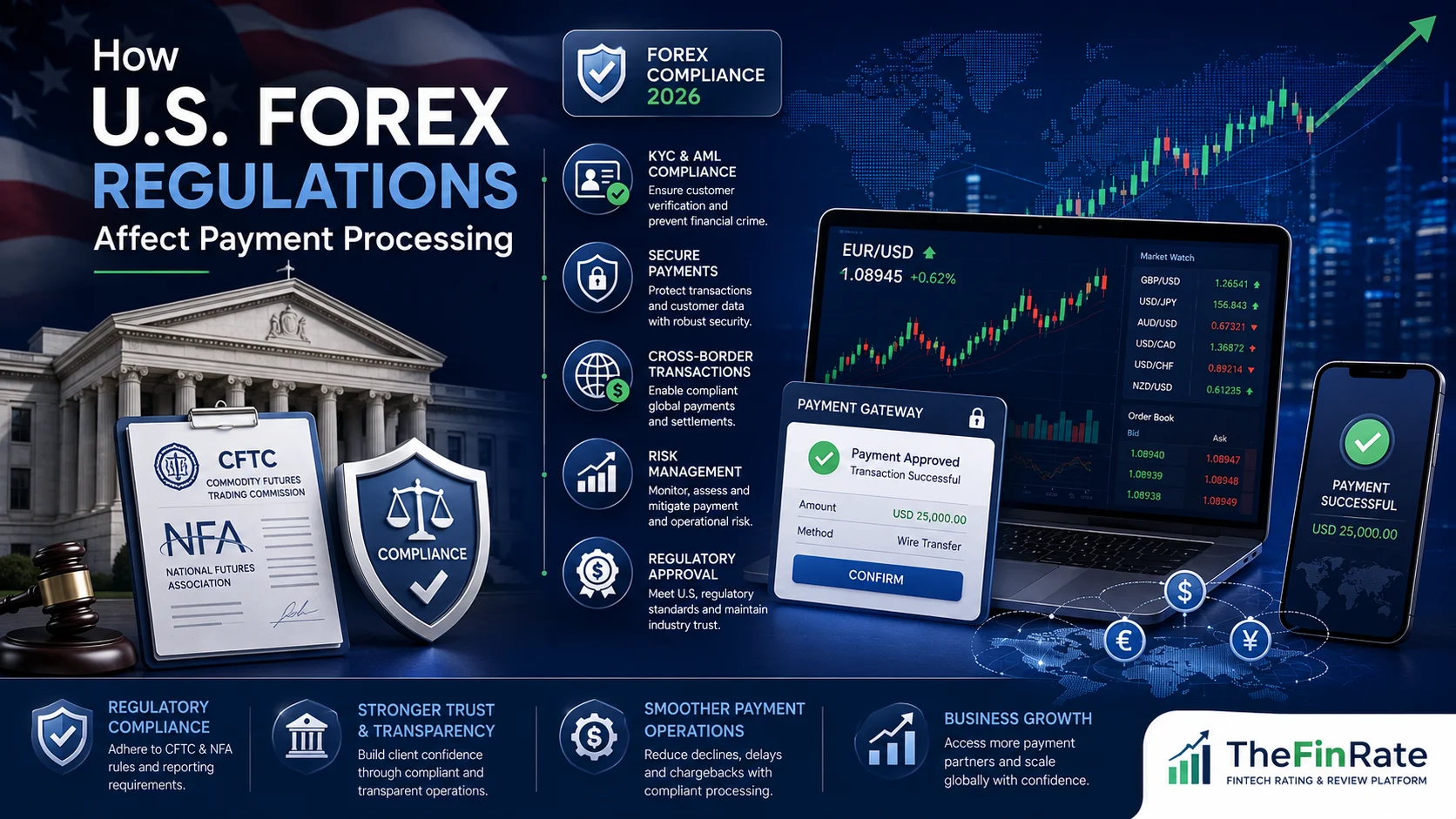
A forex firm’s regulatory status doesn’t just determine whether it can legally serve U.S. retail traders. It determines which banks will open an account for it, which payment providers will underwrite its merchant account, what reserve terms it gets offered, and how quickly it can actually move money in and out of the business. Regulation and payments aren’t two separate tracks for a forex firm, they’re the same track, and understanding exactly how they connect is essential for building infrastructure that actually holds up.
This guide ties together the regulatory framework covered elsewhere in this cluster, CFTC/NFA oversight, RFED licensing, and AML/KYC compliance, and translates each piece into its concrete, practical effect on payment processing. If you need the full detail on any one regulatory layer, the companion guides linked throughout go deeper; this piece focuses specifically on what each layer means for your payment gateway, banking, and merchant services decisions.
The Core Connection: Why Regulators and Payment Providers Ask the Same Questions
It’s worth starting with the underlying logic, because it explains everything that follows. Banks and payment providers extending services to a forex firm are, in effect, taking on a portion of that firm’s regulatory and financial risk by association. If the firm mismanages client funds, gets flagged for AML deficiencies, or operates without proper registration, the bank or payment gateway provider facilitating its transactions faces reputational and compliance exposure too.
This is exactly why payment underwriting for forex firms mirrors regulatory underwriting so closely, a payment provider evaluating a forex relationship is, functionally, asking the same core questions a regulator asks: is this firm properly registered, is it adequately capitalized, does it handle client funds correctly, and does it have a real AML program. The answers determine not just regulatory compliance, but practical access to online payments infrastructure.
CFTC/NFA Registration: The Hard Gate for Payment Access
Why Registration Status Is Verifiable, and Why That Matters
Unlike many self-reported compliance claims, CFTC registration and NFA membership are directly and publicly verifiable through NFA’s BASIC lookup tool, covered in depth in our CFTC vs. NFA guide. This verifiability is exactly what makes it such a hard underwriting gate: a payment provider doesn’t have to take a forex firm’s word for its regulatory status, it can confirm it directly in minutes.
The Practical Effect on Payment Relationships
- Verified CFTC/NFA status opens access to legitimate high-risk payment gateway providers: who specialize in the forex category and understand its risk profile properly
- Unverified or offshore status forces firms into a much narrower, generally more expensive pool of providers: often with less favorable terms, since providers serving that segment carry meaningfully higher compliance and reputational risk themselves
- Registration status affects speed, not just possibility: a firm with clean, verifiable NFA membership generally moves through payment underwriting faster than one whose status requires additional investigation or manual verification
RFED Status Specifically Shapes Banking Structure
For firms structured as RFEDs specifically, covered in full in our RFED Licensing guide, the $20 million minimum adjusted net capital requirement isn’t just a regulatory hurdle. It directly shapes what kind of banking relationships and merchant accounts the firm can realistically obtain, since banks evaluating an RFED relationship factor that capital requirement into their own risk assessment of the firm’s solvency and stability.
Segregated Client Funds: Where Regulation and Banking Architecture Meet Directly
What Segregation Actually Requires
Regulated forex brokers are legally required to hold client deposited capital in bank accounts completely separate from the broker’s own operational funds, money that cannot be used for day-to-day business expenses, debt repayment, salaries, or any other operational purpose. This is one of the clearest points where regulatory requirement and banking architecture become the same thing: a compliant forex firm doesn’t have one bank account, it has a segregated structure built specifically to satisfy this rule.
Why This Directly Shapes Merchant Account Setup
- A forex firm’s payment and banking infrastructure has to be built around this segregation from the start: not retrofitted later, client-facing deposit and withdrawal flows need to route into and out of properly segregated accounts, not commingled with general operating funds
- Payment providers evaluating a forex relationship look specifically at how segregation is structured: since improperly segregated funds represent one of the most serious compliance failures a forex firm can have
What Happens When Segregation Fails
The stakes here aren’t theoretical. In early 2026, BlockFills, a firm operating in the forex/CFD-adjacent space, filed for Chapter 11 bankruptcy amid over $75 million in losses, with the company’s own position in court confirming that customer funds “have always been commingled” rather than properly segregated. The case is a stark, current illustration of exactly what segregation rules exist to prevent, and why payment and banking providers treat verified segregation practices as a serious underwriting factor rather than a checkbox, the consequences of getting it wrong are not abstract.
A Note of Caution on Segregation Marketing
Segregated funds protection is a real, meaningful safeguard, but it’s also heavily marketed by brokers, and marketing claims don’t always match actual practice, as the case above demonstrates. For payment providers and for traders alike, verified regulatory status and independently confirmed compliance matter more than a broker’s own claims about how it handles client money.
Leverage Limits and Trading Constraints: An Underappreciated Payment Risk Factor
How Leverage Connects to Payment Risk
U.S.-regulated forex brokers must cap leverage at 50:1 on major currency pairs and 20:1 on minor pairs, considerably more conservative than leverage commonly available through offshore, unregulated platforms. This constraint has a payment-processing dimension that’s easy to overlook: lower leverage means smaller, more predictable margin calls and liquidation events relative to deposited capital, which translates into more stable, more predictable payment and settlement flows for the firm’s banking and processing partners to manage.
Why Offshore Brokers Present Harder Payment Risk
Offshore brokers offering leverage well beyond U.S. limits, sometimes dramatically higher, create correspondingly larger, less predictable swings in client account balances and margin-related fund movements. This volatility is part of why payment providers and banks generally treat unregulated, high-leverage offshore forex operations as carrying meaningfully elevated risk compared to CFTC/NFA-compliant firms operating within standard leverage constraints.
AML/KYC Program Maturity: A Direct Underwriting Input
This connection is covered in depth in our AML and KYC guide, but the payments-specific summary is worth restating here directly: AML program maturity isn’t just a regulatory compliance matter for a forex firm, it’s one of the more direct, controllable levers a firm has over its own payment and banking relationship quality.
- A well-documented CIP, CDD process, and clean SAR filing history moves a firm through payment provider underwriting meaningfully faster: than one with thin or undocumented compliance
- Weak AML programs create compounding risk: beyond regulatory enforcement exposure, they directly limit which banks and payment providers are willing to extend services at all
- Correspondent banking relationships, essential for cross-border forex operations, carry their own AML exposure by extension: meaning a forex firm’s AML program quality affects not just its direct banking relationship, but the broader correspondent banking chain supporting international cross-border payments
Chargeback and Dispute Handling: Where Regulatory Structure Shapes Payment Operations
Forex firms face a somewhat different dispute dynamic than typical high-risk e-commerce categories, and regulatory structure is part of why:
- NFA’s dispute resolution framework and mandatory disclosure requirements: create a formal channel for customer complaints that operates somewhat separately from standard card network chargeback processes, though card-based deposits themselves remain subject to normal chargeback rules
- Segregated fund requirements mean a client’s deposited capital is protected from broker insolvency: but this doesn’t eliminate the standard chargeback risk tied to card-based funding methods, which forex firms still need to manage through the same fraud prevention and dispute-handling infrastructure any high-risk merchant needs
- Firms with strong regulatory standing generally see more favorable chargeback-related underwriting terms: since regulatory compliance signals lower overall dispute and fraud risk to payment providers evaluating the relationship
Cross-Border Considerations for Regulated U.S. Forex Firms
Even a fully CFTC/NFA-compliant U.S. forex firm faces additional payment complexity when serving clients who fund accounts internationally:
- Cross-border payments: introduce currency conversion, correspondent banking chains, and regional compliance variance layered on top of the firm’s core U.S. regulatory obligations
- International client funding doesn’t change the underlying segregation and AML requirements: but it does add operational complexity to how those requirements get satisfied across multiple currencies and banking jurisdictions
- Multi-currency settlement infrastructure: covered in more general terms in our guide on the future of forex payment processing, becomes especially important for regulated U.S. firms trying to serve a genuinely global client base without compromising the domestic compliance structure their registration depends on
Why Unregulated or Offshore Forex Operations Struggle With Payment Processing
Pulling all of this together explains a pattern seen consistently across the payments industry: forex firms operating without genuine CFTC/NFA status face a structurally harder path to stable payment processing, not just a legally riskier one.
- No verifiable registration status: means payment providers can’t confirm the underwriting signal they’d normally rely on, pushing the firm toward a smaller, less favorable pool of providers willing to accept that uncertainty
- No enforced segregation requirement: removes a key safeguard payment providers use to assess counterparty risk
- No mandated AML program: (or a self-reported one with no independent verification) creates exactly the compliance uncertainty that drives banks toward the broader “de-risking” pattern of avoiding entire categories rather than evaluating individual firms
- Higher leverage and less predictable fund flows: compound the risk picture further, making payment relationships more expensive and less stable even where they’re available at all
This is the practical, bottom-line reason genuine CFTC/NFA compliance matters well beyond the legal obligation itself: it’s the foundation nearly every other favorable payment and banking outcome is built on top of.
Decision Framework: Building a Payment Stack Around Your Regulatory Status
If you’re a fully CFTC/NFA-registered firm building out payment infrastructure:
- Lead with your verified registration status when approaching payment providers, it’s your strongest underwriting asset, and specialized high-risk gateway providers will recognize its value immediately
- Ensure your segregated fund structure is documented clearly enough to present proactively during underwriting, not just maintained internally
- Present your AML program documentation alongside your registration status, since together they tell the complete compliance story a payment provider needs
If you’re newly registering and building payment relationships in parallel:
- Sequence your payment provider outreach to align with registration milestones, approaching providers with pending-but-verifiable registration status is a meaningfully different conversation than approaching them with no registration progress at all
- Build your segregated account structure and AML program simultaneously with registration, not as a follow-up task, since payment underwriting will expect to see both fully operational
If you’re evaluating whether to pursue offshore registration instead of full CFTC/NFA compliance:
- Weigh the payment processing consequences explicitly, not just the regulatory ones, offshore status doesn’t just carry legal risk, it structurally limits access to the payment infrastructure a growing forex business needs
- Understand that the cost savings of avoiding CFTC/NFA compliance are frequently offset, or exceeded, by the higher fees, weaker terms, and narrower provider pool that come with operating outside that framework
Conclusion
U.S. forex regulation and payment processing aren’t separate concerns that happen to intersect occasionally, they’re deeply, structurally connected, because every payment provider evaluating a forex relationship is ultimately asking the same questions regulators ask. Verified CFTC/NFA status, properly segregated client funds, appropriate leverage discipline, and a mature AML program aren’t just legal requirements. Together, they’re the foundation that determines whether a forex firm gets fast, favorable payment processing terms or gets pushed into a narrower, more expensive, less stable corner of the market.
The firms building durable forex operations in 2026 understand this connection explicitly, they don’t treat regulatory compliance and payment infrastructure as two separate workstreams, but as two views of the same underlying question: can this business be trusted with other people’s money.
Frequently Asked Questions
Q: Does CFTC/NFA registration guarantee approval for payment processing?
A: No, but it’s a foundational underwriting factor that meaningfully improves access to legitimate high-risk payment gateway providers. Payment providers still evaluate additional factors, capital position, AML program quality, segregation practices, but verified registration status is generally the first gate a firm needs to clear.
Q: Why do payment providers care about segregated client funds specifically?
A: Improperly segregated funds represent one of the most serious compliance failures a forex firm can have, directly affecting the firm’s financial stability and the payment provider’s own risk exposure by association. Recent cases of fund commingling and resulting bankruptcies illustrate why this gets scrutinized closely.
Q: Does a forex firm’s leverage policy actually affect its payment processing terms?
A: Indirectly, yes. Lower, U.S.-compliant leverage (50:1 on majors, 20:1 on minors) produces more predictable margin and fund-flow patterns than the higher leverage common at unregulated offshore brokers, which factors into how payment providers assess overall risk.
Q: Can an offshore forex firm without CFTC/NFA registration still get payment processing in the U.S.?
A: Sometimes, but through a narrower, generally more expensive pool of providers willing to accept the added compliance uncertainty, not through the same access legitimate, verified CFTC/NFA-registered firms have to specialized high-risk gateway providers built for the category.
Q: How does AML program quality specifically affect payment underwriting speed?
A: A well-documented Customer Identification Program, ongoing due diligence process, and clean SAR filing history allow a payment provider to complete underwriting review faster and with more confidence than a firm with thin or undocumented AML compliance, which often requires additional manual review.
Q: Do segregated fund requirements eliminate chargeback risk for card-funded forex accounts?
A: No. Segregation protects client deposited capital from broker insolvency specifically, but it doesn’t eliminate standard chargeback risk tied to card-based funding methods, which forex firms still need to manage through normal fraud prevention and dispute-handling infrastructure.
Comments
No comments yet. Be the first to share your thoughts.
Leave a comment