
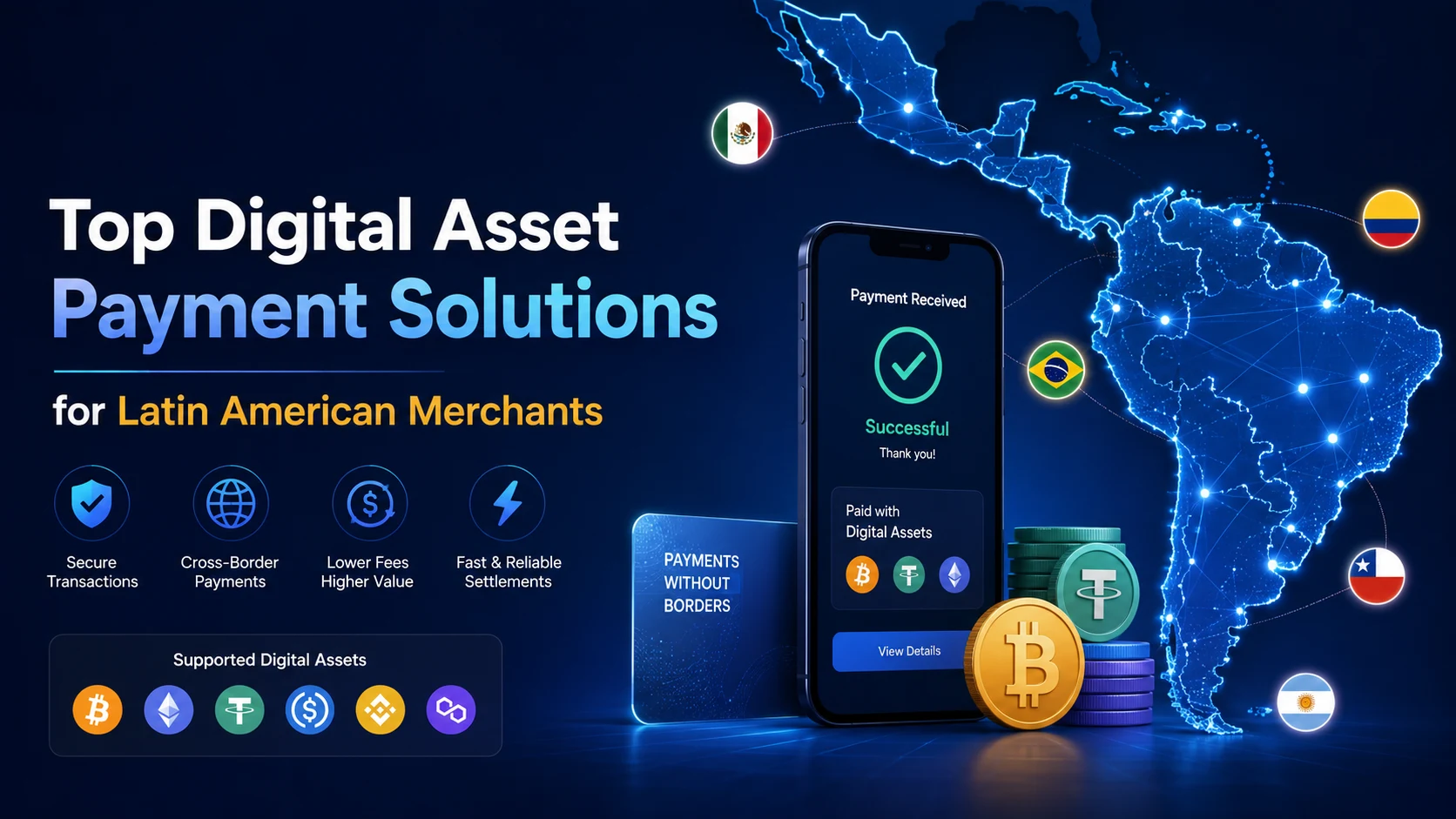
Latin America is the world’s fastest-growing region for stablecoin-based commerce, driven by currency volatility in Argentina, Bolivia, and Venezuela and by structural remittance gaps in Mexico and Brazil.
Merchants no longer need to choose between local payment rails and digital assets, providers like dLocal, PayRetailers, Nuvei, RedotPay, and Bitso now bridge stablecoins directly into pesos, reais, and soles.
Regulatory divergence is the biggest operational risk. Brazil, Argentina, Mexico, and Chile each run separate VASP or fintech licensing regimes, so a single processor rarely covers the whole region.
The right solution depends less on brand recognition and more on settlement currency, licensing footprint, and how the provider handles volatility between authorization and settlement.
Why LATAM Merchants Are Turning to Digital Asset Payments
If you sell into Latin America and you’re still treating crypto payments as a side experiment, the numbers say otherwise. Argentina alone generated an estimated $47 billion in stablecoin transaction volume in 2025, with the bulk of that activity split between savings, payments, and remittances. Mexico receives roughly $62 billion a year in remittances, about 3.5% of GDP, and 2025 was the first year digital channels overtook cash for moving that money. A new U.S. excise tax on cash remittances, effective January 2026, explicitly exempts digital payments, which is accelerating the shift toward stablecoin-based corridors even further.
For merchants, this isn’t an abstract macro trend. It shows up as a very concrete pain point: buyers in Argentina, Venezuela, and Bolivia increasingly hold value in USD-pegged stablecoins because their local currency can lose double-digit purchasing power in a matter of months. If your checkout only accepts pesos or bolivianos, you’re asking a customer to convert dollars back into a depreciating currency just to pay you, friction that costs conversions. Merchants who accept digital assets directly, or who route through a processor that settles in stablecoins with fiat conversion built in, sidestep that entire problem.
The second driver is infrastructure. Latin America has leapfrogged card-based payments in favor of real-time systems, Pix in Brazil, SPEI in Mexico, PSE and Bre-B in Colombia. Alternative payment methods already account for close to half of regional ecommerce volume, and stablecoin rails are increasingly plugged into that same instant-settlement expectation. Buyers who are used to Pix transfers landing in seconds don’t tolerate multi-day card settlement any better than they tolerate currency risk.
What “Digital Asset Payment Solution” Actually Means for a Merchant
Before comparing providers, it’s worth being precise about what you’re buying. A digital asset payment solution for a LATAM merchant typically does three things: it lets a customer pay in Bitcoin, Ethereum, or, far more commonly, a USD-pegged stablecoin like USDT or USDC; it converts that payment into local currency or a merchant-preferred settlement currency automatically; and it wraps the transaction in AML and KYC controls so the merchant isn’t left holding unlicensed exposure. Miss any one of those three functions and you either take on volatility risk yourself, lose the customers who don’t want a crypto-native checkout, or run into regulatory trouble the moment volume grows.
Comparing the Leading Providers
| Provider | Regional Strength | Digital Asset Approach | Licensing Signal |
|---|---|---|---|
| dLocal | Broad LATAM coverage (Peru, Brazil, Mexico, Argentina) | Not crypto-native; supports select workflows via partnerships | Established cross-border payment license base |
| PayRetailers | Pan-LATAM local methods, high approval-rate focus | APM-first, stablecoin settlement through partner rails | Regionally regulated PSP |
| Bitso | Mexico–US remittance corridor, Argentina | Native exchange plus MXNB peso-pegged stablecoin | Banxico-authorized VASP |
| RedotPay | Card-based crypto spend across Brazil, Mexico, Argentina, Colombia | Virtual/physical cards funded by digital assets | Multi-jurisdiction VASP registrations |
| Nuvei | Enterprise cross-border processing, 45+ local acquiring markets | Stablecoin conversion via Rain, BitGo, and Visa partnership | Publicly listed, licensed payment institution |
| Localpayment (Aleph Group) | Argentina-focused, cross-border pay-in/payout | Single API for crypto on/off-ramps alongside local methods | Regional PSP with banking coverage |
| Sprintcheckout | Argentina SMB checkout | USDT/USDC via QR or API, settlement in stablecoins | Early-stage, smaller-scale processor |
Two things stand out from this comparison. First, the market has split into two camps: traditional cross-border PSPs (dLocal, PayRetailers, Nuvei) that are bolting stablecoin settlement onto existing local-payment infrastructure, and crypto-native platforms (Bitso, RedotPay) that are building fiat and card rails on top of a digital asset core. Neither approach is inherently better, the right fit depends on whether your existing volume is mostly card and bank transfer with occasional crypto demand, or the reverse.
Second, licensing depth varies enormously even among reputable names. Bitso operates as an authorized virtual asset service provider under Mexico’s central bank, which matters if you’re processing meaningful remittance-adjacent volume. Smaller Argentine-focused checkout tools may be perfectly functional for SMB volume but carry less regulatory weight if a bank later asks questions about your payment stack.
Country-Level Considerations That Change the Decision
Argentina: has become one of the most permissive environments for pricing and settling in stablecoins, with businesses free to price contracts in pesos, dollars, or crypto. Argentina’s Central Bank is reportedly moving to let commercial banks offer crypto custody, reversing a 2022 ban, a signal that mainstream banking rails and crypto rails are converging rather than staying separate. Merchants here benefit from picking a provider with local CNV registration under Resolution 1058, since Argentina introduced mandatory registration for VASPs in 2025.
Brazil: runs the region’s strictest framework. The Central Bank of Brazil requires VASP authorization under the Virtual Assets Law and Resolution 519/2025, and a domestic Travel Rule took effect in February 2026 with full compliance required by November 2026. A proposed $100,000 cap on cross-border stablecoin transactions remains under regulatory consultation. Any provider serving Brazilian merchants at scale needs to demonstrate BCB authorization and COAF-aligned AML reporting, this is not a market where a lightly regulated processor is a safe long-term bet.
Mexico: has carried VASP authorization through Banxico under its 2018 Fintech Law for years, giving it one of the more mature and predictable regulatory postures in the region. This is part of why Bitso’s MXNB stablecoin and its role in the US-Mexico remittance corridor have scaled as far as they have.
Chile: introduced licensing requirements for exchanges, wallets, and stablecoin issuers under its 2023 Fintech Law, putting it on a similar trajectory to Mexico but with a shorter compliance track record.
Bolivia: sits at the opposite end of the spectrum. Facing an acute foreign exchange crisis, businesses reliant on imports are increasingly settling with foreign suppliers in USDT or USDC sourced through peer-to-peer or OTC channels, while local wallets built on networks like Stellar are enabling everyday stablecoin purchases. This is a market where informal and formal payment rails are blending in real time, and merchants need partners who can operate credibly in that ambiguity without exposing the business to sanctions or AML risk.
Practical Selection Criteria for Merchants
When you’re evaluating a digital asset payment solution for LATAM operations, work through these questions rather than starting from brand familiarity:
Settlement currency and timing: Does the provider settle in your preferred fiat currency, in stablecoins, or does it let you choose per transaction? Settlement lag between authorization and conversion is where volatility risk actually bites, ask for the provider’s average settlement window in writing.
Licensing coverage by country, not by company: A processor licensed in Panama or the Cayman Islands isn’t automatically authorized to serve Brazilian consumers. Confirm VASP or equivalent registration in every country where you have meaningful transaction volume.
AML and Travel Rule readiness: With Brazil’s domestic Travel Rule now in force and Argentina’s CNV registration mandatory, ask providers directly how they screen counterparty wallets and whether they can produce audit-ready reporting on demand.
Local payment method interoperability: The strongest LATAM solutions don’t force customers into a crypto-only checkout, they blend stablecoin settlement with Pix, SPEI, PSE, and card acceptance so the buyer never has to think about which rail they’re using.
Chargeback and reversal handling: Crypto transactions are generally irreversible on-chain, but the fiat-facing side of your relationship with a processor still needs clear dispute and refund mechanics, particularly for consumer-facing ecommerce.
The Bottom Line for Merchants
Digital asset payments in Latin America have moved past the experimental phase. The macro conditions, currency instability, remittance costs, and instant-payment culture, make stablecoin settlement a genuine advantage rather than a novelty for merchants serving the region. But the providers worth building on are the ones treating licensing as core infrastructure, not an afterthought. Before signing with any processor, map their VASP or equivalent authorization against every country you actually sell into, and prioritize settlement transparency over marketing claims about “instant” or “borderless” payments.
Frequently Asked Questions
Is it legal for merchants to accept crypto payments in Latin America?
It depends on the country. Argentina, Mexico, Chile, and Brazil all permit licensed entities to process digital asset payments, but each requires registration or authorization with a specific regulator, CNV in Argentina, Banxico in Mexico, the CMF in Chile, and the Central Bank of Brazil. Bolivia has taken a far more restrictive stance, so merchants should verify local rules before assuming crypto acceptance is straightforward everywhere in the region.
Which countries in LATAM have the highest digital asset payment adoption?
Argentina and Brazil lead in transaction volume, driven respectively by currency instability and by a large, tech-forward consumer base. Mexico leads specifically in remittance-linked stablecoin flows given its size and proximity to the US corridor.
Do merchants need a VASP license to accept crypto payments directly?
If a merchant simply accepts crypto and immediately hands off custody and conversion to a licensed processor, the merchant typically doesn’t need its own VASP license. If the merchant holds, converts, or transmits digital assets on behalf of customers directly, licensing requirements may apply, this is exactly why most merchants route through a regulated payment provider rather than self-custody.
How do merchants avoid stablecoin volatility risk during settlement?
Choose a provider with a short, disclosed settlement window and automated conversion rules that trigger at defined thresholds, rather than letting stablecoin balances sit unconverted. This is standard practice among the more established LATAM-focused processors.
Are stablecoins treated differently from Bitcoin or Ethereum for payment purposes in LATAM?
Generally yes. Regulators across the region focus disproportionate attention on stablecoins because of their use in remittances and cross-border settlement, while volatile assets like Bitcoin are more often treated as investment or savings vehicles by consumers rather than payment instruments.
What is the safest way for a small merchant to start accepting digital asset payments in LATAM?
Start with a licensed processor that already operates in your target country rather than attempting direct wallet-to-wallet acceptance. This shifts most of the compliance burden, KYC, AML, Travel Rule reporting, onto a party built to handle it.
Comments
No comments yet. Be the first to share your thoughts.
Leave a comment