
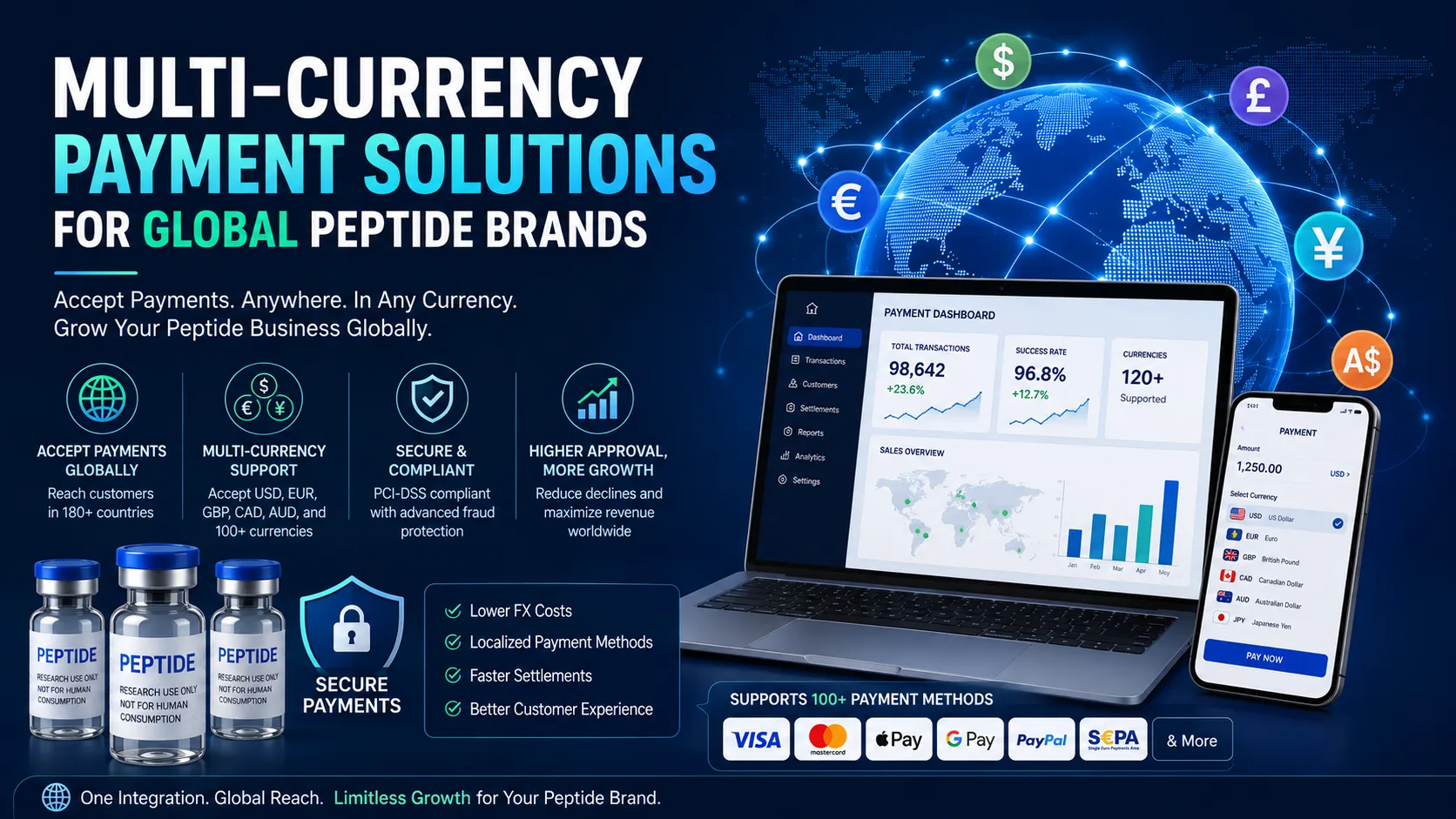
A customer in Germany adds a peptide order to their cart, sees the price in USD, watches their bank apply a foreign transaction fee and an unfavorable conversion rate at checkout, and abandons the purchase. Multiply that friction across every non-US customer, and a peptide brand can be losing a meaningful share of international revenue to currency mechanics alone, before high-risk classification even enters the picture.
Global peptide brands carry a double burden: the high-risk underwriting challenges covered elsewhere in this cluster, plus the currency and settlement complexity of selling across borders. This guide focuses specifically on that second problem, how multi-currency payment infrastructure actually works, what it costs, and how to decide what your brand actually needs.
Why Currency Strategy Matters More for High-Risk Sellers Than Most Businesses Realize
For a typical low-risk e-commerce brand, currency mismatches are an optimization problem, worth fixing, but not existential. For a peptide business already facing elevated decline rates and stricter underwriting, currency friction compounds an already fragile checkout experience.
- Declined transactions from foreign-currency mismatches look identical to fraud-related declines: in most reporting dashboards, making it hard to diagnose whether a specific market’s poor conversion is a currency problem or a genuine risk-flagging problem
- International customers are more price-sensitive to hidden FX costs: and peptide buyers, often repeat purchasers comparing prices across multiple sellers, notice unfavorable conversion rates quickly
- Every additional friction point compounds the trust deficit: a high-risk business already has to overcome at checkout, where customers are already wary of an unfamiliar billing descriptor or a “research use only” disclaimer
Getting currency infrastructure right isn’t a nice-to-have for a global peptide brand, it’s one of the few conversion levers fully within the business’s control, unlike the underwriting and classification issues covered in this cluster’s other guides.
How Multi-Currency Payment Processing Actually Works
The Core Problem: Where Does Currency Conversion Happen?
Every cross-border transaction involves a currency conversion somewhere in the chain. The question that actually matters is where that conversion happens, because it determines who bears the cost and the exchange-rate risk.
- At authorization (customer’s card issuer converts): the customer’s bank converts the transaction to their local currency at the point of sale, often called Dynamic Currency Conversion (DCC) when the merchant’s system offers to lock in a rate at checkout. This shifts FX exposure to the customer, and DCC margins tend to be worse for the buyer than standard card network conversion rates
- At settlement (merchant’s processor converts): the transaction stays in its original currency through authorization, then gets converted when funds settle into the merchant’s account. This shifts FX exposure and cost onto the merchant unless multi-currency settlement is specifically enabled
- Like-for-like settlement (no conversion needed): the merchant maintains local currency balances and settles directly in the currency the transaction was made in, avoiding the conversion step entirely for that currency pair
Settlement timing itself matters beyond just which party bears the cost. A delay of even 24 to 72 hours between authorization and settlement can materially change the realized FX value during a volatile currency period, a real, if often overlooked, source of margin erosion for brands processing meaningful volume in less stable currencies.
Local Pricing vs. Local Processing vs. Local Settlement
These three concepts get conflated constantly, and the difference matters for decision-making:
- Local pricing: displaying prices in the customer’s currency at checkout, even if the transaction ultimately processes and settles in a different currency
- Local processing: routing the transaction through a local acquiring relationship in the customer’s country or region, which can meaningfully improve authorization rates compared to routing everything through a single home-market acquirer
- Local settlement: receiving and holding funds in the local currency itself, avoiding conversion costs on that currency pair entirely until the business chooses to convert
A brand can implement any one of these without the others, and each layer adds real value independently. Local pricing alone improves conversion by reducing sticker shock. Local processing alone improves approval rates. Local settlement alone reduces FX cost. Doing all three is the goal for a brand with genuinely global volume, but it isn’t necessary to have all three from day one.
What Multi-Currency Infrastructure Solves for a Peptide Brand
1. Reduced Cart Abandonment From Currency Sticker Shock
Displaying prices in a customer’s local currency, rather than forcing a mental (and often inaccurate) conversion from USD, consistently improves conversion rates for international buyers, a well-documented pattern across online payments generally, and one that applies directly to peptide brands selling to a global customer base.
2. Fewer Declines From Cross-Border Risk Flagging
A transaction where the card’s issuing currency, the merchant’s processing currency, and the customer’s billing address all mismatch looks statistically riskier to fraud-detection systems than a matched transaction, even when it’s entirely legitimate. Local processing through regionally appropriate acquiring relationships reduces this mismatch and, with it, unnecessary declines.
3. Protection Against FX Volatility Eating Into Margin
For brands processing meaningful volume in currencies prone to swings, locking in conversion rates at the moment of transaction, rather than letting exposure sit unmanaged until an eventual settlement date, materially protects margin. Some providers now offer guaranteed FX rates at the exact moment of transaction initiation, letting a business see the exact conversion fee upfront and lock it in for a defined window.
4. Simplified Reconciliation Across Multiple Markets
Without a unified multi-currency system, a peptide brand selling across five or six countries ends up reconciling payments manually across disconnected banking portals and spreadsheet-based FX tracking, a genuine operational burden that scales badly as the business grows. Centralizing currency conversion, settlement, and reconciliation into one system removes this overhead.
Building the Right Multi-Currency Stack: Options by Business Stage
Early-Stage Global Sellers (Limited International Volume)
If international sales are a meaningful but still-secondary share of revenue, the highest-leverage, lowest-complexity move is usually local pricing display through your existing payment gateway, without necessarily overhauling settlement infrastructure yet.
- Enable local currency display at checkout, even if settlement still converts back to your home currency
- Monitor decline rates by country to identify which markets are losing the most conversions to currency-related friction specifically, versus classification-related declines
- Avoid over-investing in full local settlement infrastructure until volume in a specific currency justifies the operational complexity
Growing Multi-Market Brands (Meaningful Volume in 2–5 Currencies)
Once a business has sufficient, sustained sales volume in specific currencies, multi-currency settlement starts making direct financial sense, accruing balances in a given currency and settling them without incurring FX fees on funds that stay in that currency.
- Evaluate providers offering like-for-like settlement in your top-volume currencies, since this avoids the double-conversion cost that erodes margin for sellers relying on generalist processors
- Prioritize a high-risk payment gateway provider that supports multi-currency settlement natively rather than bolting it on as an afterthought, since peptide-specific underwriting and currency infrastructure both need to work together
- Consider whether a near-shore acquiring relationship makes sense before jumping straight to a fully offshore setup, if a majority of international customers sit in one region, a regional acquirer there can meaningfully improve authorization rates with less regulatory friction than a more distant jurisdiction
Established Global Brands (Broad International Footprint)
At real scale, the priorities shift toward infrastructure that centralizes complexity rather than multiplying it:
- Consolidated multi-currency accounts that collect locally and settle internationally with full visibility into fees and FX outcomes, rather than managing dozens of disconnected local accounts and ad-hoc FX processes
- Payment-versus-Payment (PvP) mechanisms or instant multi-currency networks for larger transaction volumes, ensuring funds exchange only when the corresponding currency is delivered at the same time, reducing settlement risk on larger transfers
- Direct local clearing integrations that bypass the traditional correspondent banking sequence, reducing both cost and the multi-day delays correspondent chains can introduce
- An offshore merchant account as part of a diversified acquiring strategy, offering broader geographic coverage, improved approval rates on certain foreign card issuers, and genuine multi-currency settlement, while accepting the tradeoffs of longer underwriting timelines, potentially higher discount rates, and stricter compliance reporting that come with it
The High-Risk Layer: Where Multi-Currency and Peptide Classification Intersect
Multi-currency infrastructure doesn’t exist in a vacuum for peptide brands, it has to work within the same high-risk underwriting constraints covered elsewhere in this cluster. A few points specific to that intersection:
- Not every high-risk payment gateway supports genuine multi-currency settlement: Some providers that specialize in peptide or nutraceutical underwriting are built primarily for domestic U.S. processing, meaning a brand may need to layer a separate cross-border-focused provider alongside its primary high-risk account rather than expecting one provider to solve both problems
- Offshore acquiring is not a shortcut around domestic underwriting requirements: An offshore merchant account can expand currency and geographic coverage, but it still requires the same category of KYC/KYB documentation, processing history, and compliance review as a domestic high-risk application, it’s a complement to proper underwriting, not a way around it
- Don’t misdescribe the product to access easier multi-currency processing: Presenting a peptide business under a different, lower-risk MCC to access broader multi-currency infrastructure is a fast path to account termination once discovered, not a legitimate optimization
What Multi-Currency Payments Cost
Costs vary meaningfully by approach, but the general pattern for 2026 looks like this:
| Approach | Typical Cost Structure | Best Fit |
|---|---|---|
| Local pricing only (no settlement change) | Minimal added cost beyond existing gateway fees | Early-stage international sellers |
| DCC at checkout | Often the worst rate for the customer – can hurt conversion and repeat purchase trust | Generally avoid for peptide brands prioritizing customer trust |
| Multi-currency settlement (via processor) | FX markups as low as roughly 0.5% with specialized cross-border providers, versus significantly higher markups from generalist processors | Growing multi-market brands |
| Local acquiring / offshore merchant account | Higher setup and underwriting cost, potentially higher discount rates and reserves, offset by improved authorization rates and multi-currency settlement | Established global brands |
| PvP / instant multi-currency networks | Enterprise-tier infrastructure cost | High-volume brands with large cross-currency transfers |
The comparison worth internalizing: a slightly higher processing rate paired with a meaningfully higher authorization rate very often yields more net revenue than a cheaper setup that quietly declines a larger share of legitimate international transactions.
Common Mistakes Global Peptide Brands Make
- Treating currency display as the whole solution: Showing local currency at checkout helps conversion, but if settlement still routes through poor FX rates or a single home-currency account, the brand is leaving real margin on the table
- Defaulting to DCC because it’s the easiest setup: DCC often gives the customer a worse rate than standard conversion, and buyers who feel overcharged on FX are less likely to become repeat customers
- Going offshore before trying near-shore: For a U.S.-based brand with concentrated EU or UK volume, a regional acquiring relationship in that market often improves authorization rates with meaningfully less regulatory complexity than an offshore setup in a more distant jurisdiction
- Ignoring settlement timing: Assuming FX exposure doesn’t matter because “the rate will average out” ignores that even short settlement delays can meaningfully change realized value during volatile periods
- Splitting currency infrastructure and high-risk underwriting across providers with no coordination: A brand running a domestic high-risk gateway and a separate multi-currency processor with no unified reporting ends up with the exact reconciliation burden multi-currency infrastructure was supposed to eliminate
Decision Framework: What Your Peptide Brand Actually Needs
If international sales are under roughly 15-20% of total revenue:
- Start with local currency display through your existing high-risk gateway
- Track decline and abandonment rates by country before investing further
- Hold off on offshore or local settlement infrastructure until volume justifies it
If you have sustained, meaningful volume in 2-5 specific currencies:
- Evaluate multi-currency settlement with a provider offering like-for-like settlement in your top currencies
- Prioritize a provider that can support both peptide-specific underwriting and genuine currency infrastructure, even if that means running two coordinated providers rather than one
- Consider near-shore acquiring in your highest-volume region before going fully offshore
If you’re operating at real global scale across many markets:
- Consolidate onto unified multi-currency account infrastructure rather than managing markets individually
- Add an offshore merchant account as part of a diversified acquiring strategy, not a replacement for your primary domestic relationship
- Evaluate PvP settlement mechanisms if cross-currency transfer volume is large enough to justify the infrastructure
Looking Ahead: Where This Is Heading in 2026 and Beyond
Cross-border B2B and B2C payment volume globally is projected to keep climbing sharply through the rest of the decade, and the infrastructure supporting it is maturing quickly, more providers offering guaranteed, lockable FX rates, more local clearing integrations bypassing traditional correspondent banking, and more unified platforms consolidating what used to require dozens of disconnected local accounts.
For global peptide brands specifically, this means the gap between businesses that treat currency strategy as an afterthought and those that build it deliberately is likely to widen. As underwriting for the category continues tightening on the high-risk side, currency and settlement optimization becomes one of the more reliable levers a brand actually controls to protect margin and conversion, rather than another front where the business is purely reacting to processor and card network decisions.
Conclusion
Multi-currency payment infrastructure isn’t a luxury feature for global peptide brands, it’s one of the few genuinely controllable levers in a payments stack otherwise shaped by high-risk classification and underwriting decisions made elsewhere. Getting local pricing, processing, and settlement right reduces friction at exactly the point where a high-risk business can least afford to lose a legitimate customer to an avoidable currency mismatch.
The businesses getting this right aren’t necessarily running the most complex infrastructure, they’re matching the right level of multi-currency investment to their actual international volume, coordinating it properly with their high-risk underwriting relationship, and building it deliberately rather than defaulting to whatever their payment gateway happens to offer out of the box.
Frequently Asked Questions
Q: What’s the difference between multi-currency pricing and multi-currency settlement?
A: Multi-currency pricing displays prices in the customer’s local currency at checkout, which can process and settle in a different currency behind the scenes. Multi-currency settlement means the merchant actually receives and holds funds in the local currency itself, avoiding conversion costs on that currency pair.
Q: Is Dynamic Currency Conversion (DCC) a good option for peptide brands?
A: Generally not recommended as a primary strategy. DCC often gives customers a worse exchange rate than standard card network conversion, which can hurt trust and repeat purchases, a real risk for a category already working to build customer confidence.
Q: When should a peptide brand consider an offshore merchant account for currency purposes?
A: When international volume is significant enough that broader geographic coverage, improved approval rates on foreign card issuers, and genuine multi-currency settlement outweigh the higher underwriting complexity and potentially higher reserves offshore acquiring involves.
Q: Does multi-currency processing help with high-risk decline rates specifically?
A: Indirectly, yes. Transactions with mismatched issuing currency, processing currency, and billing address statistically appear riskier to fraud-detection systems even when legitimate. Local processing through regionally appropriate acquiring relationships reduces that mismatch and the unnecessary declines it can trigger.
Q: Should a peptide brand use one provider for both high-risk underwriting and multi-currency processing?
A: Where possible, yes, since it simplifies reconciliation and reporting. In practice, not every high-risk payment gateway offers strong multi-currency infrastructure, so some global peptide brands run a coordinated primary high-risk gateway alongside a separate cross-border-focused provider.
Q: How much does multi-currency settlement typically cost compared to standard processing?
A: It varies by provider, but specialized cross-border processors have offered FX markups as low as roughly 0.5% for like-for-like settlement, meaningfully lower than the conversion costs typical of generalist processors handling currency conversion as an afterthought.
Comments
No comments yet. Be the first to share your thoughts.
Leave a comment