
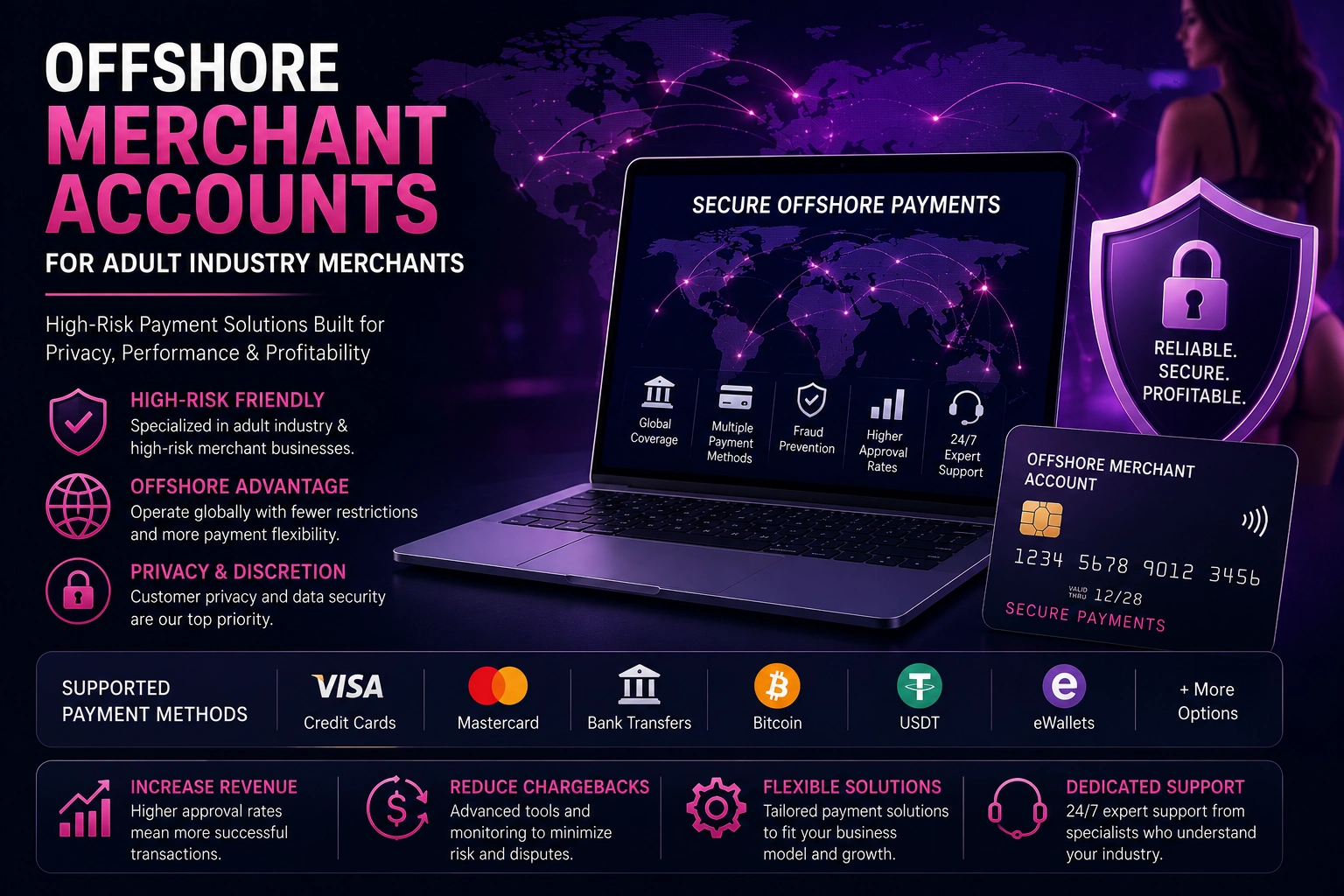
When domestic banks won’t touch an adult business, an offshore merchant account is often the fastest working path back to stable payment processing. It’s not a loophole, it’s a legitimate structure many high-risk categories rely on, adult content included. This guide covers how it actually works, which jurisdictions matter, and which providers are worth evaluating.
Offshore high-risk merchant accounts give adult businesses access to acquiring relationships domestic banks won’t extend, typically through an EU EMI (Electronic Money Institution) route or a more traditional offshore banking jurisdiction. Isle of Man, Cyprus, Georgia, Seychelles, and certain Caribbean territories are the most commonly used jurisdictions for adult merchants specifically. Expect higher fees and rolling reserves in exchange for approval odds domestic processors won’t offer, and treat offshore accounts as a complement to (not full replacement for) a primary banking relationship.
Why Adult Merchants Look Offshore
Adult content sits in the high-risk merchant category globally, and domestic banks in many markets simply decline the category outright regardless of business quality. Offshore payment providers and EMIs have built underwriting specifically around businesses in this position, evaluating actual compliance and processing history rather than filtering by industry code alone.
The Two Real Routes
EU EMI Licensing (PSD2)
EU EMIs licensed under PSD2 are generally the most accessible route for adult businesses today, providing IBAN and SEPA access, multi-currency accounts, and in some cases card issuing. This is often faster and better-documented than traditional offshore banking, and it’s increasingly the default starting point for adult merchants building payment infrastructure from scratch.
Traditional Offshore Banking Jurisdictions
The most commonly used offshore jurisdictions for adult businesses are the Isle of Man, Georgia, Seychelles, and select Caribbean territories, while Cyprus and Malta are generally easier for banks to work with than lower-tier jurisdictions like Seychelles or Belize. The strongest setups typically pair a credible offshore company jurisdiction with an EMI account in Europe or the US, balancing legitimacy with operational flexibility.
What Offshore Accounts Actually Offer
- Multi-currency and cross-border payments capability: useful for adult platforms serving a genuinely international subscriber base
- Higher approval odds: than domestic processors extend to this category, since underwriting is built around high-risk business models rather than blanket exclusion
- Card issuance and virtual cards: through many EMI structures, useful for operational expense management alongside customer-facing processing
- Jurisdictional diversification: reducing dependence on a single country’s banking relationship
The Real Tradeoffs
- Higher transaction fees and rolling reserves: than domestic processing, reflecting the elevated underwriting risk offshore providers absorb
- Longer approval timelines and heavier documentation: for full EU bank accounts specifically, though EMI routes are typically faster
- An offshore account that doesn’t require a real compliance file is also one that can close without notice: don’t sacrifice documentation rigor for speed
Providers Worth Evaluating
Several general high-risk and offshore-capable processors are worth researching for adult merchant relationships specifically, including PayCly and WebPay, both offer multi-currency, cross-border payments-oriented merchant services relevant to offshore structuring, though reviews on both are mixed enough that confirming current reserve terms directly is worth doing before committing volume. Boxcharge, Amald, and Inquid are newer entrants in this space positioning toward high-risk and offshore-adjacent merchant accounts, worth evaluating alongside more established EMI routes as your due diligence process develops.
For deeper offshore structuring guidance beyond the adult vertical specifically, see our companion guide on choosing the right offshore merchant account.
Decision Framework
If you’re a new adult business building payment infrastructure from scratch:
- Start with an EU EMI under PSD2, it’s generally the fastest, most accessible route with solid multi-currency support
If you’ve already been declined by domestic processors:
- Pair a credible offshore jurisdiction (Cyprus or Malta over lower-tier options) with an EMI account for the best balance of legitimacy and approval odds
If you’re scaling internationally:
- Layer a backup account in a different jurisdiction holding several months of operational reserve, so a single account disruption doesn’t stop your online payments entirely
Conclusion
Offshore merchant accounts are a legitimate, widely used solution for adult businesses locked out of domestic banking, not a workaround, but genuine infrastructure built for this exact situation. The EU EMI route offers the fastest path for most merchants today, while pairing a credible offshore jurisdiction with an EMI account gives the strongest combination of legitimacy and flexibility for established businesses. Whichever path you take, prioritize genuine compliance documentation over speed, it’s what keeps the account open long-term.
Frequently Asked Questions
Q: What’s the fastest way for an adult business to get offshore payment processing?
A: An EU EMI account under PSD2 is generally the most accessible and fastest route, offering IBAN, SEPA, and multi-currency support without the longer timeline traditional offshore banking requires.
Q: Which offshore jurisdictions work best for adult merchants?
A: Isle of Man, Georgia, Seychelles, and select Caribbean territories are commonly used, while Cyprus and Malta are generally easier for banks to work with than lower-tier jurisdictions.
Q: Should an adult business rely on offshore accounts alone?
A: No, offshore accounts work best as a complement to a primary banking relationship, with a backup account in a different jurisdiction protecting against a single point of failure.
Comments
No comments yet. Be the first to share your thoughts.
Leave a comment