
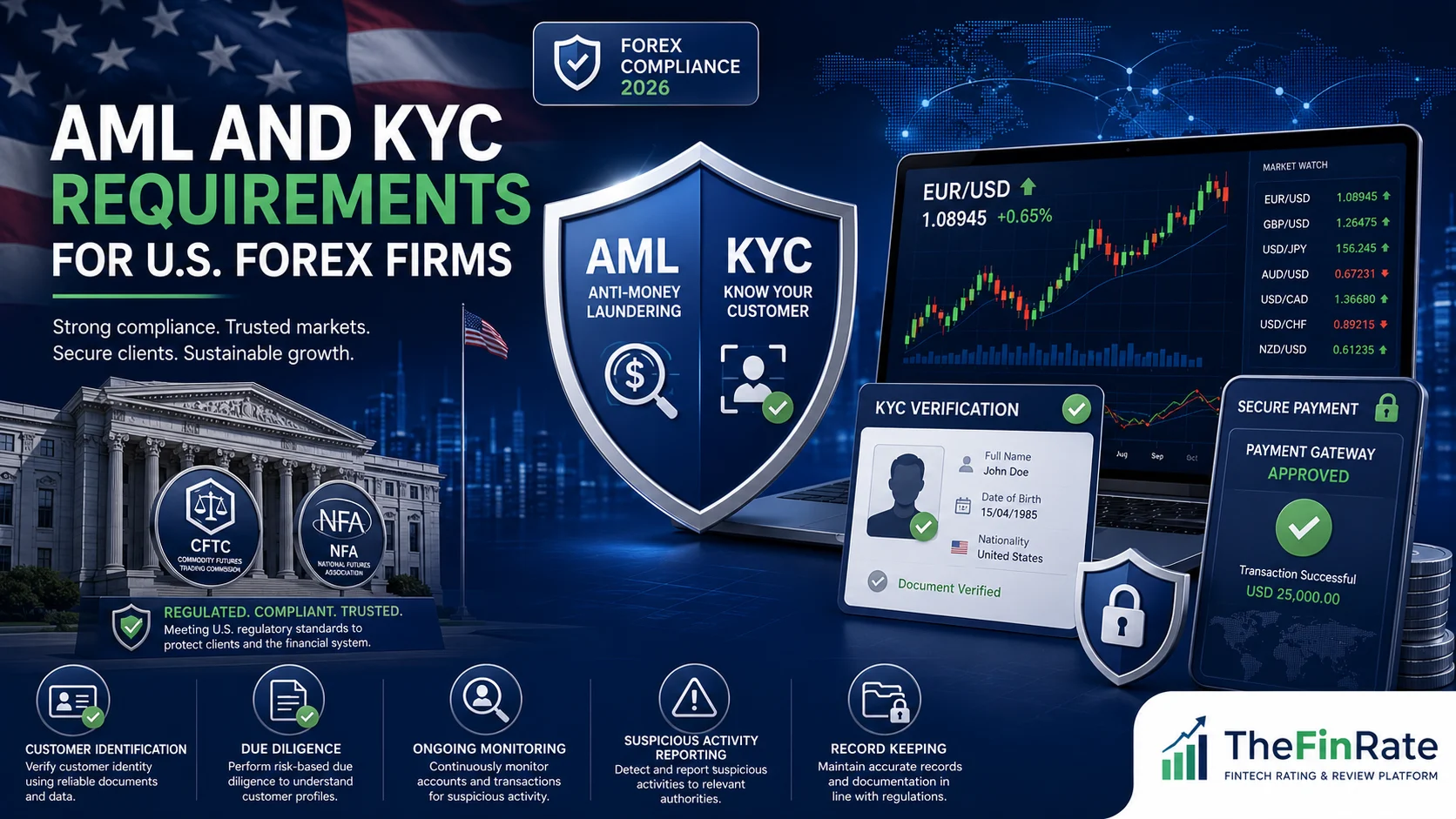
Forex is one of the easiest markets in the world to move large sums of money across borders quickly and with relatively little friction, which is exactly why it’s also one of the markets regulators watch most closely for money laundering activity. For any firm operating as an FCM, RFED, or Introducing Broker in the U.S. retail forex space, AML and KYC compliance isn’t an optional best practice layered on top of trading operations. It’s a legal requirement with real regulatory teeth behind it.
This guide breaks down exactly what’s required, why the requirements exist, where they come from legally, and how they connect directly to the banking and payment relationships that keep a forex firm operational. This is general regulatory information, not legal advice, AML/KYC program design should always involve qualified compliance counsel given how much liability rides on getting it right.
Why Forex Specifically Attracts This Level of Scrutiny
It’s worth understanding the “why” before the “what,” because it explains why regulators treat forex AML compliance as seriously as they do.
- Speed and volume: Forex transactions settle quickly and at massive scale, making it structurally harder to trace and interrupt suspicious activity compared to slower-moving asset classes
- Cross-border by design: Nearly every forex transaction inherently involves currency conversion and, often, movement of value across jurisdictions, exactly the pattern money laundering schemes rely on
- Leverage amplifies exposure: Because retail forex trading involves leverage, relatively modest deposited funds can control much larger notional positions, creating more complex money flows to monitor than a simple cash transaction would
- Historical precedent: The pre-Dodd-Frank retail forex market included documented cases of fraud and abuse that directly informed the more stringent AML expectations built into the post-2010 regulatory framework
None of this means forex trading itself is inherently suspicious, the overwhelming majority of activity is entirely legitimate. It means the market’s structural characteristics create genuine opportunity for abuse, which is exactly what AML and KYC programs are designed to detect and interrupt.
The Legal Foundation: Where These Requirements Actually Come From
The Bank Secrecy Act (BSA)
The Bank Secrecy Act functions as the backbone of AML compliance in the United States, providing regulators with broad authority to examine institutions and enforce violations. FinCEN’s implementing regulations, set forth in the Code of Federal Regulations, define which financial institutions are covered, establish AML program requirements, set customer due diligence obligations, and mandate specific reporting, including Suspicious Activity Reports (SARs) and Currency Transaction Reports (CTRs).
NFA Compliance Rule 2-9(c)
This is the specific rule that translates the BSA’s broad federal mandate into a direct obligation for forex firms. NFA Compliance Rule 2-9(c) requires each Member registered as an FCM or IB to maintain an AML program, with an accompanying Interpretive Notice explaining the specific standards that program must meet. Members must establish and implement policies, procedures, and internal controls reasonably designed to ensure compliance with the BSA’s AML provisions and related regulations.
Interpretive Notice 9045: The Customer Identification Program Requirement
As part of its AML program, each FCM and IB Member must adopt a written Customer Identification Program (CIP) that meets BSA requirements. For CIP purposes, a “customer” includes individuals or entities opening new accounts, meaning this requirement applies at the account-opening stage, not as an afterthought layered on later.
The Role of FinCEN and Other Federal Regulators
Beyond the CFTC and NFA specifically, additional regulatory guidance and enforcement authority around AML compliance is exercised by federal functional regulators including the Office of the Comptroller of the Currency, the Federal Reserve, the FDIC, the National Credit Union Administration, the SEC, and the CFTC itself, reflecting how AML obligations cut across the entire U.S. financial regulatory landscape rather than existing as a forex-specific silo.
The Core Components of a Compliant AML/KYC Program
1. Customer Identification Program (CIP)
Every account opening must run through a documented identification and verification process, confirming who the customer actually is before the account becomes operational. This is the foundational KYC layer underneath everything else in the program.
2. Risk-Based Customer Due Diligence (CDD)
Firms must develop risk-based, ongoing CDD procedures designed to:
- Understand the nature and purpose of customer relationships in order to develop an accurate customer risk profile
- Conduct ongoing monitoring to detect and report suspicious transactions
- Maintain and update customer information on a risk basis, including identifying and verifying beneficial owners
This isn’t a one-time check at account opening, it’s an ongoing obligation that scales with the actual risk profile of each customer relationship, meaning higher-risk customers warrant more frequent and more thorough review than lower-risk ones.
3. Sanctions, PEP, and Adverse Media Screening
Core AML requirements for brokers include screening for sanctions list matches, politically exposed persons (PEPs), and adverse media, layers designed to catch risk that basic identity verification alone wouldn’t flag. A customer can pass standard identity verification and still present elevated risk due to sanctions exposure or public corruption allegations, which is exactly what this additional screening layer exists to catch.
4. Suspicious Activity Report (SAR) Filing
Firms must have procedures in place to file Suspicious Activity Reports to relevant authorities within mandated timelines whenever they know, suspect, or have reason to suspect that a transaction involves illicit activity or is designed to evade BSA requirements. Each firm’s AML program must specifically require employees to promptly notify designated firm personnel of potentially suspicious activity, with appropriate supervisory personnel then evaluating that activity and deciding whether to escalate it to the firm’s Designated Self-Regulatory Organization or directly to FinCEN.
Notable SAR filing exemptions: FCMs and IBs are not required to file a SAR for activity related to a robbery or burglary, provided the activity is reported to the appropriate law enforcement agency. They’re also relieved of SAR filing for a Commodity Exchange Act, CFTC regulation, or NFA rule violation that’s already required to be reported through those specific regulatory channels, avoiding duplicate reporting for the same underlying event through different mechanisms.
5. Beneficial Ownership Identification
CDD procedures must include identifying and verifying beneficial owners of entity customers, not just the individual directly opening the account, a requirement that has taken on additional prominence following recent FinCEN beneficial ownership regulatory updates affecting the broader financial industry.
6. Recordkeeping and Documentation
SAR filings, and the underlying documentation supporting them, must be timely, complete, and confidential. Firms are also required to provide supporting documentation to relevant regulatory agencies upon request, meaning documentation practices need to hold up not just at filing time, but under subsequent regulatory review.
7. Independent Testing
A mature AML program includes periodic independent testing of AML controls to confirm they’re actually functioning as designed and meeting regulatory expectations, not just documented on paper but genuinely operational in practice.
Why “KYC Compliance Is Illegal to Skip” Isn’t an Exaggeration
In the U.S. specifically, FinCEN requirements mean non-KYC forex brokers are operating illegally, not just outside best practice. This is a meaningfully stronger legal position than “recommended”, a firm operating without a genuine KYC program isn’t cutting a corner, it’s violating a legal requirement with direct enforcement consequences attached.
What This Means for Payment and Banking Relationships
This is where AML/KYC compliance connects directly to the operational side of running a forex firm, and it’s a connection worth understanding clearly, because it affects far more than regulatory risk alone.
AML Program Maturity Is a Direct Underwriting Factor
Banks and payment providers evaluating a forex firm for merchant account or banking relationships don’t just check whether the firm is registered, they scrutinize the actual maturity of its AML program. A firm with a thin, poorly documented AML program presents meaningfully higher compliance risk to any bank or high-risk payment gateway provider extending it services, and that risk translates directly into harder underwriting, higher reserves, or outright rejection.
Correspondent Banking and Cross-Border Exposure
Because forex inherently involves cross-border payments, firms face additional scrutiny tied to correspondent banking relationships specifically. Banks providing correspondent banking services to forex firms carry their own AML exposure by extension, which is part of why the broader “de-risking” trend, banks proactively exiting entire high-risk categories rather than managing risk merchant-by-merchant, has hit forex-adjacent businesses particularly hard in recent years.
Documentation Quality Speeds Up Payment Onboarding
A forex firm with a genuinely well-documented CIP, CDD process, and SAR filing history in good standing moves through payment processing and banking onboarding meaningfully faster than one that has to reconstruct or defend gaps in its compliance history during underwriting review. This is the same dynamic seen across other high-risk categories: documentation that satisfies the legal requirement is, in nearly every case, the same documentation that satisfies a payment provider’s underwriting review.
Weak AML Programs Create Compounding Risk
A firm that treats AML/KYC as a minimal box-checking exercise doesn’t just risk regulatory enforcement, it risks losing access to the banking and payment gateway relationships the entire business depends on, since providers increasingly treat AML program quality as a threshold gate rather than a secondary consideration.
Building an AML/KYC Program: Practical Steps
For Newly Registering Firms
- Build the written AML program and CIP as part of initial registration preparation, not as a follow-up task after approval
- Designate specific personnel responsible for AML compliance, with clear escalation paths for potentially suspicious activity
- Establish sanctions, PEP, and adverse media screening as part of the account-opening workflow from day one, not layered on later
For Established Firms Strengthening an Existing Program
- Conduct a gap analysis of current CIP, CDD, and SAR filing procedures against current NFA and FinCEN expectations, since regulatory guidance and enforcement priorities continue to evolve
- Implement or strengthen ongoing, risk-based CDD monitoring rather than relying solely on point-in-time checks at account opening
- Schedule independent testing of AML controls on a regular cadence, and document the results and any remediation taken
For Firms Preparing for Payment or Banking Relationship Reviews
- Prepare AML program documentation as part of the standard package for any new banking or payment provider relationship, rather than waiting for it to be requested
- Be ready to demonstrate not just that a program exists on paper, but that it’s genuinely operational, staff training records, SAR filing history, and independent testing results all support this
- Understand that a stronger, well-documented AML program is one of the more direct levers a firm has to improve its odds with payment providers increasingly cautious about the forex category broadly
Where This Is Heading: Broader Regulatory Momentum
While the FCM/IB-specific AML requirements under NFA Compliance Rule 2-9(c) are well-established, the broader regulatory environment around AML/KYC in U.S. financial services continues to tighten. FinCEN’s recent final rule extending BSA-style AML/CFT program requirements to SEC-registered investment advisers, originally set for January 2026 and now delayed to January 2028, signals a broader regulatory trend toward closing AML gaps across financial services categories that historically fell outside traditional enforcement. Forex firms should expect continued regulatory attention in this direction rather than a loosening of standards.
Firms building AML programs today are well served by treating current requirements as a floor to build on, not a ceiling to meet minimally, both because standards are trending toward greater rigor, and because payment and banking partners increasingly reward demonstrably strong compliance with easier onboarding and better terms.
Decision Framework: What Your Firm Actually Needs
If you’re a newly registering FCM, RFED, or IB:
- Build your written AML program, including CIP, before or alongside your registration application, don’t treat it as a post-approval task
- Establish sanctions and PEP screening as a standard part of account opening from the start
- Budget for compliance staffing and independent testing as ongoing operational cost, not a one-time setup expense
If you’re an established firm with an aging or thin AML program:
- Prioritize a gap analysis against current NFA/FinCEN expectations before a routine examination or a payment provider review surfaces the gaps for you
- Strengthen ongoing CDD monitoring specifically, since point-in-time-only checks are one of the most common weaknesses examiners and payment underwriters flag
- Document independent testing results clearly, since “the program exists” and “the program is demonstrably functioning” are different claims to a reviewer
If you’re struggling to secure or maintain payment and banking relationships:
- Treat AML program documentation as a direct lever, not just a compliance requirement, present it proactively to prospective payment providers rather than waiting for it to be requested
- Consider whether gaps in SAR filing history, CDD documentation, or beneficial ownership verification are contributing to banking friction, since these are exactly the areas payment underwriters scrutinize most closely for forex-adjacent relationships
Conclusion
AML and KYC requirements for U.S. forex firms aren’t a bureaucratic add-on to the actual business of trading, they’re a legally mandated program with direct roots in the Bank Secrecy Act, operationalized specifically for forex firms through NFA Compliance Rule 2-9(c) and its supporting interpretive guidance. The firms that treat this program as core infrastructure, built and maintained with the same seriousness as capital requirements or trading systems, are the ones that move faster through both regulatory examination and payment provider underwriting, because in both cases, the same documentation answers the same underlying question: does this firm genuinely know who it’s doing business with, and can it prove it.
This article provides general regulatory information current as of 2026 and should not be treated as legal advice. AML/KYC program design carries significant compliance liability and should always involve qualified legal and compliance counsel familiar with your firm’s specific registration status and risk profile.
Frequently Asked Questions
Q: Is AML/KYC compliance legally required for all U.S. forex firms, or just a best practice? A: It’s a legal requirement, not a best practice. FCMs and IBs are required under NFA Compliance Rule 2-9(c), which implements Bank Secrecy Act obligations, to maintain a written AML program including a Customer Identification Program. In the U.S., non-KYC forex brokers are operating illegally.
Q: What’s the difference between a CIP and broader CDD requirements?
A: A Customer Identification Program (CIP) is the identity verification process conducted at account opening. Customer Due Diligence (CDD) is the broader, ongoing risk-based process of understanding a customer relationship’s nature and purpose, monitoring for suspicious activity, and updating customer information over time, CIP is a component within the larger CDD framework.
Q: When must a forex firm file a Suspicious Activity Report?
A: Whenever the firm knows, suspects, or has reason to suspect that a transaction involves illicit activity or is designed to evade BSA requirements, filed within mandated timelines. Certain exemptions apply, including robbery/burglary-related activity already reported to law enforcement, and violations already required to be reported through other CFTC or NFA regulatory channels.
Q: Does a strong AML program actually help with getting approved for payment processing?
A: Yes, directly. Banks and payment providers evaluating a forex firm treat AML program maturity as a core underwriting factor, since it directly affects the compliance risk the provider itself takes on by extending services to the firm.
Q: Are AML requirements for forex firms the same as the new FinCEN rule for investment advisers?
A: No, they’re separate frameworks. NFA Compliance Rule 2-9(c) has applied to FCMs and IBs for years. The newer FinCEN rule extending AML/CFT program requirements to SEC-registered investment advisers is a different regulatory category, currently delayed until January 2028, and doesn’t directly apply to forex FCMs, RFEDs, or IBs already covered under existing NFA requirements.
Q: What happens if a forex firm’s AML program is found deficient during examination?
A: Deficiencies can result in regulatory enforcement action from the CFTC or NFA, and separately, they materially weaken the firm’s standing with banks and payment providers who scrutinize AML program quality as part of their own risk management, meaning the consequences extend well beyond the regulatory relationship alone.
Comments
No comments yet. Be the first to share your thoughts.
Leave a comment