
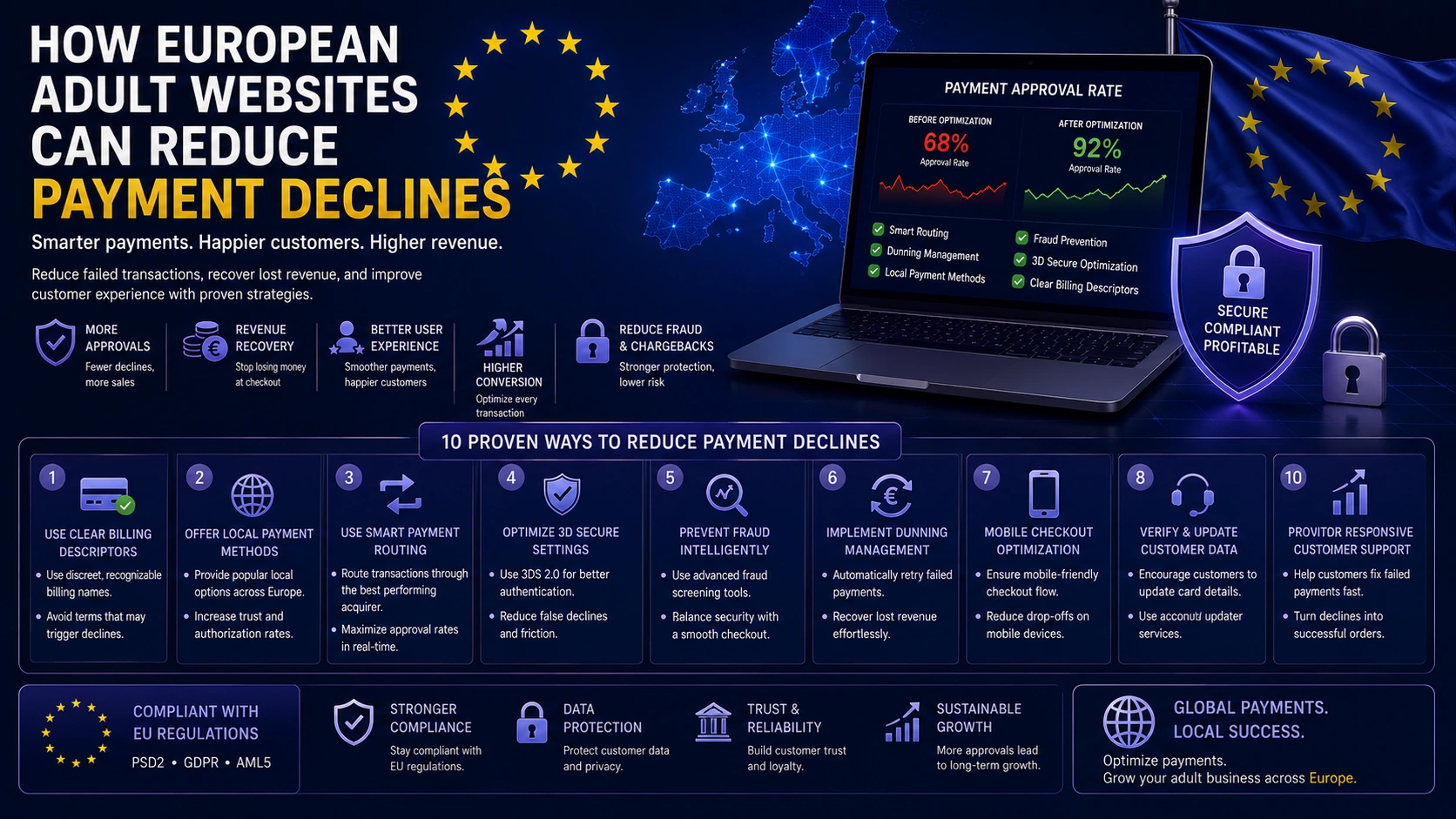
In France, 45% of shoppers abandon a purchase due to 3D Secure friction. In Italy, that figure hits 50%. For a European adult site, every one of those failed authentications is a customer who wanted to pay and couldn’t, not fraud, not a bad card, just a checkout flow that mishandled a mandatory regulatory step. This guide covers exactly where those declines come from and the specific, fixable technical causes behind them.
Most avoidable payment declines for EU adult sites trace back to how SCA/3D Secure 2.0 is implemented, not to fraud or bad cards. A soft decline (issuer response code 1A: “SCA required”) is recoverable if the merchant correctly re-initiates a 3DS2 challenge, but a large share of merchants mishandle this step entirely, turning a recoverable decline into a lost sale. Distinguishing soft declines from hard declines, correctly implementing recurring-billing exemptions, and diagnosing decline patterns by BIN and issuer are the highest-leverage fixes available.
Why EU Adult Sites See More Declines Than Other Categories
Two factors compound for this category specifically: PSD2’s Strong Customer Authentication mandate applies to every EU card-not-present transaction, and adult merchants already carry elevated issuer scrutiny from risk-based underwriting. A transaction that would clear frictionlessly for a low-risk retailer can trigger a full 3DS2 challenge for an adult merchant, and if that challenge is mishandled technically, a fully legitimate, willing-to-pay customer gets declined for reasons that have nothing to do with fraud.
Soft Decline vs. Hard Decline: The Distinction That Matters Most
A hard decline: is permanent, lost card, closed account, insufficient funds. Retrying the same transaction won’t help.
A soft decline: signals the issuer wants something more before it will approve, most commonly, under PSD2 in the EEA, response code 1A: the issuer has determined Strong Customer Authentication is required and the transaction wasn’t submitted with it. This is fully recoverable, but only if the merchant re-initiates the transaction through an actual 3DS2 challenge flow, a bare retry without authentication returns the identical decline every time.
Why this distinction matters practically: merchants who don’t distinguish these two decline types either give up on recoverable soft declines (losing real revenue) or blindly retry hard declines (wasting processing attempts and risking scheme penalties for excessive retries under system integrity rules that came into force in 2021).
Where Adult Sites Lose Recoverable Transactions
Mishandled Soft Decline Escalation
When an issuer returns a soft decline, the merchant’s checkout and payment platform needs to detect that specific response, initiate a fresh 3DS2 authentication with an active challenge, and present it to the customer, then resubmit for authorization with the completed 3DS data attached. Merchants that don’t support this escalation path simply see the transaction fail, full stop, when it was genuinely recoverable.
Poor Frictionless-Path Optimization
3DS2’s risk-based model is designed to approve most legitimate transactions frictionlessly, no challenge at all, using richer data exchange than older 3DS1 ever supported. Adult merchants sending thin or incomplete transaction data reduce their own frictionless approval rate, pushing more transactions into challenge flows than necessary, which directly increases both friction and abandonment.
Missing Recurring-Billing (MIT) Exemptions
For subscription-model adult sites specifically, this is a significant, fixable gap: if the very first charge on a card (placed with the customer actively present) completes SCA successfully, subsequent unattended renewal charges of the same or materially unchanged amount can typically skip authentication entirely under the merchant-initiated transaction (MIT) exemption. Sites not implementing this correctly force every single renewal through unnecessary friction, or worse, declines, since an unattended renewal charge with no customer present to complete a challenge simply fails outright.
Excessive or Incorrectly Structured Retries
Retrying a transaction without addressing the actual decline reason doesn’t just fail again, it can breach card scheme system integrity rules and result in scheme-issued fines. Every retry needs to map to the specific decline code returned, not a blanket “try again” approach.
The Diagnostic Approach: Decline Data by BIN, Issuer, and Code
Aggregate decline rate tells a merchant almost nothing actionable. Effective decline management requires breaking data down by decline code, issuer, BIN (bank identification number), gateway, and merchant ID, this is what actually reveals whether a spike traces back to a 3DS implementation issue, a specific issuer’s risk model, or a card brand-level pattern, rather than treating every decline as the same undifferentiated problem.
Practical Fixes, Prioritized
- Implement full soft decline escalation: Detect code 1A specifically, re-initiate with a proper 3DS2 challenge, and resubmit, this single fix recovers transactions that are currently being lost entirely
- Send richer transaction data to maximize frictionless approval: More complete data at the authentication request stage increases the share of transactions issuers approve without a challenge at all
- Implement MIT exemptions correctly for recurring billing: Confirm the initial signup transaction completes full SCA, then correctly flag subsequent renewals as exempt rather than forcing repeated authentication
- Build decline diagnostics by BIN/issuer/code: not just an aggregate decline rate, so fixes target the actual cause rather than guessing
- Structure retries to match the specific decline reason returned: avoiding both under-retrying recoverable soft declines and over-retrying hard declines that will never succeed
Decision Framework
If you don’t currently distinguish soft from hard declines: This is the highest-priority fix, implement decline-code-level tracking before anything else, since it’s the foundation every other improvement depends on.
If you’re a subscription-model adult site: Prioritize MIT exemption implementation specifically, given how much recurring-renewal volume is affected by this one technical gap.
If your decline rate is high but undiagnosed: Break decline data down by BIN and issuer before assuming the problem is fraud-related or requires a new processor entirely, many “declines” are actually recoverable authentication failures.
Conclusion
Most avoidable payment declines for European adult sites aren’t fraud, bad cards, or a category-wide banking problem, they’re technical gaps in how SCA and 3D Secure 2.0 are implemented at checkout. Soft decline escalation, frictionless-path optimization, correct MIT exemption handling, and decline diagnostics by BIN and issuer together recover a meaningful share of transactions currently being lost to friction alone, not genuine non-payment.
Frequently Asked Questions
Q: What’s the difference between a soft decline and a hard decline?
A: A hard decline is permanent (lost card, closed account) and retrying won’t help. A soft decline, commonly code 1A under PSD2, means the issuer wants SCA completed first, and is fully recoverable if the merchant re-initiates a proper 3DS2 challenge rather than just resubmitting the same request.
Q: Do subscription renewals need to go through full 3D Secure authentication every time? A: No, generally not, if the initial signup transaction completed full SCA with the customer present, subsequent unattended renewal charges of the same or materially unchanged amount typically qualify for the merchant-initiated transaction (MIT) exemption and can skip authentication.
Q: How much revenue can 3DS friction actually cost an adult site?
A: Significantly, based on broader survey data, 36% of UK shoppers, 45% in France, and 50% in Italy report abandoning a purchase specifically due to 3DS friction, figures that apply with particular force to a category already managing elevated checkout friction from other sources.
Comments
No comments yet. Be the first to share your thoughts.
Leave a comment