
A finance director asked me last year whether her company should move its treasury reserves to a non-custodial wallet after reading about an exchange collapse. My first question back wasn’t about security, it was about who on her team would be personally responsible for a private key that, if lost, meant the funds were gone forever. She hadn’t thought about that part. That gap is exactly where most businesses get this decision wrong: they evaluate custody type as a security question alone, when it’s really a governance and operational question first.
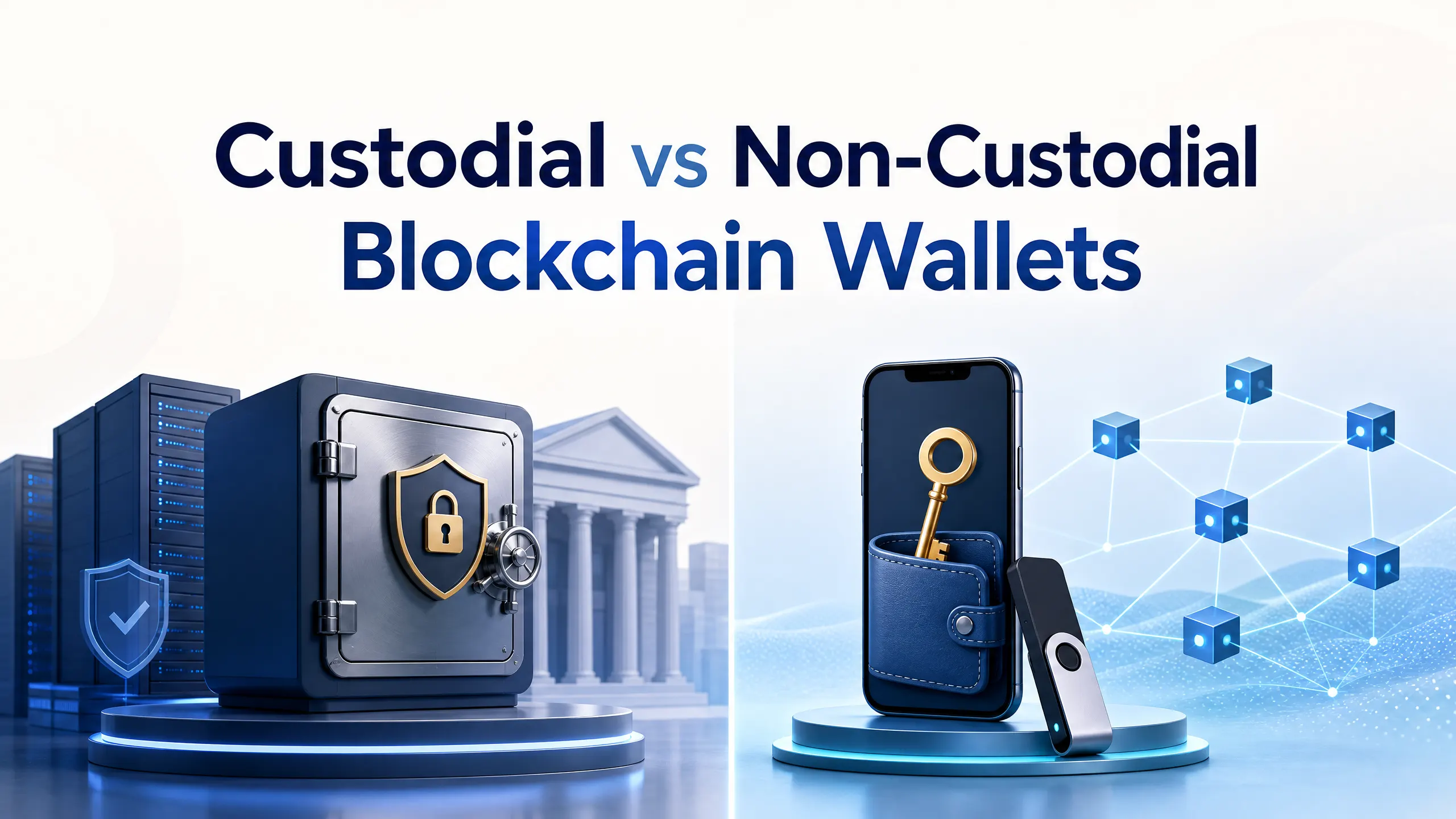
Custodial wallets hand private key management to a third party, an exchange or licensed custodian, trading some control for convenience, recovery options, and regulatory alignment. Non-custodial wallets put private keys directly in the business’2qsiness itself. In my experience, the right choice depends less on which model is “safer” in the abstract and more on regulatory status, internal security expertise, and transaction frequency. Most sophisticated enterprises I work with end up running a hybrid model rather than picking one exclusively.
Why This Decision Matters More Than Most Businesses Realize
Wallet custody isn’t just a technical setting, it determines who controls your assets, how you recover them if something goes wrong, and what regulatory protections apply. With an estimated 820 million active crypto wallets worldwide, and the wallet market projected to reach roughly $100.77 billion by 2033, this is no longer a niche decision affecting only crypto-native businesses. Any company accepting Crypto Payment or holding digital payments infrastructure needs a deliberate answer here, not a default one.
How Custodial Wallets Actually Work
A custodial wallet is one where a third party, typically an exchange or a licensed payment provider, holds and manages private keys on the business’s behalf. If your business receives crypto through a platform like a centralized exchange, you’re using a custodial wallet whether you’ve thought about it that way or not.
What I Tell Clients About the Advantages
- Recovery flows exist: Lost a password? There’s a standard process. Compare that to a lost private key on a non-custodial wallet, which is typically unrecoverable, full stop.
- Regulatory alignment is often built in: Licensed custodians frequently carry the compliance infrastructure, KYC, AML, reporting, that a regulated business needs anyway, bundled into the service.
- Fiat access is smoother: Custodial platforms generally offer more direct conversion between crypto and fiat, which matters for businesses using online payments infrastructure that expects rupiah, dollar, or euro settlement, not crypto balances sitting untouched.
- No specialized internal expertise required: A business doesn’t need staff who understand private key management, multi-signature setups, or cold storage protocols.
What I Make Sure Clients Understand About the Trade-offs
- Counterparty risk is real, not theoretical: The business is trusting the custodian’s own security, solvency, and operational integrity, a risk fully in someone else’s hands.
- Withdrawal restrictions can apply: Some custodial providers enforce limits, delays, or approval requirements on withdrawals, which can create friction exactly when speed matters most.
- Full ownership isn’t there: Assets can, in principle, be frozen or restricted by the provider, a risk I’ve seen catch businesses off guard during account reviews or compliance holds.
How Non-Custodial Wallets Actually Work
A non-custodial wallet, also called a self-custody wallet, puts private keys entirely in the business’s own hands. No third party can freeze, seize, or restrict access to the funds, because no third party has the keys in the first place.
The Advantages I Point Out First
- True ownership: Your keys, your crypto, no intermediary can unilaterally restrict access.
- Zero counterparty risk: There’s no custodian whose solvency or security posture the business needs to trust.
- Direct access to DeFi and broader blockchain functionality: which custodial platforms often restrict or don’t support at all.
- No withdrawal delays imposed by a third party: transactions move on the business’s own timeline.
The Trade-offs I Make Sure Nobody Underestimates
- The responsibility is total and unforgiving: There’s no third party to reverse a mistake or reimburse a loss, self-custody risk rests entirely with whoever controls the keys.
- Recovery is often impossible: Lose the seed phrase, lose the funds. There’s no customer support line for this.
- It demands real internal expertise: Multi-signature setups, secure key storage, and phishing-resistant operational habits aren’t optional extras, they’re the entire security model.
Why This Decision Looks Different for Enterprises Than for Individuals
This is the distinction I think gets flattened most often in generic wallet comparison content, and it’s the one that actually matters for a business reading this. Individual crypto holders weigh security against convenience. Enterprises face a fundamentally different set of questions: governance structures, regulatory compliance, insurance requirements, and operational workflows involving multiple stakeholders, not just one person’s judgment call.
For a regulated entity needing qualified custodian status, full custody is often close to a requirement, not just a preference, the compliance and insurance infrastructure a licensed custodian provides can be difficult or impossible to replicate internally. For a crypto-native company prioritizing maximum control and minimal counterparty exposure, self-custody, typically via multi-signature or MPC (multi-party computation) technology distributing key control among internal stakeholders, is often the better fit. Many enterprises I’ve worked with adopt a genuinely mixed model: custodial infrastructure for regulatory-facing balances and day-to-day payment processing, non-custodial cold storage for long-term treasury reserves that don’t need to move frequently.
A Decision Framework I Actually Use With Clients
| Factor | Favors Custodial | Favors Non-Custodial |
|---|---|---|
| Regulatory status | Regulated entity needing qualified custodian status | Crypto-native business with fewer regulatory constraints |
| Internal security expertise | Limited or none | Dedicated security or treasury function in place |
| Transaction frequency | High-frequency, operational, fiat-linked | Infrequent, long-term holding |
| Recovery tolerance | Needs standard recovery options | Comfortable with irreversible risk |
| Asset use case | Active payment processing, merchant settlement | Treasury reserves, DeFi participation |
Where the Broader Market Is Actually Heading
The trend data is genuinely mixed, and I think that nuance is worth understanding rather than picking a side. Some 2025 data suggests 59% of crypto users now prefer non-custodial wallets, with self-custody adoption up sharply year over year and hardware wallet sales rising too. At the same time, custodial services still hold the majority of the active trading population, and regulatory frameworks, MiCA in the EU, evolving US rules, FATF guidance, are increasingly built around applying traditional financial institution obligations specifically to custodial intermediaries. That regulatory gravity pulls regulated businesses toward custodial or hybrid models even as individual sentiment shifts the other way.
The Question I Ask Every Business Before Recommending Either Model
Before I tell a client which way to lean, I ask what actually happens if the person controlling the keys is unavailable, leaves the company, loses access, or worse. A custodial model has an institutional answer to that question built in. A non-custodial model only has an answer if the business has deliberately built one, usually through multi-signature governance requiring several stakeholders rather than trusting a single point of failure. I’ve seen businesses adopt self-custody for the ownership benefits without ever answering this question, and it’s the gap that turns a security upgrade into an operational crisis the day it’s actually tested.
Why I Push Back on “Not Your Keys, Not Your Crypto” as Business Advice
This phrase gets repeated constantly in crypto culture, and I understand where it comes from, it’s genuinely sound advice for an individual holder who wants to eliminate counterparty risk entirely. But I actively push back when a business applies it uncritically to enterprise treasury decisions, because the framing quietly ignores everything that makes business custody different from personal custody. An individual losing a seed phrase loses their own money. A business losing a seed phrase, because the one employee who managed it left the company without a documented handover process, has just created a governance failure that a board has to explain to shareholders or regulators.
The businesses I’ve seen handle this well don’t treat “custodial versus non-custodial” as a single binary ideological choice. They treat it as a portfolio decision, the same way they’d think about cash management: some funds need the accessibility and institutional backing of a custodial or bank-like relationship, and some funds, genuinely long-term reserves nobody needs to touch quickly, are well suited to the maximum control of self-custody, provided the internal governance around it is actually built out, not assumed. The mistake isn’t choosing non-custodial. It’s choosing it for reasons that make sense for an individual investor and forgetting that a business has stakeholders, succession risk, and audit obligations an individual simply doesn’t.
One More Distinction Worth Making Before You Decide
I’d add one final point that rarely comes up in standard wallet comparisons: the decision isn’t permanent, and treating it as a one-time choice is itself a mistake I see businesses make. A company’s optimal custody mix at launch, when transaction volume is low and regulatory exposure is minimal, often looks nothing like the right mix once that same company is processing meaningful cross-border payments volume or facing its first serious compliance review. I recommend clients revisit this decision on a fixed cadence, annually at minimum, rather than assuming the wallet architecture chosen in year one still fits the business in year three. The businesses that get caught out aren’t usually the ones that picked the wrong model initially; they’re the ones that never revisited a reasonable initial choice as the business itself changed shape around it.
Frequently Asked Questions
Is a custodial or non-custodial wallet safer for a business?
Neither is universally safer, it depends on the risk being managed. Custodial wallets reduce user-error and recovery risk; non-custodial wallets eliminate third-party counterparty risk entirely.
Can a regulated business use a non-custodial wallet?
Yes, but regulated entities needing qualified custodian status often find custodial or hybrid models easier to align with compliance and insurance requirements.
What happens if a business loses its non-custodial wallet’s private key?
In most cases, the funds are permanently inaccessible. There’s no recovery process comparable to a custodial provider’s account recovery flow.
Do most enterprises pick one model exclusively?
Not usually. Many enterprises run a hybrid approach, custodial infrastructure for active payment processing, non-custodial cold storage for long-term treasury holdings.
Are custodial wallets required for accepting crypto payments as a merchant?
Not required, but custodial or processor-managed wallets are common for merchant payment acceptance because they simplify fiat conversion and regulatory compliance.
What internal expertise does a non-custodial wallet require?
Businesses need genuine competence in key management, multi-signature or MPC setup, and security practices resistant to phishing and social engineering, this isn’t optional given the total responsibility involved.
Comments
No comments yet. Be the first to share your thoughts.
Leave a comment