
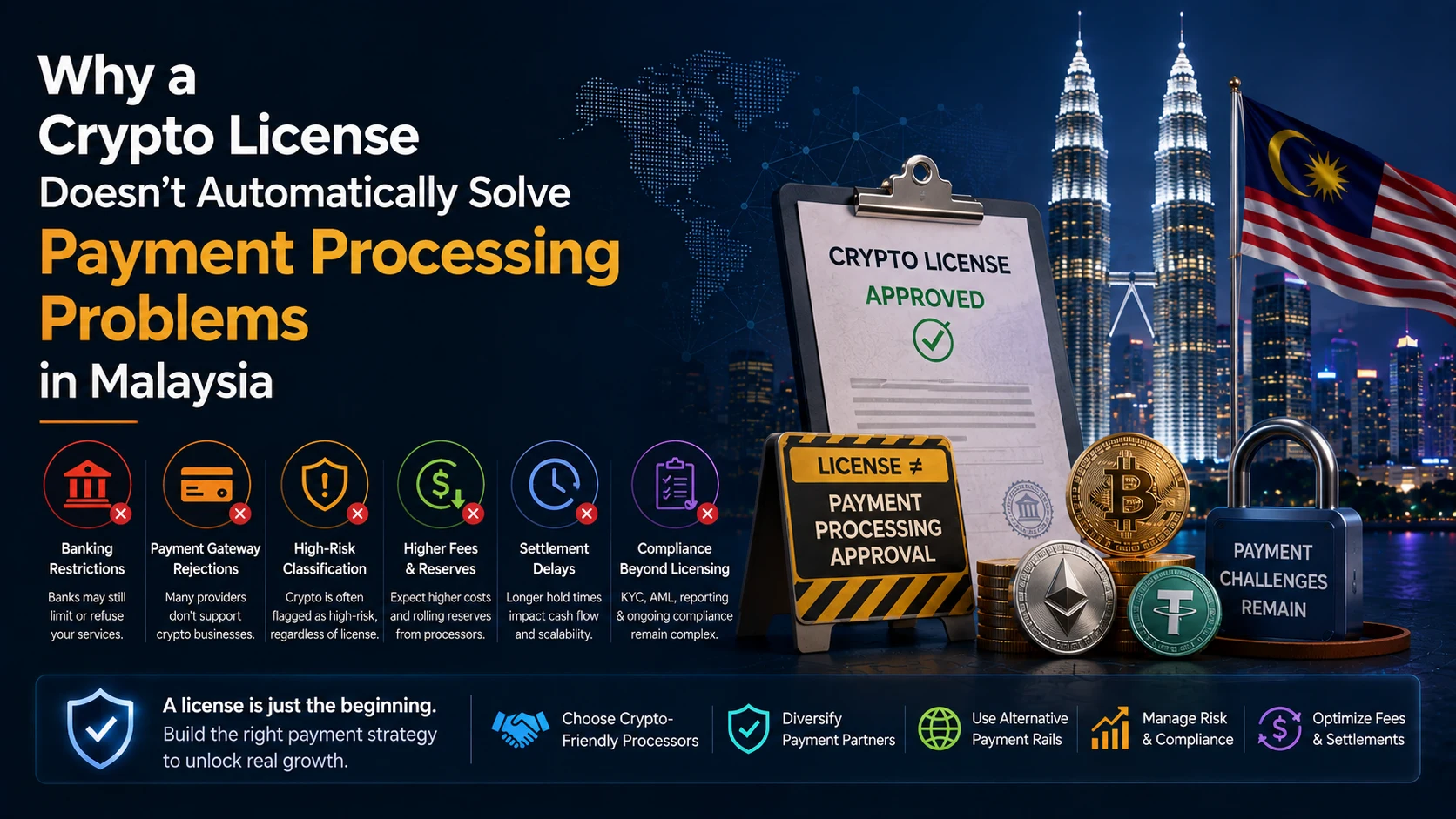
A Kuala Lumpur founder told me his Digital Asset Exchange registration felt like buying a car and discovering the dealership never installed the engine. He’d cleared Securities Commission Malaysia’s registration process, met the custody and disclosure requirements, and assumed payment processing would simply follow. It didn’t. I’ve had close to a dozen versions of this same conversation, and the reason is structural, not accidental: Malaysia’s crypto licensing regime and its payment processing infrastructure are governed by two different regulators with two different mandates, and getting one right says almost nothing about the other.
Securities Commission Malaysia licenses crypto exchanges, custodians, and token platforms as securities market operators, not as payment infrastructure providers. Bank Negara Malaysia, separately, doesn’t recognize crypto as legal tender at all, which means a licensed Malaysian crypto business still has to build payment processing capability from scratch, often through a different regulatory pathway entirely. In my experience, the businesses that struggle longest are the ones that assumed SC registration was a payments green light. It isn’t, and understanding exactly where the line sits is the difference between a smooth launch and a year of avoidable friction.
The Two-Regulator Problem Nobody Explains Clearly Enough
Malaysia runs crypto oversight through a genuine split. Securities Commission Malaysia classifies most digital assets as securities under the Capital Markets and Services Act, and licenses Digital Asset Exchanges, Digital Asset Custodians, and Initial Exchange Offering platforms under that framework. Bank Negara Malaysia, the central bank, sits entirely outside that securities framework, it doesn’t recognize crypto as legal tender or a valid payment instrument, and its role is limited to AML/CFT oversight and running its own fintech sandbox for tokenization and stablecoin experimentation.
I explain this to founders as plainly as I can: your Crypto Payment Provider ambitions and your exchange licensing sit in two different regulatory lanes that don’t automatically connect. An SC-licensed Digital Asset Exchange is authorized to operate a trading platform. It is not, by virtue of that licence, authorized or equipped to process online payments for goods and services the way a conventional payment gateway does. Those are separate capabilities requiring separate infrastructure, and often a separate licensing pathway altogether.
What Actually Happened in Malaysia’s Licensing Framework Recently
The framework itself has kept moving, which adds another layer founders need to track. As of December 2025, the SC had registered six Recognised Market Operators to establish and operate Digital Asset Exchanges, a meaningful expansion of the licensed field. In May 2026, the SC tightened capital requirements for exchange operators, though it gave existing licensees until May 2028 to comply, alongside broader moves to make token listing somewhat easier while adding stricter custody rules.
I flag this not because the licensing changes are dramatic, but because founders often treat “we got licensed” as a permanent, static achievement. It isn’t. The SC has kept refining disclosure requirements and expanding its recognised categories through 2025 and into 2026, and a business built around a snapshot of the rules from eighteen months ago can find its compliance posture quietly out of date without anything having gone obviously wrong on their end.
Where Payment Processing Actually Requires a Different Pathway
This is the part I think gets least attention in generic coverage of Malaysia’s crypto rules. Where a business’s activity looks like payment or money-services territory, a crypto-to-fiat remittance corridor is the clearest example, Bank Negara Malaysia can assert jurisdiction instead of the SC, which means payment service provider or electronic money issuer licensing pathways come into play, not the DAX framework. I’ve seen founders assume their exchange licence covers this kind of activity by extension. It doesn’t, and operating a remittance-style flow under exchange licensing alone is exactly the kind of gap that draws regulatory attention later rather than being caught at launch.
For a business that genuinely wants to accept digital payments from customers, not just facilitate trading , the practical path usually runs through proper payment services or e-money licensing, built and integrated separately from whatever DAX, DAC, or IEO registration the core trading business already holds.
The Operational Gaps I See Most Often After Licensing
Banking Relationships That Don’t Follow Automatically
Malaysian banks apply their own risk assessment to crypto-adjacent merchant accounts, independent of SC registration status. I’ve watched licensed, well-documented exchanges wait months for a workable banking relationship, because the bank’s own risk committee runs on a different clock and a different standard than the regulator’s approval did.
Settlement Infrastructure Built for Trading, Not Commerce
A licensed exchange’s settlement systems are typically built to move funds between a customer’s wallet and the trading platform, not to process a merchant’s day-to-day commercial transactions. I regularly see businesses discover, only after launch, that the settlement rails supporting their trading activity don’t translate into a functioning payment gateway for accepting customer payments elsewhere in the business.
Fraud and Compliance Tooling Calibrated to the Wrong Risk Model
Securities-focused compliance tooling, built around market conduct, insider trading, and disclosure risk, doesn’t transfer cleanly to payment processing risk, which is much more about transaction-level fraud, chargeback patterns, and real-time monitoring. I’ve reviewed compliance stacks that were genuinely strong on the securities side and essentially undeveloped on the payments side, because nobody had treated them as separate disciplines requiring separate tooling.
Cross-Border Complexity Without a Clear Provider Match
Malaysian crypto businesses serving regional customers face real friction finding payment providers willing to bridge crypto-adjacent risk with genuine cross-border payments capability. The provider list narrows quickly once a business needs both crypto-risk tolerance and multi-currency settlement competence in the same relationship.
Matching the Right Infrastructure to the Right License
| Licensing Status | What It Covers | What Still Needs Building |
|---|---|---|
| DAX (Digital Asset Exchange) registration | Trading platform operation, securities compliance | Merchant payment acceptance, commercial settlement rails |
| DAC (Digital Asset Custodian) registration | Custody of client digital assets | Payment processing for non-custody commercial activity |
| PSP/EMI licensing (BNM pathway) | Payment services, e-money issuance | Crypto-specific integration if the business also trades |
| No formal payment license, exchange-only | Nothing outside trading and custody | The entire payment processing stack, from banking to reconciliation |
What I’d Actually Recommend to a Newly Licensed Malaysian Crypto Business
Get clear, in writing if possible, on which regulator governs which part of your actual activity, don’t assume DAX registration extends to commercial payment acceptance just because both involve the same underlying assets. Start banking conversations independently and early, since approval on the SC side carries no weight with a bank’s own risk committee. If any part of the business resembles remittance or money-services activity, evaluate the BNM pathway specifically rather than stretching an exchange licence to cover it. And treat payment infrastructure, settlement, fraud tooling, reconciliation, as its own build, staffed and budgeted separately from securities compliance, because the two disciplines genuinely don’t overlap as much as founders expect going in.
Why I Point Merchants Toward Specialists Rather Than Generic Providers
For Malaysian crypto-adjacent businesses navigating this two-regulator split, I increasingly recommend working with payment providers who already understand both sides, the securities licensing context and the payment infrastructure requirement, rather than piecing together a generic merchant services stack and a separate compliance consultant with no shared context. A high-risk payment gateway specialist familiar with this exact regulatory split can shortcut months of the trial-and-error I’ve watched other merchants go through, even though the fees typically run above what a standard merchant account would cost.
The Mistake I See Founders Make When They Try to Solve This Alone
The instinct I run into most often is a founder trying to bridge the SC/BNM gap internally, treating it as a documentation exercise their compliance team can handle alongside everything else. I understand the appeal, hiring an additional specialist feels like an unnecessary cost when the core licensing work is already done. But the two regulatory frameworks don’t just differ on paper; they require genuinely different operational muscle. A team that’s spent a year mastering securities disclosure and custody requirements under the SC doesn’t automatically develop payment-processing fraud intuition or settlement-rail expertise just because the underlying business is the same.
I’ve watched this play out the same way more than once: a compliance team stretches to cover both disciplines, technically checks every box on paper, and still ends up with a payment experience that frustrates customers and a banking relationship that takes twice as long as it should. The founders who avoid this bring in dedicated payment expertise early, treating it as a distinct hire or partner relationship rather than an extension of existing compliance headcount. It costs more upfront. It’s consistently cheaper than the alternative.
Frequently Asked Questions
Does an SC exchange license cover payment processing in Malaysia?
No. Securities Commission Malaysia licenses exchanges, custodians, and token platforms as securities market operators, not as payment infrastructure providers. Payment processing capability has to be built or licensed separately.
Why doesn’t Bank Negara Malaysia treat crypto as a payment method?
BNM does not recognize crypto as legal tender or a valid payment instrument, which is why crypto-adjacent payment activity, where it exists, typically needs a separate PSP or EMI licensing pathway rather than falling under crypto exchange rules.
When does a crypto business need BNM licensing instead of SC registration?
When the activity resembles payment or money-services territory, such as a crypto-to-fiat remittance corridor, BNM can assert jurisdiction instead of the SC’s DAX framework applying.
Do Malaysian banks treat SC-licensed crypto businesses as low risk automatically?
Not necessarily. Banks apply their own independent risk assessment to crypto-adjacent merchant accounts, and SC registration doesn’t guarantee a smooth or fast banking relationship.
What changed in Malaysia’s crypto licensing in 2026?
The SC tightened capital requirements for exchange operators in May 2026, with existing licensees given until May 2028 to comply, alongside continued expansion of registered exchanges and evolving custody and disclosure rules.
Should a licensed exchange build its own payment processing or use a specialist?
In my experience, working with a specialist payment provider familiar with Malaysia’s two-regulator split is usually faster and more reliable than assembling generic infrastructure and compliance support separately.
Comments
No comments yet. Be the first to share your thoughts.
Leave a comment