
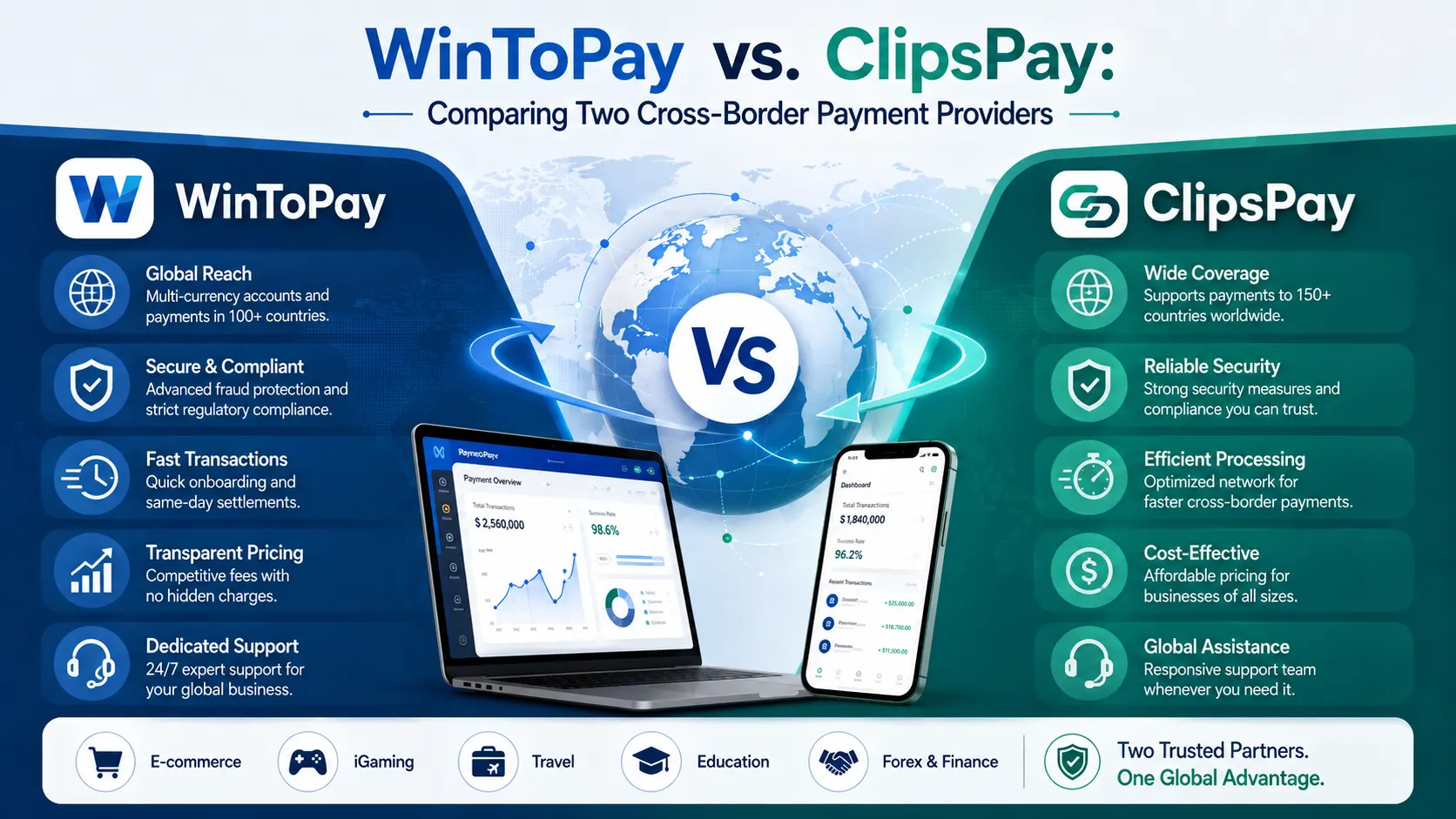
Choosing a cross-border payment provider is a trust decision as much as a technical one. Two smaller, less widely known names that come up in cross-border payment provider searches are WinToPay and ClipsPay, both positioning themselves as global payment gateways for merchants selling internationally.
Here’s a straightforward look at what each claims to offer, how they compare on paper, and — just as importantly, what independent trust signals show about each before you consider them for your payment processing stack.
Why This Comparison Matters
Cross-border payments are one of the hardest categories for merchants to get right. You need a payment gateway that supports multiple currencies, local payment wallets, and reliable settlement, while also being confident the provider holding your transaction funds is actually going to pay out.
That second part is where smaller, less-established payment providers deserve more scrutiny than household names like Stripe or Adyen. A polished website and a long features list aren’t proof of reliability, verified track record is.
WinToPay: What It Claims to Offer
WinToPay positions itself as a global cross-border acquiring service, reportedly founded in 2013 and focused on payment solutions for cross-border ecommerce merchants. According to its own marketing, it holds a Hong Kong Money Service Operator (MSO) license, is registered as a US Money Services Business (MSB), and is PCI DSS certified.
Claimed capabilities include:
- Support for major card networks including Visa and Mastercard
- One-click access to a large network of global payment gateways and local payment methods
- Multi-language payment pages supporting 20+ languages
- Localized operations across Europe, the US, the Middle East, and Asia-Pacific
- Support for digital payments, payment wallets, and buy-now-pay-later options in some markets
What Independent Sources Show About WinToPay
This is where merchants should slow down. Independent trust-scoring and review sources paint a considerably less confident picture than WinToPay’s own marketing:
- A widely used scam-detection service assigns WinToPay a low trust score, flagging it as “Questionable” with indicators tied to potential phishing and spam activity
- Another independent site-safety checker flags wintopay.com as a site that “might be a scam” based on aggregated risk indicators
- Trustpilot reviews for WinToPay average around 2.1 out of 5 stars, with multiple recurring complaints about undelivered refunds, unresponsive customer support, and, in at least one review, an allegation that the company was involved in cloning a legitimate merchant’s website
- Some reviewers do report positive experiences with straightforward card transactions, but the volume and consistency of negative reports stand out
None of this definitively proves fraudulent activity, third-party trust scores aren’t a court ruling, and negative reviews exist for every payment company at some scale. But the pattern here, low algorithmic trust scores from multiple independent tools, plus a below-average review history with specific, recurring complaint types, is meaningfully different from typical customer-service grumbling, and it’s the kind of signal a merchant should weigh seriously before routing revenue through a provider.
ClipsPay: What It Claims to Offer
ClipsPay markets itself similarly, as a global online payment solution built through partnerships with banks and payment institutions across multiple countries, aimed at cross-border ecommerce merchants.
Claimed capabilities include:
- Credit and debit card processing, mobile payments, and recurring billing support
- Access to over 200 local payment methods across various countries and regions
- Integration with dozens of digital wallets, particularly across Asian markets
- E-commerce platform integrations for a smoother checkout experience
- Reporting and analytics tools for monitoring transaction and customer behavior data
- Advertised security measures including encryption, tokenization, and real-time fraud detection
What Independent Sources Show About ClipsPay
ClipsPay’s independent trust picture is more mixed than clearly negative:
- One scam-detection tool gives it a “medium” trust score, flagging it as “Questionable”, a step above WinToPay’s rating but still not a clean bill of health
- A separate site-safety checker rates it as “very likely not a scam,” citing domain age and SSL certification as positive signals, while cautioning that no automated tool can guarantee legitimacy
- ClipsPay has notably low web traffic and visibility, consistent with a small or early-stage platform rather than an established processor
- There isn’t a comparable pattern of specific fraud-related complaints in public review sources at the time of writing
In short: ClipsPay reads less like a red flag and more like an unproven, low-visibility provider, the caution here is about limited track record, not documented complaint patterns.
WinToPay vs. ClipsPay: Feature Comparison
| Category | WinToPay | ClipsPay |
|---|---|---|
| Founded (claimed) | 2013 | Not clearly disclosed |
| Licensing (claimed) | Hong Kong MSO, US MSB registration | Not clearly disclosed |
| Local payment methods | 140+ payment systems claimed | 200+ local payment methods claimed |
| Digital wallets | Supported, claimed | Strong claimed focus on Asian digital wallets |
| Independent trust score | Low (“Questionable,” flagged for phishing/spam risk) | Medium (“Questionable,” no fraud-pattern complaints found) |
| Review reputation | ~2.1/5 average, recurring refund and support complaints | Limited public review volume |
What This Means If You’re Choosing Between Them
Feature lists between smaller cross-border payment providers tend to look similar on the surface, most claim broad local payment method coverage, wallet support, and multi-currency settlement. The differentiator that actually protects your business is verification, not marketing copy.
Before committing transaction volume to either provider, or any less-established payment gateway, merchants should:
- Verify licensing claims directly: with the stated regulatory body rather than taking a website’s word for it
- Check independent trust and scam-detection tools yourself: since these ratings change over time
- Read recent reviews, not just the volume of them: a handful of five-star reviews next to specific, detailed complaints about non-payment is a pattern worth taking seriously
- Start with a small transaction volume: before routing significant revenue through an unfamiliar processor
- Confirm settlement timelines and dispute processes in writing: before integration, not after a problem arises
Broader Context: What Merchants Actually Need From a Cross-Border Payment Provider
Regardless of which specific provider you’re evaluating, a legitimate cross-border payments partner should offer:
- Verifiable licensing appropriate to the markets you’re operating in
- Transparent merchant accounts terms, including reserve policies and settlement timelines
- Real support for the online payments and digital payments methods your customers actually use, including regional payment wallets
- A documented, responsive process for handling disputes and chargebacks
- If you fall into a restricted category, access to a properly underwritten high-risk payment gateway rather than a generic merchant services signup
Smaller providers can be legitimate and useful, particularly for reaching markets where major processors have limited local payment method coverage. But “smaller and newer” also means the burden of verification sits more heavily on the merchant than it would with an established, independently audited processor.
FAQ
Is WinToPay a legitimate payment provider? WinToPay claims licensing as a Hong Kong MSO and US MSB, but independent trust-scoring tools give it a low trust rating, and its Trustpilot reviews show a recurring pattern of refund and support complaints. Merchants should independently verify its licensing and proceed cautiously rather than relying on its own marketing claims.
Is ClipsPay safer than WinToPay? Based on available independent data, ClipsPay doesn’t show the same pattern of fraud-related complaints as WinToPay, but it also has a thinner public track record overall. “Fewer red flags” isn’t the same as “verified reliable”, both warrant independent due diligence.
What should merchants check before using a smaller cross-border payment gateway? Verify licensing claims directly with the named regulator, check multiple independent trust-scoring tools, read recent detailed reviews rather than just star averages, and start with limited transaction volume before scaling up.
Are there better-established alternatives for cross-border payments? Yes – larger processors with longer independently verified track records, such as those covered in TheFinRate’s broader payment provider guides, generally carry lower reputational risk for merchants prioritizing payment processing reliability over niche local payment method coverage.
Why doesn’t this article declare a clear winner between WinToPay and ClipsPay? Because the evidence doesn’t support one. WinToPay’s documented complaint pattern and low trust scores are a real concern, not a marketing footnote, and presenting either brand as a confirmed “winner” in cross-border dominance would overstate what’s actually verifiable.
Comments
No comments yet. Be the first to share your thoughts.
Leave a comment