
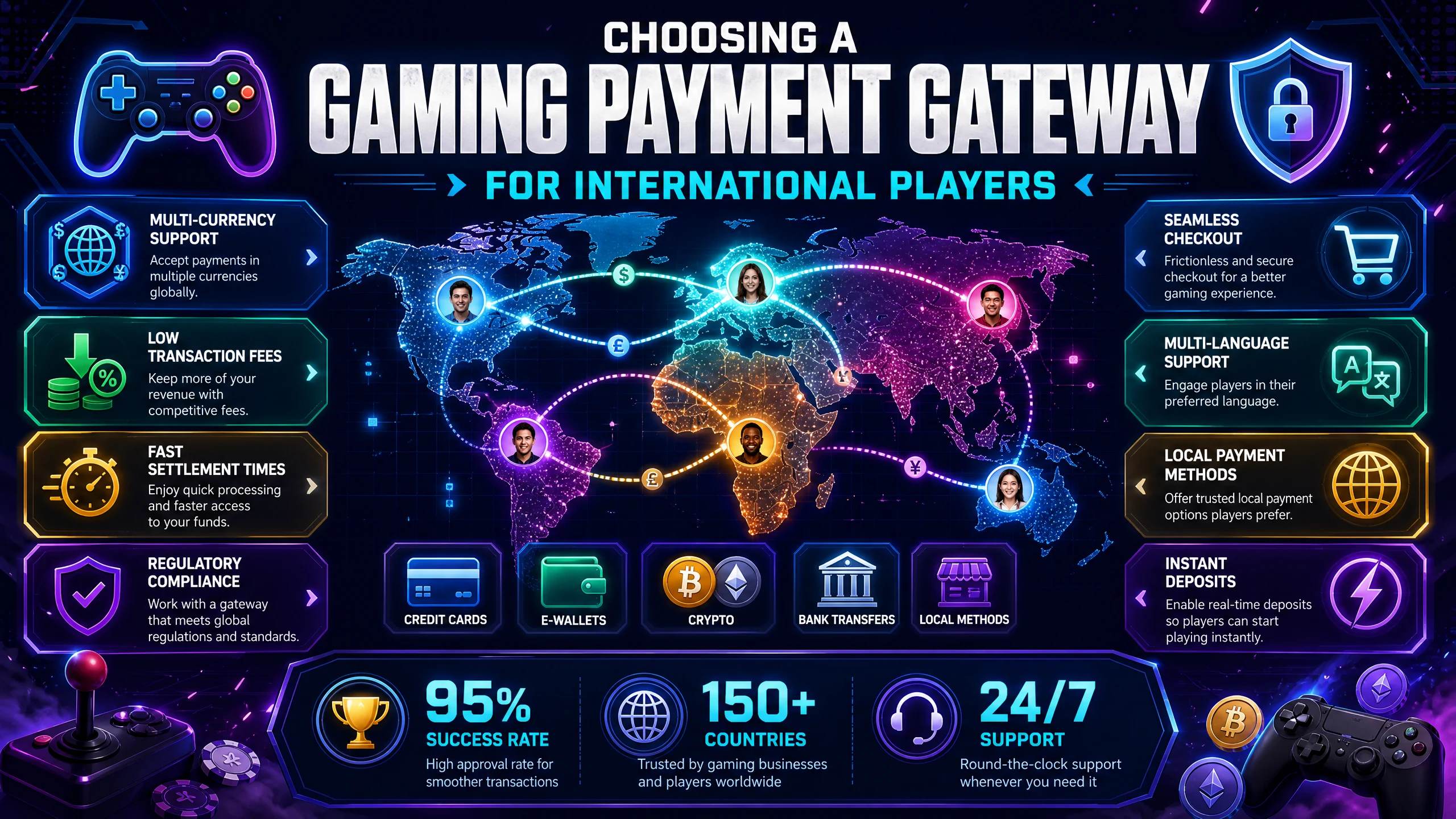
Running a gaming platform for a global audience means one payment method will never be enough. Players expect local cards, wallets, and sometimes crypto, and your payment gateway needs to handle all of it without triggering compliance headaches or losing revenue to failed transactions.
A gaming platform serving international players needs a payment gateway built for iGaming Payment and Casino Payment, not a generic e-commerce processor. Look for multi-currency support, local alternative payment methods, strong fraud tooling, and licensing awareness across your target markets. Gaming is classified as high-risk almost everywhere, so approval speed and reserve terms matter as much as the fee percentage. The right provider treats cross-border payments and regulatory variation as core functionality, not an afterthought.
Why Gaming Needs a Specialized Payment Gateway
Gaming and gambling platforms face a different risk profile than typical online payments businesses, and standard processors usually aren’t equipped, or willing, to handle it.
High-Risk Classification by Default
Almost every card network and acquiring bank classifies Casino Payment and iGaming Payment activity as high-risk, regardless of how well-run the platform is. This isn’t about trustworthiness, it’s about chargeback rates, regulatory exposure, and the volatility of gambling-related disputes.
Licensing Varies by Jurisdiction
Gambling regulation differs dramatically between countries. A payment gateway needs to understand which markets it can legally serve and how licensing requirements affect settlement and reporting.
Players Expect Local Payment Methods
International players don’t want to hunt for a workaround. They expect the alternative payment methods they already use at home, local bank transfers, regional e-wallets, or crypto payments, available at checkout.
What to Look for in a Gaming Payment Gateway
1. High-Risk Underwriting Experience
Choose a provider that already works with high-risk merchants in gaming, not one bolting on gambling support as an afterthought. Existing experience means faster onboarding and fewer surprise account freezes.
2. Multi-Currency and Local Payment Coverage
International reach depends on accepting the way players actually pay. Prioritize gateways offering:
- Multi-currency processing and local currency settlement
- Regional e-wallets and bank transfer options
- Card acceptance across major and regional networks
- Optional crypto payments support for players who prefer digital assets
3. Fraud and Risk Tools Built for Gaming
Gaming platforms deal with bonus abuse, multi-accounting, and higher fraud attempts than typical retail. Look for velocity checks, device fingerprinting, and real-time risk scoring as standard features, not add-ons.
4. Fast, Reliable Payouts
Player trust depends heavily on withdrawal speed. A gateway that delays payouts, even for compliance reasons, creates reputational risk faster than almost any other issue in merchant services.
5. Compliance and Reporting Support
Look for payment providers who understand AML obligations, KYC verification flows, and jurisdiction-specific reporting. This matters more in gaming than almost any other digital payments vertical.
6. Transparent High-Risk Terms
Since gaming almost always falls under high-risk payment gateway pricing, get clarity upfront on:
- Rolling reserve percentage and holding period
- Chargeback fees and thresholds
- Settlement timelines by currency
- Termination and account review policies
Standard vs. Gaming-Specialized Gateways
| Feature | Standard Payment Gateway | Gaming-Specialized Gateway |
|---|---|---|
| High-risk underwriting | Limited or none | Built-in |
| Local payment method coverage | Basic | Extensive, region-specific |
| Crypto payment support | Rare | Often available |
| Fraud tools for bonus abuse | Not designed for it | Purpose-built |
| Licensing/compliance awareness | Generic | Jurisdiction-specific |
| Approval speed for gaming merchants | Slow or declined | Faster, risk-priced upfront |
Offshore and Cross-Border Considerations
Many international gaming operators structure their business through an offshore merchants account to access more flexible underwriting and better multi-currency settlement. This isn’t unusual, it’s a standard approach for platforms serving players across dozens of countries, provided it’s set up through a properly licensed payment gateway partner that understands cross-border payments compliance.
FAQ
Why is gaming considered high risk by payment processors?
Gaming and gambling carry elevated chargeback rates, regulatory scrutiny, and fraud exposure compared to typical retail transactions, which places them in standard high-risk merchant classifications.
Do gaming platforms need different gateways for different countries?
Not always a fully separate gateway, but the provider needs strong local payment method coverage and jurisdiction-aware compliance to serve multiple regions effectively.
Can gaming platforms accept crypto payments?
Yes, many gaming-specialized gateways support crypto trading-adjacent payment options alongside cards and wallets, giving international players more flexibility.
What’s a reasonable rolling reserve for a gaming merchant account?
Reserve percentages vary by provider and risk profile, but gaming merchants should expect a reserve as standard practice rather than a red flag when comparing offers.
Is an offshore merchant account necessary for international gaming platforms?
Not strictly necessary, but it’s a common structure that offers more flexible underwriting and multi-currency settlement for platforms with a global player base.
How important is payout speed for player retention?
Very important, slow withdrawals are one of the top reasons players distrust or abandon a gaming platform, making payout speed a key gateway selection criterion.
Comments
No comments yet. Be the first to share your thoughts.
Leave a comment