
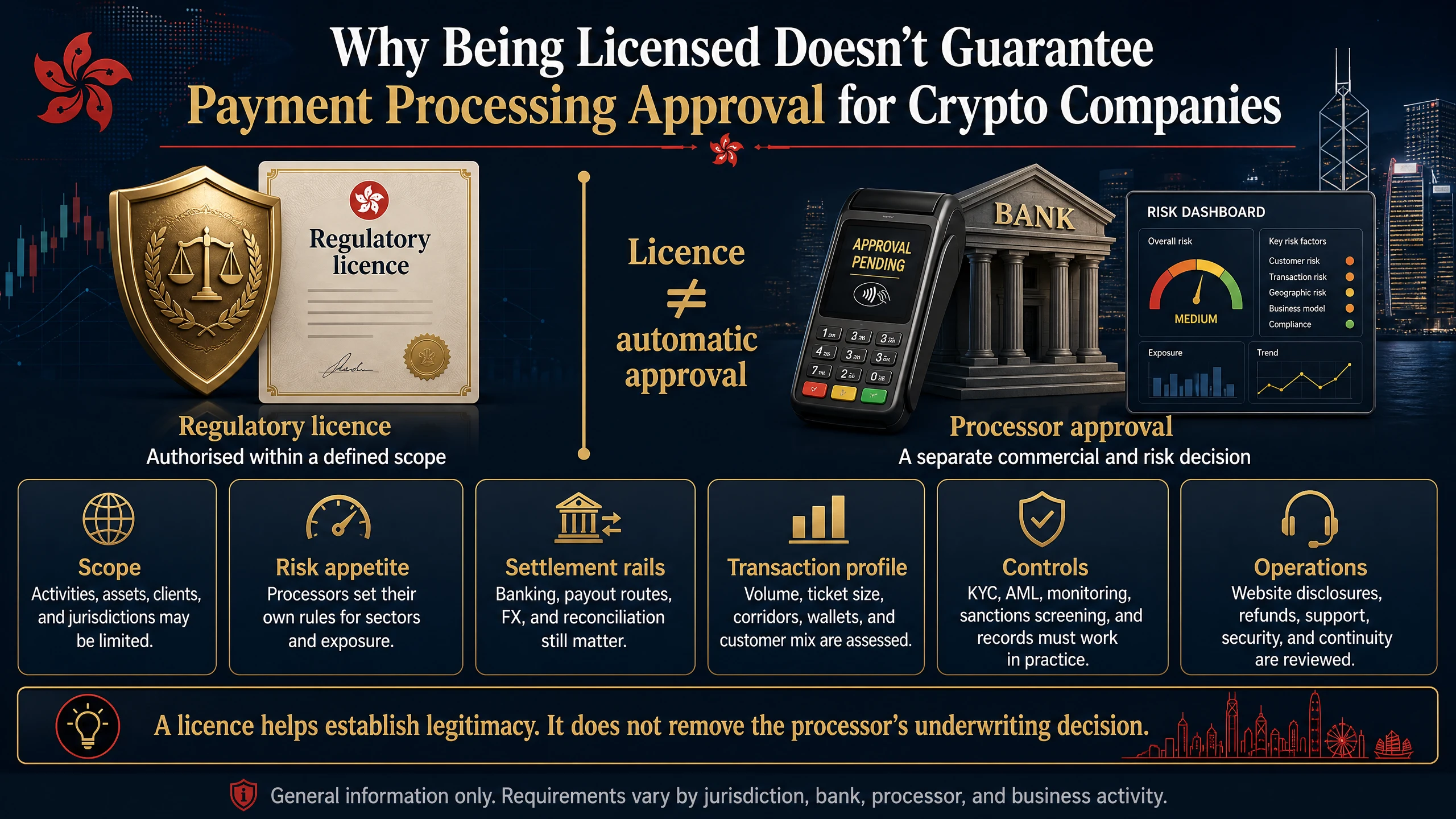
I’ve lost count of how many fully licensed crypto founders have called me confused and a little angry, some version of the same sentence every time: “We passed the regulator, why won’t a payment provider touch us?” I understand the frustration. Getting licensed is genuinely hard, capital requirements, compliance staffing, months of review. It’s reasonable to assume that clearing the hardest gate means the rest follows. It doesn’t, and understanding exactly why is the difference between planning realistically and getting blindsided.
A license proves a regulator is satisfied with your compliance posture. It doesn’t obligate any bank or payment provider to accept your business’s risk. Those are two separate institutions making two separate decisions on two separate timelines, with different incentives entirely. In my experience, licensed crypto companies that treat payment processing approval as automatic waste months they didn’t need to lose, the ones who plan for both gates independently, in parallel, get to market faster and with far less friction.
The Distinction I Explain in Almost Every First Conversation
A regulator’s job is to decide whether your business is allowed to operate. A payment processor‘s job is to decide whether it wants to carry your transaction risk on its own books. Those are fundamentally different questions, evaluated by fundamentally different institutions, and passing one tells you almost nothing about how the other will go.
I’ve watched founders conflate these so consistently that I now draw the distinction explicitly, every time, before we talk about anything else. Your regulator cares whether you meet AML/CFT standards, capital requirements, and consumer protection rules. Your payment provider cares whether carrying your specific transaction volume creates acceptable financial, reputational, and regulatory exposure for them. A business can score perfectly on the first question and still fail the second, because the second question is fundamentally about someone else’s risk appetite, not your compliance record.
Why Payment Providers Evaluate Licensed Businesses Independently
Underwriters function, in practice, as risk assessors for whoever is ultimately carrying the transaction exposure, an acquiring bank, a card network, or the processor’s own balance sheet. They analyze the viability of your entire business model, not just whether a regulator signed off on it. Two licensed crypto companies can apply to the same processor in the same week; one gets approved quickly, the other gets declined before pricing is even discussed. The difference is rarely the license itself. It’s how clearly the underlying risk can be understood, verified, and managed by the party taking it on.
This is why I tell every newly licensed client the same thing: your license is necessary, and it genuinely helps, but it functions as one input into a payment provider’s decision, not a determining one. Crypto businesses specifically get closely reviewed for AML exposure, regulatory complexity, and volatility regardless of licensing status, because those risk factors don’t disappear the moment a regulator approves you.
What Payment Providers Actually Look At, Beyond the License
Transaction History and Volume Patterns
If the business has processed before, underwriters typically review monthly volume, chargeback and refund ratios, approval rates, average ticket size, and prior acquirer relationships. None of that shows up on a regulatory license. A licensed business with no processing history still looks, to an underwriter, like an unknown quantity.
Source-of-Funds and Wallet Monitoring Controls
Strong applications explain source-of-funds controls, wallet monitoring, on-ramp and off-ramp flows, and customer verification in operational detail, not just a reference to the license covering it. I’ve seen licensed businesses lose underwriter confidence simply by assuming the license spoke for itself here, when the underwriter wanted the operational specifics spelled out.
Customer Acquisition and Traffic Quality
Underwriters increasingly review how customers actually reach checkout, affiliate traffic, paid acquisition, GEO targeting, traffic stability, independent of licensing status entirely. A perfectly licensed business with volatile or unclear acquisition patterns still reads as elevated risk, because that’s a different risk category than the one the regulator assessed.
Banking Relationships Running on a Separate Clock
Getting licensed doesn’t produce a bank willing to hold your merchant accounts or settle your funds. Banks make that decision on their own timeline and risk model, often slower than the licensing process itself. I’ve had clients fully licensed and ready to operate, sitting for months waiting on banking relationships that should have started the same month as the licensing application, not after approval.
Where I See This Gap Cause the Most Damage
The costliest version of this mistake isn’t a single declined application, it’s a founder who builds an entire launch timeline assuming payment infrastructure follows automatically from licensing, then discovers the gap only after the license clears and the launch clock is already running. Cross-border payments capability, fraud tooling calibrated to crypto-specific risk, reconciliation systems that scale past a handful of daily transactions, none of that comes bundled with regulatory approval, and building it after the fact under launch pressure produces worse infrastructure than building it in parallel, calmly, ahead of time.
How Licensed Businesses Should Actually Sequence This
| Workstream | Who Controls the Timeline | When to Start |
|---|---|---|
| Regulatory licensing | The regulator | As early as possible |
| Banking relationship | The bank’s own risk committee | Same month as licensing application, not after |
| Payment gateway integration | The business and its provider | In parallel with licensing, not sequenced after |
| Fraud and reconciliation tooling | The business | Built against realistic volume projections before launch |
| Cross-border settlement capability | The business and its provider | Before international customers are onboarded, not reactively |
The founders I’ve seen handle this best don’t wait for licensing certainty before starting these conversations. Banking relationships and processor evaluations take months regardless of the licensing outcome, so running them in parallel means no wasted time either way, if the license takes longer than expected, the payment-side groundwork isn’t sitting idle.
Why Specialist Processors Close This Gap Faster Than Generic Ones
For licensed crypto companies navigating this, I increasingly recommend crypto-native payment processors or high-risk payment gateway specialists over generic merchant services providers. These specialists have already solved the specific combination of problems, crypto-calibrated fraud detection, source-of-funds documentation standards, cross-border settlement, that a generic provider treats as a case-by-case exception rather than a core competency. The fees typically run above a standard merchant account, and I tell clients that plainly, but the time saved not rebuilding trust and infrastructure from zero with an unfamiliar provider is usually worth the difference.
The Question I Ask Every Newly Licensed Founder
Before we discuss anything else, I ask: who’s your banking partner, and have you started that conversation yet? The answer tells me more about how smooth the next six months will be than the license itself does. Founders who can answer confidently have usually understood, instinctively, that licensing and payment approval are separate battles. Founders who pause, or say they’re waiting until the license clears, are the ones I know are about to lose months they didn’t need to lose.
A Mistake I See in How Founders Interpret a Decline
When a licensed business gets declined by a payment provider, the instinct is almost always to treat it as evidence something is wrong with the license or the business itself. I try to redirect that instinct immediately, because it’s usually the wrong diagnosis. A decline from a payment provider is a statement about that specific provider’s risk appetite at that specific moment, not a verdict on the business’s legitimacy. I’ve watched founders spend weeks second-guessing a perfectly sound compliance program because one processor said no, when the actual fix was simply applying to a provider whose risk model was built for exactly this kind of business in the first place.
This misreading costs real time. A founder convinced something is fundamentally broken starts auditing their own licensing posture, second-guessing decisions the regulator already approved, when the far more productive move would have been diagnosing why that specific provider’s risk model didn’t fit and moving to one that does. I ask every declined client the same first question: did the provider explain the reason, and if so, was it about your business or about their own category-level policy? The answer almost always points toward the second, and toward a faster path forward than the founder assumed was available.
What I’d Tell a Founder Starting the Licensing Process Today
If a founder came to me before filing a single licensing document, I’d tell them to build a two-track plan from day one rather than a single sequential one. Track one is the regulatory process, with its own timeline that nobody can meaningfully accelerate. Track two is everything payment-related, banking outreach, processor evaluation, fraud and reconciliation infrastructure, which moves entirely on the founder’s own initiative and doesn’t depend on the regulator’s calendar at all. Treating these as one continuous process, where payment work waits politely for licensing to finish, is the single most common planning error I see in this space, and it’s also the easiest one to avoid once a founder actually sees the two tracks laid out separately instead of as one linear path.
Frequently Asked Questions
Does a crypto license guarantee approval from a payment provider?
No. Licensing confirms regulatory compliance; payment providers independently assess transaction risk, banking exposure, and operational readiness before approving an account.
Why do payment providers review licensed businesses so closely?
Because they’re carrying the financial and reputational exposure of the transaction relationship, which is a different risk question than the one a regulator evaluates during licensing review.
Should licensing and payment infrastructure be pursued at the same time?
Yes, in my experience this consistently saves the most time. Waiting until after licensing approval to start banking and processor conversations adds months of avoidable delay.
What matters most to a payment provider beyond the license itself?
Transaction history, source-of-funds documentation, customer acquisition quality, and banking relationship readiness all carry more weight in practice than the license alone.
Is a specialist crypto payment processor worth higher fees than a generic provider?
Often, yes. Specialist processors have typically already solved the infrastructure and documentation problems a licensed crypto business will otherwise face from scratch.
What’s the biggest mistake licensed companies make with payment processing?
Assuming approval follows automatically from the license and starting payment infrastructure conversations only after regulatory approval clears, rather than in parallel.
Comments
No comments yet. Be the first to share your thoughts.
Leave a comment