
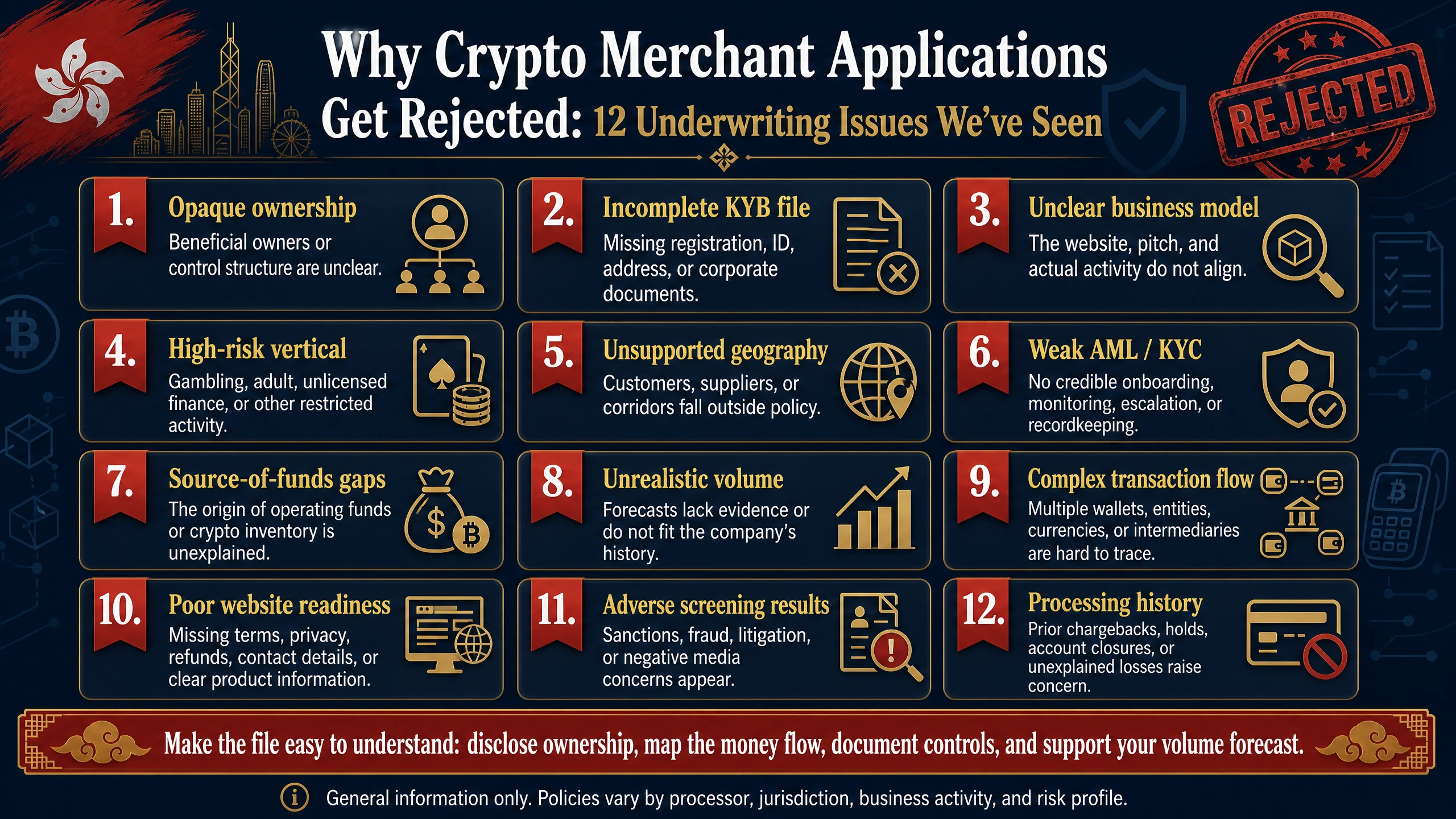
Two crypto businesses can apply to the same processor in the same week. One gets approved in days. The other gets declined before pricing even comes up. I’ve watched this exact split happen often enough to stop believing it’s luck. It’s almost never the vertical itself that sinks an application, it’s a specific, identifiable gap in how the business presented its risk. After reviewing enough of these files to see the repeats, here are the twelve I run into constantly, in roughly the order underwriters actually find them.
Crypto merchant rejections rarely come down to “crypto is too risky.” They come down to specific, fixable gaps, unclear licensing, undocumented source of funds, vague business descriptions, or a website that doesn’t match the application. In my experience, the businesses that get approved fastest are the ones that treat the application like a payment processing partner’s due diligence exercise, not a form to fill out and hope for the best. Fix the twelve issues below before you apply, and most of the friction disappears.
1. Licensing Status Left Ambiguous
This is the single most common issue I see, and it’s almost always avoidable. An application that says “we operate in compliance with applicable regulations” without naming the specific regulator, licence type, or exemption basis reads as a red flag, not reassurance. Underwriters can’t verify what isn’t specified, and ambiguity gets treated as risk by default.
2. Beneficial Ownership That Doesn’t Trace Cleanly
Layered ownership structures are common in crypto for legitimate tax and jurisdictional reasons, but if your own team can’t diagram the ownership chain in two minutes, neither can the underwriter. I’ve watched strong applications stall for weeks over a structure nobody could clearly explain, not because anything was hidden, just because nobody had documented it plainly.
3. Undocumented Source of Funds
Wallet transaction logs alone have never been enough in any review I’ve been part of. Underwriters want invoices, counterparty contracts, or other evidence of real commercial activity behind the volume. A Crypto Payment Provider relationship depends on the underwriter being able to explain, in plain terms, where the money actually comes from.
4. A Website That Doesn’t Match the Application
This one is almost embarrassingly common, and entirely preventable. If the application describes a B2B settlement service but the live website reads like a consumer trading app, that mismatch gets flagged immediately. I check this myself before letting a client submit anything, because it’s the fastest thing an underwriter checks too.
5. Prior Terminations Left Undisclosed
Underwriters run their own checks against shared industry databases and prior processor relationships. I’ve never seen a hidden termination stay hidden. Disclosing a prior termination upfront, with context, is consistently treated better than having it discovered mid-review.
6. No Transaction History to Assess
New businesses face a genuine catch-22 here: processors need transaction history to calculate risk, but a new business doesn’t have any yet. The fix isn’t waiting, it’s providing signed contracts, pre-orders, or credible volume projections backed by evidence, so the underwriter has something concrete to assess instead of a blank page.
7. High-Risk Products Not Disclosed Upfront
I’ve seen underwriters find undisclosed high-risk elements buried on a website, a token offering, a lending product, an unlicensed custody feature, that the application never mentioned. Once trust is broken this way, the rest of the application gets read far more skeptically, even the parts that were accurate.
8. Vague or Generic Business Descriptions
Weak applications lean on generic language and assume the underwriter will fill in the gaps. They won’t. If your business model isn’t clearly explained on paper, what you do, who your customers are, how money moves, the application won’t survive review regardless of how sound the underlying business actually is.
9. Applying to the Wrong Category of Processor
Traditional payment gateways decline crypto-adjacent businesses by default, as a category, regardless of individual merit. I still see merchants burn weeks applying to mainstream payment providers who were never going to say yes, instead of going straight to a high-risk payment gateway specialist built for this exact risk profile.
10. Missing or Incomplete AML and KYC Documentation
Nearly a third of application declines in recent underwriting data trace back to incomplete documentation or unclear compliance policies discovered during the initial screening phase, not deeper review. This is one of the cheapest fixes on this list, it just requires assembling the paperwork before applying, not after a decline.
11. Affiliate Traffic and Customer Acquisition Nobody Can Explain
Underwriters increasingly review how customers actually reach checkout, not just what happens once they arrive. Aggressive affiliate traffic, incentivized campaigns, or unstable acquisition patterns raise questions even when the core business is sound, because that traffic pattern is itself a risk signal independent of the product.
12. Chargeback and Refund Handling With No Clear Process
A business that can’t describe how it handles disputes, refunds, and chargebacks reads as unprepared for the operational reality of payment processing, not just the sales side of the business. I ask every client to have this documented before applying, because it’s one of the first operational questions a serious underwriter raises.
What These Twelve Issues Actually Have in Common
None of these are really about crypto being inherently too risky. They’re about how clearly a business can explain its own risk to someone who has to sign off on carrying it. I tell clients this constantly: underwriters aren’t trying to catch you out, they’re trying to understand you fast enough to say yes with confidence. Every one of these twelve issues is a place where that understanding broke down, usually from omission, not deception.
How I’d Actually Prepare an Application Differently
Before submitting anything, I walk clients through the same exercise every time: read your own application as if you’d never seen the business before, and flag every place a reasonable person would still have a question. That’s usually where three or four of these twelve issues are hiding. Pair that with proactive documentation, licensing status stated plainly, ownership diagrammed clearly, source of funds evidenced, prior processing history disclosed voluntarily, and most applications clear review markedly faster than the industry average.
A Pattern I Keep Seeing Across All Twelve
If I had to compress every one of these issues into a single root cause, it would be this: the businesses that get rejected almost always assumed the underwriter would connect dots that were never actually written down. A founder knows their licensing status intimately, knows exactly where funds originate, knows their affiliate traffic is clean, and assumes that knowledge somehow transfers to a stranger reviewing a file in twenty minutes. It doesn’t. Every gap on this list is really the same gap wearing different clothes: information that exists somewhere in the founder’s head but never made it onto paper in a form the underwriter could actually use.
I’ve started telling clients to treat the application itself as the product, not a formality standing between them and the real work of running a business. A payment processing underwriter reviewing a crypto file has less time and less built-in trust than one reviewing a conventional retailer, precisely because the category carries more regulatory and reputational weight. That means the burden of proof sits more heavily on the applicant to make every one of these twelve points unmissable, not just technically present somewhere in a supporting document nobody reads closely.
What I Do Differently Now Before Any Client Submits
I run a version of a pre-mortem on every application before it goes out: assume it gets declined, then work backward through these twelve issues to figure out which one would most plausibly be the reason. Nine times out of ten, that exercise surfaces at least one gap the client hadn’t thought to address, because they were too close to their own business to see it as a stranger would. It’s a simple habit, and it’s consistently the highest-leverage thing I do for a client before an application goes in.
Why Fixing These Twelve Matters More Than Finding a “Friendlier” Processor
I get asked constantly whether there’s a shortcut, a specific processor known for looser underwriting that a struggling merchant should just target directly. I understand the appeal, but I’d push back on the framing. Even processors built specifically for high-risk payment gateway relationships still run through most of these same twelve checks; they’re simply more experienced at evaluating crypto risk specifically, which means clearer documentation matters just as much with them as with a mainstream provider, not less. A merchant who fixes these twelve issues before applying tends to get approved faster everywhere, not just at one lenient outlier. Chasing a reputation for leniency instead of closing the actual gaps in an application is, in my experience, the slower path, even when it feels like the faster one.
Frequently Asked Questions
What’s the single most common reason crypto merchant applications get rejected?
In my experience, ambiguous or undisclosed licensing status outweighs almost every other factor in how underwriters decide.
Can a new business with no processing history still get approved?
Yes, but it requires substituting evidence for history, signed contracts, pre-orders, or credible volume projections that give the underwriter something concrete to assess.
Does one rejection mean a crypto business can’t get a merchant account anywhere?
No. A decline from one processor reflects that processor’s specific risk criteria, not a universal judgment. Many businesses get approved through a different provider better suited to their risk profile.
Should a declined merchant reapply to the same type of processor?
Generally not without first diagnosing the decline reason. Reapplying to the same category of processor with the same unresolved gaps usually produces the same result.
Do standard payment gateways ever accept crypto businesses?
Rarely, and often not by design, most mainstream payment gateways decline crypto-adjacent businesses as a category regardless of individual merit, which is why applying to a high-risk specialist directly saves time.
How much does undisclosed information actually matter if the business is otherwise legitimate? More than most founders expect. Underwriters treat anything discovered rather than disclosed as a trust issue, which colors how the rest of the application gets read, even the accurate parts.
Comments
No comments yet. Be the first to share your thoughts.
Leave a comment