
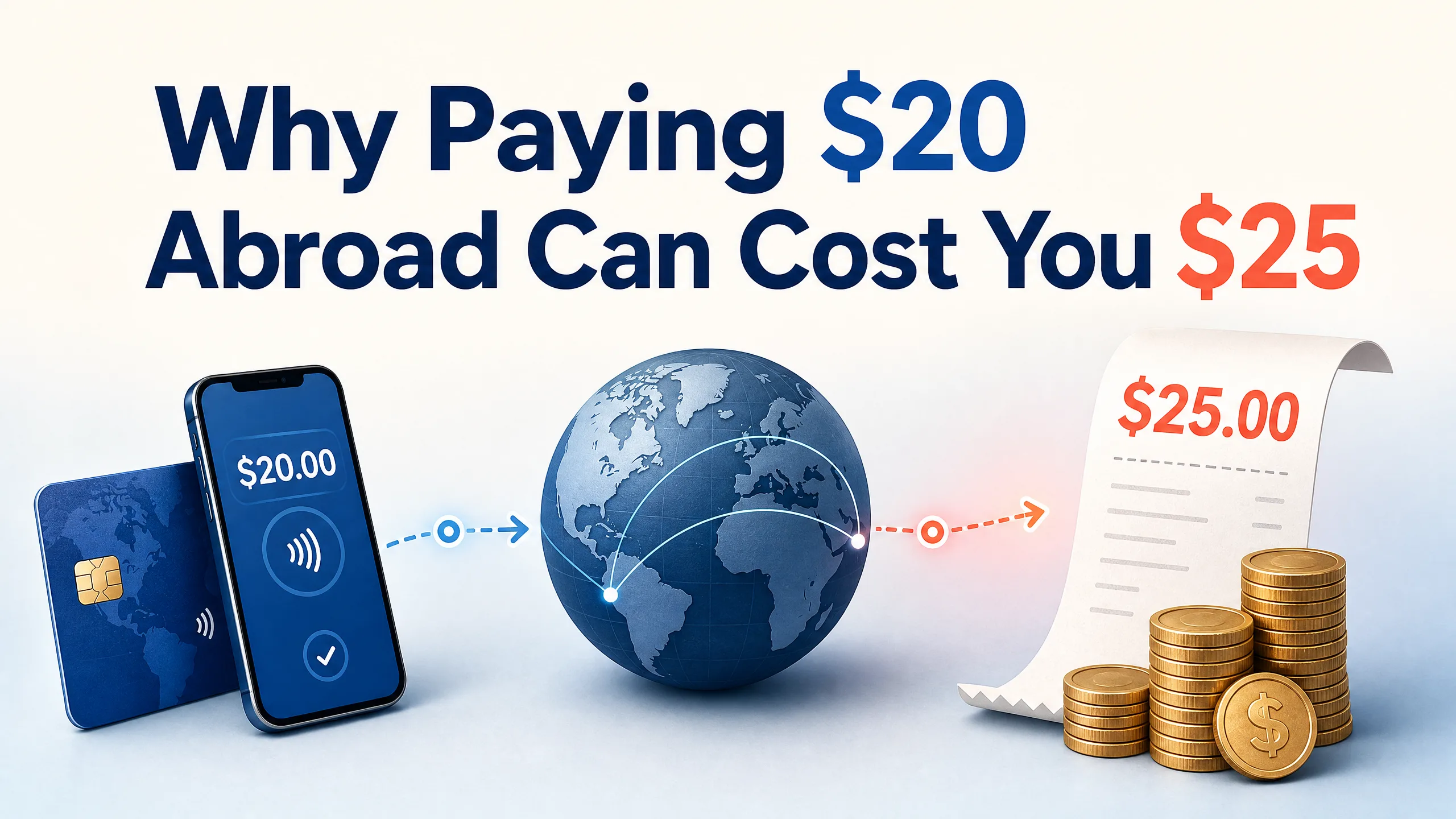
You’re at a café in Lisbon, your card taps clean, the receipt says €18.50, and somehow your bank app shows you got charged the equivalent of $25 for what should’ve been a $20 coffee-and-pastry situation. You didn’t get scammed. Nobody stole your card. What actually happened is quieter and, honestly, kind of sneaky, a stack of small fees you never agreed to in any obvious way, layered on top of each other by your card issuer, the card network, and sometimes the merchant’s own terminal. I break this down for clients constantly, and once you see the mechanics, you’ll never swipe abroad the same way again.
That extra $5 on your $20 purchase usually comes from two or three fees stacking silently: a foreign transaction fee (typically 1-3%), a currency conversion markup on top of the real exchange rate, and sometimes a sneaky “pay in your home currency” trap called dynamic currency conversion that can add up to 7% more. None of this is illegal, it’s just built into how traditional payment processing works across borders, and most people never learn to spot it. The fix isn’t complicated once you know what to look for, and it matters just as much if you’re running a business that takes cross-border payments as it does if you’re just traveling.
Let’s Actually Do the Math
I like showing people the real numbers because it makes the abstract fee talk suddenly very concrete. Say you spend 500 euros on a trip. At the real market exchange rate, that’s about $555. But your card converts it using a slightly worse rate, say 1 USD to 0.85 euros instead of the market’s 0.90, which alone bumps your cost to roughly $588. Then your card adds its 2% foreign transaction fee on top, and you land at $600. That’s $44.45 in fees on a $555 trip, and if you added it up transaction by transaction while you traveled, you probably never noticed it happening in real time. That’s the whole trick, it’s death by a thousand small cuts, not one obvious charge.
The Three Fees Actually Stacking on Your Purchase
Foreign Transaction Fees
This is the most straightforward one, and also the most avoidable if you know to check for it. Your card issuer or bank charges this whenever you buy something in a foreign currency or from an international merchant, typically 1% to 3% of the purchase. It doesn’t matter if you’re standing in Bangkok or shopping online from your couch at 2am buying something from a UK retailer, if the transaction touches a foreign currency or crosses a foreign bank, this fee can apply. And here’s the part that genuinely annoys me on your behalf: it usually doesn’t count toward your card’s cash-back or points rewards. It’s a pure net negative, no upside attached.
Currency Conversion Markup
This one’s sneakier because it’s baked into the exchange rate itself rather than shown as a separate line item. Every provider, your bank, your card network, a payment gateway processing the transaction, sets its own conversion rate, and that rate sits above the real mid-market rate you’d see on Google. The difference between “the actual exchange rate” and “the rate your bank decided to give you” is where a meaningful chunk of that extra $5 lives, quietly, without ever showing up as its own labeled fee on your statement.
Dynamic Currency Conversion (DCC) – The One I’d Actually Warn You About
This is the trap I make sure every client understands before they travel. When a foreign merchant’s card terminal asks “would you like to pay in US dollars instead?”, that innocent-sounding question is DCC, and saying yes usually costs you more, sometimes up to 7% above the real conversion rate. The merchant’s own payment provider sets that rate, not your bank, and it’s rarely in your favor. My rule, and I say this to literally everyone: always decline. Always pay in the local currency. Let your own card issuer handle the conversion, they’re still taking a cut, but nowhere near what a merchant-side DCC markup will cost you.
Why This Even Exists in the First Place
I don’t think this is some evil conspiracy, it’s just how payment processing infrastructure was built decades before anyone was thinking about a borderless digital economy. Every time money moves across a currency boundary, it typically passes through multiple intermediaries, card networks, correspondent banks, payment providers, and each one takes a small cut to cover currency risk and processing costs. Cross-border online shopping specifically can tack on an extra 10–20% to your sticker price once you factor in conversion fees, customs duties, and international shipping, which is why that item that looked like a steal on an overseas site sometimes lands very differently once it actually clears checkout and customs.
How to Actually Avoid Losing Money to This
- Get a card with zero foreign transaction fees: Around a quarter of credit card offers on the market don’t charge one at all, there’s genuinely no reason to keep paying it if you travel or shop internationally with any regularity.
- Always decline dynamic currency conversion: Pay in the local currency, every single time, no exceptions.
- Check the real exchange rate before you buy: A quick search gives you the mid-market rate so you can see roughly how much markup you’re actually eating.
- Use payment apps built for cross-border spending: Some digital payments platforms and modern payment wallets are specifically designed to convert at rates much closer to the real market rate than a traditional card issuer offers.
- For frequent international spenders, consider a multi-currency account: Holding balances in multiple currencies and converting only when rates are favorable can meaningfully cut what you lose to markup over a year of travel or online shopping.
Why This Matters Even More If You’re Running a Business
I talk to a lot of small business owners who assume this fee stack is purely a consumer travel problem. It isn’t. If your business accepts online payments from international customers, or pays overseas suppliers, contractors, or vendors, the exact same markup and fee stacking applies to your transactions just at a scale where it actually shows up meaningfully on your books. A business processing regular cross-border payments through a generic merchant account not built for international transactions can lose a real percentage of revenue to conversion markup alone, month after month, without anyone on the finance side flagging it as a fixable problem rather than just “the cost of doing business globally.”
This is exactly why choosing the right payment processor matters so much for any business with international customers or suppliers. Modern payment gateways built specifically for cross-border commerce increasingly offer far more competitive conversion rates than a business would get defaulting to whatever their domestic bank offers, and the savings compound fast once you’re moving real volume rather than one $20 coffee purchase.
What I’d Actually Tell a Gen Z Traveler or Founder Reading This
If you’re someone who travels often, shops from international sites, or is building a business with global customers from day one, which, let’s be honest, describes a lot of people running online stores or service businesses right now, this isn’t a “someday” problem to fix. It’s a “set this up before your next transaction” problem. The fee stack described here compounds every single time you spend across a border, and the tools to avoid most of it already exist and are usually free to set up. The only real cost of ignoring this is continuing to quietly lose money you didn’t have to.
The Habit I Actually Wish More People Built
Here’s the thing I’ve noticed working with clients across both ends of this, travelers and business owners alike: almost nobody actually checks their statement line by line to see where these fees hit. It’s genuinely a five-minute habit that pays for itself. Pull up your last international purchase, compare what you were quoted in the local currency against what actually posted in your home currency, and do the quick math on the percentage gap. Most people are shocked the first time they actually do this, not because the fees are hidden in some illegal way, but because nobody ever taught them to look.
I’d compare it to checking your grocery receipt against the shelf price, most of us don’t do it, and most of the time it doesn’t matter much. But international transactions are exactly the category where the gap between “sticker price” and “actual price” is consistently large enough to be worth five minutes of attention, especially if you’re someone doing this regularly rather than once a year on a single vacation. Small, repeated leaks are the ones that actually cost real money over a year, not the one-off big purchase you already scrutinized carefully.
Frequently Asked Questions
Why did my $20 purchase actually cost $25 on my statement?
It’s almost always a combination of a foreign transaction fee (1-3%), a currency conversion markup built into the exchange rate, and sometimes a dynamic currency conversion charge if you accidentally agreed to pay in your home currency at the terminal.
What’s the difference between a foreign transaction fee and a currency conversion fee?
A foreign transaction fee is charged by your card issuer for any purchase involving a foreign currency or merchant. A currency conversion fee is the markup applied when converting one currency to another, sometimes charged separately by the card network.
Should I always say yes or no to paying in my home currency abroad?
Almost always say no. That’s dynamic currency conversion, and the merchant’s payment provider usually sets a worse rate than your own card issuer would.
Do businesses face the same fees as travelers?
Yes, functionally the same mechanics apply. A business accepting or making cross-border payments through a standard merchant account often absorbs similar conversion markup, just at a scale that shows up meaningfully in revenue.
Are there cards or apps that avoid these fees entirely?
Many cards now offer zero foreign transaction fees, and some digital payment platforms convert much closer to the real market rate than traditional card issuers, meaningfully reducing what travelers and businesses lose to markup.
Is it worth switching payment providers for a business with international customers?
Often, yes. A payment processor built specifically for cross-border transactions can offer materially better conversion rates than a generic domestic merchant account, and the savings scale with transaction volume.
Comments
No comments yet. Be the first to share your thoughts.
Leave a comment