
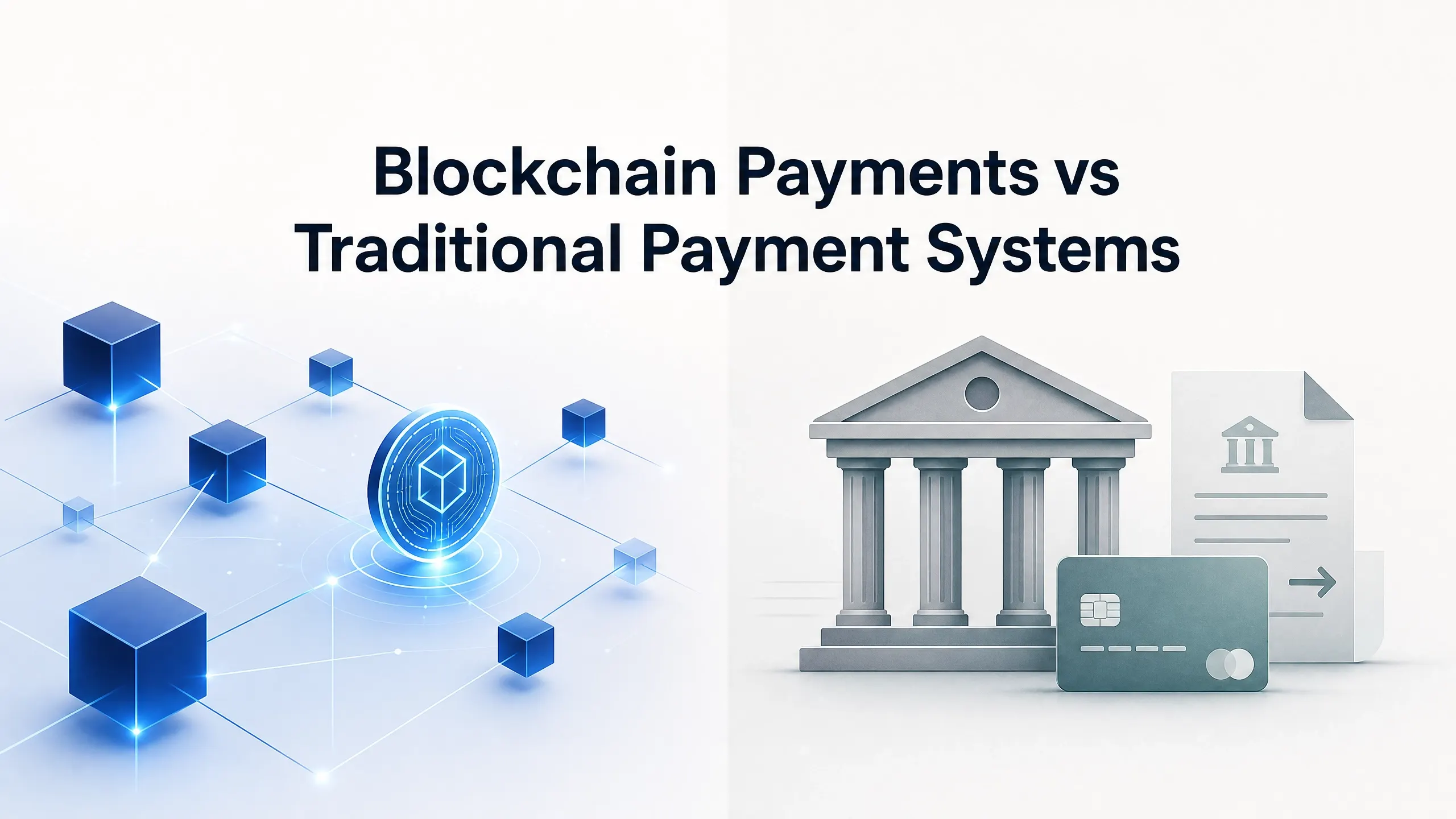
A client of mine ran the same $80,000 supplier payment through both rails last year, deliberately, just to see the difference for himself. The wire took four days, passed through three correspondent banks, and lost almost 3% to fees and FX markups along the way. The stablecoin transfer landed in nine minutes for a fraction of the cost. He didn’t need me to explain the trade-offs after that. He’d already felt them. That’s the conversation I want to have here, not blockchain versus traditional as an abstract debate, but as a real operational choice with real numbers behind it.
Blockchain payments consistently beat traditional rails on cross-border speed and cost, settlement in seconds to minutes versus three to five days, at a fraction of the fee load. Traditional payment processing still wins on regulatory maturity, dispute resolution, and integration depth with existing accounting and banking workflows. Neither system is “better” in absolute terms; the right choice depends on transaction volume, geography, and how much operational risk a business can tolerate. Most sophisticated global businesses I work with aren’t choosing one exclusively, they’re running both, deliberately, for different transaction types.
Why This Comparison Matters More in 2026 Than It Did Even Two Years Ago
I’ve watched the tone of this conversation shift substantially. Five years ago, blockchain payments were something founders asked me about out of curiosity. Now they ask because the traditional rail is visibly costing them money and time they can measure. Stablecoin supply alone grew from $5 billion to $305 billion between 2020 and September 2025, and payment-specific stablecoin volume is now estimated around $5.7 trillion annually. That’s not speculative trading volume, that’s businesses actually moving value through this infrastructure.
The reason is structural, not fashionable. Cross-border B2B payment volume is projected to exceed $42.7 trillion in 2026, up from $34 trillion in 2021, and the traditional correspondent banking system underneath most of that volume simply wasn’t built for this scale or this pace. A payment from the US to a supplier in Vietnam typically still passes through two to five intermediary banks, each one adding a fee and processing time. Trapped liquidity from slow settlement is estimated to cost the global economy around $120 billion annually. That’s the backdrop against which this comparison actually matters.
How the Two Systems Actually Compare
Settlement Speed
This is where the gap is starkest, and where I see it change business decisions fastest. Traditional cross-border transfers typically take three to five business days to settle, constrained by banking hours, correspondent bank chains, and weekend closures. Blockchain-based transfers settle in roughly 10 seconds to 5 minutes, around the clock, with no weekend or holiday delay. For a business managing supplier relationships or payroll across time zones, that difference compounds fast.
Cost Structure
Traditional cross-border payments carry fees that can reach 3-5% or more once FX markups, intermediary bank charges, and compliance costs are stacked together. Blockchain transfers, particularly stablecoin-based ones, cut most of that stack out entirely, there’s no chain of correspondent banks each taking a cut. This is the single biggest reason I see businesses pilot blockchain rails: the cost delta is visible on the very first transaction, not something that requires months of aggregate data to notice.
Regulatory Maturity and Dispute Handling
Here’s where traditional rails still lead clearly, and I don’t think that gets said often enough in blockchain-forward content. Card networks and bank transfers come with decades of established dispute resolution, chargeback frameworks, and consumer protection law behind them. Blockchain transactions are generally final and irreversible, there’s no built-in chargeback mechanism, which is a feature for fraud prevention but a real gap for buyer protection. Businesses handling consumer-facing online payments with return and refund expectations need to plan for this difference explicitly, not discover it after a dispute happens.
Integration With Existing Financial Workflows
Traditional payment processing integrates natively with decades-old accounting, ERP, and banking infrastructure that most finance teams already know how to operate. Blockchain payments increasingly integrate too, on-ramps and off-ramps are improving, and blockchain rails are connecting with local fast-payment systems like Pix in Brazil and UPI in India, but the learning curve for a finance team unfamiliar with wallet management and on-chain reconciliation is real, and I don’t think it should be minimized.
Where Blockchain Payments Clearly Win
- High-value, cross-border B2B settlement: the fee savings and speed advantage compound most visibly at scale, which is why treasury teams are the fastest adopters I see.
- Markets with limited traditional banking access: Bitcoin and stablecoins see genuine adoption in regions where correspondent banking relationships are thin or unreliable.
- 24/7 operational needs: a business that can’t wait for banking hours to clear a payment gets real, measurable value from round-the-clock settlement.
- Smart-contract-based automation: conditional payments that release automatically once agreed terms are met reduce operational overhead in ways traditional rails structurally can’t replicate.
Where Traditional Payment Systems Still Hold the Advantage
- Consumer-facing commerce with return expectations: chargeback and dispute frameworks protect buyers in ways blockchain transactions currently don’t.
- Regulatory-heavy industries: established compliance frameworks and audit trails built around traditional rails are more mature in most jurisdictions.
- Businesses without in-house crypto expertise: the operational learning curve for wallet security, key management, and reconciliation is a genuine barrier, not just a perception problem.
- Domestic, low-value transaction volume: where the cost and speed advantage of blockchain rails simply doesn’t move the needle enough to justify the operational shift.
The Hybrid Model I Actually Recommend
I stopped advising clients to pick one system exclusively a while back, because the businesses actually winning with this technology aren’t doing that either. The pattern I see working best: traditional payment gateways and merchant services handle domestic, consumer-facing, and dispute-sensitive transactions, while blockchain rails, usually via a Crypto Payment Provider or Crypto Payment Processing partner, take over supplier payments, cross-border settlement, and high-value B2B transfers where speed and cost matter more than chargeback protection.
This hybrid approach is increasingly the industry default, not an edge case. Modern payment providers are building infrastructure specifically to let businesses use both rails through a single integration, converting between fiat and crypto behind the scenes so the business doesn’t need deep blockchain expertise to benefit from it.
What I’d Actually Ask a Business Before Recommending a Rail
Before I tell any client which way to lean, I ask a few specific questions: How much of your volume is cross-border versus domestic? How often do you deal with disputes or refunds? Does your finance team have any existing comfort with payment wallets and on-chain reconciliation, or would this be entirely new territory? What’s your actual fee load today, in real numbers, not estimates? The answers usually make the decision obvious, most businesses don’t need a philosophical debate about decentralization, they need a clear-eyed look at where their money is actually leaking today.
A Detail Worth Understanding: Not All “Blockchain Payments” Mean the Same Thing
I find a lot of confusion here worth clearing up directly. A Crypto Payment made in Bitcoin carries real price volatility risk between the moment of payment and settlement. A payment made in a stablecoin like USDC or USDT is designed specifically to avoid that, it’s pegged to a fiat currency, which is why stablecoins now dominate genuine commercial blockchain payment volume rather than volatile assets. Asset-backed tokens reached a market cap of roughly $320 billion in 2026, increasingly favored by corporate treasuries specifically because they remove the volatility question from the payment decision entirely. If a business is evaluating blockchain payments and volatility is the concern holding them back, that concern usually applies to Bitcoin and Ethereum specifically, not to the stablecoin rails most commercial digital payments infrastructure is actually built around today.
Why I Don’t Trust the “Blockchain Will Replace Banking” Narrative
I hear this framing constantly at industry events, and I think it’s the wrong way to understand where this is actually headed. What I’ve watched happen in practice isn’t replacement, it’s specialization. Traditional banking infrastructure isn’t disappearing; it’s being pushed toward the transactions it’s genuinely best suited for, while blockchain rails absorb the transaction types where legacy infrastructure was always going to struggle: high-frequency cross-border settlement, programmable conditional payments, and value transfer to regions traditional correspondent banking never served well in the first place.
I think the more useful mental model for a business leader isn’t “which system wins” but “which system is this specific transaction type built for.” A business that tries to force all of its payment volume onto one rail or the other, out of ideological preference rather than operational fit, ends up paying for that rigidity eventually, either in fees it didn’t need to pay, or in dispute protection it didn’t have when it needed it. The businesses I’ve seen navigate this most successfully treated the choice as an engineering decision, transaction type by transaction type, rather than a single strategic bet made once and left unexamined.
Frequently Asked Questions
Is blockchain payment processing cheaper than traditional payment processing?
Generally yes for cross-border transactions, where traditional fees can reach 3-5% including FX markups, versus a fraction of that for blockchain-based transfers, particularly stablecoin rails.
Do blockchain payments settle instantly?
Most settle within seconds to a few minutes, compared to three to five business days for traditional cross-border wire transfers, and blockchain rails operate 24/7 without banking-hour restrictions.
Can a business use both blockchain and traditional payment systems together?
Yes, and this hybrid approach is increasingly the standard model, traditional rails for domestic and dispute-sensitive transactions, blockchain rails for cross-border and high-value B2B settlement.
Is Bitcoin the main blockchain payment method businesses use?
Not primarily. Stablecoins like USDC and USDT dominate commercial blockchain payment volume because they avoid the price volatility associated with Bitcoin and Ethereum.
What’s the biggest risk of blockchain payments for a business?
The lack of built-in chargeback or dispute mechanisms is the most significant operational gap compared to traditional payment processing, particularly for consumer-facing commerce.
Do businesses need deep crypto expertise to use blockchain payments?
Not necessarily. Modern payment providers and processors handle the technical complexity, letting businesses send and receive value without managing wallets or blockchain infrastructure directly.
Comments
No comments yet. Be the first to share your thoughts.
Leave a comment