
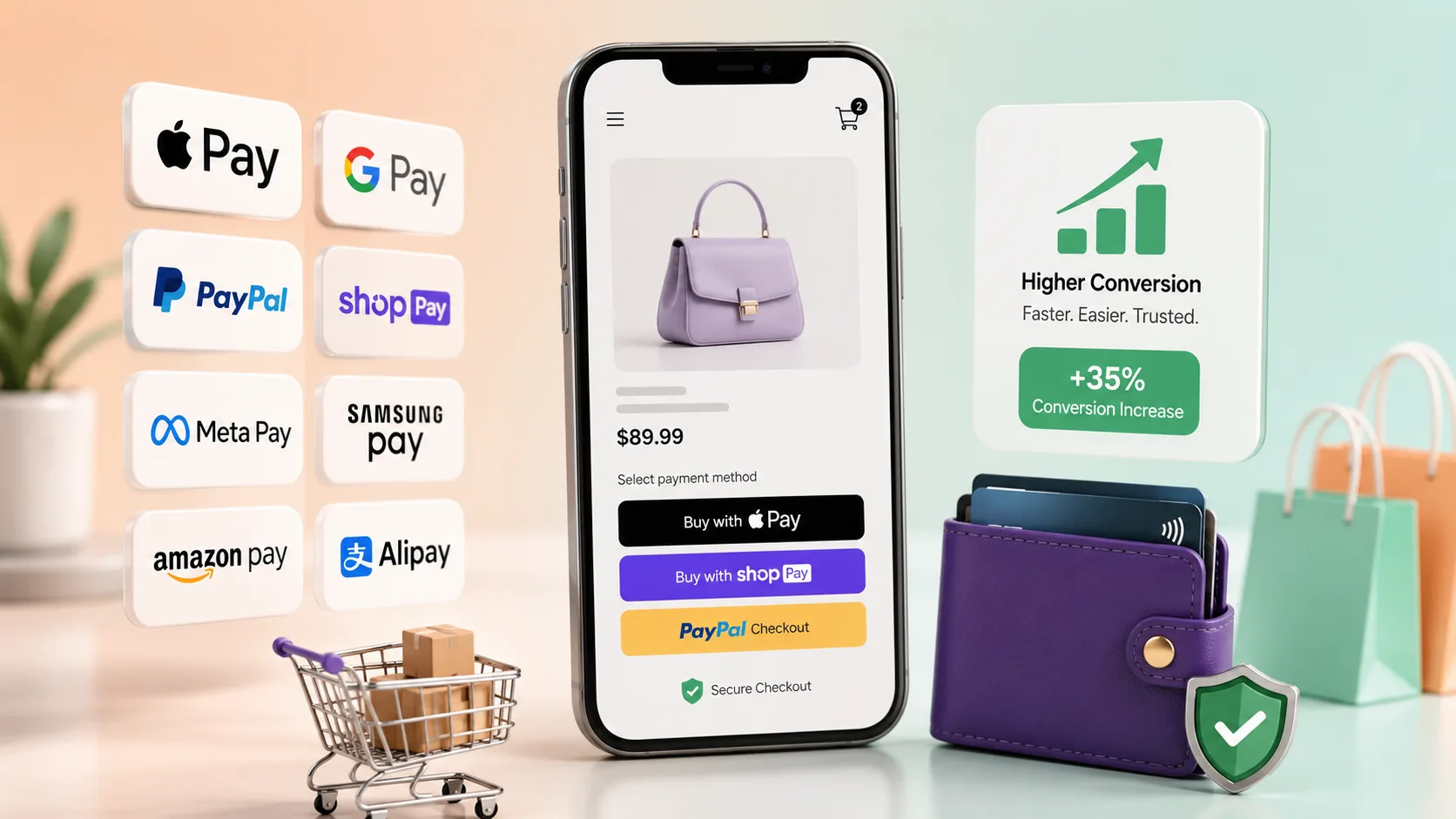
Every ecommerce merchant knows checkout abandonment is a problem. Fewer treat payment wallet selection as one of the most fixable causes of it. With average cart abandonment sitting north of 70% industry-wide, the wallets a store chooses to support at checkout aren’t a UX nicety, they’re a direct lever on completed orders.
TL;DR:
Digital wallets now account for over half of global ecommerce transaction value, and offering the right mix at checkout can lift conversion by 12-50%, depending on the study and implementation. Apple Pay and Google Pay deliver the strongest mobile conversion lift by eliminating manual card entry entirely; PayPal remains essential for trust-driven purchases; and regional wallets matter enormously for cross-border payments. The wallets that convert best aren’t necessarily the most popular globally, they’re the ones that match your specific customer base’s habits and device usage.
Why Payment Wallets Are a Conversion Metric, Not Just a Convenience Feature
The scale of checkout abandonment makes this a revenue conversation, not a UX preference. The average documented cart abandonment rate sits at roughly 70%, and a meaningful share of that is directly tied to payment friction, somewhere between 13% and 19% of abandoners cite missing preferred payment methods or complicated checkout as the reason they left.
That translates into real money. For a store processing 100 orders a day at a $60 average order value, recovering even half of payment-related lost conversions can add tens of thousands of dollars in monthly revenue, without spending a cent more on traffic acquisition. Payment processing and wallet support sit upstream of nearly every other conversion optimization tactic, because a customer who can’t find their preferred way to pay never reaches the rest of the funnel.
The Wallet Conversion Data: What Actually Moves the Needle
Several independent studies converge on the same directional conclusion, even if the exact percentages vary by methodology.
- Offering diverse, friction-reducing payment options increases conversion by 12-15% on average, with Apple Pay and Google Pay flagged as the highest-impact additions for most consumer stores
- Digital wallets can boost conversion rates by up to 35% compared to card-only checkout, according to PYMNTS research
- Boston Consulting Group and Shopify found accelerated payment methods can lift conversion by up to 50.4%, among the more striking figures in this data set
- One-click or one-tap checkout delivers roughly 35% higher conversion than standard multi-step checkout flows
- Sites offering five or more payment options see 4.2% lower abandonment rates, reinforcing that variety itself, not just any single wallet, plays a role
- 13% of shoppers abandon a cart specifically because their preferred payment method isn’t available, according to Baymard Institute research
The consistent thread: payment wallets don’t just add convenience, they remove the specific friction points, manual card entry, unfamiliar forms, forced account creation, that cause shoppers to leave at the final, highest-intent step of the funnel.
Ranking the Major Payment Wallets by Conversion Impact
Not all payment wallets convert equally, and the right mix depends heavily on device usage, average order value, and customer demographics.
Apple Pay and Google Pay: The strongest mobile conversion performers. Both eliminate card number entry entirely; the shopper authenticates with Face ID, Touch ID, or fingerprint, and billing and shipping auto-populate. This turns the most friction-heavy step of checkout into a two-tap interaction, which is why these wallets are consistently flagged as the highest-impact payment addition for mobile-heavy stores.
PayPal: Still a conversion driver despite the rise of native wallets, largely on trust. Roughly 30% of online shoppers hold a PayPal account, and many specifically prefer it because it avoids sharing card details directly with individual merchants. Skipping PayPal means losing a real, non-trivial segment of shoppers who won’t switch to another payment method just for one store.
Shop Pay: For merchants on Shopify specifically, Shop Pay has shown a particularly strong lift, with reported conversion increases of up to 50% compared to standard guest checkout, largely due to saved payment and shipping details persisting across any Shopify-powered store a customer has purchased from before.
Amazon Pay: A strong option for merchants whose customer base overlaps heavily with Amazon shoppers, since it removes the need to create a new account or re-enter payment details, leveraging existing trust and stored information.
Venmo: Particularly effective for merchants targeting Gen Z and Millennial audiences, given Venmo’s social features and strong mobile-native usage patterns among younger consumers, even though its overall ecommerce transaction share remains smaller than the major wallets above.
Why One-Tap Wallets Outperform Everything Else on Mobile
Mobile is where the wallet conversion story gets most dramatic, and most costly to ignore. Mobile cart abandonment rates run notably higher than desktop, with some studies putting the gap at over 20 percentage points between device types. Typing a 16-digit card number, expiry date, and CVV on a mobile keyboard is exactly the kind of friction one-tap wallets are built to eliminate.
Practical implementation details matter here as much as which wallets are offered:
- Apple Pay and Google Pay should appear as the first payment option: not buried below manual card entry
- Express checkout buttons should appear at multiple funnel points: product page, cart, and top of checkout, not only at the final step
- Numeric keyboards should trigger automatically: for phone, ZIP, and card fields when manual entry is still needed
- The pay button should stay visible without scrolling: since every additional scroll adds measurable mobile drop-off
Regional Wallet Preferences: One Size Doesn’t Convert Everywhere
Global wallet dominance doesn’t mean universal wallet dominance, preferences vary sharply by region, and getting this wrong is one of the more common mistakes in international payment processing.
- North America and Europe: lean heavily on PayPal, Apple Pay, and Google Pay
- Asia-Pacific: is dominated by region-specific payment wallets like Alipay, WeChat Pay, and India’s UPI, which outperform Western wallets by a wide margin in local markets
- Latin America: shows growing preference for local digital wallets alongside broader adoption of buy-now-pay-later options
- Younger shoppers globally: skew toward digital wallets and BNPL, while older demographics still lean toward credit cards and PayPal specifically
A merchant expanding into a new region without adjusting wallet support to match local habits is effectively recreating the same “missing preferred payment method” abandonment problem that plagues domestic checkouts, just at a larger, cross-border scale.
Cross-Border Payments: Wallets as a Trust Signal for International Buyers
For cross-border payments specifically, payment wallets do double duty: they reduce checkout friction and they function as a trust signal. International customers are often more cautious about entering card details on an unfamiliar foreign merchant site, and a recognized local wallet option meaningfully lowers that hesitation.
This matters increasingly for merchant services strategy broadly. As merchants add support for global payment providers, evaluating which payment wallets are locally trusted, not just globally popular, should be a standard part of any cross-border expansion plan, alongside currency display and local payment method support.
Travel Ecommerce: Where Wallet Choice Matters Most
Travel and booking businesses experience payment wallet conversion dynamics more intensely than most ecommerce categories, for a straightforward reason: bookings are high-value, often made on mobile during comparison shopping, and frequently involve international customers.
A few specific implications for travel merchants:
- High-value transactions amplify wallet friction: A shopper hesitant to type a full card number for a $30 purchase is even more likely to abandon a $2,000 vacation booking without a fast, trusted payment option.
- Mobile comparison shopping is the norm for travel: Customers often compare prices across sites on their phones before booking, so a slow or unfamiliar checkout is an easy excuse to book elsewhere.
- International customers need recognizable wallets: A travel platform serving multiple countries but only supporting Western wallets leaves conversion on the table with travelers who default to regional alternatives.
- Trust matters disproportionately for advance bookings: Since travel payments often precede the trip by weeks or months, a trusted wallet reduces the hesitation of paying in advance for a future service.
Travel merchants should treat wallet coverage as directly tied to booking completion rates, not a secondary checkout detail, the data on payment-driven abandonment applies with extra force to high-ticket, advance-purchase transactions like travel.
High-Risk Merchants: Wallet Support Without New Underwriting
Merchants operating through a high-risk payment gateway sometimes assume digital wallet support requires separate approval. In most cases, it doesn’t, wallet integrations typically sit at the payment gateway level rather than requiring a distinct merchant account application. That said, high-risk merchants should confirm dispute handling and reserve terms specifically apply the same way across wallet transactions as they do for standard card processing, since terms can vary by provider.
How to Choose Which Wallets to Add First
Rather than adding every available wallet at once, prioritize based on actual customer data:
- Check your analytics for device split: A mobile-heavy store should prioritize Apple Pay and Google Pay above all else.
- Review your customer geography: International sales volume should directly inform which regional wallets get added next.
- Consider your platform: Shopify merchants should treat Shop Pay as close to mandatory, given its documented conversion lift.
- Factor in demographics: A younger customer base justifies prioritizing Venmo and BNPL-adjacent wallet options over legacy payment methods.
- Test placement, not just presence: Adding a wallet buried at the bottom of a payment list captures little of its potential conversion lift, placement above manual card entry matters as much as availability.
Frequently Asked Questions
Which payment wallet converts best for ecommerce?
There’s no single universal answer, Apple Pay and Google Pay generally deliver the strongest mobile conversion lift, while PayPal remains critical for trust-driven purchases. The best mix depends on your specific customer base’s device usage and geography.
How much can adding payment wallets actually improve conversion?
Reported lifts range from roughly 12% to over 50% depending on the study, implementation, and starting point, but the consistent finding across independent research is that wallet availability directly and measurably affects checkout completion.
Do I need to support every popular payment wallet?
No. Prioritizing the wallets that match your actual customer base’s device usage, geography, and demographics delivers more conversion impact than adding every available option indiscriminately.
Why do mobile shoppers abandon carts more than desktop shoppers?
Manual card entry is significantly more frictional on a mobile keyboard, and mobile cart abandonment rates run well above desktop as a result, a gap that one-tap wallets like Apple Pay and Google Pay are specifically built to close.
Are regional payment wallets important for cross-border ecommerce?
Yes, international customers often trust and default to regional wallets over globally recognized ones, and supporting local options is one of the more overlooked levers in cross-border payments conversion.
Comments
No comments yet. Be the first to share your thoughts.
Leave a comment