
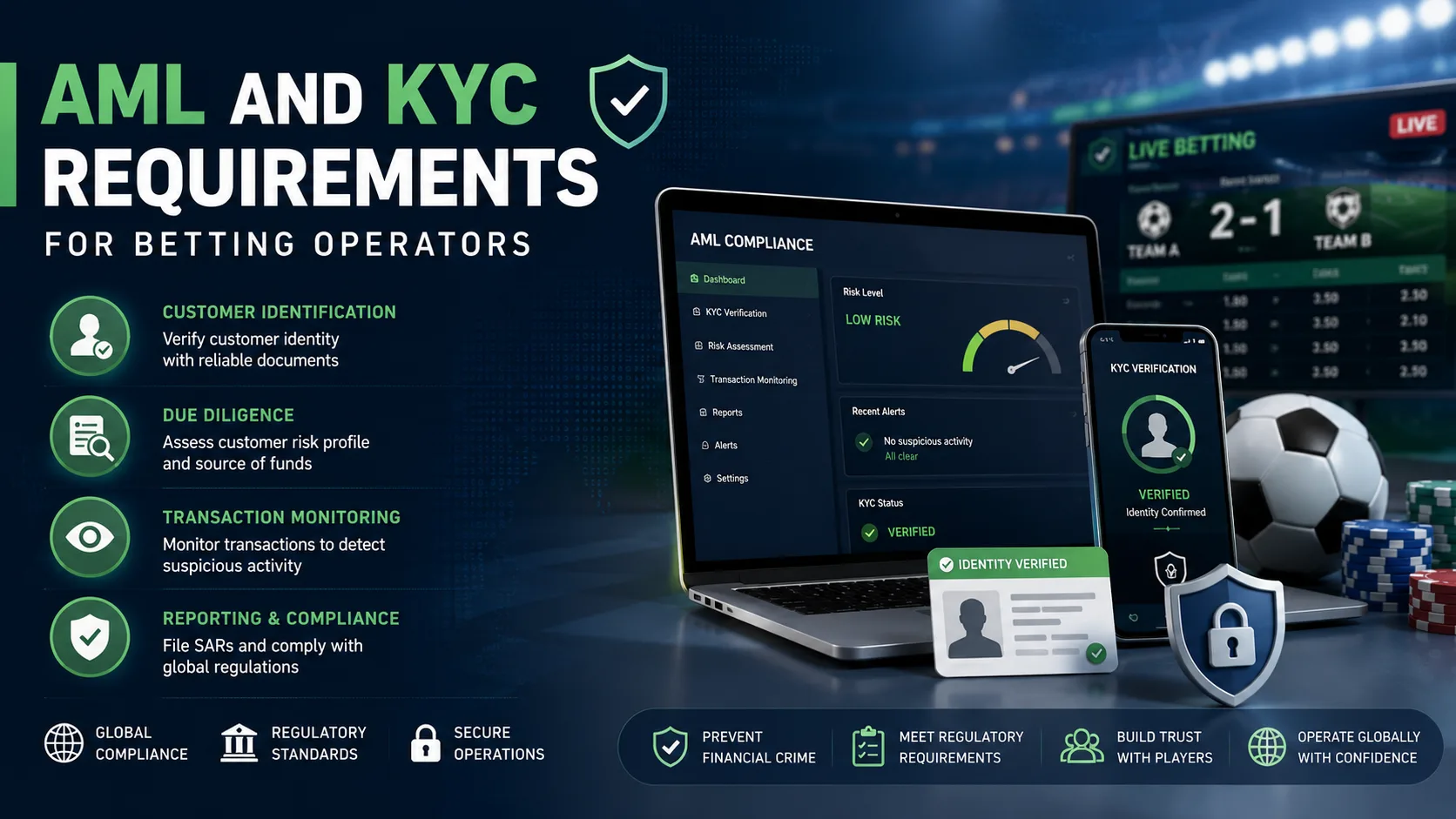
The UK Gambling Commission removed its 72-hour grace period for identity verification. Not long ago, a new player could deposit, place a bet, and complete verification within three days after the fact. Under current LCCP requirements, that gap is gone entirely, verification has to happen before the first deposit, before the first bet, before any access to the gambling product at all. This single change captures where betting-industry AML/KYC compliance has moved in 2026: tighter, more prescriptive, and considerably less forgiving of operators who treat verification as something to complete eventually rather than immediately.
This guide breaks down what AML and KYC actually require of betting operators today, across the UKGC, MGA, and global frameworks, and, specifically for this cluster, how compliance program quality connects directly to an operator’s payment and banking relationships.
Why Betting Carries Baseline High-Risk Classification
Gambling is internationally recognized as an inherently high-risk industry for money laundering and terrorist financing, meaning every product and channel demands heightened vigilance by default, this isn’t a classification an individual operator can argue its way out of through good conduct alone; it’s the baseline the entire regulatory framework starts from.
The core mechanics that drive this classification are specific to how betting actually works:
- Cash-to-account conversion at speed: Betting inherently converts funds into account balances and back into payouts quickly, creating a structurally attractive laundering vector, deposit
- funds, place minimal-risk bets, withdraw as “winnings”
- High transaction volume with variable patterns: Legitimate betting behavior already looks volatile (win streaks, loss chasing, variable bet sizing), making it genuinely harder to distinguish suspicious patterns from normal player behavior than in most other financial services categories
- Global, often anonymous or pseudonymous access: Online betting’s borderless nature, combined with the growing role of crypto payment rails (covered in our dedicated guide on crypto payments for betting sites), adds genuine cross-border AML complexity on top of the base risk
The Regulatory Frameworks That Actually Apply
FATF: The International Baseline
The Financial Action Task Force sets the international standards underlying every national framework discussed below, designating gambling businesses as subject to AML obligations at a standard comparable to traditional financial institutions. This FATF designation is why gambling operators face compliance expectations that look more like a bank’s AML program than a typical retail business’s, the international baseline itself assumes elevated risk.
UKGC: The Most Prescriptive Framework Globally
The UK Gambling Commission applies a rule-based approach that leaves comparatively little room for operator discretion, with requirements set out in the Licence Conditions and Codes of Practice (LCCP) and the Commission’s own AML guidance.
- Under LCCP Condition 17.1.1, verification must happen before any deposit, bet, or access to a gambling product: the previously existing 72-hour grace period no longer exists
- Source of Funds (SoF) and Source of Wealth (SoW) checks are required: not just identity verification, operators must confirm not just who a player is, but where their money is actually coming from
- The UKGC’s financial risk assessment specifically looks for signs of financial pressure or gambling-related harm: connecting AML compliance directly to responsible gambling obligations in a way not every jurisdiction’s framework does explicitly
- These are licensing conditions, not policy recommendations: failure to comply technically, not just in written policy documents, is what triggers enforcement action, and deficiencies here have historically resulted in multimillion-pound fines and temporary license suspensions
MGA: A Risk-Based, More Flexible Framework
The Malta Gaming Authority takes a materially different regulatory philosophy, giving operators more design flexibility in how they structure compliance, but requiring them to document and justify their own risk methodology rather than following a uniform prescriptive checklist.
- Full Customer Due Diligence is required by a €2,000 threshold: with suspicion-based triggers requiring earlier checks regardless of that threshold
- Operators must comply with the Prevention of Money Laundering and Funding of Terrorism Regulations (PMLFTR): and file Suspicious Transaction Reports (STRs) with Malta’s Financial Intelligence Analysis Unit (FIAU)
- The tradeoff for this flexibility is documentation burden: an MGA-licensed operator needs to be able to demonstrate and justify why its specific risk-based approach meets regulatory expectations, rather than pointing to a fixed rule it simply followed
Other Major Frameworks Worth Knowing
- EU AML Directives (5th and 6th AMLD): impose strict KYC and AML obligations across EU member states generally, layered on top of individual national gambling regulators
- North America: splits responsibility between financial and gaming authorities, FinCEN and FINTRAC alongside state, provincial, or tribal gaming regulators, creating a genuinely fragmented compliance picture for operators serving US or Canadian markets
- Even offshore jurisdictions have tightened requirements: Curaçao, the Isle of Man, and Gibraltar have all strengthened their AML frameworks in recent years specifically to align more closely with FATF recommendations, a trend directly connected to the jurisdiction-tier dynamics covered in our companion guide on offshore versus local betting licenses
The Core Compliance Components Every Operator Needs
Customer Due Diligence (CDD) and Identity Verification
Every operator must verify a player’s identity, age, and residential address at onboarding, the specific timing requirement (before first deposit under UKGC rules; by a defined threshold under MGA rules) varies by jurisdiction, but the underlying obligation is universal.
Source of Funds and Source of Wealth Checks
Beyond confirming who a player is, operators increasingly need to confirm where a player’s money is actually coming from, particularly once deposit or spending activity crosses defined thresholds. This is distinct from basic identity verification, it’s a financial-crime risk assessment, not just an identity check.
Enhanced Due Diligence (EDD) for High-Risk Players
Politically exposed persons (PEPs), players with unusual deposit patterns, and other elevated-risk profiles require a more intensive review process than standard onboarding, a universal requirement across every major framework, even where the specific EDD triggers vary by jurisdiction.
Ongoing Transaction Monitoring
Compliance doesn’t end at onboarding. Regulators increasingly require operators to run transaction monitoring algorithms that detect discrepancies between deposits and actual gaming behavior, a player depositing far more than their apparent betting activity would suggest, for instance, is exactly the kind of pattern ongoing monitoring is designed to catch.
Sanctions and PEP Screening
Modern compliance platforms in this space typically screen against 3,500-plus global watchlists across 215-plus sanction regimes, with data refreshed roughly every 15 minutes, reflecting how continuously this screening needs to run, not as a one-time onboarding check but as a persistent background process.
Suspicious Activity/Transaction Report Filing
When monitoring flags potential money laundering, operators must generate and submit reports to the relevant authority, the National Crime Agency (NCA) in the UK, the FIAU in Malta, or the equivalent body in other jurisdictions, within required timelines.
Beneficial Ownership Verification
Many gambling operators themselves operate through complex holding structures involving offshore companies, SPVs, or nominee directors, which complicates identification of the operator’s own ultimate beneficial owners from the regulator’s perspective. Regulators including the MFSA and UKGC increasingly demand UBO disclosure and verified ownership registries specifically because of how common these complex structures are in the industry.
Where Crypto Payments Add AML Complexity
Cryptocurrency has become a genuinely popular betting payment option, covered in depth in our dedicated guide on crypto payments for sports betting sites, but it meaningfully increases AML exposure for operators who accept it. Transactions from anonymous wallets or mixing services may connect to illicit activity in ways operators need specific tooling to detect. The EU’s Regulation (EU) 2023/1113 already mandates including crypto transactions in AML screening (the Travel Rule) and requires identification of wallet holders, a compliance obligation that doesn’t disappear because a transaction happens on-chain rather than through a traditional payment rail.
What’s Still Being Built: The EU’s AMLA
Worth flagging as a genuinely current, still-developing piece of the regulatory picture: the EU’s new Anti-Money Laundering Authority (AMLA) is actively working on standards for customer checks, linked transactions, business risk reviews, ongoing monitoring, group controls, and reporting, but these drafts don’t apply yet as of 2026. Operators serving EU markets should expect this framework to formalize and tighten further, not treat the current requirements as a stable, permanent baseline.
Why AML/KYC Compliance Directly Shapes Payment Infrastructure
This is the throughline connecting compliance back to the payments focus of this content cluster, and it mirrors a pattern seen across every high-risk vertical covered elsewhere on this site: AML program maturity isn’t just a regulatory box to check, it’s a direct underwriting input for banks and payment providers.
- Weak or undocumented AML programs are a primary driver of the banking de-risking dynamic: covered in our guide on why banks reject betting businesses, banks specifically weigh AML compliance quality when deciding whether the compliance cost of a betting relationship is worth the business
- A well-documented CDD, source-of-funds, and SAR filing history moves a betting operator through payment provider underwriting meaningfully faster: than one with thin or undocumented compliance, the same dynamic seen in forex and other high-risk verticals
- Payment processors serving betting operators increasingly build their own AML monitoring on top of the operator’s: meaning a high-risk payment gateway provider’s underwriting review will scrutinize an operator’s compliance program directly as part of extending merchant services
- Correspondent banking relationships supporting cross-border betting operations: carry compounded AML exposure, since cross-border payments infrastructure routes through additional institutions each independently assessing the same underlying risk
An operator treating AML/KYC as a compliance-department-only concern, disconnected from the business’s payment infrastructure strategy, is missing a genuinely direct and controllable lever over its own banking access.
Decision Framework: Building a Compliant AML/KYC Program
If you’re newly licensed and building your compliance program from scratch:
- Build verification timing to match your strictest applicable jurisdiction’s requirement (UKGC’s before-first-deposit standard, if you’re targeting that market) rather than the most lenient one, since retrofitting stricter timing later is more disruptive than building for it from the start
- Document your risk-based methodology explicitly even in jurisdictions with more prescriptive rules, since you’ll need this documentation for MGA-style frameworks and for payment provider due diligence regardless
If you’re operating across multiple regulatory jurisdictions simultaneously:
- Build your compliance infrastructure to the standard of your strictest jurisdiction as a baseline, then layer jurisdiction-specific requirements (SoF/SoW under UKGC, the €2,000 CDD threshold under MGA) on top, rather than maintaining entirely separate compliance workflows per market
- Factor AMLA’s still-developing EU framework into your forward planning if you serve EU markets, since current requirements are likely to tighten further
If you accept crypto payments:
- Build wallet-holder identification and Travel Rule compliance into your crypto payment flow from the start, given both the EU’s binding requirement and the broader regulatory direction across every jurisdiction covered in this guide
- Treat crypto-specific AML tooling as a distinct requirement from your standard fiat-payment AML monitoring, not an extension of the same system without modification
If you’re struggling with banking or payment processing access:
- Audit your AML program documentation specifically before assuming the rejection reflects unfair treatment of the betting category broadly, clear beneficial ownership disclosure, mature CDD/EDD processes, and a clean SAR filing history are the concrete levers that directly improve payment provider underwriting outcomes, as covered in our guide on why banks reject betting businesses
Common Mistakes Betting Operators Make
- Treating verification timing as flexible when a jurisdiction’s rules are explicit: The UKGC’s removal of its grace period means “we’ll verify after the first deposit” is no longer a compliant approach, regardless of how it may have worked under older rules
- Building one compliance workflow and assuming it satisfies every jurisdiction: MGA’s risk-based flexibility and UKGC’s prescriptive rules require genuinely different documentation and process design, not just threshold adjustments
- Treating crypto payment AML as identical to fiat payment AML: Wallet-holder identification, mixer/anonymous-wallet detection, and Travel Rule compliance are distinct requirements crypto-accepting operators need to build for specifically
- Underestimating beneficial ownership scrutiny of the operator’s own structure: Complex offshore holding structures, common in this industry, invite exactly the UBO scrutiny that both regulators and payment providers apply during their own due diligence
- Disconnecting AML compliance from payment infrastructure strategy: Treating these as separate workstreams misses how directly compliance program quality shapes banking and payment provider access
Conclusion
AML and KYC requirements for betting operators aren’t a uniform checklist, they vary meaningfully between a prescriptive framework like the UKGC’s and a risk-based one like the MGA’s, and the details (verification timing, SoF/SoW thresholds, reporting obligations) matter as much as the underlying principles. What’s consistent across every framework is the direction of travel: tighter, more documented, and increasingly connected to payment and banking access rather than treated as a purely regulatory concern.
Operators who build genuinely robust compliance infrastructure, matched to their strictest applicable jurisdiction, properly documented, and treated as core business infrastructure rather than a compliance-department afterthought, are the ones who move faster through both regulatory examination and payment provider underwriting, because in both cases, the same underlying question gets asked: does this operator genuinely know who it’s doing business with, and can it prove it.
Frequently Asked Questions
Q: When does a betting operator need to verify a player’s identity under UKGC rules?
A: Before the player makes a deposit, places a bet, or accesses any gambling product, under LCCP Condition 17.1.1, the previously existing 72-hour grace period for post-deposit verification no longer exists.
Q: What’s the difference between the UKGC and MGA approach to AML/KYC?
A: The UKGC applies a prescriptive, rule-based approach with specifically defined requirements and little operator discretion. The MGA takes a risk-based approach giving operators more design flexibility, but requiring them to document and justify their own risk methodology to regulators.
Q: What is a source of funds (SoF) check, and how is it different from identity verification? A: Identity verification confirms who a player is. A source of funds check assesses financial crime risk by examining where a player’s money is actually coming from, a deeper financial-crime risk assessment required particularly once deposit or spending activity crosses defined thresholds.
Q: Does accepting crypto payments increase a betting operator’s AML obligations?
A: Yes. Crypto transactions carry additional risk from anonymous wallets and mixing services, and under EU Regulation (EU) 2023/1113 specifically, crypto transactions must be included in AML screening with wallet-holder identification (the Travel Rule), a distinct compliance requirement from standard fiat-payment AML monitoring.
Q: How does AML/KYC program quality affect a betting operator’s banking relationships?
A: Directly. Payment providers and banks evaluating a betting operator relationship scrutinize AML program maturity as a core underwriting factor, since weak or undocumented compliance is a primary driver of the banking de-risking pattern that makes betting businesses difficult to bank in the first place.
Q: Are offshore-licensed betting operators exempt from strict AML requirements?
A: No, and increasingly less so. Even offshore jurisdictions like Curaçao, the Isle of Man, and Gibraltar have tightened their AML frameworks in recent years specifically to align more closely with FATF international standards.
Comments
No comments yet. Be the first to share your thoughts.
Leave a comment