
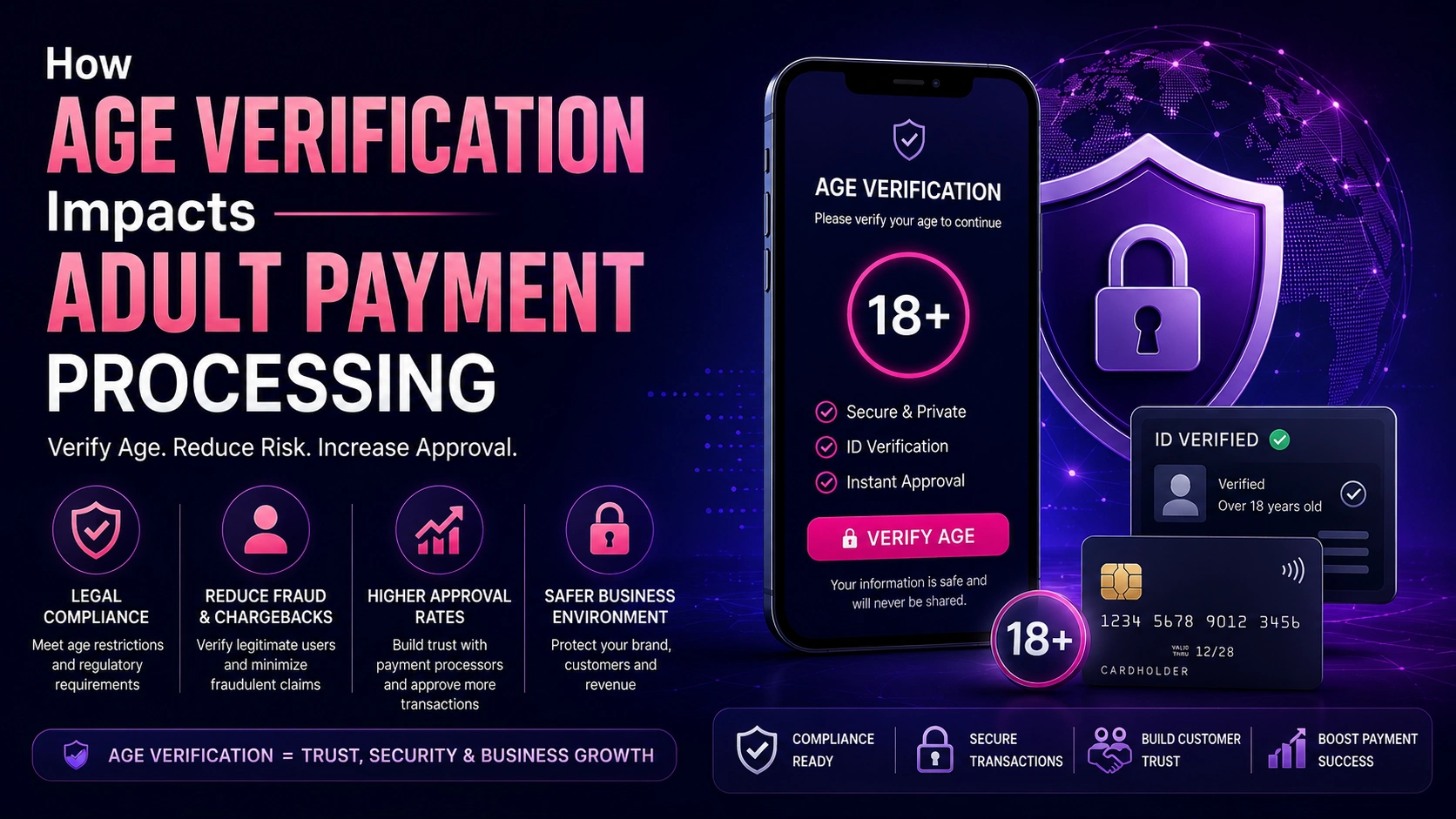
Ofcom issued its first financial penalty under the UK Online Safety Act in 2025: £1 million against an adult website for failing to implement appropriate age checks. Around the same time, the ICO separately fined Reddit £14.47 million for processing children’s personal data without adequate age safeguards. These aren’t isolated enforcement actions, they’re the leading edge of a regulatory wave that has moved age verification from a niche compliance concern into a core, non-negotiable requirement directly shaping how adult merchants get and keep payment processing.
This guide focuses specifically on the intersection: how age verification law actually affects payment infrastructure, merchant account underwriting, and processor risk assessment, not the underlying content regulation itself, but its direct payments consequences.
Age verification has moved from a self-declaration checkbox to a legally mandated, technically verified requirement across every major market, the UK Online Safety Act, EU Digital Services Act, France’s Arcom framework, and a growing US state patchwork all now require “highly effective” or certified age assurance, with self-declaration explicitly rejected as insufficient. This directly affects payment processing: payment providers and card networks increasingly treat verified age-assurance implementation as a merchant account underwriting factor, not just a separate legal compliance matter, since inadequate age controls create liability exposure that flows through to the payment relationship itself. Merchants need to treat age verification as core payment infrastructure, integrated with the checkout and billing flow, not a bolted-on legal checkbox.
The Regulatory Shift: From Self-Declaration to Verified Assurance
Why the Old Model Collapsed
The self-regulatory model, where platforms were trusted to enforce their own age policies, produced self-declaration as the universal “solution”: a simple “I am 18+” checkbox with no actual verification behind it. Regulators reviewed this approach and concluded that a date-of-birth entry screen does not constitute a meaningful control at all. That conclusion, now shared across UK, EU, and a growing list of other regulators, is what’s driving the current wave of mandatory technical verification requirements.
What Changed the Political Calculus
Three factors made stricter regulation politically inevitable rather than optional: documented public harm evidence connecting minors’ access to age-restricted content with measurable harms, growing recognition that self-declaration wasn’t functioning as genuine platform accountability, and, critically, the fact that document-based identity verification and biometric age estimation became commercially available, affordable, and technically proven, eliminating the “it’s too hard to implement” argument that had previously slowed regulatory action.
The Current Regulatory Landscape, Market by Market
United Kingdom: The Most Advanced Enforcement Regime
The UK Online Safety Act requires “highly effective age assurance” for platforms hosting or linking to pornography, with enforcement fully active since July 25, 2025. Acceptable methods include certified third-party age verification, document checks with liveness detection, and privacy-compliant facial age estimation, explicitly, self-declaration is not accepted. Ofcom, the enforcement authority, can fine violators up to 10% of global turnover or £18 million, whichever is greater, and has already demonstrated willingness to use this authority.
European Union: A Layered Framework Still Being Built Out
The EU’s Digital Services Act establishes the baseline across all 27 member states, with Article 28 requiring platforms accessible to minors to provide a high level of safety, security, and privacy, and the European Commission has moved from publishing guidelines to actively opening enforcement actions against specific platforms. Beyond the DSA baseline, individual member states are layering national requirements on top:
- France: brought Arcom’s mandatory technical standards for adult content verification into force in January 2025, with fines for a first violation reaching €150,000 or 2% of global annual turnover (whichever is higher), doubling for repeat violations, and Arcom can instruct ISPs and domain providers to block non-compliant sites within 48 hours, with providers themselves facing criminal liability for failing to comply
- Germany: requires certified verification under its JMStV framework, with identity-level assurance and liveness checks specifically required
- The Netherlands, Spain, and Italy: are in the process of passing or have already passed their own national legislation mandating age verification for adult content specifically
- A shared EU age-verification app: is already running in pilot states as of mid-2026, ahead of a planned full rollout by the end of the year, a genuinely significant development toward a unified verification infrastructure across the bloc
United States: A Rapidly Expanding State Patchwork
US courts have upheld states’ authority to enforce age verification requirements on adult websites, with the relevant ruling applying intermediate scrutiny, a meaningfully lower bar than the strict First Amendment review platforms had previously relied on to block enforcement. This judicial green light removed the primary legal uncertainty operators had been citing to delay compliance.
- Three states – Ohio, South Dakota, and Wyoming – set no minimum content threshold at all: meaning any platform hosting adult content is covered regardless of what proportion of overall content that represents
- Penalties frequently reach up to $10,000 per day: of non-compliance in states with active enforcement
- A federal layer is now moving as well: the SCREEN Act reached Senate Commerce markup in August 2026, with a covered-platform test that reaches well beyond dedicated adult sites specifically, meaningfully expanding who would need to answer this compliance question at all if enacted
- The regulatory landscape remains fluid: with further state laws continuing to be dated through 2026 and into 2027
Australia: A Newer But Active Framework
Australia’s Age-Restricted Material Codes came into force in March 2026, following an Age Verification Trial Bill passed in late 2024 and pilot programs run throughout 2025 by the eSafety Commissioner’s office, mandatory age verification for adult sites targeting Australian users is now an active operational reality, not a future obligation.
Accepted Verification Methods
Regulators across jurisdictions are broadly converging on similar accepted approaches, even where specific requirements differ:
- Document-based date-of-birth verification: checking a government-issued ID, often paired with liveness detection to confirm the document belongs to the actual user submitting it, providing what’s generally considered regulatory-grade certainty
- Facial age estimation: a privacy-preserving approach that estimates whether a user meets an age threshold (commonly 18+ or 25+) without retaining a document or personally identifiable information, appropriate where an approximate threshold is legally sufficient
- Digital identity / certified third-party verification: leveraging an existing verified digital identity credential rather than requiring fresh document submission each time
- What’s explicitly rejected almost everywhere: simple self-declaration (an unverified “I am 18+” checkbox) no longer satisfies any major regulatory framework’s requirements
Where This Directly Intersects With Payment Processing
This is the core focus of this guide, and it’s worth being explicit about the mechanism: age verification and payment processing are increasingly treated as connected compliance obligations, not separate legal and financial workstreams.
Payment Providers Scrutinize Age-Assurance Implementation During Underwriting
Payment providers and acquiring banks evaluating an adult merchant relationship increasingly review age-verification implementation directly as part of underwriting, not as a courtesy check, but because inadequate age controls create liability exposure (regulatory fines, potential platform liability for minor access) that a payment provider doesn’t want flowing indirectly into its own risk exposure by association with the merchant relationship. This mirrors the pattern seen across other high-risk verticals in this content category, where compliance program maturity functions as a direct underwriting signal rather than a peripheral legal detail.
Card Networks Have Their Own Parallel Age-Content Requirements
Beyond government regulation, card networks (Visa’s BRAM program, Mastercard’s equivalent framework) already impose their own content and compliance standards on adult merchants, and the direction of both regulatory and card network requirements is converging toward the same underlying expectation: demonstrable, verified age controls, not just a policy document claiming they exist.
Verification Vendor Selection Becomes a Payments-Adjacent Decision
Choosing an age verification provider isn’t purely a legal compliance decision anymore, it has real payment infrastructure implications:
- Integration with checkout flow matters: A verification step that creates excessive friction before payment can meaningfully hurt conversion, while one that’s too lightweight risks failing to satisfy the “highly effective” or certified standard multiple frameworks now require
- Data handling and PII retention policies affect both regulatory compliance and payment provider risk assessment: Regulators increasingly require that only the minimum data necessary for age assurance is collected and that PII isn’t retained after the check, a data minimization principle that also reduces the merchant’s overall risk profile from a payment provider’s perspective
- Documentation of the verification method used becomes part of the compliance record: payment providers may request during their own periodic account reviews, similar to how AML/KYC documentation functions across other high-risk verticals
The Cost of Getting This Wrong Extends Beyond Regulatory Fines
An adult merchant facing a regulatory enforcement action for inadequate age verification doesn’t just face the fine itself, the same event is exactly the kind of reputational and compliance red flag that can trigger a payment provider’s own account review, potentially independent of the merchant’s actual chargeback or fraud performance. This connects directly to the banking reputational risk dynamics covered in our companion guide on adult payment processing challenges: a regulatory enforcement action is precisely the kind of documented, specific risk factor that gives a payment provider legitimate grounds for account review or termination, distinct from the vaguer “reputational discomfort” that (in the US specifically) can no longer serve as sufficient justification on its own.
Building Age Verification Into Payment Infrastructure, Not Around It
Treat Verification as a Core Platform Component
Rather than treating age verification as a separate legal compliance module bolted onto an existing platform, the merchants navigating this landscape most successfully build it into the core checkout and access flow from the start, integrated with, not separate from, the payment experience.
Match Verification Method to Jurisdiction Requirements
Given how much specific requirements vary, the UK’s “highly effective” standard, France’s Arcom technical specifications, individual US state requirements, Australia’s Age-Restricted Material Codes, a single global verification approach may not satisfy every market a merchant serves. This mirrors the broader pattern covered throughout this content cluster: compliance infrastructure needs to be built to the standard of the strictest applicable jurisdiction, then layered with jurisdiction-specific requirements on top, rather than assuming one implementation satisfies every market simultaneously.
Document Everything for Both Regulatory and Payment Provider Review
Given that both regulators and payment providers may request evidence of age-verification implementation, maintaining clear, current documentation, which method is used, when it was implemented, how data is handled and retained, serves both compliance purposes simultaneously rather than requiring separate documentation efforts.
Plan for Continued Regulatory Tightening, Not a Stable Baseline
The enforcement posture across every major jurisdiction covered in this guide has hardened considerably through 2025 and into 2026, with no sign of softening, a federal US framework (the SCREEN Act) advancing through Senate markup, the EU’s shared verification app moving toward full rollout, and additional US state laws continuing to be enacted. Merchants should build age-verification infrastructure assuming requirements will tighten further, not treat current standards as a fixed target to meet once and move on from.
Decision Framework: What Adult Merchants Should Prioritize
If you’re not yet serving UK, EU, or regulated US state markets:
- Build age-verification infrastructure now rather than waiting for enforcement to reach your specific market, given how clearly the regulatory direction of travel points toward expansion, not contraction, of these requirements
- Choose a verification approach that can scale to meet stricter standards later, rather than the minimum viable implementation for your current market only
If you’re already serving regulated markets:
- Audit your current verification method against the specific “highly effective” or certified standard your operating jurisdictions require, self-declaration alone no longer satisfies any major framework
- Document your verification implementation clearly enough to satisfy both a regulatory review and a payment provider’s underwriting request, since both are increasingly likely to ask
If you’re evaluating payment providers or facing underwriting scrutiny:
- Present your age-verification compliance proactively as part of your application or account review, rather than waiting for it to be requested, this is exactly the kind of documented risk-mitigation factor that improves underwriting outcomes across every high-risk vertical covered in this content category
- Understand that a documented regulatory enforcement action, if one occurs, will likely trigger payment provider scrutiny independent of your payment performance metrics
If you’re building for genuinely global reach:
- Plan for jurisdiction-specific verification requirements rather than a single global implementation, given how much specific standards diverge between the UK, individual EU member states, the US state patchwork, and Australia
- Monitor the EU’s shared age-verification app rollout and the US SCREEN Act’s progress specifically, since both represent potentially significant infrastructure and compliance shifts still actively developing as of 2026
Conclusion
Age verification has moved decisively from a legal afterthought to a core requirement shaping adult payment processing directly, payment providers increasingly treat verified age-assurance implementation as an underwriting factor, and a regulatory enforcement action for inadequate controls creates exactly the kind of documented risk signal that can trigger a payment provider’s own account review. The merchants navigating this landscape successfully are the ones treating age verification as integrated payment infrastructure, built to the standard of their strictest applicable jurisdiction and documented clearly enough to satisfy both regulators and payment providers simultaneously, not as a separate legal compliance task disconnected from the actual business of processing payments.
Frequently Asked Questions
Q: Does self-declaration (“I am 18+” checkbox) satisfy current age verification requirements?
A: No. Every major regulatory framework covered in this guide, the UK Online Safety Act, EU DSA and national frameworks, US state laws, and Australia’s Age-Restricted Material Codes, has explicitly rejected self-declaration alone as insufficient, requiring certified, technically verified methods instead.
Q: Why would a payment provider care about a merchant’s age verification method?
A: Inadequate age controls create liability exposure, regulatory fines, potential platform liability, that payment providers increasingly treat as a direct underwriting factor, since a regulatory enforcement action is exactly the kind of documented risk signal that can trigger the provider’s own account review.
Q: What are the accepted age verification methods across major jurisdictions?
A: Document-based verification with liveness detection, facial age estimation, and certified third-party or digital identity verification are broadly accepted across the UK, EU, and other major frameworks, the specific technical standards required vary by jurisdiction, but self-declaration is rejected essentially everywhere.
Q: How much can regulators actually fine a non-compliant adult platform?
A: It varies significantly by jurisdiction, UK Ofcom can fine up to 10% of global turnover or £18 million, France’s Arcom framework imposes up to €150,000 or 2% of global turnover for a first violation (doubling for repeat violations), and several US states allow penalties up to $10,000 per day of non-compliance.
Q: Is age verification only a concern for merchants serving the UK and EU?
A: No. The US state patchwork is expanding rapidly, with three states (Ohio, South Dakota, Wyoming) applying requirements with no minimum content threshold at all, a federal SCREEN Act advancing through Senate markup, and Australia’s own framework now actively enforced as of March 2026, this is a genuinely global regulatory trend, not a UK/EU-specific one.
Q: Should age verification be built as a separate compliance layer or integrated with payment infrastructure?
A: Integrated. Merchants treating age verification as core platform infrastructure, built into checkout flow, documented alongside compliance records payment providers may request, are better positioned than those treating it as a bolted-on legal checkbox disconnected from the actual payment relationship.
Comments
No comments yet. Be the first to share your thoughts.
Leave a comment