
Introduction
In today’s borderless digital economy, businesses are no longer restricted to serving customers within their home countries. E-commerce platforms, SaaS providers, travel agencies, online gaming companies, subscription businesses, and numerous other industries now operate on a global scale. As international commerce expands, businesses require payment solutions capable of supporting customers across different countries, currencies, and regulatory environments.One solution that has gained significant attention is the Offshore Merchant Account. Often associated with international payment processing and high-risk industries, offshore merchant accounts provide businesses with greater flexibility when accepting payments from customers worldwide.
While offshore merchant accounts can offer valuable advantages, they also come with unique compliance requirements, operational considerations, and risk management obligations. Understanding how these accounts function is essential for businesses seeking to expand globally and optimize payment acceptance strategies.
What Is an Offshore Merchant Account?
An offshore merchant account is a merchant processing account established with a financial institution or payment provider located outside the business owner’s country of incorporation or primary operation.
The account enables businesses to accept electronic payments, including credit cards, debit cards, and alternative payment methods, through international acquiring banks.
Unlike traditional domestic merchant accounts, offshore merchant accounts are designed to support businesses with international operations, cross-border transactions, or elevated risk profiles.
Many offshore providers specialize in serving industries that may face challenges obtaining approval from local banks due to regulatory concerns, chargeback exposure, or business model complexity.
Why Businesses Seek Offshore Merchant Accounts
The growing demand for offshore merchant accounts is driven by several factors.
Many businesses operate globally and need payment solutions capable of handling customers from multiple jurisdictions. Others may belong to industries classified as high-risk by domestic acquiring banks.
Businesses often pursue offshore merchant accounts for reasons such as:
- International payment acceptance
- Multi-currency processing
- Access to global acquiring networks
- Support for high-risk industries
- Improved approval rates
- Diversified banking relationships
- Business expansion opportunities
For many organizations, offshore merchant accounts provide access to payment capabilities that may not be readily available through local providers.
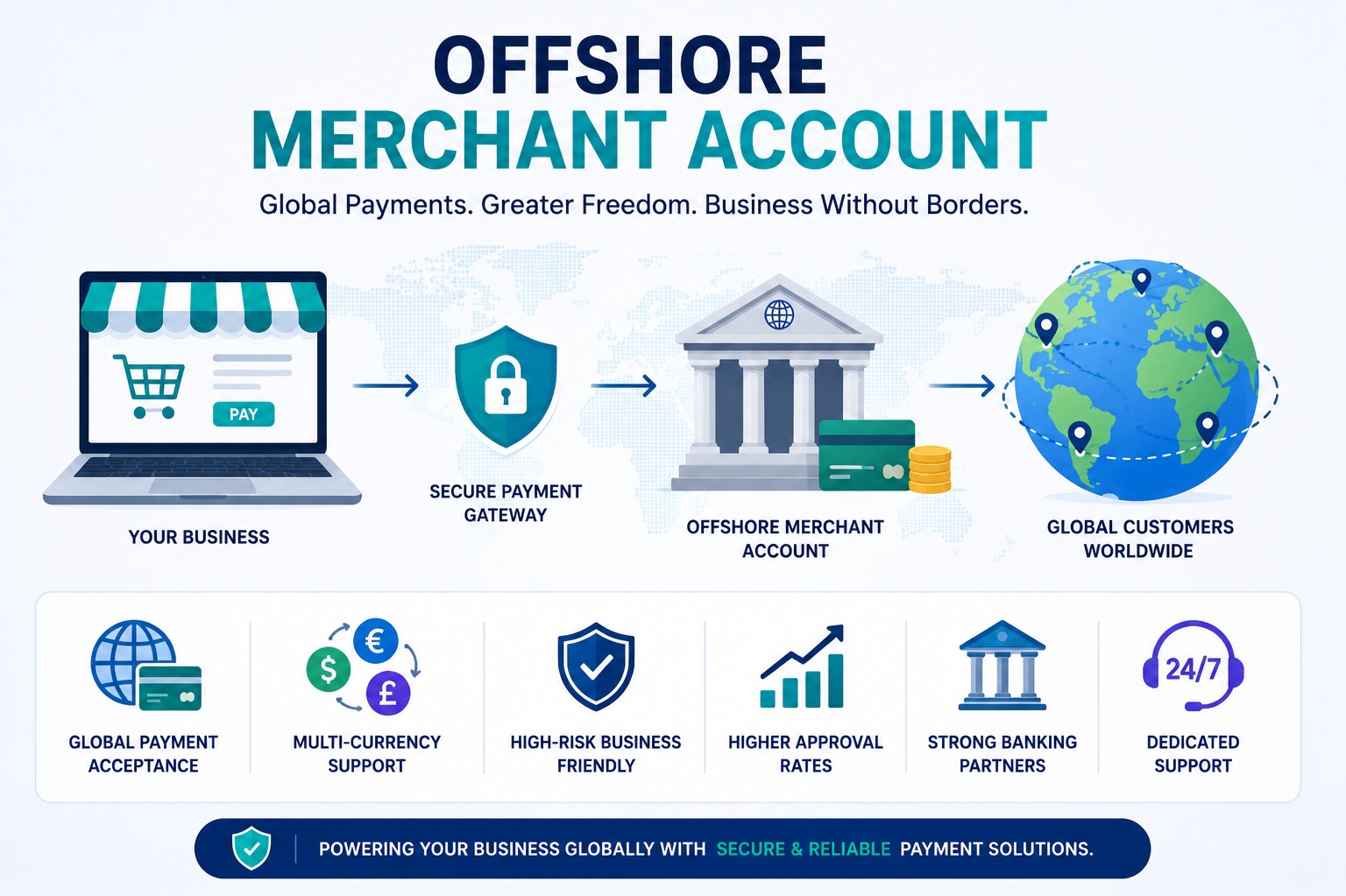
How Offshore Merchant Accounts Work
The process of accepting payments through an offshore merchant account is similar to traditional payment processing.
When a customer makes a purchase, the transaction is routed through a payment gateway to the acquiring bank supporting the offshore merchant account. The acquiring institution processes the payment request, communicates with card networks, and obtains authorization from the issuing bank.
Once approved, funds are settled into the merchant account according to the provider’s settlement schedule.
The primary difference lies in the location of the acquiring institution and the regulatory framework governing the merchant relationship.
Many offshore providers offer enhanced international payment capabilities and specialized risk management services designed for global commerce.
Industries Commonly Using Offshore Merchant Accounts
While businesses across various sectors utilize offshore merchant accounts, they are particularly popular among industries facing elevated payment processing challenges.
These industries often include:
E-Commerce Businesses
Online retailers selling internationally frequently require multi-currency support and global payment acceptance capabilities.
Subscription-Based Services
Recurring billing businesses often seek offshore solutions to improve payment continuity and reduce transaction declines.
Travel and Hospitality
Travel agencies, booking platforms, and tourism businesses frequently process cross-border transactions and benefit from international acquiring capabilities.
Forex and Financial Services
Companies operating in regulated financial sectors often require specialized merchant processing solutions.
Digital Services and Software Providers
SaaS companies and digital product businesses serving international customers frequently leverage offshore payment infrastructure.
Key Benefits of Offshore Merchant Accounts
Global Payment Acceptance
One of the most significant advantages is the ability to accept payments from customers worldwide through international card networks and alternative payment methods.
Multi-Currency Processing
Many offshore providers support multiple currencies, allowing businesses to improve customer experiences and reduce foreign exchange friction.
High-Risk Business Support
Offshore acquiring banks often serve industries that domestic institutions may consider too risky.
Enhanced Geographic Reach
Businesses can expand into new markets without being constrained by local payment infrastructure limitations.
Revenue Diversification
Access to international payment channels can support broader customer acquisition strategies and reduce dependence on domestic markets.
These benefits make offshore merchant accounts particularly attractive for globally oriented businesses.
Understanding High-Risk Merchant Processing
The term “high-risk” frequently appears in discussions about offshore merchant accounts.
A business may be classified as high-risk for several reasons:
- High chargeback rates
- Recurring billing models
- International customer bases
- Regulatory complexity
- Industry-specific risks
- Large transaction volumes
High-risk classification does not necessarily indicate wrongdoing. Instead, it reflects the acquiring bank’s assessment of potential financial and operational exposure.
Offshore merchant account providers often possess greater expertise in managing these risks.
Compliance and Regulatory Considerations
Operating an offshore merchant account requires careful attention to compliance requirements.
Businesses must satisfy Know Your Customer (KYC), Anti-Money Laundering (AML), and regulatory verification standards established by acquiring institutions and payment networks.
Documentation commonly includes:
- Business registration certificates
- Ownership information
- Financial statements
- Website compliance reviews
- Processing history
- Banking references
Failure to maintain compliance can result in account restrictions, increased monitoring, or account termination.
Businesses should work with reputable providers that prioritize regulatory compliance and transparency.
Challenges of Offshore Merchant Accounts
Despite their advantages, offshore merchant accounts are not without challenges.
Approval processes may be more extensive than domestic merchant account applications. Providers often conduct detailed due diligence reviews before onboarding merchants.
Businesses may also encounter:
- Higher processing fees
- Rolling reserve requirements
- Enhanced monitoring obligations
- Complex regulatory environments
- Longer underwriting processes
Understanding these factors is important when evaluating offshore payment solutions.
Offshore Merchant Accounts and Cross-Border Commerce
Cross-border commerce continues to grow rapidly as consumers increasingly purchase products and services from international merchants.
Offshore merchant accounts play a crucial role in facilitating these transactions by providing:
- Global acquiring capabilities
- Currency flexibility
- International settlement options
- Alternative payment methods
- Regional payment optimization
As businesses expand internationally, access to reliable payment infrastructure becomes a competitive advantage.
Future Trends in Offshore Payment Processing
The offshore payments landscape is evolving alongside broader fintech innovation.
Emerging technologies such as artificial intelligence, open banking, embedded finance, and real-time payments are improving transaction efficiency and fraud prevention capabilities.
Key trends include:
- AI-driven risk management
- Advanced fraud detection
- Multi-currency digital wallets
- Open banking integrations
- Instant payment settlements
- Enhanced compliance automation
These developments are making offshore payment processing more secure, scalable, and accessible for global businesses.
Conclusion
An Offshore Merchant Account can be a powerful tool for businesses seeking to expand internationally, support multi-currency transactions, and access specialized payment processing solutions. Whether serving global customers, operating in a high-risk industry, or pursuing cross-border growth opportunities, offshore merchant accounts provide valuable flexibility and payment acceptance capabilities.
However, successful implementation requires careful attention to compliance, provider selection, risk management, and operational transparency. As international commerce continues to expand, offshore merchant accounts will remain an important component of the global payments ecosystem, helping businesses connect with customers and unlock new growth opportunities across international markets.
Comments
No comments yet. Be the first to share your thoughts.
Leave a comment