
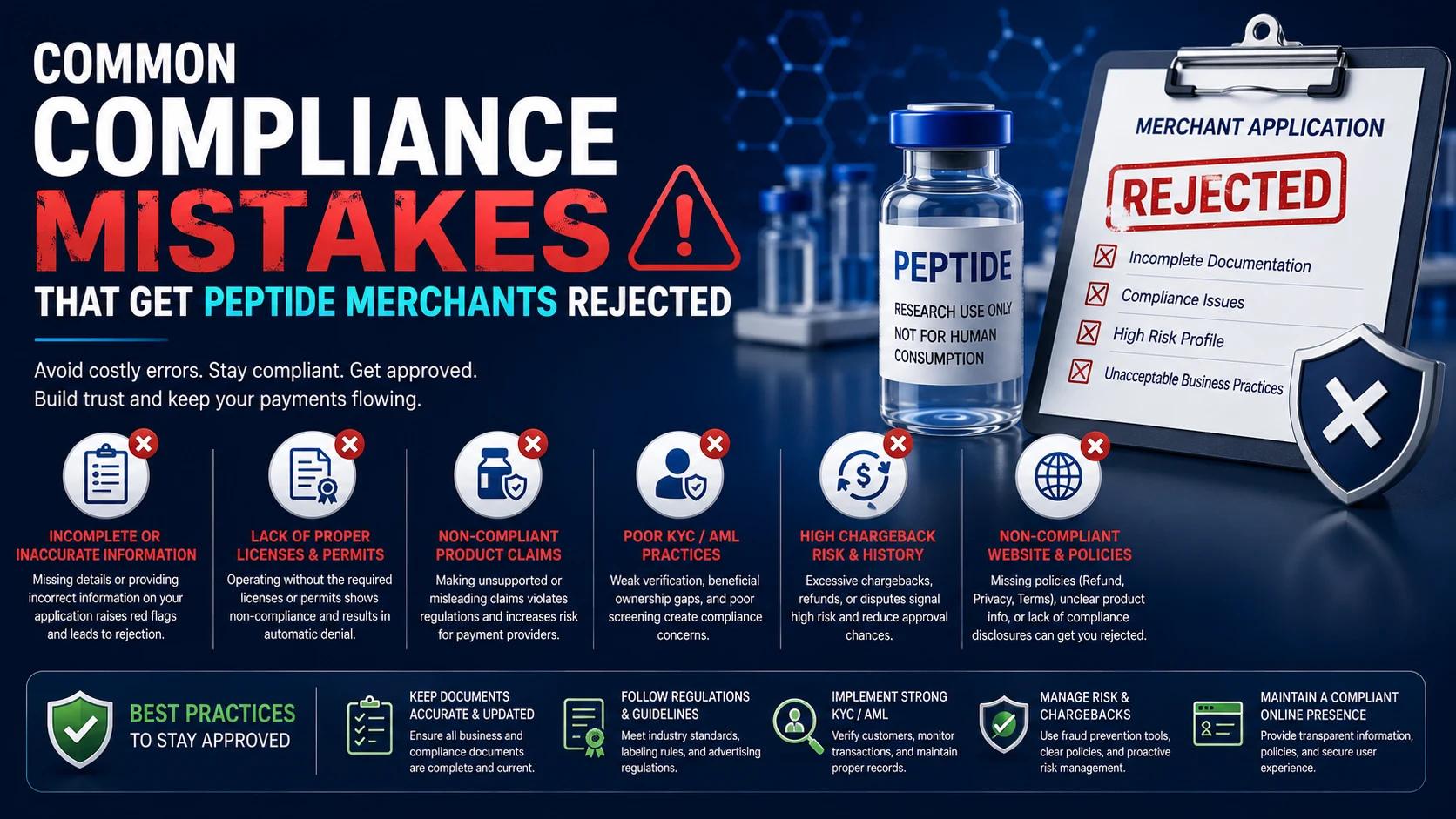
Most peptide merchant account rejections aren’t caused by the product category itself, they’re caused by specific, fixable mistakes in how the business presents itself on paper and online. Two peptide businesses selling nearly identical products can get completely different underwriting outcomes based entirely on execution: one gets approved in a week, the other gets declined or terminated months later.
This guide is an audit checklist, not a general explainer. If you’re preparing to apply for a peptide merchant account, or trying to figure out why an existing account got flagged, work through this list against your actual business, application, website, billing, and ongoing account management, before assuming the rejection is simply “because it’s peptides.”
Why “It’s Just a High-Risk Category” Is the Wrong Explanation
It’s tempting for a rejected peptide merchant to assume the category alone explains the decline. That’s only part of the story. Underwriters specifically inspect how a business sells, fulfills, and supports customers, not just its industry code, and a strong share of peptide merchants get declined even with clean bank statements simply because website wording, layout, or policy gaps trigger red flags that have nothing to do with the underlying product being legitimate.
That distinction matters practically: it means the fix usually isn’t finding a more lenient processor. It’s closing the specific gaps underwriters are actually looking for.
Inconsistent Product Positioning Across the Business
What It Looks Like
- Website copy that says “research use only” on the product page, but blog content, FAQs, or customer testimonials describe personal use, dosing schedules, or expected effects
- Marketing language implying therapeutic or performance outcomes not supported by the product’s actual regulatory status
- Social media or influencer content promoting the product in ways inconsistent with the website’s own disclaimers
Why It Gets Merchants Rejected
Underwriters read the entire funnel as one story, intake, product pages, supporting content, and fulfillment, not just the checkout page. A gap between “research use only” copy and how the product is actually marketed elsewhere is one of the most common decline reasons, even for otherwise well-run, established brands.
How to Fix It
- Audit every customer-facing surface, product pages, blog, FAQ, social channels, for consistency, not just the checkout flow
- Remove any language implying dosing, personal effects, or outcomes tied to human use
- Archive marketing screenshots when campaigns change, since underwriters may request historical evidence during review
A Billing Descriptor That Doesn’t Match Customer Expectations
What It Looks Like
- A statement descriptor that doesn’t resemble the business name customers actually recognize from checkout
- No post-purchase communication reinforcing what the charge will look like on a bank statement
- Descriptor mismatches between the website’s public-facing brand and the underlying processing entity name
Why It Gets Merchants Rejected
During underwriting, a common and direct question is why the descriptor differs from the business name, and a mismatch here is also one of the most common drivers of “friendly fraud” disputes after approval, where a customer simply doesn’t recognize a legitimate charge and files a chargeback rather than contacting the merchant first. Since friendly fraud accounts for a large majority of disputes in the peptide and supplement space, this single mistake has an outsized effect on chargeback ratios.
How to Fix It
- Match the billing descriptor as closely as possible to the brand name customers see at checkout
- Update post-purchase emails to explicitly state the exact descriptor text customers will see on their statement
- Add a “how the charge will appear” note directly on the order confirmation page, not just in a follow-up email
Incomplete or Poorly Organized Documentation
What It Looks Like
- Applying without certificates of analysis (COAs) ready for each product
- No clear business licensing documentation matched to the actual business model (RUO retailer vs. compounding vs. wholesale)
- Missing or outdated processing history from prior payment relationships
- No documented refund and dispute resolution policy
Why It Gets Merchants Rejected
Incomplete applications don’t just slow down underwriting, they often get declined outright, since a missing document reads as a compliance gap rather than an oversight. Complete documentation is directly tied to faster underwriting timelines; specialized processors report significantly faster turnaround when documentation is pre-assembled versus submitted piecemeal.
How to Fix It
- Assemble the full documentation package before applying, not after a request for more information
- Match documentation specifically to your business model, a compounding pharmacy needs different proof than an RUO retailer
- Keep documentation current as products, suppliers, or licensing status change, rather than treating it as a one-time submission
No Chargeback Prevention Infrastructure
What It Looks Like
- No visibility into chargeback ratio until a processor flags it
- No delivery confirmation or tracking evidence for shipments
- No proactive dispute resolution process before a customer escalates to their bank
- Weak or nonexistent 3D Secure implementation at checkout
Why It Gets Merchants Rejected
Card network thresholds are unforgiving for a category with narrow margin for error. Visa’s Acquirer Monitoring Program (VAMP) threshold dropped from 2.2% to 1.5% effective April 2026, and Mastercard flags merchants at a 1% chargeback-to-transaction ratio or $5,000 in monthly chargeback volume. Peptide and adjacent nutraceutical categories have historically run above the general retail average, meaning even brief dispute spikes can push a merchant into formal monitoring faster than a lower-risk business would experience.
Modern authentication tooling meaningfully changes this picture: 3D Secure 2.0 implementation has been shown to reduce fraud significantly by enabling real-time verification between merchants and cardholders’ banks, a tool many peptide merchants simply don’t implement before applying.
How to Fix It
- Track chargeback ratio and refund rate on an ongoing dashboard, not just when a processor raises a flag
- Implement delivery confirmation and tracking for every shipment as standard practice
- Deploy 3D Secure 2.0 or equivalent strong authentication at checkout
- Build a proactive customer service process that resolves disputes before they escalate to a formal chargeback
Applying to the Wrong Type of Processor Entirely
What It Looks Like
- Applying to mainstream aggregators (Stripe, PayPal, Square) expecting approval based on clean bank statements alone
- Choosing a generalist high-risk processor with no specific peptide or nutraceutical underwriting experience
- Not verifying whether a processor’s stated approval timeline and requirements actually match your specific business model
Why It Gets Merchants Rejected
Mainstream processors rely heavily on automated risk systems that flag peptide businesses before any human review happens at all, meaning the application quality itself often doesn’t matter, because the classification alone triggers rejection. Generalist high-risk processors, meanwhile, may lack the specific underwriting frameworks that peptide and nutraceutical accounts actually need, leading to mismatched fee structures, unclear reserve terms, or slower approval than a category-specific specialist would offer.
How to Fix It
- Go directly to processors with documented peptide or nutraceutical underwriting experience, rather than starting with a mainstream platform and hoping
- Ask specifically about the processor’s track record with your exact business model, not just “high-risk” experience broadly
- Compare stated approval timelines against your documentation readiness, well-prepared applications with specialized processors can move considerably faster than expected
Skipping LegitScript Certification When It’s Expected
What It Looks Like
- Applying without LegitScript certification, assuming it’s optional or unnecessary
- Not understanding that certification eligibility itself depends on genuine RUO positioning
Why It Gets Merchants Rejected
LegitScript certification isn’t legally mandated, but it has become close to a baseline expectation among acquiring banks specifically for peptide merchant account approval, and increasingly, processors treat it as a differentiator rather than a bonus. Skipping it doesn’t automatically disqualify a business, but it closes off approval paths with specialized processors that require it, and it removes a trust signal that would otherwise speed up underwriting significantly.
How to Fix It
- Pursue LegitScript certification proactively as part of application preparation, not reactively after a rejection
- Ensure the underlying business genuinely qualifies, certification itself functions as a filter reinforcing proper research-use positioning, so misaligned businesses may not pass the certification review either
Treating Approval as the Finish Line, Not the Start of an Ongoing Relationship
What It Looks Like
- No ongoing monitoring of chargeback ratio, refund rate, or account health after approval
- Assuming the business can operate exactly as it did during underwriting without periodic review
- No plan for what happens if the account gets flagged, held, or reviewed
Why It Gets Merchants Rejected (or Terminated Later)
Getting approved is only the first step, because peptide businesses are classified as high risk, processors monitor them closely on an ongoing basis. A live account that gets frozen after a routine monitoring scan is a more expensive and disruptive problem than a slower, more accurate underwriting process up front would have been. Businesses that treat approval as a solved problem, rather than an ongoing compliance relationship, are the ones most likely to face a sudden termination months down the line.
How to Fix It
- Set up ongoing chargeback alerts, descriptor review, and account health monitoring as standard practice, not a one-time setup task
- Reassess website copy, product positioning, and documentation periodically, not just at initial application
- Build a relationship with your processor’s compliance team rather than treating them as a vendor to interact with only when something goes wrong
No Backup Processor When the Primary Account Gets Reviewed
What It Looks Like
- Relying entirely on one payment gateway with no secondary processing relationship
- No contingency plan for a hold, review, or termination on the primary account
Why It Gets Merchants Rejected (Functionally, If Not Literally)
This isn’t a mistake that gets an application declined, it’s the mistake that turns a routine account review into a full revenue stoppage. Given how closely peptide accounts are monitored on an ongoing basis, a single point of failure recreates exactly the risk category-specific underwriting was supposed to solve in the first place.
How to Fix It
- Maintain a backup high-risk payment gateway relationship, ideally with a different acquiring bank, so a hold on one account doesn’t stop revenue entirely
- Consider an offshore merchant account as a diversification layer for businesses with meaningful international sales
- Treat multi-processor redundancy as standard infrastructure, not a reaction to a first termination
Quick Audit: Run This Checklist Before You Apply
- Product pages, blog content, FAQs, and social channels all consistently support research-use-only positioning
- Billing descriptor matches the brand name customers recognize from checkout
- Post-purchase emails explicitly state what the charge will look like on a bank statement
- COAs, business licensing, and refund policy are complete and ready before applying
- Delivery confirmation and tracking are standard practice for every shipment
- 3D Secure 2.0 or equivalent authentication is implemented at checkout
- Applying directly to processors with documented peptide/nutraceutical underwriting experience
- LegitScript certification is in place or actively in progress
- A monitoring process exists for chargeback ratio and account health post-approval
- A backup processing relationship exists in case the primary account gets reviewed or held
Decision Framework: Where to Focus First
If you haven’t applied yet:
- Start with Mistakes #1, #2, and #3, product positioning, billing descriptor, and documentation are the highest-leverage fixes before your first application, since they directly shape the underwriter’s first impression
If you’ve been declined once already:
- Revisit Mistake #5 specifically, reapplying to the same type of processor without changing anything rarely produces a different outcome; go directly to a category-specific specialist instead
- Address whatever specific gap likely triggered the decline (usually #1 or #3) before reapplying anywhere
If you’re currently approved but want to avoid a future termination:
- Focus on Mistakes #4, #6, and #7, chargeback prevention infrastructure, LegitScript certification, and ongoing monitoring are what protect an already-approved account from a sudden review
- Add Mistake #8’s backup processor as insurance regardless of how healthy your current account looks
Conclusion
Rejection isn’t usually a verdict on whether a peptide business is legitimate, it’s most often a verdict on whether the application, website, and ongoing operations tell a consistent, well-documented story. The businesses that get approved quickly and stay approved long-term aren’t necessarily the ones with the lowest-risk products; they’re the ones that closed these specific, fixable gaps before an underwriter, or a monitoring system, found them first.
Frequently Asked Questions
Q: What’s the single most common reason peptide merchants get declined?
A: Inconsistency between product labeling and how the product is actually marketed elsewhere on the business’s website, blog, or social channels. Underwriters read the entire funnel as one story, and gaps here are one of the most common decline reasons even for established, well-run brands.
Q: Does a mismatched billing descriptor really affect approval odds?
A: Yes, directly. Underwriters specifically ask why a descriptor differs from the business name during review, and a mismatch also drives “friendly fraud” disputes after approval, since customers who don’t recognize a charge often file a chargeback rather than contacting the merchant.
Q: How long does peptide merchant account approval typically take?
A: Roughly two to four weeks through a high-risk processor, though well-prepared applications with pre-assembled documentation can move considerably faster with specialized processors. Delays most often stem from regulatory red flags discovered during review, not the base timeline itself.
Q: Is LegitScript certification required to avoid rejection?
A: Not legally required, but increasingly expected by acquiring banks specifically for peptide accounts. Skipping it doesn’t automatically disqualify a business, but it closes off approval paths with processors that require it and removes a trust signal that speeds up underwriting.
Q: What chargeback ratio puts a peptide merchant at risk of formal monitoring?
A: Mastercard flags merchants at a 1% chargeback-to-transaction ratio or $5,000 in monthly chargeback volume, while Visa’s VAMP threshold dropped to 1.5% effective April 2026. Peptide merchants have historically run above general retail averages, leaving less margin for error than lower-risk categories.
Q: Can a peptide business get approved after a previous termination?
A: Yes, but reapplying to the same type of processor without addressing the underlying issue rarely works. Businesses in this situation should identify the specific gap that likely triggered the original termination and apply directly to a category-specific high-risk specialist instead.
Comments
No comments yet. Be the first to share your thoughts.
Leave a comment