
Only a handful of forex brokers are legally permitted to serve U.S. retail traders. That’s not an accident of market competition, it’s the direct result of one of the strictest regulatory frameworks in global retail forex, built around two organizations that get confused with each other constantly: the CFTC and the NFA.
Understanding the actual difference between them isn’t just academic. It determines what protections traders actually have, what compliance burden brokers actually carry, and, for anyone building merchant services or payment processing infrastructure around U.S. forex, what regulatory status a broker needs before a bank or payment gateway will even consider the relationship. This guide breaks down exactly how these two bodies work, separately and together.
Why This Framework Exists in the First Place
Before Dodd-Frank Title VII reshaped U.S. retail forex regulation, the market operated in a considerably less structured environment. Unregulated platforms could and did fail, often due to poor risk management or outright fraud, leaving U.S. customers with no legal recourse or fund protection when things went wrong.
The post-2010 regulatory environment eliminated that dynamic by requiring CFTC registration and NFA membership as prerequisites for legal operation in the U.S. retail forex market. Today, that framework functions as the primary guardian of market integrity and retail trader safety in what remains a genuinely massive market, global daily forex turnover runs into the trillions of dollars.
The CFTC: The Federal Regulator
What the CFTC Actually Is
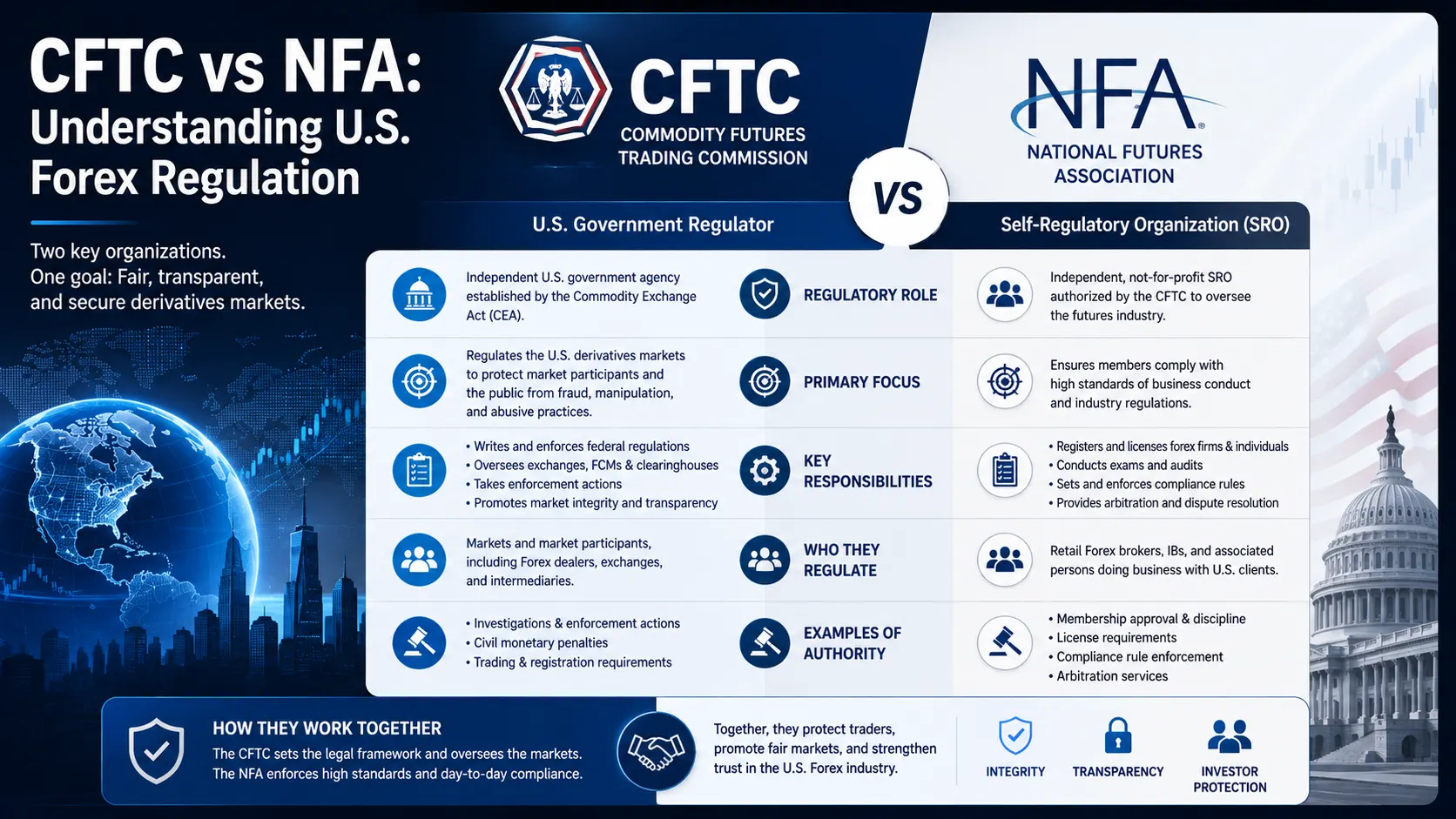
The Commodity Futures Trading Commission is an independent federal agency, not a private industry body. It’s the entity with actual statutory authority under U.S. law to regulate derivatives markets, including retail forex, and it derives that authority directly from federal legislation, most significantly, Dodd-Frank Title VII.
What the CFTC Does
- Writes the rules: The CFTC establishes the actual regulatory framework, capital requirements, leverage limits, disclosure obligations, that governs how forex dealers can legally operate
- Enforces federal law: The CFTC has direct enforcement authority, including the ability to bring civil actions against firms and individuals violating the Commodity Exchange Act
- Sets consumer protection standards: Dodd-Frank-era CFTC rules established consumer protections including segregation of customer funds, minimum net capital requirements, and dispute resolution mechanisms designed specifically to protect traders from broker insolvency
- Oversees the broader derivatives market: Forex is one piece of a much larger CFTC mandate that includes futures, swaps, and other derivatives products
Key CFTC Requirements for Forex Dealers
- Minimum adjusted net capital: U.S. forex brokers must maintain a minimum of $20 million in adjusted net capital, a substantial solvency requirement designed specifically to protect retail client funds from broker insolvency or market instability
- Registration as a Retail Foreign Exchange Dealer (RFED) or Futures Commission Merchant (FCM): before legally offering forex products to U.S. retail customers
- Compliance with leverage limits: a maximum of 50:1 on major currency pairs and 20:1 on minor pairs, considerably more conservative than leverage commonly available through offshore or non-U.S.-regulated brokers
The NFA: The Self-Regulatory Organization
What the NFA Actually Is
The National Futures Association is a self-regulatory organization (SRO), not a government agency, that the CFTC designated to handle the operational, day-to-day work of registration and member oversight. This distinction matters: the NFA doesn’t write federal law, but it enforces a detailed rulebook that member firms are contractually and legally bound to follow as a condition of membership.
What the NFA Does
- Handles registration processing: Firms seeking to operate as Forex Dealer Members go through the NFA’s registration process, which sits underneath the CFTC’s overall regulatory authority
- Enforces its own detailed rulebook: The NFA maintains specific compliance rules covering everything from promotional material review to security deposit requirements, with regular amendments, including updates effective as recently as March 2026
- Requires ongoing compliance reporting: Each Forex Dealer Member must designate a Chief Compliance Officer (CCO), who prepares an annual compliance report meeting CFTC Regulation 3.3(e) requirements and submits it to NFA within 90 days of the firm’s fiscal year end
- Conducts market oversight and discipline: NFA rules explicitly prohibit member firms from cheating, defrauding, or deceiving customers in any forex transaction, with the NFA authorized to investigate and discipline violations directly
Key NFA Requirements for Forex Dealer Members
- Minimum security deposits per transaction: 2% of notional value for major currency pairs (British pound, Swiss franc, Canadian dollar, Japanese yen, Euro, Australian dollar, New Zealand dollar, Swedish krona, Norwegian krone, Danish krone), and 5% for other currency pairs
- CCO annual reporting: including a formal certification under penalty of law that the report’s contents are accurate and complete
- Promotional material review and recordkeeping: requiring member firms to maintain copies of all promotional material along with review and approval records for specified retention periods
- Prior notification before commencing customer business: meaning a Forex Dealer Member must notify the NFA before actually beginning to serve customers, not just at initial registration
CFTC vs. NFA: The Core Structural Difference
| Dimension | CFTC | NFA |
|---|---|---|
| Legal status | Independent federal government agency | Self-regulatory organization (SRO) |
| Source of authority | Direct statutory authority under federal law (Dodd-Frank Title VII, Commodity Exchange Act) | Authority delegated by the CFTC |
| Primary function | Writes and enforces federal regulatory framework | Handles registration, member oversight, and day-to-day rule enforcement |
| Enforcement power | Civil enforcement actions under federal law | Disciplinary action against member firms under NFA rules |
| Relationship to brokers | Regulatory authority over the entire derivatives market | Direct membership relationship with individual firms |
| Analogy | Congress/regulatory rulemaking body | Industry compliance and enforcement arm |
The relationship isn’t competitive, it’s layered. The CFTC sets the overarching federal rules; the NFA operationalizes and enforces a more granular rulebook underneath that framework, with violations of certain CFTC regulations explicitly deemed NFA rule violations as well.
What This Means in Practice for U.S. Forex Brokers
Both Are Mandatory, Not Alternatives
A legally operating U.S. forex broker needs CFTC registration and NFA membership, this isn’t a choice between two regulatory paths, it’s two required layers of the same compliance structure. Skipping either one means the broker cannot legally solicit or serve U.S. retail forex customers.
The Practical Result: A Very Short List of Legal Options
Because of how demanding this combined framework is, the $20 million net capital requirement alone eliminates the vast majority of would-be entrants, only a small number of forex brokers actually hold both CFTC registration and NFA membership and legally serve U.S. retail residents. This stands in sharp contrast to the far larger number of brokers accepting U.S. clients from offshore jurisdictions without either credential, a distinction with real consequences for trader protection.
Trading Constraints U.S.-Regulated Brokers Must Enforce
Regardless of which CFTC/NFA-regulated broker a trader chooses, several constraints apply uniformly:
- Leverage caps: 50:1 maximum on major currency pairs, 20:1 on minor pairs
- FIFO rule (First In, First Out), requiring trades in the same currency pair to be closed in the order they were opened
- No same-pair hedging: U.S.-regulated brokers cannot allow customers to hold both long and short positions on the same currency pair simultaneously within the same account
These constraints are frequently the reason traders cite for choosing offshore brokers instead, but that choice comes with a direct tradeoff: leaving the CFTC/NFA framework means leaving behind the fund segregation, capital requirements, and dispute resolution protections that framework specifically exists to provide.
Why This Matters for Payment Infrastructure, Not Just Trading
This is where the regulatory picture connects directly to payment processing and merchant services for forex-adjacent businesses. Banks, payment providers, and high-risk payment gateway operators evaluating a forex-related merchant relationship treat CFTC registration and NFA membership status as a core underwriting signal, not a peripheral detail.
- Segregated client fund requirements: tied to CFTC and NFA rules directly shape how a broker’s banking relationships and merchant accounts need to be structured, client funds generally can’t simply flow through the same operational accounts as company revenue
- NFA membership status is verifiable and checked: A payment provider evaluating a forex broker relationship can and typically does verify NFA membership directly through NFA’s public registration lookup, making regulatory status a hard underwriting gate rather than a self-reported claim
- Compliance reporting obligations (like the CCO annual report) generate documentation: that payment providers may request as part of ongoing risk monitoring, not just initial onboarding
- Offshore, non-NFA-member forex operations face a fundamentally different, generally more difficult path: to securing stable payment gateways and banking relationships, since providers serving that segment carry meaningfully higher compliance and reputational risk
For any business building Forex Payment processing infrastructure specifically for the U.S. market, understanding whether a broker counterpart holds genuine CFTC/NFA status, versus operating offshore without it, isn’t a minor detail. It’s one of the most consequential underwriting variables in the entire relationship.
How Traders Can Verify Broker Regulatory Status
Given how much rides on this distinction, verifying a broker’s actual status is a straightforward, essential step before funding any account:
- Check NFA membership directly: through the NFA’s public BASIC (Background Affiliation Status Information Center) lookup tool, which shows registration status, disciplinary history, and membership standing
- Confirm the specific registration type: Retail Foreign Exchange Dealer (RFED) or Futures Commission Merchant (FCM), rather than assuming any CFTC-adjacent registration covers retail forex specifically
- Review any disciplinary history: disclosed through NFA’s public records, which is a meaningful signal beyond simple registration status alone
- Be skeptical of brokers offering leverage well above 50:1 on major pairs to U.S. residents: since this is a direct signal the broker is operating outside CFTC/NFA constraints regardless of other claims made
Common Misconceptions About CFTC and NFA Regulation
“NFA Membership Alone Is Sufficient”
NFA membership without underlying CFTC registration isn’t a valid regulatory status for a forex dealer, the two are structurally linked, with NFA membership functioning as part of the broader CFTC-authorized framework, not a substitute for it.
“CFTC Regulation Means the Government Guarantees My Funds”
CFTC and NFA rules mandate fund segregation and capital requirements specifically to reduce the risk of loss from broker insolvency, but this is meaningfully different from a government guarantee or deposit insurance. It reduces counterparty risk substantially; it doesn’t eliminate all risk of loss, including ordinary trading losses.
“All Regulated Brokers Offer the Same Protections”
While the baseline CFTC/NFA requirements apply uniformly, individual brokers can differ in additional protections, dispute resolution responsiveness, and platform-specific risk controls. Regulatory status is a floor, not a ceiling, on trader protection.
“Offshore Brokers Accepting US Clients Are Just as Regulated, Under a Different Body”
Some offshore brokers do hold legitimate regulatory status in their home jurisdiction. But that status doesn’t confer CFTC/NFA protections specifically, and U.S. traders using such platforms generally have limited-to-no recourse through U.S. regulatory or legal channels if something goes wrong.
Decision Framework: What This Means for Different Readers
If you’re a U.S. retail trader evaluating brokers:
- Verify CFTC registration and NFA membership directly through NFA’s public lookup tool before funding any account
- Understand that leverage caps and trading restrictions (FIFO, no same-pair hedging) are the tradeoff for the fund segregation and capital protections this framework provides
- Treat any broker offering leverage or trading structures inconsistent with these constraints as a signal of unregulated, non-compliant status
If you’re evaluating a forex-adjacent business for payment processing:
- Confirm CFTC/NFA status as a primary underwriting input, not an afterthought, before extending merchant services
- Understand that segregated fund requirements shape how a compliant broker’s banking and merchant account structure needs to look
- Recognize that offshore, non-NFA-member forex operations carry a fundamentally different, generally higher risk profile for payment relationships
If you’re building or advising a forex brokerage on U.S. market entry:
- Budget realistically for the $20 million minimum adjusted net capital requirement and the operational compliance infrastructure (CCO reporting, promotional material review, security deposit management) that NFA membership requires on an ongoing basis
- Build payment and banking relationships with providers who understand this regulatory framework specifically, rather than treating forex as generically “high-risk” without the CFTC/NFA context
Conclusion
The CFTC and NFA aren’t competing regulators, and they’re not interchangeable credentials, they’re two layers of one deliberately strict framework built after a period when U.S. retail forex traders had essentially no protection at all. The CFTC writes and enforces the federal law; the NFA operationalizes and enforces a detailed rulebook underneath it, with real teeth: capital requirements, fund segregation, leverage limits, and ongoing compliance reporting that together explain why so few brokers actually qualify to serve U.S. retail clients legally.
For traders, understanding this distinction is the difference between verifying real protection and taking a broker’s marketing at face value. For anyone building payment or banking infrastructure around U.S. forex, it’s one of the most consequential underwriting variables in the entire relationship, not a regulatory footnote.
Frequently Asked Questions
Q: Is the NFA a government agency like the CFTC?
A: No. The CFTC is an independent federal government agency with direct statutory authority. The NFA is a self-regulatory organization the CFTC designated to handle registration, member oversight, and day-to-day rule enforcement, a different legal status, working underneath the CFTC’s overall authority.
Q: Do U.S. forex brokers need both CFTC registration and NFA membership?
A: Yes. These aren’t alternative regulatory paths, both are required for a forex dealer to legally solicit or serve U.S. retail customers. Skipping either one means the broker cannot legally operate in the U.S. retail forex market.
Q: Why can U.S. traders only choose from a small number of forex brokers?
A: The combined CFTC/NFA framework is demanding, including a $20 million minimum adjusted net capital requirement, which eliminates most potential entrants. This results in a considerably shorter list of legally operating options compared to the broader global market of offshore, non-CFTC/NFA-regulated brokers.
Q: What’s the maximum leverage U.S.-regulated forex brokers can offer?
A: 50:1 on major currency pairs and 20:1 on minor pairs, under CFTC rules. This is considerably lower than leverage commonly advertised by offshore brokers operating outside CFTC/NFA jurisdiction.
Q: How can I verify if a forex broker is actually CFTC/NFA regulated?
A: Use the NFA’s public BASIC (Background Affiliation Status Information Center) lookup tool to directly verify registration status, registration type (RFED or FCM), and any disciplinary history, rather than relying on a broker’s own marketing claims.
Q: Does CFTC/NFA regulation guarantee I can’t lose money trading forex?
A: No. These rules mandate fund segregation and minimum capital requirements specifically to reduce the risk of loss from broker insolvency or fraud, they don’t eliminate ordinary trading losses, which remain a normal risk of forex trading itself.
Comments
No comments yet. Be the first to share your thoughts.
Leave a comment