
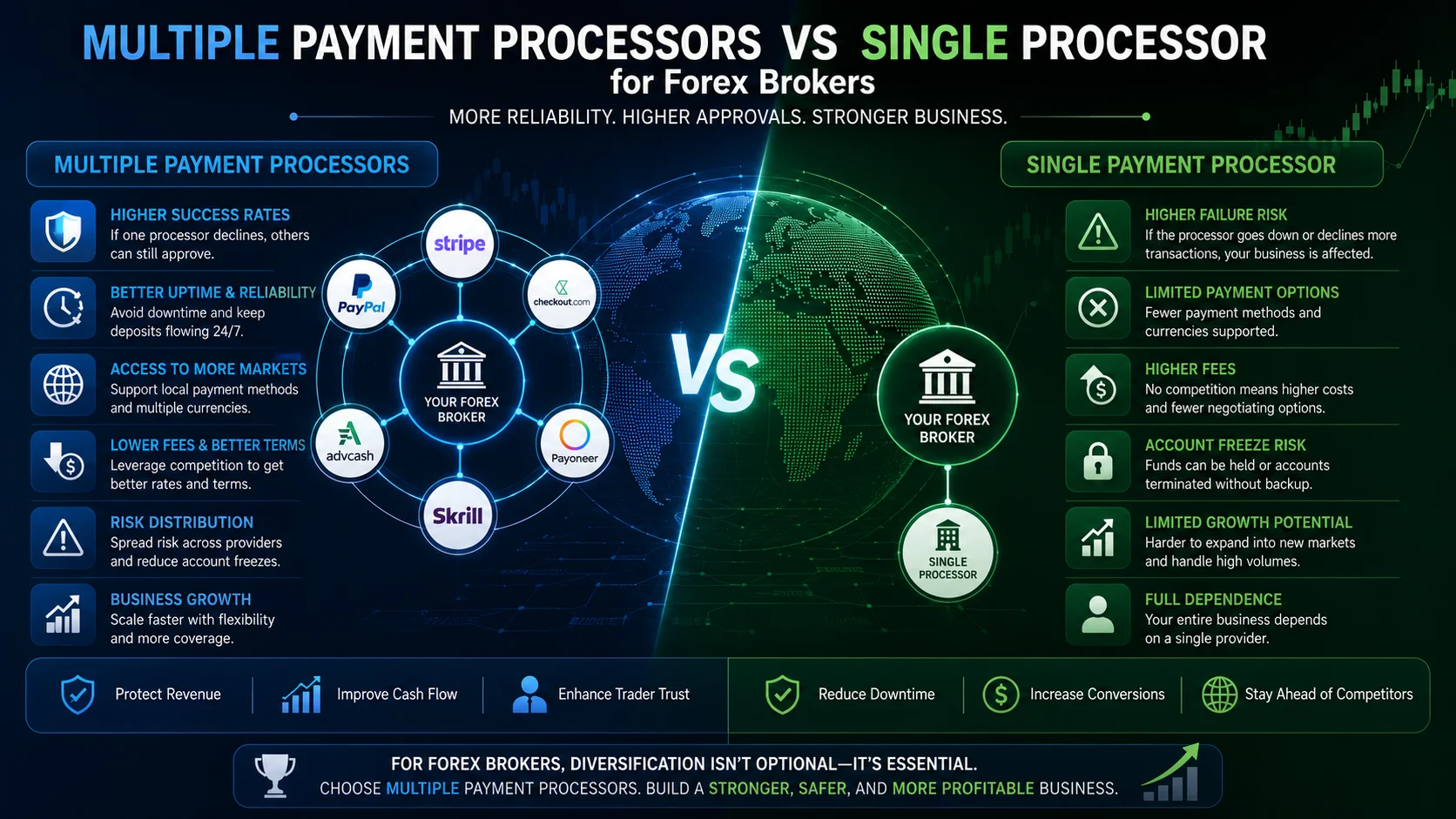
One morning your acquiring bank exits the Forex category. No warning, no grace period, just a notice that your merchant account is being terminated in 30 days. If you’re running on a single processor, that email doesn’t just create a headache. It can stop your brokerage from taking a single deposit.
This scenario isn’t hypothetical. It’s a recurring, well-documented risk in the high-risk payments world, and it’s the single biggest argument for why more Forex brokers are moving away from single-processor setups in 2026. This guide breaks down exactly when a single processor is fine, when it becomes a liability, and how to make the decision for your specific brokerage.
Why This Decision Matters More for Forex Brokers Than Almost Any Other Business
Forex brokers sit in one of the most difficult categories in payments. High average transaction values, cross-border client bases, and chargeback ratios well above retail norms mean acquiring banks treat Forex brokerages with more caution than nearly any other vertical outside gambling and adult content.
That caution translates into real operational risk:
- Account terminations happen without much warning: Acquirers periodically reassess their risk appetite for the entire Forex category, not just individual merchants with bad metrics.
- Regulatory tightening compounds the problem: As KYC, AML, and card network rules tighten in parallel across jurisdictions, some banks simply exit categories rather than build the compliance infrastructure to keep serving them.
- A single frozen processor can freeze client trust: Traders who can’t withdraw funds on schedule don’t wait around to see if the issue resolves, they move to a competitor.
This is the core reason payment infrastructure decisions for a Forex broker deserve board-level attention, not just an operations team’s afterthought.
The Case for a Single Processor
Before assuming multiple processors are automatically the right call, it’s worth being honest about when a single-processor setup makes sense.
When Single-Processor Makes Sense
- Early-stage brokers: with limited transaction volume and a narrow client geography
- Brokers operating in one primary jurisdiction: with a stable, established banking relationship
- Teams without dedicated payments or compliance staff: to manage multiple provider relationships, reconciliation, and reporting
- Businesses prioritizing simplicity: over redundancy while proving out the model
Advantages of Staying Single-Processor
- Lower operational complexity: One dashboard, one reconciliation process, one support relationship
- Simpler compliance reporting: Audit trails and KYC documentation live in a single system
- Potentially better negotiated rates: at moderate volume, since consolidating volume with one provider can unlock better pricing tiers than splitting it thin across several
- Faster initial integration: Getting one payment gateway live is faster than building and testing multiple integrations
The Real Risk Underneath the Simplicity
Here’s the problem: none of those advantages address what happens when that one processor goes down, gets flagged, or exits the Forex category entirely. Industry analysis of high-risk payment processing consistently makes the same point, by 2026, relying on a single payment gateway or processor for a high-risk business is no longer considered a sustainable long-term strategy, because declines, sudden account reviews, frozen funds, and compliance shifts can disrupt revenue overnight.
For a low-risk retail business, that risk might be acceptable. For a Forex broker holding client trading capital, it usually isn’t.
The Case for Multiple Processors
What “Multiple Processors” Actually Means
There are two ways brokers run multiple payment providers:
- Manual multi-processor setup: separate integrations with two or more payment gateways, switched manually or split by region/product line
- Payment orchestration: a unified layer that connects multiple PSPs, acquirers, and fraud tools under one system, automatically routing each transaction to the best-performing provider in real time
Orchestration has become the more common approach for brokers operating at meaningful scale in 2026, because it delivers redundancy without multiplying the operational overhead of managing several disconnected systems.
Core Advantages of a Multi-Processor Setup
1. True redundancy against account termination
If one acquiring bank exits the Forex category or freezes an account under review, a broker with a second live processor keeps taking deposits and processing withdrawals without interruption. This single benefit is often enough to justify the added complexity on its own, client trust, once broken by a funding outage, is expensive to rebuild.
2. Higher approval rates through smart routing
Not every processor approves every transaction type equally well. Routing logic can direct transactions based on:
- Geography and issuing bank
- Currency and payment method
- Card type and transaction size
- Real-time processor performance and decline patterns
This matters enormously for cross-border payments, where currency mismatches and regional acquiring relationships significantly affect approval rates. A broker serving clients across LATAM, Southeast Asia, and the Middle East will see meaningfully different approval rates from different acquirers in each region.
3. Better fraud and chargeback management
Rather than depending on one processor’s fraud engine, orchestration lets brokers layer multiple fraud tools and adapt as fraud patterns evolve, reducing false declines on legitimate large trader deposits while still catching genuine fraud. This directly supports staying under card network chargeback thresholds, including Visa’s VAMP framework, which set its effective chargeback-to-transaction monitoring threshold at 1.5% in April 2026.
4. Consolidated reporting despite provider diversity
Modern orchestration platforms centralize reporting from multiple gateways and acquirers into a single dashboard, so brokers get redundancy without losing the operational simplicity of one clear reconciliation view.
5. Easier expansion into new markets
A broker expanding into a new region doesn’t need to rebuild its entire payment stack, it can add a regional acquirer or offshore merchant account into the existing orchestration layer, supporting global expansion without duplicating engineering or compliance effort from scratch.
The Tradeoffs of a Multi-Processor Setup
Multiple processors aren’t free of downsides:
- Higher operational cost: Managing several provider relationships, each with its own contract, compliance documentation, and support channel, takes more resources than one
- Integration complexity: Even with orchestration abstracting the routing layer, someone still has to configure, monitor, and tune routing rules
- Reconciliation overhead without the right tooling: Splitting volume across providers without a consolidated reporting layer creates a genuine accounting headache
- Dilution of volume-based pricing leverage: Spreading transaction volume across multiple processors can mean losing the best-tier pricing any single provider would offer at full volume
Forex-Specific Considerations
Forex Merchant Accounts Aren’t Interchangeable
A generic merchant account underwritten for retail e-commerce will not handle Forex-specific transaction patterns well, large deposit sizes, client funding from dozens of countries, and dispute ratios that would trigger automatic review on a standard account. A proper Forex merchant account is underwritten specifically for this risk profile, and that underwriting expertise doesn’t automatically transfer when a broker adds a second provider.
This means diversifying processors isn’t just about adding any second payment gateway, it’s about adding a second provider that genuinely understands Forex payment processing, with underwriting, chargeback thresholds, and compliance processes built for the vertical. Two mismatched processors can create more operational friction than one well-matched one.
Offshore Merchant Accounts as Part of the Stack
Many Forex brokers use an offshore merchant account as one leg of a multi-processor strategy, not as a way to avoid regulation, but as a legitimate tool for:
- Accessing local payment rails in regions where a domestic acquirer has no presence
- Maintaining banking continuity if a broker’s primary jurisdiction tightens Forex-specific rules
- Diversifying banking relationships across jurisdictions so a single regulatory shift doesn’t take down the entire payment stack
An offshore merchant relationship works best as a complement to a primary Forex merchant account, not a replacement for proper compliance infrastructure in the broker’s core operating jurisdiction.
High-Risk Payment Gateway Selection
Because Forex sits alongside categories like online trading platforms and crypto in the high-risk bracket, brokers evaluating a high-risk payment gateway provider should specifically ask:
- Does this provider have documented experience underwriting Forex specifically, not just “high-risk” broadly?
- What’s the actual chargeback threshold before account review is triggered, and how does that align with VAMP and equivalent card network programs?
- Does the provider support multi-currency settlement natively, or does every transaction route through a single settlement currency with added conversion cost?
- What’s the account termination notice period, and is it documented in the contract rather than left to discretion?
Cost Comparison: Single vs. Multiple Processors
| Factor | Single Processor | Multiple Processors (Orchestrated) |
|---|---|---|
| Setup cost | Lower – one integration | Higher – multiple integrations or one orchestration layer |
| Ongoing operational cost | Lower – one relationship to manage | Higher – multiple relationships, though orchestration reduces overhead |
| Volume-based pricing leverage | Stronger – all volume concentrated with one provider | Weaker per-provider, but often offset by improved approval rates |
| Downtime/termination risk cost | High – full revenue exposure if processor fails | Low – failover protects continuity |
| Approval rate optimization | Limited to one provider’s strengths | Higher – routing to best-performing provider per transaction |
| Compliance overhead | Lower – one audit trail | Higher – multiple KYC/AML relationships to maintain |
The honest takeaway from this comparison: multiple processors cost more to run day-to-day, but a single processor carries a tail risk, total revenue stoppage, that can dwarf the extra operational cost many times over if it actually happens.
Decision Framework: How to Choose
Stick with a Single Processor If:
- You’re pre-revenue or early-stage, testing product-market fit before investing in redundant infrastructure
- Your client base is concentrated in one region with one stable, established banking relationship
- You don’t yet have the operational capacity to manage multiple provider relationships and reconciliation processes
- Your current processor has a strong, multi-year track record with no signs of category-level risk reassessment
Move to Multiple Processors If:
- You’re processing meaningful volume where even a few days of downtime would materially damage client trust and revenue
- Your clients fund from multiple regions, and approval rates vary noticeably by geography
- You’ve experienced, or want to proactively avoid, a sudden account review, hold, or termination
- You’re expanding into new regulatory jurisdictions and need local acquiring relationships alongside your primary account
- Your chargeback ratio is close enough to card network thresholds (like Visa VAMP’s 1.5%) that losing access to fraud tooling from a single provider would be a real compliance risk
A Practical Middle Path
Brokers don’t have to choose between “one processor” and “full orchestration platform” as a binary. A common, lower-complexity middle step:
- Keep a primary Forex merchant account as the main processing relationship
- Add one backup payment gateway, ideally with a different acquiring bank relationship, configured for manual failover rather than automated routing
- Layer in an offshore merchant account specifically for regions the primary provider doesn’t serve well
- Only move to full automated orchestration once transaction volume and geographic complexity justify the added tooling and management cost
This staged approach lets a broker build real redundancy without front-loading the cost and complexity of a full orchestration platform before it’s actually needed.
What Multi-Processor Setups Solve – and What They Don’t
It’s worth being clear-eyed about the limits of diversification. Multiple processors solve:
- Continuity risk if one provider exits or freezes an account
- Approval rate variance across regions and payment methods
- Overreliance on a single fraud engine
They don’t solve:
- Underlying compliance gaps: If a broker’s KYC/AML processes are weak, adding more processors just multiplies the number of relationships at risk, not the underlying risk itself
- Poor client fund segregation practices: Payment infrastructure is separate from custody and fund segregation compliance, which regulators like the FCA, CySEC, and ASIC scrutinize independently
- Bad transaction hygiene: Routing declined or fraudulent transactions to a second processor to get them approved is not risk mitigation, it’s exactly the kind of pattern that gets brokers flagged across the industry, since acquirers increasingly share risk intelligence
Multi-processor strategy is infrastructure resilience, not a substitute for genuine compliance discipline.
Looking Ahead: Where This Is Heading in 2026 and Beyond
Payment orchestration is increasingly treated as standard infrastructure for high-risk merchants rather than an advanced or optional layer, driven by the same forces pushing Forex brokers toward multi-processor setups: outages, regional underperformance, and pricing changes that used to be tolerable annoyances now carry a heavier cost as expectations for uptime and instant settlement rise.
For Forex brokers specifically, the direction of travel is clear:
- Redundancy is moving from “nice to have” to baseline expectation: among brokers competing for serious trader volume
- Routing intelligence is getting more sophisticated: increasingly factoring in real-time decline patterns and fraud signals rather than static rules
- Data sovereignty and isolation between merchants sharing a processor’s infrastructure: is becoming a more prominent evaluation criterion, reducing the risk that one merchant’s issue on a shared platform drags down others
- Card network monitoring programs like VAMP: are tightening further, making proactive multi-layered fraud and chargeback management a financial necessity rather than a best practice
Brokers building payment infrastructure decisions today should assume this trajectory continues, regulatory and card network scrutiny is not loosening, and client expectations for instant, reliable funding are not softening either.
Conclusion
There’s no universal right answer to “multiple processors or one”, the correct choice depends on your volume, your client geography, and how much revenue disruption your brokerage can actually absorb. But the trend line across high-risk payments in 2026 is unambiguous: single-processor dependency is increasingly viewed as a liability, not a simplification, for any Forex broker serious about scaling.
The brokers building durable payment infrastructure aren’t necessarily the ones with the most processors, they’re the ones who matched their processor strategy to their actual risk exposure, built in redundancy before they needed it, and treated their Forex merchant account relationships as core infrastructure rather than a solved problem they set up once and forgot about.
Frequently Asked Questions
Q: Do small or early-stage Forex brokers need multiple payment processors?
A: Not necessarily. Early-stage brokers with limited volume and a single stable market often do fine with one well-matched Forex merchant account. The case for multiple processors strengthens as volume, client geography, and revenue exposure to downtime all grow.
Q: What’s the difference between manually managing multiple processors and using payment orchestration?
A: Manual multi-processor setups require separately integrating and switching between providers. Payment orchestration adds a unified layer that automatically routes each transaction to the best-performing processor in real time and consolidates reporting across providers into one dashboard.
Q: How does Visa’s VAMP threshold affect the decision to use multiple processors?
A: Visa’s VAMP framework monitors chargeback-to-transaction ratios, with an effective threshold of 1.5% as of April 2026. Brokers near that threshold benefit from multiple processors’ layered fraud tools, which help reduce false declines while catching genuine fraud more effectively than relying on one provider’s fraud engine alone.
Q: Is an offshore merchant account a way to avoid regulation?
A: No – used properly, an offshore merchant account is a legitimate tool for accessing local payment rails and diversifying banking relationships across jurisdictions, not a way to bypass KYC/AML or licensing requirements. Brokers should treat it as a complement to strong compliance, not a substitute for it.
Q: Does adding more payment processors reduce a broker’s payment processing costs?
A: Not automatically. Concentrating volume with a single provider can unlock better pricing tiers, while splitting volume across multiple processors often means losing that leverage. The cost benefit of multiple processors comes from avoiding revenue-stopping downtime, not from lower per-transaction fees.
Q: What should a broker look for when evaluating a high-risk payment gateway provider?
A: Documented experience underwriting Forex specifically, clear chargeback thresholds aligned with card network programs like VAMP, native multi-currency settlement support, and a contractually defined account termination notice period rather than one left to the provider’s discretion.
Comments
No comments yet. Be the first to share your thoughts.
Leave a comment