
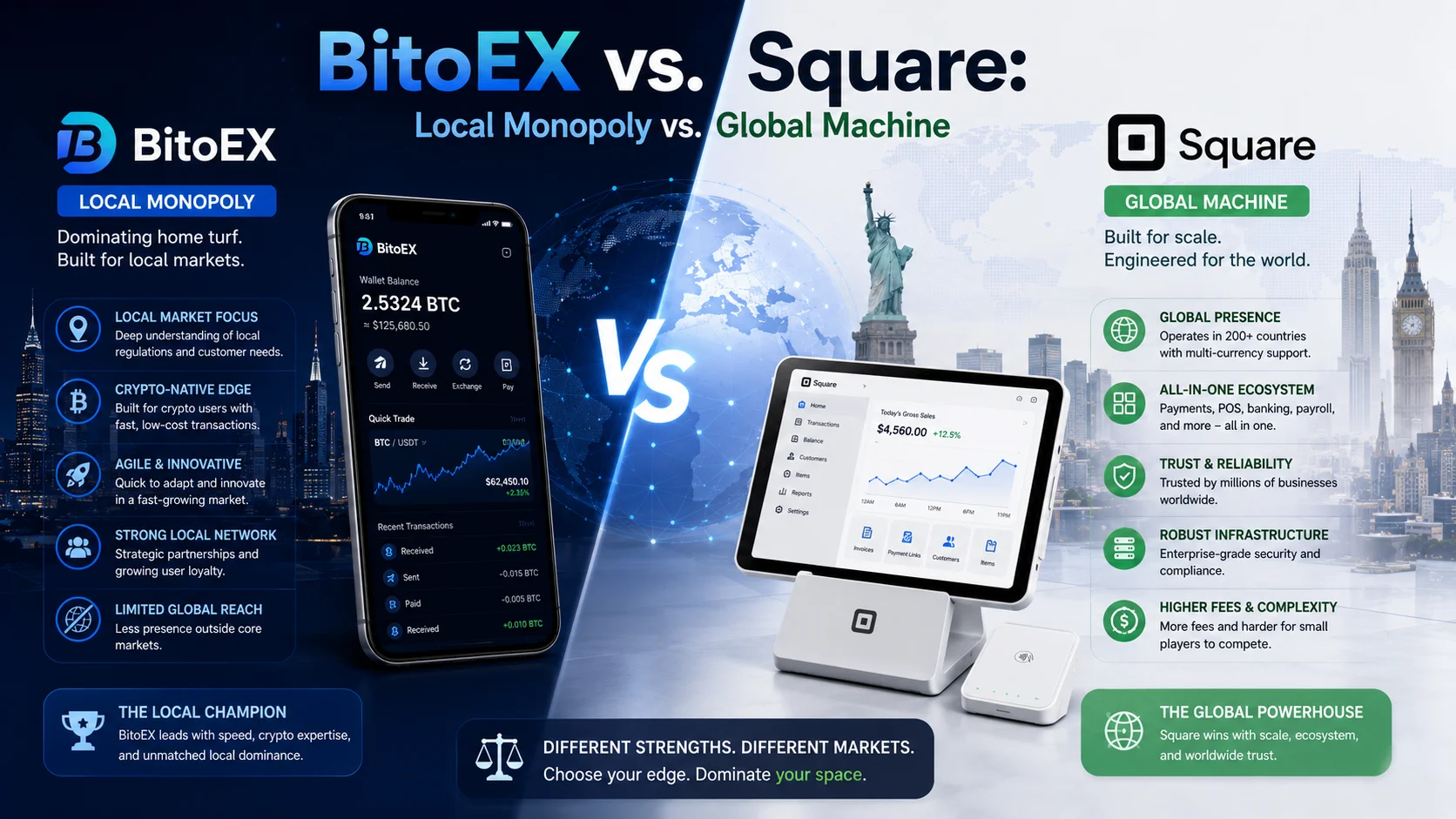
Two payment companies. Two completely different playbooks. BitoEX built a near-total grip on how Taiwan buys and moves crypto. Square built a sprawling commerce operating system that now touches millions of merchants across nearly 100 countries.
Neither approach is “better” in the abstract. They’re optimized for different problems. This guide breaks down exactly how each business works, where each one wins, and, most importantly, which model actually fits the business you’re running or building.
Company Snapshots
BitoEX / BitoPro at a Glance
BitoEX was founded in Taiwan in 2014, initially as a crypto wallet service that let users buy Bitcoin at convenience stores. That single insight, meeting Taiwanese consumers where they already paid cash, at 7-Eleven and FamilyMart counters, became the foundation of the entire business.
Key facts:
- Launched its exchange product, BitoPro, in 2018 as an international fiat-to-crypto exchange
- Reported to command a majority share of Taiwan’s retail crypto on-ramp market in its early growth years, built almost entirely on local convenience-store cash funding and TWD bank rails
- Completed a Virtual Asset Service Provider (VASP) compliance registration, making it a licensed operator under Taiwan’s Financial Supervisory Commission (FSC) framework
- Offers spot trading across roughly 15+ tradable assets, with maker/taker fees around 0.2% each, in line with other Taiwan-licensed exchanges like MAX
- R&D teams based in Taipei and Hong Kong
BitoEX’s advantage was never product breadth. It was distribution. Cash-based FamiPort funding removed the single biggest barrier to crypto adoption in a market where a large share of consumers were unbanked for digital-asset purposes or simply distrusted linking a bank card to a new platform.
Square / Block at a Glance
Square launched in the US in 2009, solving a narrower problem: letting small merchants accept card payments without a traditional bank relationship. Founder Jack Dorsey’s original insight, a dongle that turned any phone into a card reader, has since grown into Block, Inc., a diversified financial services company trading on the NYSE.
Key facts:
- Block reported roughly $24.2 billion in 2025 revenue, with Square as one of two core ecosystems alongside Cash App
- Square now operates in the United States, Canada, the UK, Australia, Japan, France, Ireland, and Spain, with non-US gross payment volume growing meaningfully faster than domestic volume
- The product suite spans point-of-sale hardware, online payments, invoicing, payroll, lending, and Square Banking, more than 30 distinct commerce products under one roof
- 2026 US pricing: roughly 2.6% + 15¢ in person, 2.9% + 30¢ online (Plus/Premium tiers), and 3.5% + 15¢ for manually keyed transactions
- Owns Afterpay (buy-now-pay-later) and Cash App Pay, giving it a closed-loop system that routes consumer spending back into its own merchant network
Square’s advantage is the opposite of BitoEX’s: breadth over depth. One integrated platform serves a coffee shop in Austin and a multi-location retail franchise in the UK with the same underlying payment infrastructure.
The Core Business Model: Local Monopoly vs. Global Machine
This is the real story behind the comparison, and it explains almost every other difference on this page.
BitoEX: Depth in One Market
BitoEX’s entire strategy is regulatory and cultural depth in a single jurisdiction. It knows Taiwan’s banking rails, FSC compliance requirements, consumer payment habits, and retail distribution network better than any global competitor could replicate quickly.
This is a genuine local monopoly dynamic:
- High switching costs for Taiwanese users already funding accounts through familiar convenience-store rails
- Regulatory relationships and VASP licensing that took years to build and are difficult for new entrants to fast-track
- A product experience (Traditional Chinese interface, TWD-native pricing) tuned specifically for one audience rather than localized as an afterthought
The tradeoff: BitoEX’s growth ceiling is capped by Taiwan’s population and crypto adoption curve. International expansion means competing directly against exchanges with far deeper liquidity and broader asset listings, a fight fought on someone else’s turf.
Square: Breadth Across Many Markets
Square’s strategy is the inverse, build one flexible commerce and payment processing stack, then replicate it across as many markets and merchant verticals as possible. It monetizes not just transaction fees but software subscriptions, lending, and banking attached to the same merchant relationship.
This creates a global machine dynamic:
- Revenue diversification across payment gateways, hardware, software, lending, and digital payments, no single revenue line is a single point of failure
- A merchant who opens a second location in a new country can often stay on the same platform rather than switching payment providers
- Scale economics: more merchants and more countries mean better negotiating leverage with card networks and banking partners
The tradeoff: breadth dilutes depth. Square’s footprint in the UK, Australia, and Japan remains a small fraction of its US presence, and it faces entrenched local competitors, Adyen, Toast, and regional acquirers, in every market it enters. It also carries the operational fragility that comes with massive scale: a March 2026 global outage caused checkout errors and slowed transaction processing across its merchant base, a risk concentration risk BitoEX simply doesn’t face at the same scale.
Market Position & Reach
| Dimension | BitoEX / BitoPro | Square / Block |
|---|---|---|
| Primary market | Taiwan (near-exclusive focus) | US, with expansion into UK, Australia, Japan, France, Ireland, Spain, Canada |
| Market approach | Deep local dominance | Broad multi-market presence |
| Core product | Crypto exchange + wallet | Point-of-sale, payment gateways, banking, lending |
| Distribution edge | Convenience-store cash on-ramps | Vertically integrated software + hardware ecosystem |
| Revenue model | Trading fees, spread | Payment processing fees, subscriptions, lending, BNPL |
| Regulatory scope | Single-jurisdiction VASP licensing | Multi-jurisdiction banking and payments licensing |
The pattern is clear: BitoEX optimizes for trust and habit within a closed system. Square optimizes for replicability across open, competitive markets.
Payment Infrastructure: A Side-by-Side Look
Merchant Accounts and Onboarding
Square built its reputation on radically simple merchant account onboarding, a business owner can sign up, receive a card reader, and start accepting online payments within days, without the underwriting friction of a traditional bank merchant account. This democratized card acceptance for millions of small businesses that traditional acquirers considered too small or too risky to bother with.
BitoEX’s onboarding is built around a different friction point entirely: identity verification and VASP-compliant KYC for crypto trading, not merchant underwriting. It isn’t competing in the merchant services space the way Square is, it’s solving fiat-to-crypto conversion trust, which is its own distinct compliance challenge.
Payment Gateways and Processing Stack
Square’s payment gateway infrastructure supports card-present and card-not-present transactions, ACH, digital wallets (Apple Pay, Google Pay, Cash App Pay), and BNPL through Afterpay, all routed through one unified payment processing backend. This matters enormously for merchants who sell both in-store and online: transaction data, reporting, and reconciliation live in one place instead of being split across multiple payment providers.
BitoPro’s infrastructure, by contrast, is purpose-built for exchange matching and custody, order books, TWD deposit/withdrawal rails, and API access for automated trading. It isn’t a general-purpose payment gateway in the merchant-acquiring sense; it’s exchange infrastructure with fiat rails attached.
Digital Wallets
Both companies rely heavily on payment wallets, but for different purposes:
- Square: integrates third-party digital payments wallets (Apple Pay, Google Pay) at checkout and operates its own closed-loop wallet, Cash App, which now functions as a payment method merchants can accept directly
- BitoEX: operates a crypto wallet as its original product line, the on-ramp that lets users hold and later trade digital assets, distinct from a merchant-facing checkout wallet
Cross-Border Payments
This is one of the sharpest divides between the two models. Cross-border payments are core to Square’s growth thesis, non-US gross payment volume has been growing faster than domestic volume, and the company is actively investing in deeper European and Asia-Pacific presence.
BitoEX’s cross-border exposure is comparatively narrow. Its TWD-denominated rails and convenience-store funding model are inherently domestic; the exchange’s role in cross-border flow is largely as a bridge, Taiwanese users converting TWD to crypto assets that can then move internationally, rather than the platform itself operating cross-border merchant rails the way Square does.
High-Risk Payment Considerations
Neither business fits neatly into a standard low-risk merchant account profile, but the risk sits in different places.
For crypto exchanges like BitoEX: the high-risk classification comes from asset volatility, AML exposure, and the historical difficulty crypto businesses have had maintaining stable banking relationships. Exchanges operating without a licensed high-risk payment gateway partner have historically faced sudden banking terminations, a major reason BitoEX’s VASP licensing and long-standing local bank relationships are a genuine competitive moat, not just a compliance checkbox.
For Square: high-risk exposure shows up differently, concentrated in specific merchant verticals (certain retail categories, high-ticket sales, subscription businesses with elevated chargeback ratios) rather than the platform as a whole. Square’s flat-rate model works well for low-risk, low-chargeback merchants but becomes expensive fast for businesses that would be better served by a negotiated high-risk payment gateway arrangement with interchange-plus pricing.
The decision-making takeaway: if your business sits in a genuinely high-risk category, elevated chargebacks, regulatory scrutiny, or volatile settlement assets, neither a pure crypto exchange model nor a flat-rate SMB processor is likely to be your best long-term fit. That’s a case for a dedicated high-risk payment gateway provider built for the vertical.
Fee Structure Comparison
Square’s 2026 Pricing (US)
- In-person (tap, dip, swipe): 2.6% + 15¢
- Online (Free plan): 3.3% + 30¢
- Online (Plus/Premium): 2.9% + 30¢
- Manually keyed / card-on-file: 3.5% + 15¢
- Instant transfers: 1.95% per transfer; standard next-business-day transfers free
- Custom interchange-plus pricing available above roughly $250,000 in annual card volume
Square’s flat-rate simplicity is attractive for businesses under about $25,000/month in card volume. Past that threshold, industry analysts consistently note that interchange-plus pricing through a dedicated merchant services provider typically saves 30-40% versus Square’s published rates, a real consideration for any merchant treating Square as a permanent solution rather than a starting point.
BitoEX / BitoPro’s Fee Structure
- Maker/taker trading fees: approximately 0.2% each, broadly in line with other Taiwan-licensed exchanges
- TWD bank transfer deposits/withdrawals: typically settled within one business day, with limited direct fee friction beyond standard bank transfer costs
- Convenience-store cash funding: a service fee applies at the point of purchase, reflecting the physical distribution cost of the FamiPort network
The two fee structures aren’t really comparable apples-to-apples, one is a card payment processing fee schedule, the other a crypto trading fee schedule, but the underlying lesson is the same: know exactly what you’re optimizing for. Square merchants optimize for payment processing cost per transaction; BitoPro users optimize for trading spread and on-ramp convenience.
Compliance and Regulatory Environment
Taiwan: A Maturing but Still-Developing Framework
Taiwan’s Financial Supervisory Commission has moved from a largely hands-off posture toward formal VASP registration requirements, with 2026 rules increasingly favoring direct bank-linked funding over cash-based convenience-store transactions above certain limits, a direct response to AML and fraud concerns. BitoEX/BitoPro’s early VASP compliance positions it well relative to newer entrants scrambling to meet tightening requirements, but it also means the convenience-store distribution advantage that built the business is being gradually constrained by regulation.
United States and Multi-Market: A Denser, More Established Framework
Square operates under a denser web of financial regulation by necessity, money transmitter licensing state-by-state in the US, FCA oversight in the UK, and equivalent frameworks in each market it enters. New UK rules effective May 2026 require payment providers to give 90 days’ notice before terminating a merchant account, a protection that does not automatically extend to US-based Square merchants, a meaningful gap worth knowing about if you’re comparing account-termination risk across regions.
Decision-making note: if regulatory continuity and account stability matter more to your business than growth speed, examine each platform’s termination and dispute-resolution policies in your specific operating jurisdiction before committing, don’t assume protections are uniform across every market a provider operates in.
Strengths and Weaknesses at a Glance
BitoEX / BitoPro
Strengths:
- Deep, defensible local market trust in Taiwan
- Convenience-store cash funding removes a major adoption barrier
- Licensed, compliant operator under Taiwan’s VASP framework
- Fast TWD settlement (typically same business day)
Weaknesses:
- Growth ceiling tied to a single market’s size and crypto adoption
- Limited cross-border merchant infrastructure
- Regulatory tightening around cash-based funding may erode a core distribution advantage
- Asset selection (~15+ coins) is narrow compared to global exchanges
Square / Block
Strengths:
- Unified payment processing stack across POS, online, invoicing, and banking
- Multi-country presence with room to expand further
- Diversified revenue (processing, software, lending, BNPL) reduces reliance on any one line
- No chargeback fees, a real advantage for dispute-prone merchants
Weaknesses:
- Flat-rate pricing becomes expensive at scale compared to negotiated merchant services arrangements
- International presence still thin relative to established local competitors in each new market
- Platform-wide outages (such as the March 2026 incident) create concentrated operational risk
- US merchants lack the account-termination protections now guaranteed in markets like the UK
Decision Framework: Which Model Fits Your Business?
Rather than asking “which company is better,” ask which structural model matches what you actually need.
Choose a local-monopoly model (BitoEX-style infrastructure) if:
- Your business operates almost entirely within one country or region
- Regulatory relationships and local trust matter more to your customers than global brand recognition
- You’re serving a market where a significant share of your users need non-bank funding options (cash, convenience-store rails, informal on-ramps)
- You’d rather be the dominant player in a smaller pond than a small player in a large ocean
Choose a global-machine model (Square-style infrastructure) if:
- You’re selling across multiple countries now, or plan to within the next 12–24 months
- You want one payment gateway and reporting stack rather than reconciling data across several regional payment providers
- Your volume is currently under the threshold where custom interchange-plus pricing makes sense, and simplicity matters more than shaving fee percentage points
- You value platform breadth (POS, banking, lending, digital payments) over specialization in one niche
Choose neither, and look at specialized infrastructure instead, if:
- Your business is classified as high-risk (elevated chargebacks, regulated verticals, volatile settlement assets), you’ll get better economics and account stability from a dedicated high-risk payment gateway provider than from either a flat-rate SMB processor or a single-market exchange
- You need genuine multi-region cross-border payments infrastructure with local rails in more markets than either platform currently covers directly
What This Comparison Says About the Future of Payments
The BitoEX-vs-Square contrast is really a preview of a broader tension playing out across payment processing globally in 2026: consolidation and commoditization at the top of the market, alongside durable, defensible niches at the local level.
Global platforms like Square will keep expanding, but genuine disruption of entrenched local payment providers, especially in markets with unique regulatory frameworks or funding habits, like Taiwan’s convenience-store crypto on-ramps, remains slow and expensive. Meanwhile, local monopolies face their own existential pressure: regulatory tightening, shrinking cash-funding channels, and the eventual arrival of better-capitalized global competitors.
For merchants and platforms making infrastructure decisions in 2026, the real question isn’t which company has the bigger valuation. It’s which structural model, depth in one market, or breadth across many, actually matches the shape of the business you’re building.
Frequently Asked Questions
Q: Is BitoEX the same company as BitoPro?
A: BitoPro is BitoEX’s exchange product. BitoEX launched in 2014 as a crypto wallet and convenience-store on-ramp service, then launched BitoPro in 2018 as its formal fiat-to-crypto exchange platform. Today, BitoPro is the primary consumer-facing trading product.
Q: Does Square operate outside the United States?
A: Yes. Square is available in the US, Canada, the UK, Australia, Japan, France, Ireland, and Spain, with non-US gross payment volume growing faster than domestic volume as of 2025–2026.
Q: Which is cheaper for a small business – Square’s flat-rate pricing or a negotiated merchant account?
A: For businesses under roughly $25,000/month in card volume, Square’s flat-rate simplicity is usually cost-competitive. Above that threshold, a negotiated interchange-plus merchant account typically saves 30-40% versus Square’s standard published rates.
Q: Is BitoPro a regulated exchange?
A: Yes. BitoPro has completed Virtual Asset Service Provider (VASP) compliance registration under Taiwan’s Financial Supervisory Commission, making it a licensed operator in its home market.
Q: Why would a merchant choose a specialized high-risk payment gateway instead of Square or a crypto exchange?
A: Businesses in regulated or elevated-chargeback verticals typically get better long-term account stability and pricing from a high-risk payment gateway provider built specifically for that risk profile, rather than a flat-rate SMB processor (not designed for high-dispute volume) or a single-market crypto exchange (not built for card-based merchant acceptance at all).
Q: What happened with Square’s outage in 2026?
A: On March 17, 2026, Square experienced a global outage causing intermittent connectivity, elevated checkout error rates, and slower transaction processing across its merchant base, a reminder of the concentration risk that comes with relying on one large, centralized platform.
Comments
No comments yet. Be the first to share your thoughts.
Leave a comment