
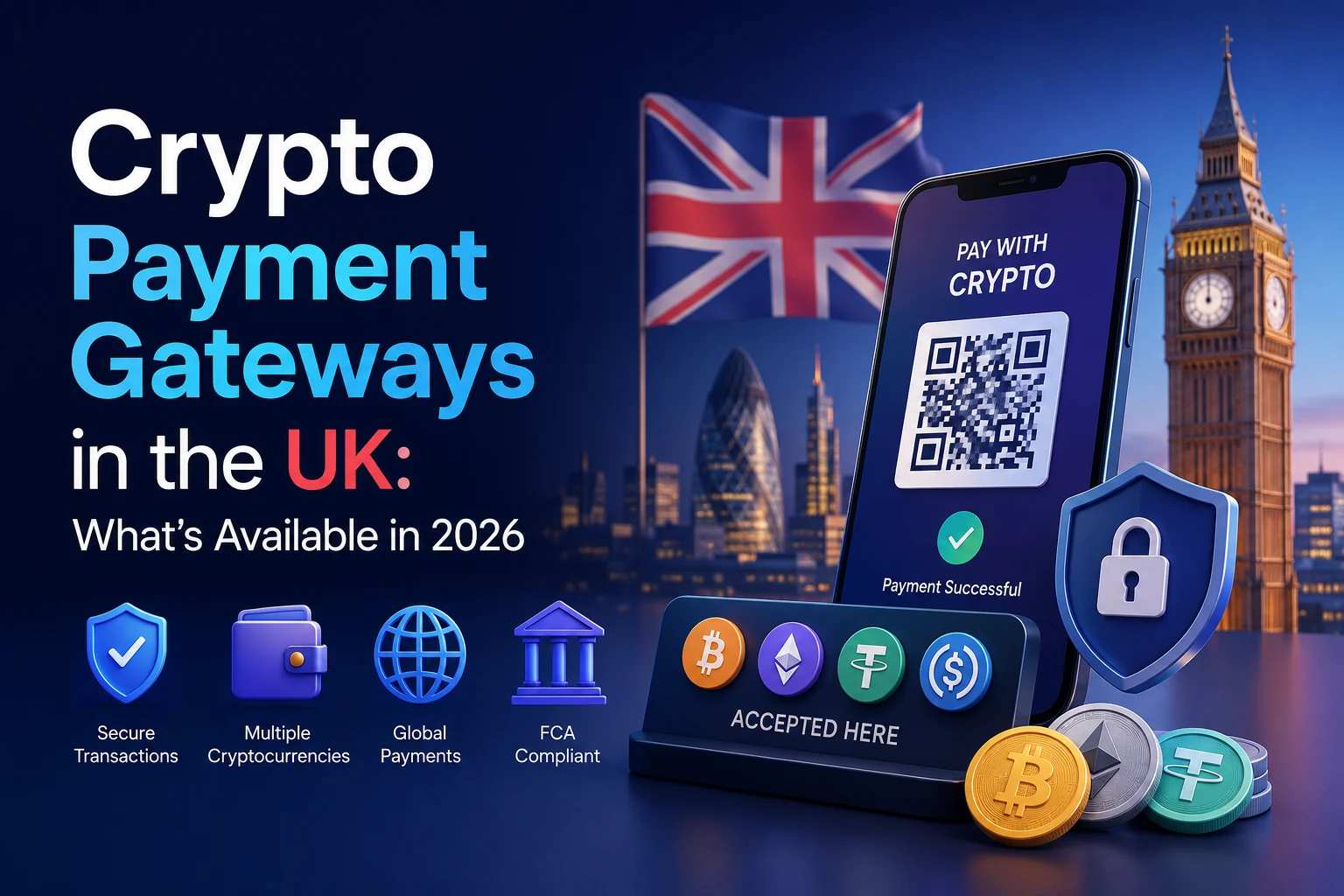
UK merchants exploring a crypto payment gateway are no longer choosing between “wait and see” and “jump in blind.” 2026 has brought both a maturing market of providers and, for the first time, a clear regulatory roadmap from the Financial Conduct Authority (FCA) that UK businesses can actually plan around.
TL;DR:
UK merchants can already accept crypto payments through providers ranging from mainstream payment processors adding stablecoin support to dedicated crypto payment gateways built specifically for GBP settlement. The bigger 2026 story is regulatory: the FCA’s new cryptoasset authorisation gateway opens 30 September 2026, with the full regime live from 25 October 2027. Merchants don’t need to wait for full implementation to start accepting crypto payments, but choosing an FCA-registered or otherwise compliant provider now will matter increasingly as the regime tightens.
Why 2026 Is a Turning Point for Crypto Payments in the UK
Card processing fees, chargeback fraud, and cross-border friction have pushed a growing number of UK merchants to look seriously at crypto payments as a genuine addition to their merchant services stack, not just a novelty for tech-forward brands.
The appeal is straightforward. Typical crypto payment gateway transaction fees run in the range of 0.5% to 1%, compared with 2% to 4% commonly charged by traditional card processors. Blockchain-based payments also can’t be reversed the way a card chargeback can, which materially reduces exposure to the kind of friendly fraud that costs UK retailers well over a billion pounds a year.
At the same time, UK-specific regulatory clarity has been arriving in stages throughout 2026, giving both merchants and payment providers a firmer footing than existed even twelve months ago.
The FCA’s New Cryptoasset Regime: What Merchants Need to Know
For years, UK crypto regulation was, in the FCA’s own words, piecemeal. That’s changing. The Financial Services and Markets Act 2000 (Cryptoassets) Regulations 2026 were enacted by Parliament on 4 February 2026, bringing a broad range of cryptoasset activities within the FCA’s regulatory perimeter for the first time.
Here’s the timeline every UK merchant working with a crypto payment provider should understand:
- 4 February 2026: The Cryptoassets Regulations were enacted, formally bringing crypto activities into FSMA’s scope
- 30 June 2026: The FCA published its finalised rules and guidance covering authorisation, prudential standards, and conduct requirements for cryptoasset firms
- 30 September 2026: The FCA’s authorisation “gateway” opens, allowing firms to apply for the permissions needed to legally provide regulated cryptoasset services
- 28 February 2027: The application window closes
- 25 October 2027: The full regime comes into force; firms without authorisation will be unable to legally operate regulated cryptoasset activities in the UK from this date
Crucially, this doesn’t just affect crypto exchanges. It applies to any firm carrying out regulated activities including issuing a qualifying stablecoin, safeguarding cryptoassets, arranging deals in cryptoassets, and operating a trading platform, which means the payment providers and gateways UK merchants rely on are directly in scope.
What This Means for Choosing a Crypto Payment Gateway Now
Merchants don’t need to wait until 2027 to start accepting crypto payments, but the regulatory direction of travel should shape provider selection today.
- Prioritise providers already FCA-registered or authorised: Some UK-based crypto payment firms already hold Authorised Payment Institution status, which puts them ahead of the authorisation curve rather than scrambling once the gateway opens.
- Ask directly about transition plans: A reputable payment provider should be able to explain whether it intends to apply during the September 2026 gateway window and what happens to merchant accounts if authorisation is delayed.
- Understand the savings and transitional provisions: Firms that apply during the gateway window can generally continue operating while their application is assessed, but firms that miss the window entirely face real risk of being unable to legally continue cryptoasset services.
- Watch for stablecoin-specific rules: The Bank of England and FCA are jointly developing a separate framework for systemic sterling-denominated stablecoins, which could affect settlement options for merchants relying on stablecoin conversion.
Crypto Payment Gateways Available to UK Merchants in 2026
The UK crypto payment landscape splits roughly into three categories, each suited to a different type of merchant.
Mainstream payment providers adding crypto support: Several payment processors UK merchants already use for card payments have added stablecoin acceptance directly into their existing dashboards, letting merchants receive crypto payments and settle in fiat currency without a separate integration. This is the lowest-friction path for merchants who want to add crypto payments alongside existing online payments rather than run a parallel system.
UK-based and Europe-focused crypto payment gateways: A number of dedicated crypto payment gateways specifically support GBP settlement and UK business verification, converting incoming cryptocurrency to pounds automatically. These typically offer ecommerce plugins, invoicing tools, and payment links, with fees generally in the 0.5%-1% range. For merchants prioritising regulatory clarity, checking whether a provider holds relevant EU or UK authorisation (rather than operating purely offshore) is a meaningful differentiator.
Global crypto payment processors: Larger international crypto payment gateways support broad cryptocurrency coverage, sometimes hundreds of assets, and are typically used by merchants with a more crypto-native customer base or those operating across multiple regions rather than the UK alone.
Whichever category fits, the evaluation criteria should stay consistent: settlement currency and speed, fee transparency, ecommerce and invoicing integration, and, increasingly in 2026, regulatory status ahead of the FCA gateway opening.
Cross-Border Payments: Where UK Crypto Gateways Add Real Value
Domestic UK online payments already run efficiently through cards and open banking rails. Where crypto payment gateways earn their keep is cross-border payments, a persistent pain point for UK merchants selling internationally or paying overseas suppliers.
Traditional cross-border payments route through multiple correspondent banks, adding FX conversion markup and settlement delays that can stretch several days. Crypto and stablecoin settlement compress that timeline considerably, often to under an hour, while avoiding the multi-layered fee stack of SWIFT-based transfers. Industry estimates put the global stablecoin cross-border payments market at roughly $17.9 trillion, with B2B payments representing the majority of that volume, a strong signal this isn’t a fringe use case anymore.
Why UK Travel Companies Should Watch This Space Closely
UK travel and booking companies face a sharper version of the cross-border payments problem than most other merchant categories. International bookings, multi-currency supplier payments, and the long gap between a customer paying and a trip actually being delivered all create room for currency risk and payment friction to build up.
Crypto payment gateways, particularly those settling in stablecoins, offer several concrete advantages for this vertical:
- Reduced FX exposure: on bookings taken months ahead of departure, when currency rates can shift meaningfully before the trip is delivered
- Faster supplier settlement: for payments to hotels, airlines, and local tour operators overseas, without the multi-day delays typical of correspondent banking
- Access to international customers: in markets where UK card-based payment providers may decline transactions or apply high surcharges
- Lower processing costs: on high-value bookings, where even a percentage-point difference in fees represents meaningful money on a family holiday or group booking
As with any new payment method, UK travel businesses should treat crypto acceptance as a supplementary rail alongside existing merchant accounts rather than a full replacement, particularly while the FCA’s authorisation regime is still working through its transition period.
High-Risk Merchants and Crypto Payment Gateways
UK merchants already routed toward a high-risk payment gateway due to elevated chargeback history or industry classification sometimes explore crypto as an alternative. The appeal is real: blockchain transactions can’t be reversed the way a card chargeback can, which removes a major source of dispute-related risk.
That said, this isn’t a way to bypass compliance scrutiny. Crypto payment providers still apply KYC and AML checks, arguably more rigorously given the direction of UK regulation, and merchants should expect similar underwriting diligence to what a traditional high-risk merchant account would require, just applied to a different rail.
Compliance Basics UK Merchants Shouldn’t Skip
Beyond the FCA’s evolving authorisation regime, UK merchants accepting crypto payments should keep a few compliance fundamentals in view:
- HMRC treats cryptocurrency as property, not currency: Converting crypto received as payment into GBP is generally treated as a taxable event, so accurate record-keeping at the point of each transaction matters for both VAT and corporation tax purposes.
- The Travel Rule applies: UK crypto payment gateways are required to collect identifying information about senders and recipients for anti-money-laundering checks above certain thresholds, expect your provider to ask for this as standard practice, not a red flag.
- Client money protections are strengthening: Once the full FCA regime is live, authorised platforms will be required to meet client money rules protecting merchant funds if a platform fails, a meaningful upgrade from the current patchwork of protections.
Frequently Asked Questions
Is it currently legal for UK businesses to accept crypto payments?
Yes. UK businesses can legally accept crypto payments today, provided they comply with existing anti-money-laundering regulations and, where relevant, HMRC reporting requirements. The FCA’s new authorisation regime primarily affects the payment providers and gateways themselves, not merchants simply accepting crypto as a payment method.
When does the FCA’s crypto authorisation gateway open?
The application window opens 30 September 2026 and closes 28 February 2027, with the full regulatory regime coming into force on 25 October 2027.
Do UK merchants need a special bank account to use a crypto payment gateway?
Not necessarily. Most crypto-friendly gateways settle directly in GBP to a standard UK business bank account, though some merchants use crypto-friendly digital payment providers for smoother integration.
How are crypto payments taxed for UK businesses?
HMRC treats cryptocurrency as property. When a business receives crypto and converts it to GBP, that conversion is generally treated as a taxable event, and businesses should record the exact value at the time of each transaction for accurate reporting.
Can crypto payment gateways help UK businesses with cross-border payments specifically?
Yes, this is where crypto and stablecoin settlement show the clearest advantage, offering faster settlement and lower fees than traditional correspondent banking for international transactions.
Comments
No comments yet. Be the first to share your thoughts.
Leave a comment