
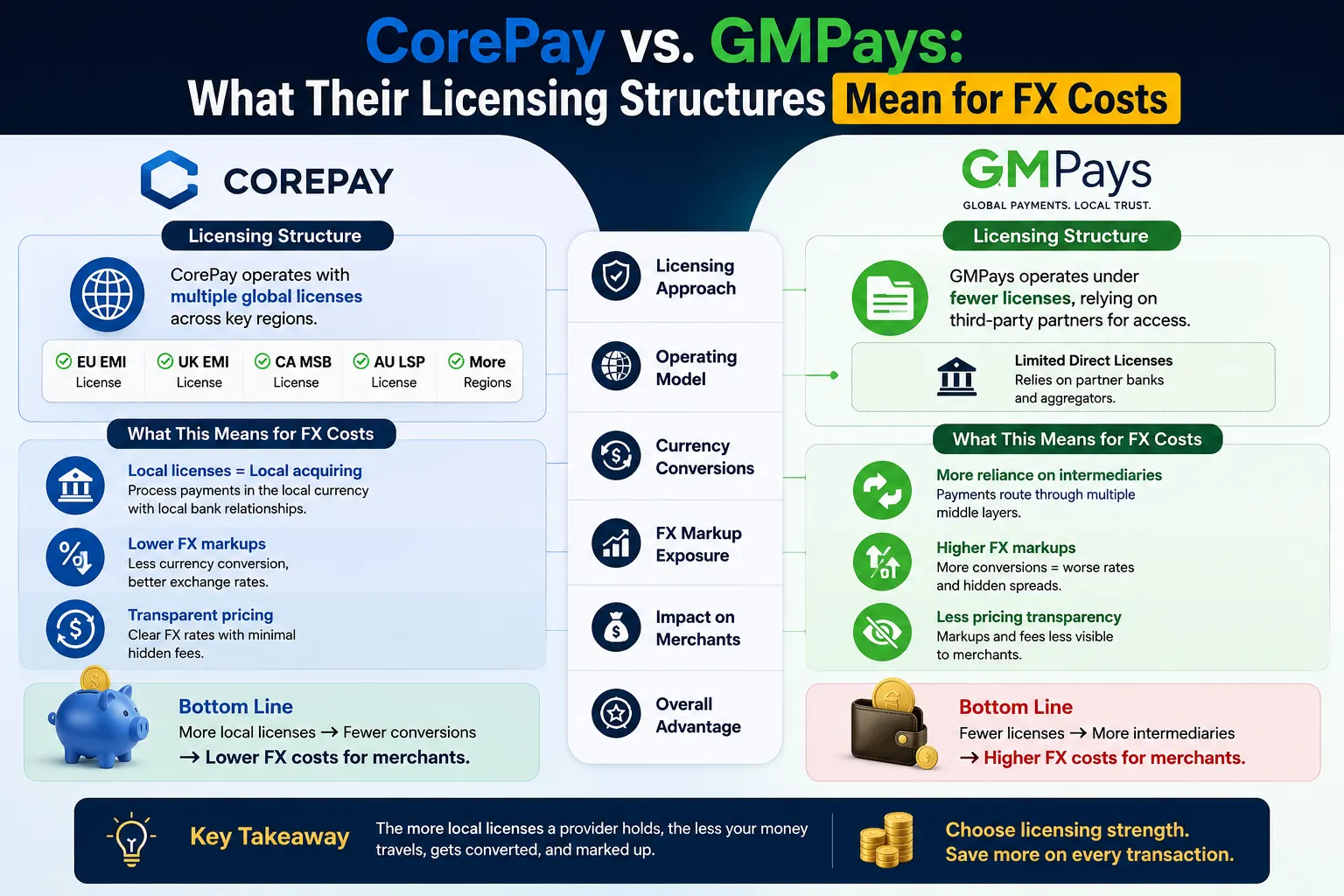
If you’re comparing these two, you’re likely trying to solve a specific problem: minimizing the gap between what a cross-border transaction should cost and what it actually costs once conversion fees and markups are applied. That gap, the FX markup problem covered broadly across the payments industry, plays out differently depending on whether your provider is the licensed institution itself or a facilitator routing you through partner banks. Here’s what that structural difference actually means in practice.
Why Licensing Structure Matters for FX Transparency Specifically
FX markup, as covered in currency-conversion research broadly, gets applied at multiple points in a transaction chain, card network scheme rates, issuer-side fees, and point-of-sale or gateway markup layered on top of each other. The more intermediaries sit between a customer’s payment and your settlement, the more points there are where a markup can get added, often without clear disclosure at any single step. That’s why a provider’s underlying structure, whether they’re the regulated institution directly, or a facilitator routing through partner banks, matters for FX cost transparency specifically, not just for general licensing accountability.
What GMPays’ Structure Means for FX Handling
GMPays operates under Mercurius Partners s.r.o., licensed by the Czech National Bank as a small-scale electronic money institution since 2017. Because GMPays is itself the regulated entity, currency conversion for cross-border payments processed through GMPays happens within a single licensed institution’s own infrastructure, rather than being handed off through a chain of separate partner banks each capable of adding their own layer of markup. That structural simplicity doesn’t guarantee a better FX rate, GMPays doesn’t publicly disclose its specific markup percentage, and merchants should verify current rates directly, but it does mean fewer intermediary handoff points where an undisclosed markup could get layered on without the merchant’s visibility.
Worth noting from GMPays’ own public materials: the company’s AML and compliance documentation acknowledges operating in some corners of the industry it describes as “not currently being subjected to regulation”, a signal that GMPays’ overall risk appetite extends into less-regulated territory even while its core EMI license and licensed-entity structure remain verifiable and named.
What CorePay’s Structure Means for FX Handling
CorePay, based in Winter Park, Florida, operates as a payment facilitator that places merchants with acquiring banks and processors across the US, UK, EU, and Australia, rather than holding a banking or e-money license itself. This structure means a cross-border transaction processed through CorePay typically passes through CorePay’s own underwriting layer plus whichever regional sponsor bank handles that specific transaction, an additional layer in the chain compared to GMPays’ single-institution model, and, by the general mechanics of how FX markup accumulates, a structure with more potential touchpoints where conversion costs could be applied.
This isn’t a knock on CorePay’s legitimacy, the facilitator/ISO model is the dominant structure for US high-risk processors generally, including many of the largest and most established names in the industry. But it does mean merchants evaluating CorePay for cross-border volume specifically should ask more pointed questions about which party in the chain, CorePay itself, or the specific regional sponsor bank, actually applies FX conversion, and at what disclosed rate.
The Core Question Neither Company’s Marketing Answers
Here’s the honest gap in evaluating either provider on FX cost specifically: neither GMPays nor CorePay publicly discloses a specific FX markup percentage in their available marketing materials. That’s not unusual, most payment providers, high-risk or otherwise, treat FX pricing as a negotiated or account-specific detail rather than a published rate. But it does mean the “compliance-first vs. risk-first” framing misses the actual due-diligence question a merchant needs answered: not which company is philosophically more cautious, but which one will actually show you, in writing, the real conversion rate applied against a market benchmark like the ECB or interbank reference rate.
Questions to Ask Either Provider Directly
Regardless of which structure you’re evaluating, these are the specific questions that actually surface FX cost transparency, general reassurances about “competitive rates” don’t:
- Request a sample transaction breakdown: showing the exact conversion rate applied versus the market mid-rate at that moment, for a currency pair relevant to your business.
- Ask which entity applies the FX conversion: for CorePay specifically, clarify whether it’s CorePay’s own systems or the regional sponsor bank, since that determines who you’d need to raise a pricing dispute with.
- Ask whether the rate is fixed or dynamic: and how frequently it’s updated relative to real market movement.
- Request written confirmation of any markup percentage: rather than accepting verbal reassurance that rates are “competitive” or “market-standard.”
- Ask about settlement currency options: whether you can settle in your own base currency to avoid unnecessary conversion steps, particularly relevant for iGaming payment and Casino Payment operations processing high transaction volumes across multiple currencies.
What This Means Depending on Your Priorities
If minimizing FX intermediary layers is your priority: GMPays’ single-licensed-institution structure is architecturally simpler, with fewer parties positioned to add a conversion markup along the way, though this needs verification against GMPays’ actual disclosed or negotiated rate, not assumed based on structure alone.
If you need coverage across multiple specific regions (US, UK, EU, Australia) with region-specific bank relationships: CorePay’s facilitator model offers that breadth, but merchants should specifically confirm FX handling terms with each regional sponsor bank relationship individually, since terms may not be uniform across all four markets.
If you’re processing high-risk merchants volume broadly and FX cost predictability matters as much as approval odds, request the same transparency documentation from any high-risk payment gateway provider you’re evaluating, this isn’t specific to GMPays or CorePay, it’s a standard due-diligence step too many merchants skip in favor of focusing purely on approval likelihood.
Alternative: Reducing FX Exposure Regardless of Provider
For merchants processing significant cross-border volume through either an offshore merchants account or a domestic merchant accounts relationship, a few structural options reduce FX exposure independent of which specific provider you choose:
- Settling in multiple currencies directly: where supported, rather than forcing every transaction through a single conversion step.
- Evaluating alternative payment methods: including crypto payments and stablecoin settlement, which can bypass several of the traditional card-network conversion layers entirely for certain corridors.
- Requesting periodic FX rate audits: from your provider, treating markup transparency as an ongoing account-management item rather than a one-time onboarding question.
Practical Takeaway
The honest answer to “compliance-first or risk-first” is that it’s the wrong framing for evaluating FX costs specifically, GMPays’ directly licensed structure and CorePay’s facilitator model each shape how currency conversion flows through the transaction chain, but neither company’s public disclosures actually answer the question that matters most: what rate, compared to a real market benchmark, will you actually pay. Before choosing between these two, or any payment providers serving high-risk verticals, request the specific FX documentation outlined above in writing. Structure tells you where the markup risk sits in the chain; only a direct rate disclosure tells you what it actually costs.
Comments
No comments yet. Be the first to share your thoughts.
Leave a comment