
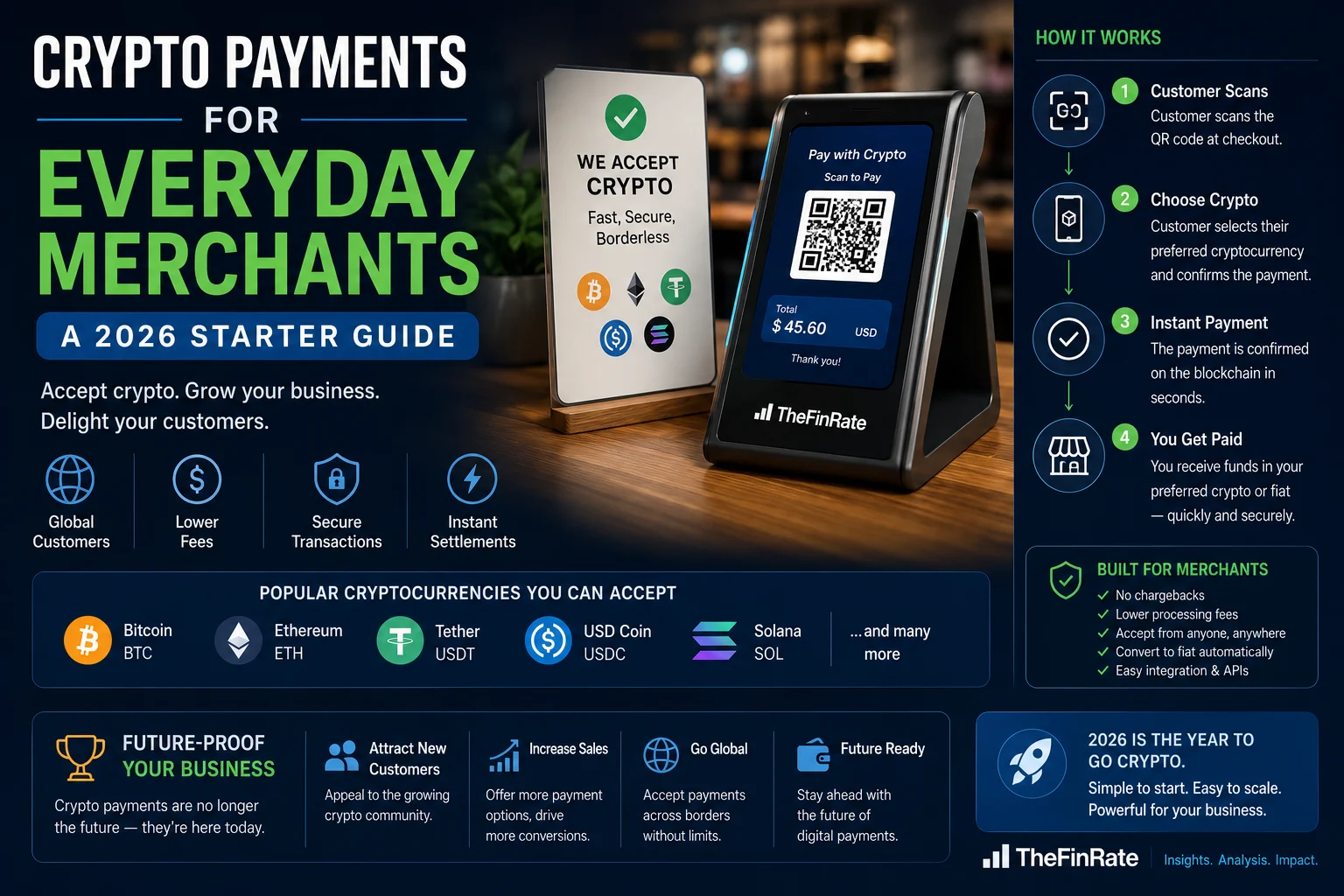
Crypto payments are no longer a niche experiment for tech-forward businesses, they are a mainstream merchant services decision. As of early 2026, 559 million people globally own cryptocurrency and 39% of US merchants now accept digital assets at checkout, according to a January 2026 PayPal and National Cryptocurrency Association report. If 88% of your merchant peers have already received customer requests to pay in crypto, this guide explains exactly how to evaluate, set up, and manage crypto payments for your business.
TL;DR
- 559 million global crypto owners; 39% of US merchants accept crypto as of early 2026
- Stablecoins (USDT, USDC) dominate merchant crypto volume, 76-82% of all crypto payments use stablecoins, eliminating most volatility risk
- Crypto retail payment volume is projected to reach $600 billion globally by end of 2026
- Average retail crypto transaction value is $112, well into everyday purchase territory
- 90% of merchants say they would accept crypto if setup were as easy as a credit card
- Top crypto payment gateways include BitPay (20% market share), CoinGate (14%), NOWPayments (10%), and Coinbase Commerce (12%)
- High-risk merchants gain specific advantages from crypto: faster settlement, fewer chargeback risks, and access to global customers without correspondent bank friction
What Are Crypto Payments – and Why Now?
A crypto payment is a transaction where the buyer settles a purchase using digital currency, Bitcoin, Ethereum, a stablecoin, or another blockchain-based asset, and the merchant receives either crypto or an automatic fiat conversion, depending on how they have configured their payment processing setup.
What has changed significantly by 2026 is the infrastructure surrounding this. A few years ago, accepting crypto meant managing wallet addresses, dealing with settlement delays, and absorbing volatile exchange rates. That is no longer the case for most merchants. Modern crypto payment gateways handle the entire conversion flow, a buyer pays in Bitcoin or USDC, and the merchant receives USD or EUR in their bank account the same day, often within hours.
Three structural shifts have made crypto payments practical for everyday merchant accounts in 2026:
- Stablecoin dominance: USDT and USDC now account for 76-82% of all crypto transactions processed at the merchant level, meaning most crypto payments carry no meaningful price volatility by the time they settle
- Gateway maturity: major payment providers like PayPal, Stripe (via Shopify USDC integration), and specialist crypto gateways now offer plug-and-play merchant tools that are as straightforward as installing a payment card terminal
- Regulatory clarity: the US GENIUS Act (signed July 2025) and EU MiCA framework have reduced compliance ambiguity enough for mainstream merchant services providers to offer crypto as a standard option
The Merchant Case for Accepting Crypto in 2026
The data makes a compelling argument. These are not theoretical benefits, they come from surveys of merchants who have already integrated crypto payment processing.
The top reasons merchants accept crypto:
- Faster transactions (45%): crypto settlements bypass card network clearing cycles, with most crypto payment gateways settling in under 24 hours
- New customer acquisition (45%): four in five merchants (79%) agree crypto acceptance helps attract customers who would not otherwise convert
- Enhanced security (41%): blockchain transactions are cryptographically verified and cannot be reversed in the same way card transactions can, reducing first-party fraud exposure
- Greater customer privacy (40%): particularly valued in digital goods and subscription merchant categories
Beyond individual merchant benefits, the market context is significant. US crypto payment adoption is projected to grow 82.1% between 2024 and 2026, and 73% of merchants globally plan to accept at least one form of crypto within the next two years. The average crypto retail transaction is valued at $112, this is not a large-ticket-only use case.
For B2B payment processing specifically, stablecoin-powered payments have already reached $226 billion in annual volume, growing at 733% year-over-year. Cross-border B2B crypto payments eliminate the correspondent banking friction that drives most FX and delay costs in international merchant services.
How Crypto Payments Work: The Merchant’s View
Understanding the flow helps merchants choose the right setup. There are three common models:
1. Gateway-Converted (Fiat Settlement)
The buyer pays in any supported cryptocurrency. The payment gateway converts it to fiat currency in real time at the point of transaction and deposits the equivalent in the merchant’s bank account, typically within 24 hours. The merchant never holds crypto. This is the most common setup for mainstream online payments.
Best for: Merchants who want zero crypto exposure, no wallet management, and simple reconciliation inside their existing merchant account.
2. Stablecoin Settlement
The buyer pays in USDT, USDC, or another fiat-pegged stablecoin. The merchant receives the stablecoin directly into a wallet. Because stablecoins hold their value 1:1 to USD or EUR, there is effectively no exchange rate risk. Settlement is near-instant.
Best for: Cross-border merchants, digital services businesses, or sellers who want to hold value in USD without a bank account in every jurisdiction.
3. Native Crypto Acceptance
The merchant receives Bitcoin, Ethereum, or other volatile cryptocurrencies directly. They choose whether to convert or hold. This is the highest-complexity option, it requires exchange relationships, treasury management, and accounting treatment for cryptocurrency holdings.
Best for: Businesses with a specific strategic interest in holding crypto assets, or those operating in markets where crypto is the primary payment infrastructure (El Salvador, parts of APAC and LATAM).
Stablecoins: The Merchant-Preferred Crypto Option
The single most important thing for any merchant evaluating crypto payments to understand is this: most merchant-level crypto volume is stablecoin volume.
USDT (Tether) alone handles approximately 33% of all merchant crypto transaction volume. Combined with USDC, DAI, and other dollar-pegged assets, stablecoins account for 76-82% of all crypto payments globally. Stablecoin transaction volume exceeded $4 trillion between January and July 2025, an 83% year-over-year increase.
The reason for this dominance is practical. Merchants don’t want to receive an asset that could fall 15% in value before they can convert. Stablecoins price in USD (or EUR), settle in minutes, carry no volatility risk on the merchant side, and work across borders without FX conversion costs.
For cross-border payments specifically, stablecoin rails are already reducing costs significantly. Global payroll and remittances represent approximately $90 billion in annualised stablecoin payment volume. Stablecoin-based cross-border payments are expected to rise from under 1% of the market today to 30-40% within three years.
Top Crypto Payment Gateways Compared (2026)
Choosing the right crypto payment gateway determines how much setup effort is required, which cryptocurrencies you can accept, how fast you settle, and what fees apply.
| Gateway | Market Share | Settlement | Best For | Key Feature |
|---|---|---|---|---|
| BitPay | 20% | 1-2 days (fiat) | Enterprise, retail | Widest crypto support; fiat auto-convert |
| CoinGate | 14% | 1-2 days | European SMBs | Strong EU merchant services focus |
| Coinbase Commerce | 12% | Near-instant (crypto) | US SMBs | Direct Coinbase wallet integration |
| NOWPayments | 10% | Flexible | SMBs, subscriptions | 300+ crypto assets; recurring billing |
| Binance Pay | 8% | Instant | Asia-Pacific merchants | Zero transaction fees for buyers |
| Shopify (via Stripe) | 9% adoption | 1-2 days | E-commerce | USDC via Stripe; plug-and-play |
| Crypto.com Pay | 7% | Instant | Mobile-first merchants | Zero-fee model; payment wallet integration |
What to evaluate before choosing:
- Auto-conversion availability: does the gateway convert to fiat before you receive funds?
- Stablecoin support: USDT and USDC support is non-negotiable for most merchants
- Integration ease: APIs, plugins for WooCommerce, Shopify, Magento, or custom checkout
- Settlement currency and timeline: EUR, USD, GBP? Same-day or T+2?
- Compliance and KYC requirements: especially relevant for high-risk merchant accounts
Crypto Payments for Cross-Border and High-Risk Merchants
Cross-Border Use Case
Traditional cross-border payments involve correspondent banks, multi-day settlement, and FX conversion fees that can erode 3-5% of transaction value. Crypto payment processing removes most of this friction.
Over 65% of crypto transactions are currently processed via mobile or web-based payment gateways, including international transactions. Brazil alone expanded to 110,000 active crypto POS terminal installations by February 2026. Japan has 35,000+ retail locations accepting crypto. Germany incorporates cryptocurrency into 10.2% of e-commerce checkouts.
For merchants with significant LATAM, APAC, or African customer bases, where traditional payment infrastructure is expensive or unreliable, stablecoin-powered digital payments offer a cost-effective alternative to card processing. Latin America’s crypto transaction volume grew 22% year-over-year in 2025, driven directly by stablecoin adoption in e-commerce.
High-Risk Merchants and Crypto: A 2026 Update
High-risk merchant categories, iGaming, adult content, nutraceuticals, forex, subscription billing, face specific advantages and constraints when using crypto payment processing.
Advantages:
- Blockchain transactions are irreversible at the protocol level, eliminating the traditional chargeback mechanism that drives rolling reserve requirements at high-risk payment gateway providers
- Crypto payments provide access to global customers in jurisdictions where card-based payment providers decline to operate
- Stablecoin settlement removes FX volatility for merchants settling internationally
- Processing fees are typically 0.5-1.5% versus 3-5% for high-risk card processing
Constraints in 2026:
- Most crypto payment gateways impose their own AML/KYC requirements, high-risk merchants still undergo enhanced due diligence at onboarding
- The elimination of chargebacks removes buyer protection, which can deter some consumer segments from paying in crypto
- Regulatory exposure remains heightened: iGaming and adult platforms face additional scrutiny from crypto payment providers regarding licensed jurisdiction requirements
- Accounting and tax treatment of crypto receipts requires professional advice in most markets, HMRC, IRS, and EU tax authorities all treat crypto transactions as taxable events at point of conversion
High-risk operators should view crypto as a complementary rail alongside their primary high-risk payment gateway, not a replacement for a properly structured merchant account with a specialist acquirer.
Pros and Cons of Accepting Crypto Payments
Pros
- No chargebacks on blockchain-native transactions, eliminates one of the highest-cost issues for high-risk merchants
- Transaction fees of 0.5-1.5%, materially cheaper than the 1.5-3.5% merchant discount rate on card payments
- Access to 559 million crypto owners globally, including unbanked and underbanked segments that have no card payment option
- Instant or near-instant settlement via stablecoin rails versus 2-5 day card settlement cycles
- No geographic restrictions, a merchant account can receive stablecoin from any country without the cross-border payment friction of correspondent banking
- 84% of merchants expect crypto to become a standard payment method within five years, early adoption is a competitive positioning play
Cons
- Volatile cryptocurrencies (BTC, ETH) carry exchange rate risk if the merchant holds them rather than auto-converting, stablecoins mitigate but do not eliminate this
- Regulatory requirements differ by jurisdiction, crypto payment processing for merchants in the UK, EU, and US each has distinct compliance obligations
- Consumer adoption remains at only 0.5% of global e-commerce transaction value as of 2026, despite growth, this is still a minority payment method
- Tax reporting overhead, each crypto transaction may trigger a taxable event requiring precise record-keeping
- Customer service complexity, crypto transactions are irreversible, so refunds require a separate outbound payment rather than a reversal
- 63% of US adults lack confidence in crypto safety, merchant acceptance must be communicated clearly to avoid abandonment at checkout
Frequently Asked Questions
What crypto payment gateway should I use as a small merchant?
For most small and mid-sized merchants, NOWPayments or CoinGate offer the best combination of low fees, straightforward integration, and stablecoin settlement. If you already use Shopify, the Stripe USDC integration is the lowest-friction path. If your customers are primarily in Asia-Pacific, Binance Pay’s zero-fee model and broad wallet coverage is worth evaluating.
Do I need a separate merchant account for crypto payments?
No. Most crypto payment gateways connect directly to your existing bank account for fiat settlement. You do not need a dedicated crypto merchant account, the gateway handles conversion, compliance, and settlement. However, if you want to hold crypto or settle in stablecoins rather than fiat, you will need a custodial wallet or exchange relationship.
What is the biggest risk for merchants accepting crypto?
For merchants using auto-conversion to fiat, the primary risk is gateway downtime and the absence of a chargeback mechanism for resolving customer disputes. For merchants holding crypto, exchange rate volatility is the dominant risk, mitigated by accepting stablecoins rather than Bitcoin or Ethereum as the primary payment currency.
Are crypto payments suitable for high-risk merchants?
Yes, with important caveats. Crypto removes chargeback exposure, which is a direct benefit for high-risk businesses. However, specialist crypto payment providers still apply KYC, AML, and jurisdictional compliance requirements. High-risk operators in regulated verticals (iGaming, adult, forex) should choose payment providers with explicit experience in their vertical and confirm licensing requirements with legal counsel in each operating market.
What is the difference between Bitcoin payments and stablecoin payments?
Bitcoin is a volatile asset, its USD value fluctuates in real time. Stablecoins are pegged 1:1 to fiat currencies (primarily USD). For merchant services, stablecoins are the practical choice, no volatility, fast settlement, and no conversion required before funds hit the merchant’s account at USD-equivalent value.
How do crypto payments compare to card payments on fees? Card processing for standard merchant accounts typically costs 1.5-3.5% per transaction in merchant discount rate plus per-transaction fees. Crypto payment processing typically costs 0.5-1.5%, with some providers like Binance Pay and Crypto.com Pay operating at zero transaction cost to the buyer. For high-risk card processing, where rates run 3-5% plus rolling reserves, the cost differential is even more significant.
Comments
No comments yet. Be the first to share your thoughts.
Leave a comment