
Introduction
E-commerce has transformed the way businesses sell products and services, making it easier than ever to reach customers worldwide. However, not every online business is viewed equally by banks and payment providers. Certain industries, business models, and transaction patterns are considered more likely to experience fraud, chargebacks, or regulatory issues. These businesses fall under the category of High-Risk E-commerce.
Being labeled as a high-risk merchant does not mean a business is illegitimate or unsafe. Instead, it indicates that payment providers believe the business carries a higher financial or operational risk than traditional merchants. As a result, these businesses often face stricter underwriting requirements, higher processing fees, and additional compliance obligations.
Despite these challenges, thousands of successful businesses operate within high-risk industries. With the right payment infrastructure, fraud prevention strategies, and regulatory compliance, high-risk e-commerce companies can grow sustainably while delivering secure customer experiences.
What Is High-Risk E-commerce?
High-risk e-commerce refers to online businesses that payment processors, acquiring banks, or financial institutions classify as having an elevated level of financial or operational risk.
This classification is based on several factors rather than a single criterion. Businesses may be considered high risk because they operate in industries with historically high chargeback rates, sell internationally, process large transaction volumes, offer recurring billing, or face increased fraud exposure.
Unlike traditional online merchants, high-risk businesses require specialized payment solutions that can effectively manage these additional risks.
Why Businesses Are Classified as High Risk
Financial institutions evaluate numerous factors before assigning a risk category to an online business.
Industry type is one of the most significant considerations. Businesses operating in sectors with frequent disputes, refund requests, or regulatory oversight often receive a high-risk designation.
Transaction behavior also plays an important role. Merchants processing unusually large payments, serving customers across multiple countries, or experiencing rapid sales growth may attract additional scrutiny.
Business history, credit profile, processing volume, chargeback ratios, and fraud levels also influence the overall risk assessment.
Rather than being a permanent label, risk classifications can evolve as businesses demonstrate consistent performance and strong operational controls.
Industries Commonly Considered High Risk
Several industries are routinely categorized as high-risk by payment providers due to their historical transaction patterns and operational complexity.
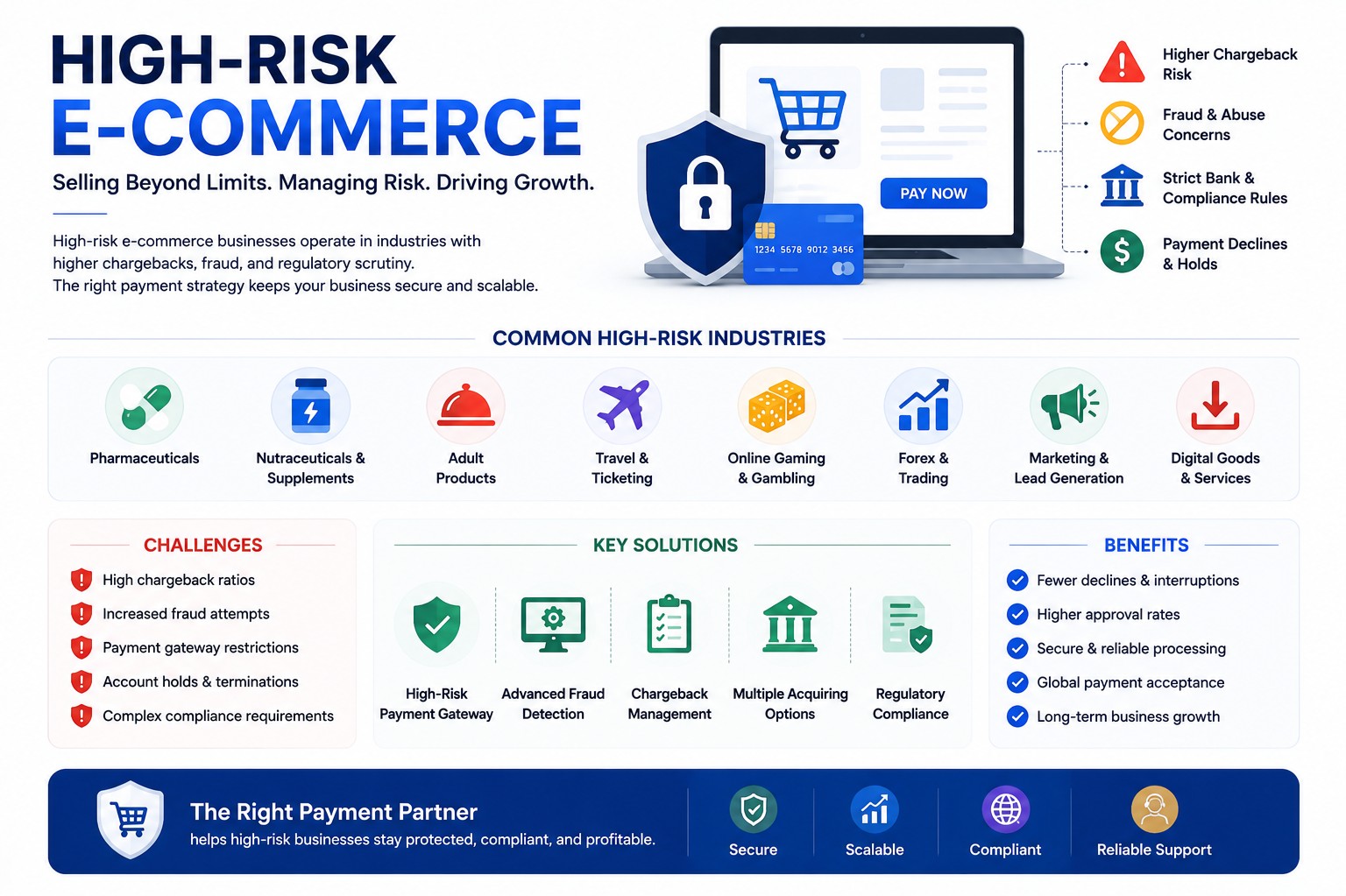
Examples include subscription-based businesses, travel agencies, online gaming, digital goods, cryptocurrency services, forex trading platforms, nutraceuticals, online education, ticketing platforms, adult entertainment, telemedicine, and high-value luxury goods.
Businesses operating internationally or offering recurring billing services may also receive high-risk classifications regardless of their specific industry.
Each payment provider uses its own underwriting criteria, meaning classifications can vary between institutions.
Challenges Faced by High-Risk E-commerce Businesses
Operating a high-risk online business often involves overcoming unique financial and operational obstacles.
One of the biggest challenges is obtaining reliable payment processing. Many traditional banks and payment gateways are reluctant to support merchants operating in higher-risk industries.
Processing fees are typically higher because payment providers must account for increased fraud exposure and chargeback risks. Reserve requirements may also be imposed, requiring merchants to maintain a percentage of funds as financial protection.
High-risk businesses may experience stricter account monitoring, enhanced compliance requirements, and periodic financial reviews.
Despite these obstacles, specialized payment providers offer solutions specifically designed for high-risk merchants.
High-Risk Merchant Accounts
A high-risk merchant account is a payment processing account specifically designed for businesses operating in industries with elevated financial risk.
These accounts enable merchants to accept credit cards, debit cards, digital wallets, and other electronic payment methods while incorporating additional fraud prevention and risk management tools.
Unlike standard merchant accounts, high-risk accounts typically include enhanced underwriting, reserve policies, transaction monitoring, and chargeback management capabilities.
Selecting the right merchant account provider is one of the most important decisions for any high-risk business.
Choosing the Right Payment Gateway
The payment gateway acts as the connection between customers, merchants, banks, and payment processors.
High-risk businesses should prioritize gateways that offer advanced fraud detection, global payment acceptance, multi-currency support, intelligent transaction routing, and strong security features.
Scalability is equally important. As transaction volumes grow, the payment gateway should continue delivering reliable performance without increasing operational complexity.
Businesses should also evaluate settlement times, integration options, customer support, reporting capabilities, and regulatory certifications before selecting a provider.
Fraud Prevention Strategies
Fraud remains one of the greatest concerns for high-risk e-commerce businesses.
Cybercriminals frequently target online merchants using stolen payment credentials, account takeovers, identity fraud, and refund scams. Without effective security controls, financial losses can increase rapidly.
Modern fraud prevention combines artificial intelligence, behavioral analytics, device fingerprinting, velocity checks, transaction monitoring, and machine learning to identify suspicious activity before payments are approved.
Strong fraud prevention protects both merchants and customers while maintaining a smooth purchasing experience.
Chargeback Management
Chargebacks are a significant issue for many high-risk merchants. Excessive chargebacks can result in higher processing costs, account restrictions, or even merchant account termination.
Effective chargeback management begins with clear product descriptions, transparent refund policies, responsive customer support, and accurate billing practices.
Businesses should monitor dispute trends closely and use chargeback prevention tools that identify potential issues before disputes occur.
Automated alert systems and detailed transaction records also improve merchants’ ability to respond successfully to disputes.
Reducing chargebacks is essential for maintaining strong relationships with payment providers.
Regulatory Compliance
High-risk merchants often operate under increased regulatory scrutiny.
Depending on the industry, businesses may need to comply with Anti-Money Laundering (AML) regulations, Know Your Customer (KYC) requirements, payment security standards, consumer protection laws, and data privacy regulations.
International businesses must also consider jurisdiction-specific compliance obligations.
Maintaining comprehensive compliance programs helps reduce operational risks while strengthening relationships with financial institutions and payment providers.
Cross-Border E-commerce Opportunities
Many high-risk businesses generate significant revenue through international customers.
Cross-border commerce creates growth opportunities but also introduces additional complexities related to currencies, taxation, fraud prevention, payment regulations, and settlement processes.
Businesses should support localized payment methods, multi-currency pricing, and regional compliance requirements to improve customer experiences.
Working with payment providers experienced in international processing can significantly simplify global expansion.
The Role of Artificial Intelligence
Artificial intelligence is transforming risk management within high-risk e-commerce.
AI-powered systems continuously analyze transaction behavior, customer activity, device information, and payment patterns to identify potential fraud in real time.
Machine learning improves authorization rates by reducing false declines while strengthening fraud prevention.
AI also assists with customer verification, payment optimization, chargeback prediction, and compliance monitoring.
As technology advances, AI is becoming an indispensable tool for managing high-risk payment environments.
Building Customer Trust
Trust is particularly important for businesses operating in high-risk industries.
Customers expect secure checkout experiences, transparent pricing, responsive customer service, and reliable order fulfillment.
Displaying security certifications, offering multiple payment methods, communicating clearly, and resolving customer issues quickly help build long-term credibility.
Businesses that prioritize transparency often experience lower dispute rates and higher customer retention.
Strong trust ultimately contributes to sustainable growth.
Future Trends in High-Risk E-commerce
The high-risk payment landscape continues evolving rapidly.
Embedded finance, payment orchestration, open banking, real-time payments, and AI-driven fraud prevention are reshaping how high-risk merchants manage transactions.
Alternative payment methods, digital wallets, and account-to-account payments are reducing reliance on traditional card networks.
Meanwhile, regulatory expectations continue increasing, encouraging businesses to invest in stronger compliance and security frameworks.
Organizations that embrace innovation while maintaining effective risk management will be well positioned for future success.
Conclusion
High-risk e-commerce presents unique challenges, but it also offers significant business opportunities. Although merchants in higher-risk industries face stricter payment requirements, increased compliance obligations, and greater fraud exposure, these challenges can be managed with the right technology and strategic planning.
By partnering with specialized payment providers, implementing advanced fraud prevention systems, reducing chargebacks, and maintaining strong regulatory compliance, high-risk businesses can build secure and scalable online operations.
As digital commerce continues to expand globally, businesses that invest in resilient payment infrastructure and customer trust will be better equipped to thrive in an increasingly competitive marketplace.
Comments
No comments yet. Be the first to share your thoughts.
Leave a comment