
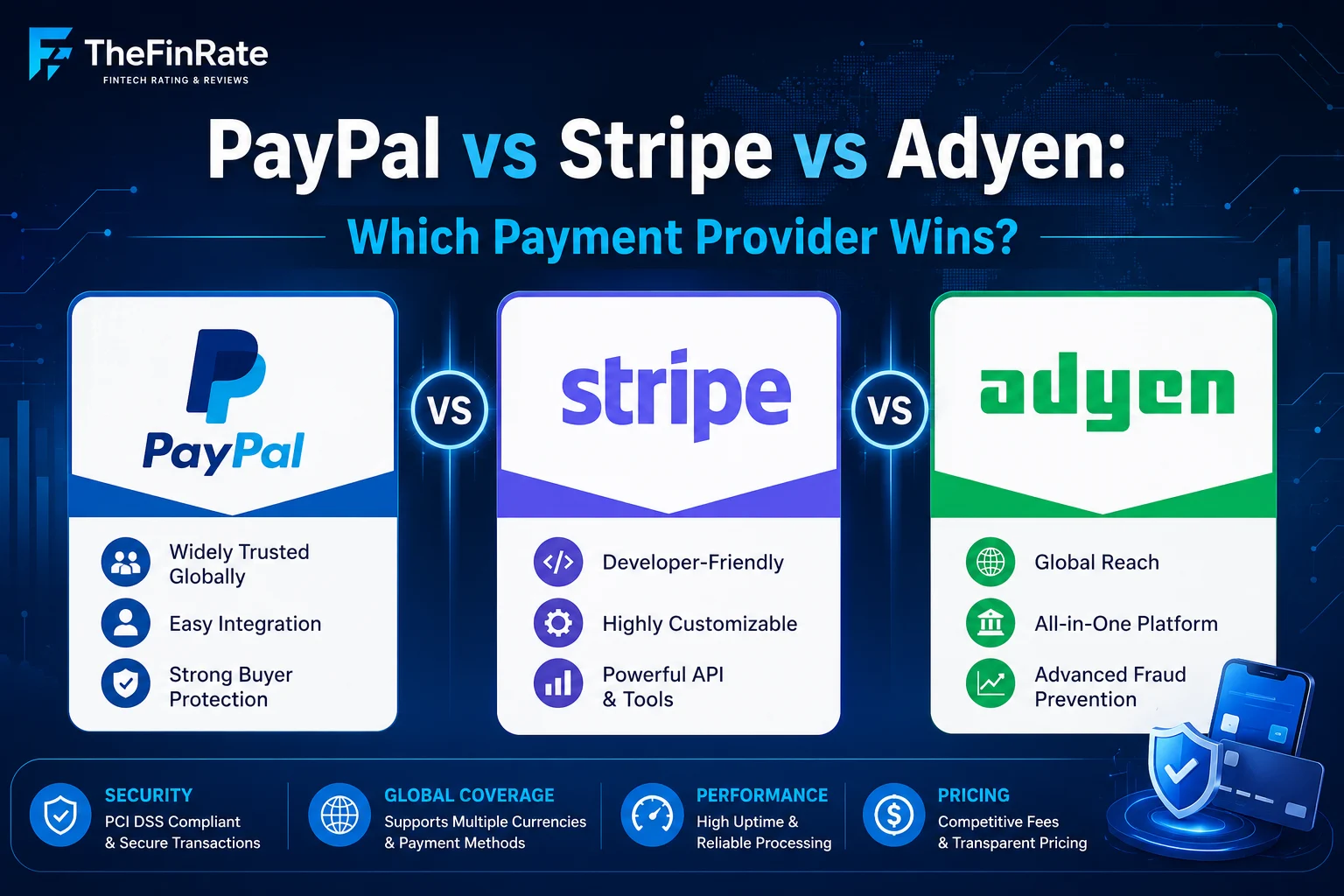
Three payment providers, PayPal, Stripe, and Adyen, collectively process more than $4 trillion in annual payment volume and dominate how merchants accept digital payments worldwide. Each operates from a fundamentally different position: PayPal leads in consumer reach, Stripe in developer infrastructure, and Adyen in enterprise economics. Choosing between them is not about brand, it’s about matching the platform to your business model, processing volume, and risk profile.
TL;DR
- PayPal leads global online payments with ~43-45% market share and 436M+ consumer accounts
- Stripe dominates developer and SaaS payments (~22% US market share; $1.9T volume in 2025)
- Adyen wins at enterprise scale with 61% EBITDA margin and €1.82B net revenue in 2025
- All three restrict or reject high-risk merchants, specialized high-risk payment gateways are required for those verticals
- Adyen’s Interchange++ pricing beats flat rates only above ~$250K-$400K in monthly volume
2026 Quick Comparison: PayPal vs Stripe vs Adyen
| Factor | PayPal | Stripe | Adyen |
|---|---|---|---|
| Standard Fee | 2.89% + $0.29 | 2.9% + $0.30 | IC++ (~1.5-3% + 0.6% markup) |
| Volume Processed (2025) | ~$1.92T | ~$1.9T | €1.08T (~$1.14T) |
| US Market Share (2026) | ~44% | ~22% | <5% |
| Active Consumer Accounts | 436M+ | N/A (merchant-focused) | Enterprise clients only |
| Countries Supported | 200+ | 195+ | 150+ currencies |
| High-Risk Support | No | No | No |
| Best For | Consumer checkout, fast setup | Developers, SaaS, eCommerce | Enterprise, omnichannel |
| Chargeback Fee | $15-$30 | $15 | ~$7.50 |
| Setup Complexity | Low | Medium | High |
Company Snapshots: Market Position in 2026
PayPal
PayPal holds an estimated 43-45% share of the global online payment processing market as of 2026, making it the dominant player across all merchant types and geographies. The platform serves over 36 million merchants across 200+ markets, processes payments in 25 currencies, and logged approximately $1.92 trillion in total payment volume in 2025.
What gives PayPal its lasting edge is consumer network effect. Shoppers paying via PayPal convert 60% more frequently than those who don’t, making the PayPal payment wallet a high-value checkout asset for consumer-facing eCommerce businesses. PayPal has expanded beyond its core digital payments product with Pay Later (BNPL), Venmo (US peer-to-peer and social commerce), and Zettle for in-person merchant services, evolving into a broader merchant services ecosystem.
Stripe
Stripe commands approximately 22% of the US payment processing market and is valued at around $159 billion as of early 2026. In 2025, it processed roughly $1.9 trillion in total payment volume and recorded $5.1 billion in net revenue for 2024,=Zxcm 136% more than Adyen. Revenue grew 27.5% year-over-year, significantly outpacing its competitors.
Stripe’s defining advantage is infrastructure depth. Its APIs are used by over 50% of Fortune 100 companies in some capacity, and Stripe Connect powers marketplace and platform payouts for businesses like Shopify, DoorDash, and Lyft. At Stripe Sessions 2026, the company launched its Agentic Commerce Suite, co-developed with OpenAI, enabling Instant Checkout directly within ChatGPT and positioning Stripe as the core payment gateway for AI-native commerce.
Adyen
Adyen processed €1.08 trillion (approximately $1.14 trillion) in 2025, a 17% increase year-over-year, and generated €1.82 billion in net revenue, a 21% improvement over 2024. Its EBITDA margin of 61% ranks among the highest in the global payment processing industry. Adyen is valued at $49.4 billion.
Unlike PayPal and Stripe, Adyen holds direct acquiring licenses across multiple markets, which means it processes transactions as the acquirer rather than routing through third-party partners. This gives Adyen a structurally superior position on payment authorization rates and cross-border payment cost efficiency. Enterprise clients include Spotify, Uber, Microsoft, McDonald’s, eBay, H&M, and Booking.com.
Pricing and Fees: What You Actually Pay
PayPal Fees
PayPal’s standard merchant processing fee is 2.89% + $0.29 per domestic card transaction via Braintree. International payments compound additional cross-border and currency conversion fees, pushing effective rates above 4% for globally trading merchants. If your dispute rate exceeds 1.5%, PayPal applies a High Volume Dispute Fee of $30 per chargeback, double the standard $15. Fund holds of up to 21 days are also documented for accounts triggering post-approval risk review.
Stripe Fees
Stripe charges a flat 2.9% + $0.30 per domestic card transaction, predictable and well-suited for businesses below $250,000 in monthly processing volume. Cross-border transactions attract a 1% international surcharge plus 1% for currency conversion, meaning international merchants can face effective rates exceeding 4.9% per transaction. Settlement is T+2 standard, with T+1 available for eligible accounts. Stripe charges $15 per disputed chargeback.
Adyen Fees
Adyen uses Interchange++ (IC++) pricing: you pay the actual card network interchange rate (1.5-3%) plus scheme fees (0.08-0.13%) plus Adyen’s processing markup, typically starting at €0.10 + 0.60% per transaction. On a $100 US credit card transaction, total costs range from $2.40 to $3.75 depending on card type.
IC++ pricing outperforms flat-rate models at approximately $250,000-$400,000 in monthly processing volume. Merchants processing $1M+ monthly can negotiate Adyen’s markup down to 0.25% + $0.10 per transaction, representing significant savings at enterprise scale. Adyen charges approximately $7.50 per chargeback, roughly half of Stripe’s fee and a fraction of PayPal’s high-volume rate. However, Adyen’s €1,000 monthly invoice minimum makes it commercially unsuitable for small merchants.
Payment Gateway Features: What Each Platform Delivers
Stripe is the benchmark for developer-built payment gateways. Its documentation is best-in-class across fintech, with SDKs in Node.js, Python, Ruby, PHP, Java, Go, and .NET. It supports 100+ payment methods via a single integration, alongside Stripe Radar (ML-powered fraud detection), Stripe Billing (subscription and recurring revenue management), and Stripe Connect (marketplace and split payments). Stripe is the go-to payment processing platform for SaaS businesses, subscription platforms, and developer-led eCommerce.
PayPal is the fastest to deploy for basic online payments. Its Smart Checkout Buttons require minimal code and instantly surface the PayPal brand, reducing checkout friction for consumers unfamiliar with entering card details directly. The platform’s digital payments ecosystem also includes Venmo integration for US audiences and Pay Later for BNPL at checkout. Customization depth is limited relative to Stripe or Adyen.
Adyen is designed for omnichannel merchant services. Its unified platform handles online, in-app, and in-store payments under a single contract and API, covering SEPA Direct Debit in Europe, iDEAL in the Netherlands, Boleto in Brazil, Alipay and WeChat Pay in Asia, and ACH in the US. Its RevenueProtect suite provides enterprise-grade fraud analytics, tokenization, and dynamic authentication. In 2026, Adyen launched Adyen Agentic, a modular API suite enabling AI-assisted cart and payment flows for agentic commerce.
Cross-Border Payments: Who Handles Global Volume Best?
For merchants with genuine international operations, Adyen is structurally stronger on cross-border payments. Its direct acquiring licenses across major markets allow domestic card transactions to be processed locally, avoiding cross-border surcharges of 0.4-1.0% per transaction and achieving higher authorization rates. A US business processing €500,000/month in European sales can realistically save €2,000-€5,000 monthly through Adyen’s local European acquiring.
Stripe supports 195+ countries and 135+ currencies, but its combined 2% international cost (1% cross-border fee + 1% FX conversion) adds up quickly for merchants with high international revenue. PayPal operates in 200+ markets, but its layered international fees make it a weak standalone option for complex cross-border payment operations.
Most mid-market global merchants pair PayPal at checkout for consumer trust with a more infrastructure-grade platform, Stripe or Adyen, for the actual acquiring and settlement.
High-Risk Payment Processing in 2026: A Critical Gap
This is where all three payment providers share the same structural limitation, and it matters to a significant and growing segment of merchants.
PayPal was not designed for high-risk merchants. Its model approves merchant accounts instantly but runs continuous post-approval risk reviews. Merchants in adult entertainment, CBD, supplements, gambling, crypto, and forex are routinely subject to sudden account holds, rolling reserves, or termination with no advance notice and limited appeal options. The $30 high-volume dispute fee further penalizes businesses with elevated chargeback rates, a common characteristic in high-risk verticals.
Stripe explicitly prohibits a long list of business categories in its Acceptable Use Policy. Online casinos, forex brokers, CBD products, adult platforms, and certain subscription models are all restricted. Because Stripe is a payment aggregator, all merchants process under a shared master merchant ID, its automated risk systems terminate accounts without individual underwriting review. There is no effective appeals process.
Adyen maintains a strict compliance stance and does not work with gambling operators (without special licenses), crypto businesses, or adult content platforms. Its €1,000 monthly minimum also makes it commercially inaccessible to businesses seeking a high-risk payment gateway entry point.
For merchants operating in restricted verticals, iGaming, adult content, forex, CBD, nutraceuticals, travel, or crypto, none of these three platforms provide viable long-term payment infrastructure. Dedicated high-risk merchant account providers that offer individual merchant IDs, category-specific underwriting by acquiring banks that understand the vertical, rolling reserve transparency, and built-in chargeback prevention tools are the only path to stable processing. The global payment gateway market is projected to reach $57 billion in 2026, with high-risk-specialized processors capturing an increasing share.
Pros and Cons
PayPal
Pros
- Largest consumer payment wallet globally (436M+ accounts)
- Highest consumer trust and checkout conversion lift (60% improvement documented)
- Fastest deployment for basic online payments, minimal technical overhead
- BNPL via Pay Later; Venmo for US digital payments; Zettle for in-person merchant services
- Accepted in 200+ markets
Cons
- Expensive at scale; fee stacking on international transactions
- $30 dispute fee when dispute rate exceeds 1.5%
- Post-approval account freezes with limited appeal process
- Poor cross-border fee structure for high-volume international merchants
- No high-risk merchant account support; no deep merchant services customization
Stripe
Pros
- Best developer experience in the payment gateway category
- 100+ payment methods in a single integration
- Stripe Connect for marketplace and platform payment processing
- Radar ML-powered fraud detection
- Agentic commerce-ready (Agentic Commerce Suite, 2026)
- Strong SaaS and subscription billing tooling
Cons
- Flat rate becomes cost-inefficient above high monthly volumes
- 1% cross-border + 1% FX surcharge adds up fast for international merchants
- Automated account termination for restricted categories with no underwriting review
- No dedicated high-risk payment gateway support
Adyen
Pros
- Lowest effective fees at enterprise volume (IC++ model)
- Direct acquiring for better authorization rates and lower cross-border costs
- 250+ payment methods and 150+ currencies supported
- Unified omnichannel platform (online + in-store + in-app under one contract)
- RevenueProtect enterprise fraud suite with tokenization and dynamic authentication
- Lowest chargeback fee (~$7.50 vs $15–$30 at competitors)
Cons
- Enterprise-only; €1,000 monthly invoice minimum excludes SMBs
- High integration complexity and longer onboarding timeline
- Strict compliance policy, rejects most high-risk verticals outright
- No cryptocurrency settlement
- Higher setup and implementation costs
Who Should Use Which Payment Provider?
Choose PayPal: if you’re a consumer-facing retailer who needs fast checkout deployment, brand-driven conversion lift, and broad multi-market reach without heavy technical overhead.
Choose Stripe: if you’re building a SaaS product, marketplace, subscription platform, or developer-led eCommerce store that requires programmable payment infrastructure, global payment gateway reach, and recurring billing tools.
Choose Adyen: if you’re a large enterprise processing $500K+/month across multiple channels and markets and want to optimize on IC++ pricing, authorization rates, and unified omnichannel merchant services.
Choose a dedicated high-risk merchant account provider: if your vertical is restricted, iGaming, adult content, forex, CBD, supplements, or crypto. PayPal, Stripe, and Adyen all lack the specialized underwriting, individual MIDs, and account stability these businesses require from a high-risk payment gateway.
Combining platforms is also a legitimate and increasingly common strategy. Running Stripe as the primary payment gateway with PayPal offered as an additional checkout option captures both developer flexibility and consumer trust, without over-relying on either platform.
Final Verdict: No Single Winner, But a Clear Framework
PayPal wins on consumer reach and speed-to-market. Stripe wins on developer infrastructure and product breadth. Adyen wins on enterprise economics and omnichannel scale.
The real risk is choosing a payment provider that doesn’t fit your category. A high-risk merchant relying on Stripe faces account termination risk. A small business on Adyen faces a monthly minimum it can’t justify. A large enterprise on PayPal leaves substantial fee savings on the table.
Match the platform to your volume, risk profile, and technical capacity. That decision, not the brand on the payment gateway, is what determines your long-term processing stability and cost efficiency.
FAQ
Q: Which payment provider has the lowest transaction fees in 2026?
Adyen offers the lowest effective rates for merchants processing $500K+/month using IC++ pricing. Enterprise merchants negotiating markups down to 0.25% + $0.10 save significantly vs Stripe’s flat rate. For lower volumes, Stripe’s predictable flat rate wins on simplicity.
Q: Can PayPal, Stripe, or Adyen support high-risk merchants?
No. All three restrict or actively prohibit high-risk business categories including iGaming, adult content, forex, CBD, and crypto. Merchants in these verticals need dedicated high-risk merchant account providers with individual underwriting and specialized acquiring bank relationships.
Q: Which is better for cross-border payments – Stripe or Adyen?
Adyen is structurally stronger on cross-border payments. Its direct acquiring licenses in multiple regions reduce per-transaction costs by 0.4–1.0% and improve authorization rates on local card transactions. Stripe supports more countries but adds a combined 2% on international sales.
Q: Is Stripe or PayPal better for SaaS payment processing?
Stripe is the clear choice for SaaS. Its Billing product handles complex subscription logic, metered billing, trial periods, and automatic renewals, all features PayPal lacks the depth to support at scale.
Q: What is Interchange++ pricing and why does Adyen use it?
Interchange++ (IC++) means you pay the exact card network interchange rate plus card scheme fees plus the processor’s markup, rather than a bundled flat rate. At high processing volumes, IC++ is materially cheaper because debit cards and low-risk transaction types carry lower interchange rates that flat-rate processors don’t pass through.
Q: Does Adyen work for small or medium-sized businesses?
Generally no. Adyen requires a minimum monthly invoice of €1,000, making it commercially unsuitable below approximately $250,000–$400,000 in monthly processing volume. Stripe or PayPal are the appropriate entry points for smaller merchants.
Q: What payment methods does each provider support? Stripe supports 100+ payment methods out-of-the-box. Adyen supports 250+ payment methods including deep local coverage in Europe, Asia, and LATAM. PayPal covers cards, its own digital wallet, and Pay Later across 200+ markets.
Comments
No comments yet. Be the first to share your thoughts.
Leave a comment