
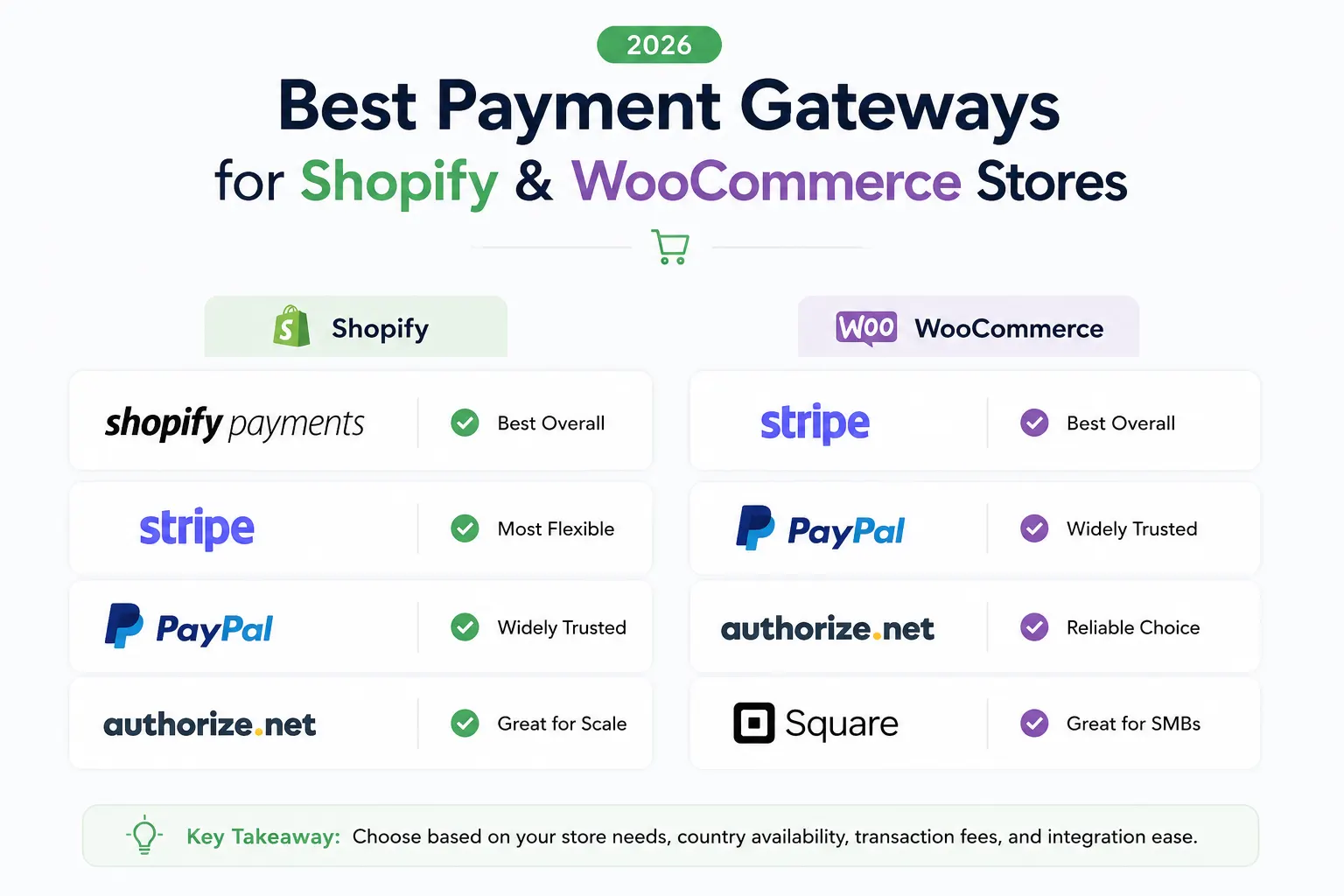
TL;DR
- There are 4.9 million active Shopify stores and 6.6 million WooCommerce stores globally in 2026. The gateway choice matters differently on each platform, Shopify imposes a transaction surcharge of 0.5%-2% if you use a third-party gateway instead of Shopify Payments, while WooCommerce has no such restriction.
- Shopify Payments offers the cleanest cost structure on Shopify but isn’t available in every country and excludes high-risk merchants entirely. For standard-risk merchants in supported markets, it’s usually the right starting point.
- On WooCommerce, gateway flexibility is a genuine strength, any PCI-compliant gateway with a WooCommerce extension works, including specialist high-risk payment gateway options unavailable on Shopify.
- PayPal remains the most recognized payment provider for consumer trust globally, but at 3.49% it’s among the more expensive options when transaction volume grows.
- High-risk ecommerce merchants, iGaming-adjacent stores, nutraceuticals, adult content, forex, should treat this as a dedicated section: most mainstream gateways won’t underwrite you, and the platform choice affects which specialist options are accessible.
Why Platform Matters Before You Pick a Gateway
Most gateway comparison articles treat Shopify and WooCommerce as equivalent environments where the same options apply equally. They don’t. The platform you’re building on shapes your gateway economics before you evaluate a single provider.
On Shopify, using any payment gateway other than Shopify Payments triggers an additional transaction fee on top of what the gateway itself charges, 2% on the Basic plan, 1% on Shopify, and 0.5% on Advanced. Over a month of meaningful volume, this surcharge makes many third-party gateways uneconomical on Shopify compared to their WooCommerce pricing. The practical result: Shopify merchants face a strong economic pull toward Shopify Payments, and need a compelling reason, usually high-risk MCC eligibility, specific cross-border capabilities, or features Shopify Payments doesn’t offer, to justify the surcharge of going elsewhere.
On WooCommerce, which runs on WordPress, there is no platform-level surcharge for using any gateway. You pay exactly what the gateway charges, full stop. This means WooCommerce merchants have genuine price competition across every provider, which tilts the gateway decision more cleanly toward features, fees, and integration quality.
Understanding this structural difference is the most important context for everything else in this guide.
Gateway Options for Shopify Stores
Shopify Payments (Built-In)
Shopify Payments is the default payment processing option built directly into Shopify, powered by Stripe infrastructure under the hood. It waives the platform transaction fee entirely, which means the all-in cost on Shopify’s Basic plan drops from 2.9% + $0.30 (third-party gateway + surcharge) to 2.9% + $0.30 (Shopify Payments rate), effectively recovering 2% for Basic plan merchants versus any alternative.
On higher Shopify plans, the Shopify Payments card rate reduces: 2.6% + $0.10 on Shopify plan, 2.4% + $0.10 on Advanced. These rates, combined with zero transaction surcharge, make Shopify Payments the most cost-efficient option for standard-risk merchants on supported plans.
Shopify Payments integrates natively with Apple Pay, Google Pay, and Shop Pay, which matters because payment wallets now account for nearly 49% of ecommerce transaction volume. The checkout experience is frictionless and well-optimized for conversion.
The hard limitations are country availability (Shopify Payments is unavailable in most of Southeast Asia, the Middle East, and large parts of Africa and LATAM), and complete exclusion of high-risk merchant categories. If your business sells nutraceuticals, adult content, or any product Shopify classifies as prohibited, Shopify Payments will not underwrite you, and Shopify may restrict your store entirely if you attempt to use it for ineligible products.
Stripe on Shopify
Stripe is the most technically capable third-party payment gateway available on Shopify, and the one most development teams default to when they need API-level control. It supports a wide range of payment wallets including Apple Pay, Google Pay, and Link (Stripe’s own saved-card network), handles 3DS2 authentication properly, and offers strong fraud tooling through Stripe Radar.
On Shopify, Stripe’s rate is 2.9% + $0.30 on card transactions, identical to Shopify Payments on the Basic plan. But Basic plan merchants pay the 2% Shopify transaction fee on top, bringing the all-in cost to 4.9% + $0.30. On the Advanced plan (0.5% Shopify surcharge), Stripe’s effective rate becomes 3.4% + $0.30, still more expensive than Shopify Payments’ 2.4% + $0.10 at the same plan level.
The case for Stripe on Shopify is therefore a features argument, not a cost argument. If you need Stripe’s advanced API, Stripe Connect for marketplace payouts, or Stripe’s global payment method coverage for cross-border payments, the surcharge may be worth paying. For most standard-risk Shopify merchants focused purely on cost, Shopify Payments dominates.
PayPal on Shopify
PayPal is the most recognizable payment provider for consumer trust globally, studies consistently show that buyers who don’t recognize a checkout complete more purchases when PayPal is an option, particularly for first-time orders. That trust premium is real and conversion-relevant, which is why PayPal remains a standard addition to Shopify checkouts even at its higher rate.
PayPal’s standard processing rate is 3.49% + $0.49 per transaction on most markets, making it the most expensive gateway in this comparison by headline rate. Add Shopify’s transaction surcharge on non-Advanced plans and the cost becomes difficult to justify for high-volume merchants. Where PayPal earns its place is as a secondary payment option alongside Shopify Payments, displayed as an alternative at checkout for buyers who prefer it, not as the primary gateway absorbing all volume.
Authorize.Net on Shopify
Authorize.Net is a more traditional payment processing provider, part of Visa’s network, with a 20-year track record and strong US market penetration. Its rate on Shopify is 2.9% + $0.30 before the transaction surcharge, with a monthly gateway fee of $25. For merchants coming from a traditional retail background or processing a high volume of phone or mail orders alongside their ecommerce channel, Authorize.Net’s unified payment processing across card-not-present and card-present environments is practical.
On Shopify specifically, Authorize.Net doesn’t offer the same native wallet integration depth as Shopify Payments or Stripe, Apple Pay and Google Pay support requires additional configuration. Unless you have a specific reason tied to your merchant account relationship or existing Authorize.Net infrastructure, it’s rarely the first choice for a native Shopify build.
Gateway Options for WooCommerce Stores
Stripe on WooCommerce
On WooCommerce, Stripe is the strongest all-around choice for standard-risk merchants and the most commonly recommended option among WordPress developers. The official Stripe WooCommerce plugin is well-maintained, supports 3DS2 and SCA compliance natively, handles payment wallets cleanly, and gives merchants access to Stripe’s full suite of fraud and dispute tools.
Critically, on WooCommerce there is no platform surcharge, Stripe’s 2.9% + $0.30 is the all-in rate for card transactions, with no additional fee from WooCommerce itself. Stripe’s cross-border payment support is also stronger on WooCommerce than in the Shopify environment, where platform constraints limit some of the gateway-level configuration that international merchants benefit from.
For WooCommerce stores with significant international traffic, Stripe’s multi-currency support and local payment method coverage through Stripe Payment Element, which includes iDEAL, SEPA Direct Debit, Bancontact, Sofort, and others depending on region, makes it a more complete solution than most alternatives at the same price point.
PayPal on WooCommerce
WooCommerce’s PayPal integration is mature and well-documented, with both PayPal Standard (redirect-based) and PayPal Commerce Platform (native checkout) available. The Commerce Platform option keeps buyers on your site during checkout rather than redirecting them to PayPal’s domain, which measurably improves conversion versus the older Standard integration.
At 3.49% + $0.49, PayPal’s rate is the same on WooCommerce as Shopify, but without the platform surcharge, it becomes a more defensible option for merchants who genuinely benefit from the PayPal brand trust effect. LATAM and Southeast Asia merchants in particular see meaningful conversion uplift from PayPal availability, since it’s often a more trusted payment method than an unfamiliar local credit card gateway.
Authorize.Net on WooCommerce
On WooCommerce, Authorize.Net’s case is stronger than on Shopify because the platform surcharge doesn’t apply. The 2.9% + $0.30 rate plus $25/month gateway fee becomes competitive for merchants with higher average ticket sizes, the fixed monthly fee amortizes well as volume grows. Its merchant account infrastructure is traditional but stable, and for US merchants who want the predictability of a long-established payment provider over a newer fintech acquirer, it’s a reasonable choice.
Authorize.Net also offers customer information management (CIM), which stores customer card data in a PCI-compliant vault and supports subscription billing, a useful feature for WooCommerce stores with a recurring element.
High-Risk Gateway Options on WooCommerce
This is where WooCommerce has a structural advantage that Shopify simply can’t match. Because WooCommerce imposes no platform-level restrictions on which gateways you integrate, specialist high-risk payment gateway providers that would be blocked or unsupported on Shopify can be connected via WooCommerce’s extensible plugin architecture.
High-risk ecommerce merchants, nutraceuticals, adult content, subscription boxes with elevated refund rates, CBD, forex-adjacent products, should build on WooCommerce rather than Shopify if they plan to use a specialist acquirer. The combination of WooCommerce’s open architecture and a dedicated high-risk merchant account from a specialist provider gives these merchants the merchant services infrastructure they need without the platform-level restrictions that make Shopify unworkable for their category.
In 2026, viable high-risk gateways need to include built-in VAMP monitoring (Visa’s 0.5% chargeback threshold for elevated-risk MCCs) and Ethoca/Verifi pre-chargeback alert integration as standard, not optional add-ons. Any high-risk provider you evaluate for WooCommerce integration should be able to demonstrate both in a live product walkthrough before you sign.
Gateway Scorecard: Shopify vs WooCommerce Side by Side
| Gateway | Shopify rate (all-in) | WooCommerce rate | Wallet support | High-risk eligible | Cross-border | Best for |
|---|---|---|---|---|---|---|
| Shopify Payments | 2.4%-2.9% + fixed | Not available | Excellent | No | Limited | Standard Shopify, supported countries |
| Stripe | 3.4%-4.9% + fixed | 2.9% + $0.30 | Excellent | Rarely | Strong | WooCommerce standard-risk, dev-heavy stores |
| PayPal | 3.49%-5.49% + fixed | 3.49% + $0.49 | Good | No | Good | Secondary option, consumer trust markets |
| Authorize.Net | 4.9% + fixed + $25/mo | 2.9% + $0.30 + $25/mo | Moderate | Rarely | Moderate | US merchants, subscription billing |
| High-risk specialist | 4.2%-5%+ | 3.8%-4.5% | Variable | Yes | Variable | High-risk MCCs on WooCommerce |
Fee Comparison: What You Actually Pay per $100 Sale
The rate listed by any gateway is only part of the real cost. Here’s what a $100 transaction costs across the main options, factoring in the Shopify surcharge on the Basic plan versus WooCommerce’s zero-surcharge environment.
On Shopify Basic with Shopify Payments, you pay $2.90 + $0.30 = $3.20 total on a $100 transaction. On Shopify Basic with Stripe (2% Shopify surcharge applied), you pay $2.90 + $0.30 + $2.00 surcharge = $5.20, more than 60% more expensive than Shopify Payments on the same plan. On Shopify Advanced with Stripe, the surcharge drops to $0.50, bringing the total to $3.70, still more than Shopify Payments’ $2.50 at the same tier.
On WooCommerce with Stripe, you pay $2.90 + $0.30 = $3.20, identical to Shopify Payments’ Basic rate, with no surcharge. On WooCommerce with Authorize.Net, you pay $2.90 + $0.30 plus the $25/month gateway fee amortized across transactions. At 500 transactions per month, the gateway fee adds $0.05 per transaction, bringing the effective rate to $3.25 on a $100 sale.
The practical takeaway: for standard-risk merchants on Shopify, Shopify Payments almost always wins on cost. For WooCommerce merchants, Stripe and Shopify Payments are at cost parity (if Shopify Payments were even available), and the decision becomes purely about features and integration depth.
2026 Updates: What Changed for Platform Gateway Users
Three changes in 2026 directly affect how merchants on both platforms should approach gateway selection.
Digital payments through payment wallets now account for 49% of ecommerce transaction volume in the SMB segment. This means Apple Pay and Google Pay support is no longer a differentiator, it’s a baseline requirement. Any gateway you consider that doesn’t support both natively is losing you nearly half of potential transactions from wallet-preferring buyers.
Visa’s VAMP program and Mastercard’s CE3.0 chargeback monitoring programs, both fully active in 2026, have raised the compliance bar for every merchant using a high-risk payment gateway, but they’ve also created a new filter for platform choice. WooCommerce’s open gateway architecture allows high-risk merchants to connect specialist providers with native VAMP monitoring built in. Shopify’s restricted gateway environment makes this considerably harder to implement cleanly.
Cross-border payment capability has also become a harder gateway criterion for growing stores. WooCommerce merchants using Stripe have access to Stripe’s local payment method coverage in 46+ countries natively. Shopify merchants using Shopify Payments are limited to the markets and payment methods Shopify itself supports, a meaningful gap for stores targeting LATAM, Southeast Asia, or the Middle East.
Pros and Cons by Platform
Shopify’s gateway ecosystem is simpler to manage, fewer decisions, native integration, optimized checkout, but it comes with real constraints: a transaction surcharge for non-native gateways, limited high-risk support, and narrower international coverage. The platform optimizes for simplicity and speed at the cost of flexibility.
WooCommerce’s gateway ecosystem is more complex to set up but far more flexible in practice. No surcharges, no platform-level MCC restrictions, and full access to the entire market of PCI-compliant gateways, including specialist high-risk and cross-border providers unavailable on Shopify. The trade-off is that more flexibility requires more decisions, more plugin management, and occasionally more developer involvement to keep integrations current.
For most standard-risk merchants starting out on Shopify, the platform’s simplicity and the economic advantages of Shopify Payments are hard to argue against. For high-risk merchants, internationally-focused stores, or merchants who need developer-level gateway control, WooCommerce’s open architecture is the right foundation.
Frequently Asked Questions
What is the best payment gateway for Shopify in 2026?
For most standard-risk Shopify merchants in supported countries, Shopify Payments is the best option, it eliminates the platform transaction surcharge and delivers the lowest all-in cost with native wallet support. For merchants outside supported countries or in high-risk categories, Stripe is the strongest third-party alternative despite the added surcharge.
Does Shopify charge a fee for using third-party payment gateways?
Yes. Shopify charges a transaction fee of 2% (Basic), 1% (Shopify), or 0.5% (Advanced) on all transactions processed through a payment gateway other than Shopify Payments. This surcharge is waived entirely when using Shopify Payments.
Which payment gateway is best for WooCommerce in 2026?
Stripe is the most recommended gateway for WooCommerce standard-risk merchants, mature plugin, no platform surcharge, strong 3DS2 and SCA support, and the broadest payment wallet and cross-border payment coverage at the same price point. For high-risk merchants, a specialist high-risk gateway provider integrated via WooCommerce’s plugin architecture is the correct path.
Can high-risk merchants use Shopify?
It depends on the risk category. Shopify restricts or prohibits certain product types entirely, and Shopify Payments excludes virtually all high-risk merchant categories. High-risk merchants who need a specialist high-risk payment gateway are generally better served by WooCommerce, which imposes no platform-level restrictions on gateway choice.
Does PayPal work with both Shopify and WooCommerce?
Yes, PayPal integrates natively with both platforms. On Shopify, PayPal Express Checkout appears as a secondary option alongside the main checkout. On WooCommerce, PayPal Commerce Platform provides a native on-site checkout experience. At 3.49% + $0.49, it’s most justified as a supplementary option for consumer trust rather than as a primary gateway.
Do I need a merchant account separate from my payment gateway on Shopify or WooCommerce?
When using Shopify Payments or PayFac-model providers like Stripe, you operate as a sub-merchant under the provider’s master merchant account, no separate account needed. Merchants who choose a specialist gateway (particularly for high-risk processing) typically need a dedicated merchant account from an acquiring bank, which is set up alongside the gateway integration.
Comments
No comments yet. Be the first to share your thoughts.
Leave a comment