
Introduction
The global financial system relies on cooperation between central banks to maintain stability, promote economic growth, and respond to financial crises. As international trade, digital payments, and cross-border financial activities continue to expand, countries require a trusted institution that facilitates collaboration and develops common banking standards. The Bank for International Settlements (BIS) fulfills this important role by serving as a forum for central banks and supporting the stability of the global financial system.
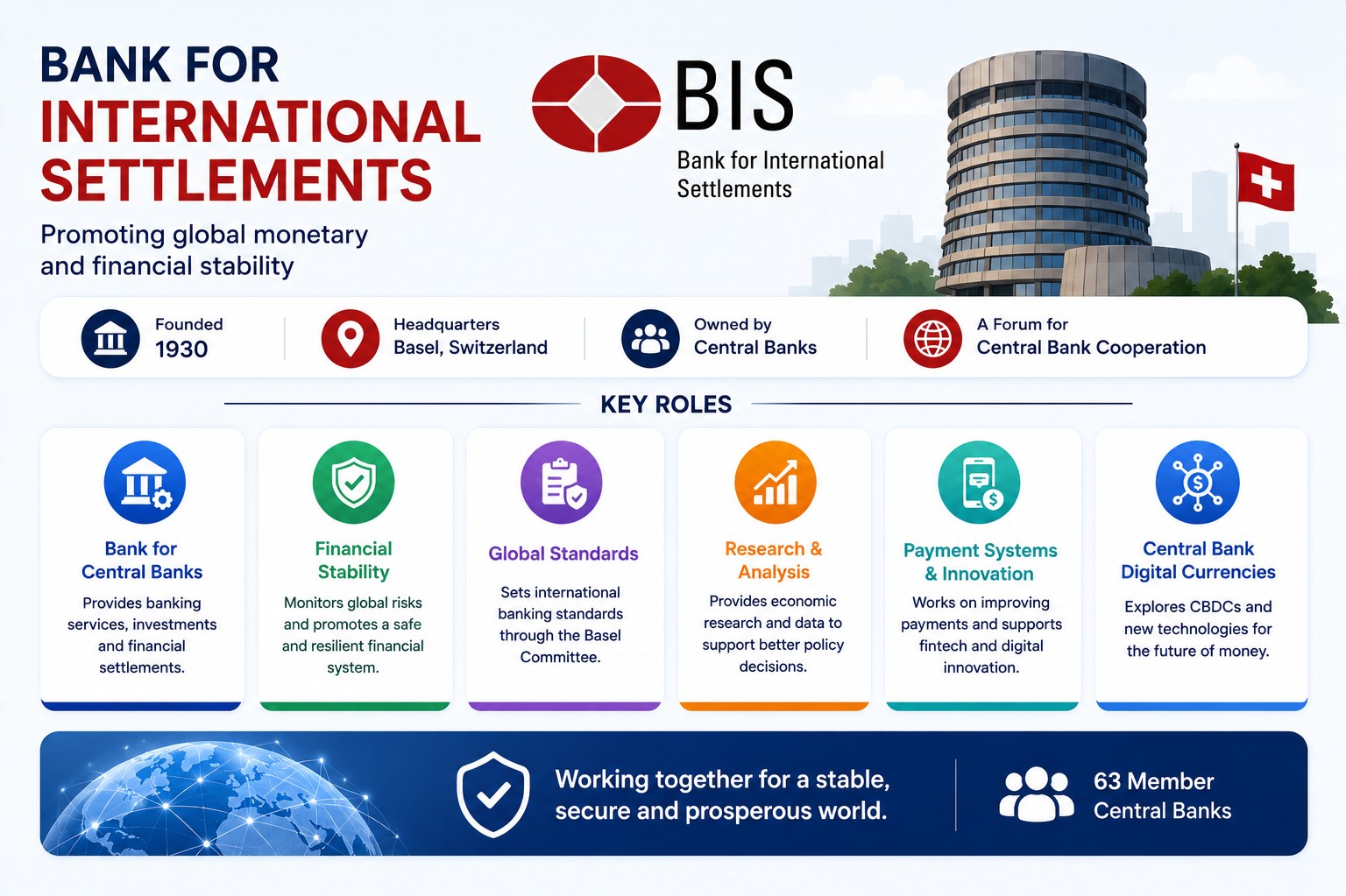
Established in 1930, the Bank for International Settlements is the world’s oldest international financial institution. It provides banking services to central banks, conducts economic research, develops global regulatory standards, and promotes cooperation among monetary authorities. Although it does not provide banking services directly to individuals or commercial businesses, its work significantly influences how financial institutions operate worldwide.
Today, the BIS plays a central role in shaping banking regulation, payment systems, financial innovation, and international monetary cooperation.
What Is the Bank for International Settlements?
The Bank for International Settlements (BIS) is an international financial institution owned by central banks.
Its primary mission is to promote global monetary and financial stability through cooperation, research, and the development of international banking standards.
The BIS serves as a meeting place where central banks exchange knowledge, coordinate policy discussions, and address challenges affecting the global financial system.
It also provides specialized banking services exclusively to central banks and certain international organizations.
History of the BIS
The Bank for International Settlements was founded in 1930 and is headquartered in Basel, Switzerland.
Initially established to facilitate financial settlements following World War I, the BIS gradually evolved into a center for international monetary cooperation.
Over the decades, it has expanded its role by supporting financial stability, supervising banking regulation, encouraging central bank collaboration, and conducting economic research.
Today, the BIS is recognized as one of the most influential institutions in global finance.
Objectives of the BIS
The BIS works to strengthen the international financial system by encouraging cooperation among central banks and supporting sound financial policies.
Its objectives include promoting monetary stability, improving banking supervision, enhancing payment systems, supporting financial innovation, and identifying emerging risks that may threaten the global economy.
The institution also provides a platform for discussing global financial challenges such as inflation, cyber threats, climate-related financial risks, and digital currencies.
How the BIS Works
The BIS operates primarily as a bank for central banks rather than for individuals or businesses.
Member central banks deposit reserves with the BIS, which provides secure financial services, investment management, and liquidity support.
The organization also hosts meetings where policymakers discuss economic developments, financial stability, banking regulation, and payment system modernization.
Its research departments analyze global economic trends and publish reports that help central banks make informed policy decisions.
Banking Services Provided by the BIS
Although the BIS is called a bank, it does not offer retail banking services.
Instead, it provides financial services exclusively to central banks and selected international institutions.
These services include reserve management, gold and foreign exchange transactions, investment services, liquidity management, and secure financial settlements.
By managing financial resources efficiently, the BIS helps strengthen confidence in the international monetary system.
The Basel Committee on Banking Supervision
One of the BIS’s most influential contributions is hosting the Basel Committee on Banking Supervision (BCBS).
The committee develops internationally recognized banking standards that strengthen financial stability and improve risk management within the global banking industry.
Its regulatory frameworks, including Basel I, Basel II, and Basel III, establish guidelines for capital adequacy, liquidity management, and risk control.
Banks around the world use these standards to improve resilience during periods of financial stress.
Research and Economic Analysis
The BIS conducts extensive research on global financial markets, banking systems, inflation, monetary policy, digital finance, and emerging economic risks.
Its publications provide valuable insights for policymakers, researchers, financial institutions, and regulators.
The institution also monitors developments in financial technology, artificial intelligence, central bank digital currencies (CBDCs), and cybersecurity.
These research efforts support evidence-based decision-making across the international financial community.
BIS and Payment Systems
Modern payment systems are a major focus of BIS activities.
The institution works with central banks to improve payment infrastructure, increase cross-border payment efficiency, and promote secure digital payment technologies.
Its initiatives support faster settlements, lower transaction costs, improved interoperability, and enhanced financial inclusion.
As global payment ecosystems continue evolving, the BIS plays an increasingly important role in developing international payment standards.
BIS and Central Bank Digital Currencies (CBDCs)
The BIS is actively involved in research related to Central Bank Digital Currencies (CBDCs).
Through innovation hubs located in multiple regions, the organization collaborates with central banks to study digital currency technologies, payment interoperability, cybersecurity, and cross-border settlement solutions.
Its research helps countries evaluate the opportunities and risks associated with digital sovereign currencies.
Financial Stability and Risk Management
Maintaining financial stability remains one of the BIS’s primary responsibilities.
The organization continuously monitors systemic risks affecting global banking, including financial crises, cyber threats, liquidity challenges, inflationary pressures, and market volatility.
It encourages international cooperation so central banks can respond effectively to economic disruptions and strengthen resilience across financial systems.
Artificial Intelligence and Financial Innovation
Artificial intelligence is becoming increasingly important in global finance, and the BIS actively studies its implications.
Research focuses on AI-driven fraud detection, regulatory technology (RegTech), supervisory technology (SupTech), financial market analysis, payment optimization, and digital identity verification.
The BIS supports responsible innovation while encouraging financial institutions to balance technological advancement with strong governance and risk management.
Future Role of the BIS
As financial technology continues transforming banking, the BIS is expected to play an even greater role in shaping the future of global finance.
Emerging technologies such as Open Banking, tokenized assets, blockchain, instant payments, AI-powered supervision, and CBDCs will require increased international cooperation.
The BIS will continue developing standards, facilitating research, and helping central banks adapt to an increasingly digital financial landscape.
Why the BIS Matters
Although consumers rarely interact directly with the Bank for International Settlements, its influence extends throughout the global financial system.
The standards, research, and policy coordination supported by the BIS help create safer banks, stronger payment systems, more resilient financial markets, and greater international economic stability.
Its work ultimately benefits businesses, governments, financial institutions, and individuals by promoting confidence in the world’s banking infrastructure.
Conclusion
The Bank for International Settlements (BIS) serves as the cornerstone of international central banking cooperation. Through research, regulatory leadership, banking services, and financial innovation, it helps strengthen the stability and resilience of the global financial system.
From developing the Basel banking standards to supporting digital payment infrastructure and Central Bank Digital Currency research, the BIS continues to shape the future of international finance. As the global economy becomes increasingly interconnected and technology-driven, the Bank for International Settlements will remain a vital institution supporting secure, stable, and sustainable financial systems worldwide.
Comments
No comments yet. Be the first to share your thoughts.
Leave a comment