
Introduction
International payments have become a routine part of global business. Companies pay overseas suppliers, receive funds from international customers, manage remote employees, and conduct transactions across multiple countries every day. With this growing volume of cross-border payments, even a small mistake in bank account details can result in failed transfers, delayed settlements, additional banking fees, and frustrated customers.An IBAN Validation Tool helps eliminate these risks by verifying whether an International Bank Account Number (IBAN) is correctly formatted before a payment is initiated. Instead of discovering an error after a transfer has failed, businesses can validate account details in advance, improving payment accuracy and operational efficiency.
Banks, fintech companies, payment service providers, ERP platforms, and businesses of all sizes rely on IBAN validation tools to support secure and reliable international transactions.
What Is an IBAN Validation Tool?
An IBAN Validation Tool is a software solution that checks whether an International Bank Account Number follows the official IBAN standard.
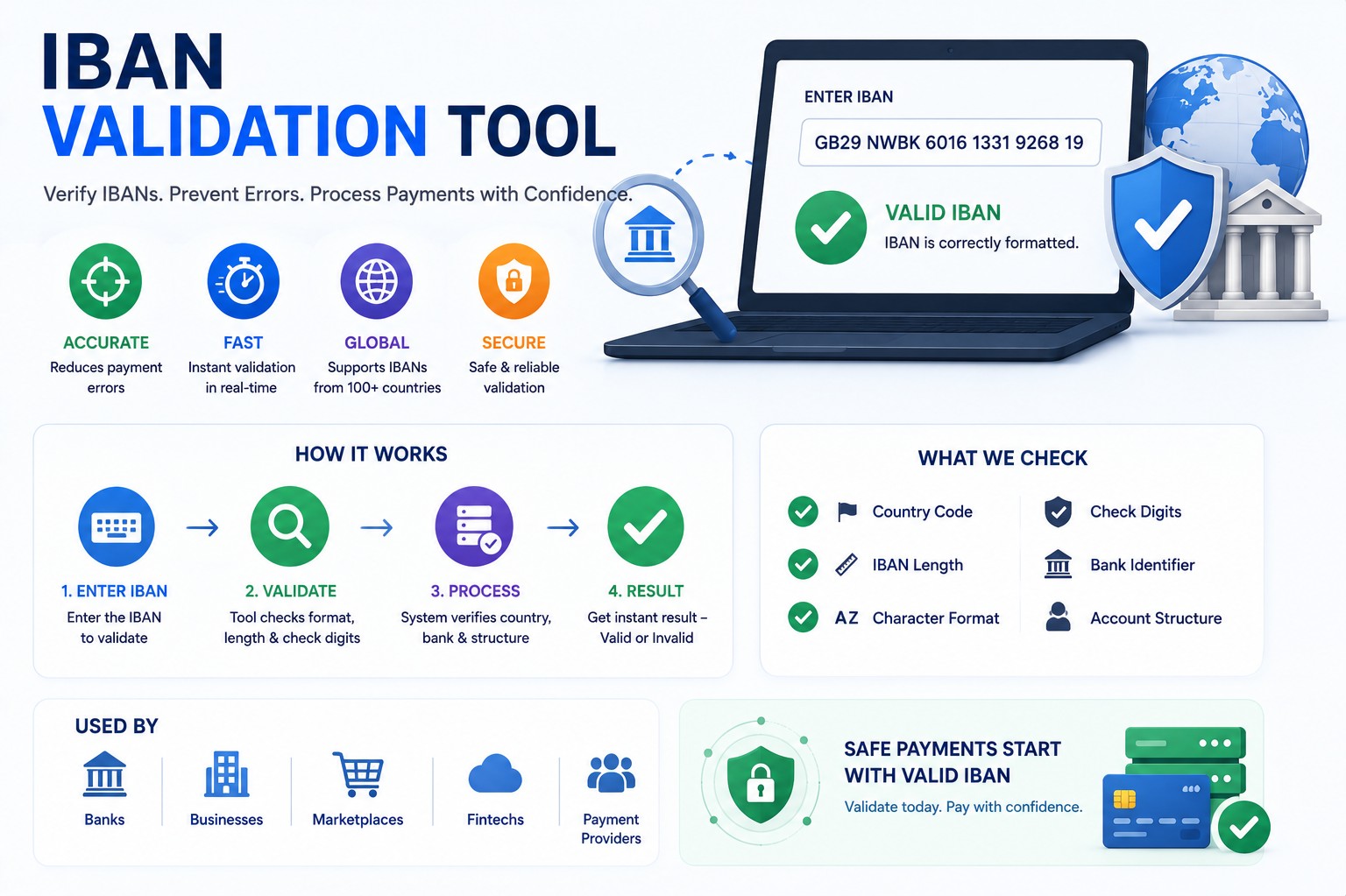
The tool verifies the structure, length, country code, check digits, and bank identifier according to the rules established for each participating country.
Its primary purpose is to identify formatting errors before payments are processed, reducing failed transactions and improving payment accuracy.
Although validation confirms that an IBAN is correctly structured, it does not always verify that the account is active or belongs to the intended recipient.
Why IBAN Validation Is Important
Incorrect banking information is one of the most common causes of failed international payments.
Typing mistakes, missing characters, incorrect country codes, or invalid check digits can lead to rejected transactions and unnecessary processing delays.
An IBAN validation tool helps detect these issues immediately, allowing users to correct mistakes before funds are sent.
For businesses handling thousands of international payments each month, validation significantly reduces operational costs and improves customer satisfaction.
How an IBAN Validation Tool Works
When an IBAN is entered into the validation tool, the system first checks whether the country code is valid.
It then verifies that the IBAN contains the correct number of characters required for that specific country. Next, the validation algorithm examines the check digits using internationally recognized mathematical calculations.
Finally, the tool confirms that the bank identifier and account structure comply with the country’s IBAN format.
If the IBAN passes every validation step, it is considered structurally valid and suitable for payment processing.
Information Verified During Validation
An IBAN validation tool performs several important checks before approving an account number.
It verifies the country code, total IBAN length, character format, bank identifier, branch information where applicable, and mathematical check digits.
Some advanced validation solutions also identify the financial institution associated with the IBAN and provide additional banking information that supports payment processing.
These verification steps reduce payment errors while improving confidence in international transactions.
Benefits for Businesses
Businesses processing international payments benefit significantly from IBAN validation.
Payment accuracy improves because incorrectly formatted account numbers are identified before transactions are submitted. Finance teams spend less time resolving rejected payments, while automated validation reduces manual review requirements.
Improved payment quality also strengthens customer relationships by minimizing delays and ensuring suppliers receive funds on time.
As payment volumes grow, automated validation becomes an essential component of efficient financial operations.
Integration with Payment Systems
Modern IBAN validation tools integrate directly with payment gateways, banking APIs, ERP platforms, accounting software, and treasury management systems.
During payment initiation, the system automatically validates IBANs before transactions are approved.
This automation eliminates repetitive manual verification while improving operational efficiency across financial workflows.
API-based validation is especially valuable for businesses processing high volumes of cross-border payments.
IBAN Validation vs Account Verification
IBAN validation and account verification are related but different processes.
IBAN validation confirms that the account number follows the official international format and contains valid check digits.
Account verification goes further by confirming that the account actually exists, is active, and may belong to the intended recipient, depending on the banking network and available services.
Many organizations combine both methods to maximize payment security and accuracy.
Security and Compliance
Security is a major advantage of IBAN validation tools.
By identifying incorrect account details before payments are processed, businesses reduce the risk of sending funds to unintended accounts.
Validation also supports compliance with internal financial controls and helps organizations maintain accurate payment records.
Combined with encryption, fraud monitoring, Know Your Customer (KYC), and Anti-Money Laundering (AML) procedures, IBAN validation strengthens overall payment security.
Common Business Use Cases
IBAN validation is widely used across industries that process international payments.
Banks validate customer account details during payment initiation. E-commerce companies verify supplier banking information before settlements. SaaS businesses validate subscription payment accounts, while marketplaces use automated validation when onboarding merchants.
Payroll providers, accounting firms, importers, exporters, and multinational corporations also rely on IBAN validation to reduce payment errors and improve reconciliation.
Artificial Intelligence and IBAN Validation
Artificial intelligence is enhancing traditional IBAN validation by identifying unusual payment behavior and detecting potential fraud.
AI-powered systems analyze transaction history, payment patterns, geographic activity, and beneficiary information to identify suspicious transfers before they are processed.
Machine learning also helps reduce false validation errors while improving payment quality through continuous optimization.
These intelligent capabilities provide an additional layer of protection for international payment operations.
Future of IBAN Validation Tools
As digital banking continues to evolve, IBAN validation tools are becoming faster, smarter, and more integrated.
Real-time payment processing, Open Banking APIs, cloud-based financial platforms, and embedded finance solutions increasingly include built-in IBAN validation.
Businesses are also adopting automated payment workflows that validate banking information instantly during invoice creation, customer onboarding, and payment execution.
These innovations will continue improving the speed, reliability, and security of international payments.
Conclusion
An IBAN Validation Tool is an essential solution for businesses and financial institutions involved in international banking. By verifying the structure and accuracy of IBANs before payments are processed, it helps reduce transaction failures, improve operational efficiency, and strengthen payment security.
Whether integrated into banking systems, ERP platforms, or payment gateways, IBAN validation enables organizations to process cross-border payments with greater confidence and accuracy.
As international commerce and digital finance continue expanding, IBAN validation tools will remain a critical part of modern payment infrastructure, supporting secure, efficient, and reliable global transactions.
Comments
No comments yet. Be the first to share your thoughts.
Leave a comment