
Introduction
Global commerce is no longer limited to multinational corporations. Today, businesses of all sizes can sell products and services to customers across continents through digital marketplaces, e-commerce platforms, and online payment systems. This growing international reach has created tremendous opportunities for merchants looking to expand revenue streams and access new markets.At the center of this global expansion are cross-border payments. These transactions enable businesses to send and receive money internationally, making it possible to serve customers, pay suppliers, manage global operations, and scale beyond domestic boundaries.
However, cross-border payments involve more than simply transferring money between countries. Merchants must navigate multiple currencies, banking systems, regulations, payment methods, and security requirements. Understanding how cross-border payments work is essential for businesses seeking sustainable international growth.
What Are Cross-Border Payments?
Cross-border payments refer to financial transactions where the sender and recipient are located in different countries.
These payments may occur between:
- Businesses and customers
- Merchants and suppliers
- Employers and international workers
- Financial institutions
- Government entities
Cross-border payments can be processed through banks, payment service providers, card networks, fintech platforms, digital wallets, and alternative payment methods.
As global trade continues to expand, the volume of cross-border transactions is increasing rapidly across nearly every industry.
Why Cross-Border Payments Matter for Merchants
International commerce offers merchants access to significantly larger customer bases.
By accepting cross-border payments, businesses can:
- Enter new markets
- Increase revenue opportunities
- Diversify customer segments
- Reduce dependence on local markets
- Build global brand recognition
Consumers increasingly purchase products and services from international merchants. Businesses that fail to support cross-border payments may miss valuable growth opportunities.
Providing a seamless international payment experience has become a competitive advantage in today’s digital economy.
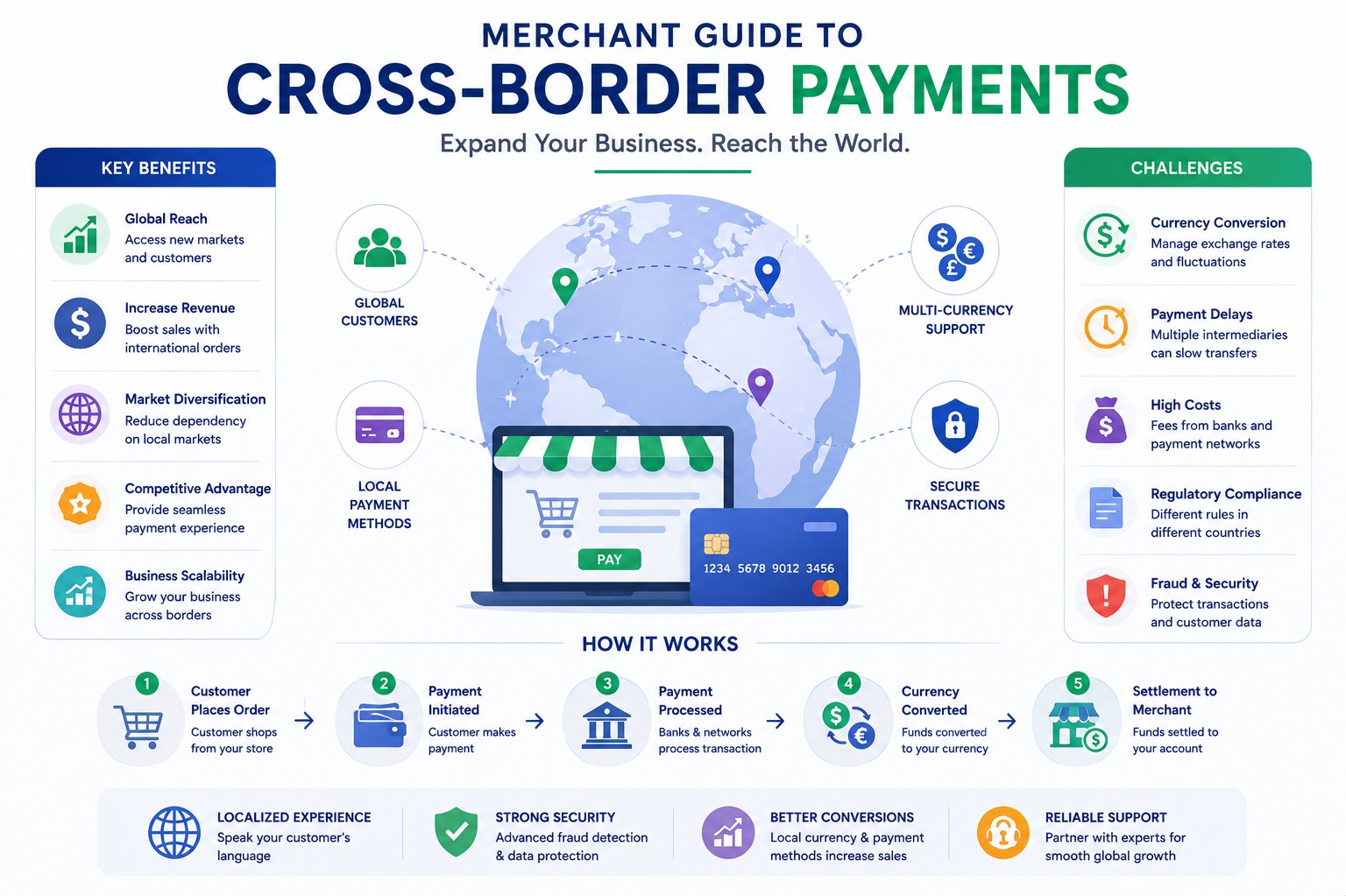
How Cross-Border Payments Work
A cross-border payment involves multiple participants working together to move funds between countries.
The process typically includes:
- A customer initiates a payment.
- Payment information is transmitted securely.
- Financial institutions verify and authorize the transaction.
- Currency conversion may occur if different currencies are involved.
- Funds are routed through payment networks.
- The merchant receives settlement.
Depending on the payment method and countries involved, this process may involve banks, payment processors, acquiring institutions, and foreign exchange providers.
Modern payment technologies are helping streamline these traditionally complex workflows.
Benefits of Cross-Border Payments
For merchants, cross-border payments unlock significant business opportunities.
Some key benefits include:
Global Customer Reach
Businesses can sell products and services to customers around the world.
Revenue Growth
International sales create new revenue streams and increase market potential.
Market Diversification
Operating across multiple regions reduces reliance on a single economy or customer base.
Competitive Advantage
Supporting international payments improves customer accessibility and enhances brand appeal.
Business Scalability
Cross-border payment infrastructure supports long-term global expansion strategies.
These benefits make international payment capabilities increasingly important for modern merchants.
Common Challenges in Cross-Border Payments
Despite their advantages, cross-border payments present several challenges.
Currency Conversion Complexity
International transactions often involve multiple currencies, requiring foreign exchange services and conversion management.
Payment Delays
Some international payment routes may involve intermediary institutions that increase processing times.
Higher Transaction Costs
Cross-border transactions may incur additional fees related to currency exchange, banking networks, and payment providers.
Regulatory Requirements
Different countries maintain unique financial regulations, compliance standards, and reporting obligations.
Fraud Risks
International transactions can create additional security and fraud prevention challenges.
Merchants must address these issues to ensure efficient global payment operations.
The Importance of Multi-Currency Support
Consumers generally prefer to shop and pay in their local currencies.
Displaying prices in unfamiliar currencies can reduce customer confidence and negatively affect conversion rates.
Multi-currency payment capabilities allow merchants to:
- Improve customer experiences
- Increase purchase confidence
- Simplify international transactions
- Reduce checkout friction
Many payment providers now offer dynamic currency conversion and localized payment experiences that support international growth.
Local Payment Methods and Customer Preferences
Payment preferences vary significantly across regions.
While card payments may dominate in some countries, consumers elsewhere may prefer bank transfers, digital wallets, or alternative payment methods.
Merchants that support local payment options often achieve:
- Higher conversion rates
- Better customer satisfaction
- Reduced cart abandonment
- Increased international sales
Understanding regional payment behaviors is essential when expanding into new markets.
A localized payment strategy can significantly improve cross-border performance.
Cross-Border Payments and E-Commerce
E-commerce has become one of the largest drivers of cross-border payment growth.
Online marketplaces allow merchants to reach international customers without establishing physical locations in every market.
However, successful international e-commerce requires efficient payment infrastructure.
Merchants should focus on:
- Fast checkout experiences
- Multiple payment methods
- Currency flexibility
- Payment security
- Transparent pricing
These factors contribute directly to customer trust and transaction success.
Security Considerations
Security remains a top priority for international payment operations.
Cross-border transactions can be targeted by fraudsters seeking to exploit differences in regulatory environments and payment systems.
Merchants should implement:
- Fraud detection systems
- Secure payment gateways
- Tokenization technologies
- Encryption protocols
- Strong customer authentication
Protecting payment data helps maintain customer trust while reducing financial losses.
Compliance and Regulatory Requirements
International payments are subject to various regulatory obligations.
Businesses must comply with:
- Anti-money laundering regulations
- Know-your-customer requirements
- Data privacy laws
- Sanctions screening obligations
- Tax reporting requirements
Failure to comply with applicable regulations can result in financial penalties and operational disruptions.
Working with experienced payment providers can help merchants navigate complex compliance requirements.
Choosing the Right Payment Partner
Selecting the right payment provider is one of the most important decisions for merchants pursuing international growth.
Businesses should evaluate providers based on:
- Geographic coverage
- Currency support
- Payment methods
- Security capabilities
- Settlement speed
- Reporting features
- Compliance support
A strong payment partner can simplify global expansion while improving operational efficiency.
The right infrastructure creates a foundation for long-term success.
Future Trends in Cross-Border Payments
The future of cross-border payments is being shaped by technological innovation.
Several trends are transforming international commerce:
- Real-time international payments
- Artificial intelligence-driven fraud prevention
- Open banking integrations
- Embedded finance solutions
- Digital wallets
- Blockchain-based payment networks
- Enhanced payment orchestration
These advancements are helping reduce costs, improve transparency, and accelerate transaction processing worldwide.
Merchants that embrace modern payment technologies will be better positioned to compete in global markets.
Conclusion
Cross-border payments have become a critical enabler of international business growth. They allow merchants to reach global customers, diversify revenue streams, and participate in the rapidly expanding digital economy.
While international payments introduce challenges related to currency conversion, compliance, security, and operational complexity, modern payment technologies are making global commerce more accessible than ever.
By implementing effective cross-border payment strategies, supporting local customer preferences, and partnering with trusted payment providers, merchants can build scalable international operations and unlock new opportunities for sustainable growth.
Comments
No comments yet. Be the first to share your thoughts.
Leave a comment